The regulatory challenges in the cryptocurrency industry have never been more complex or more consequential.
In the space of twelve months, the United States passed landmark stablecoin legislation, the European Union moved its sweeping MiCA framework into full enforcement, and jurisdictions from Hong Kong to Nigeria introduced entirely new digital asset regimes.
This is not simply a story about compliance costs and paperwork. Regulation is actively reshaping which assets can be offered, which businesses can operate, in which jurisdictions, and on what terms.
This guide breaks down the new compliance reality, specifically the US GENIUS Act and the EU’s MiCA, and provides a clear framework for businesses to command their compliance in the face of tighter scrutiny.
Related Reads: 8 Factors Affecting Crypto-to-Fiat Conversion Rates, Is Crypto a Good Investment?
Why Is Global Cryptocurrency Regulation So Fragmented?
One of the most persistent regulatory challenges in the cryptocurrency industry is the absence of a single, unified global framework.
Crypto assets are borderless by design; a Bitcoin transaction crosses continents in seconds without awareness of the jurisdictions it passes through.
The regulatory infrastructure attempting to govern it, however, remains deeply national and often internally inconsistent.
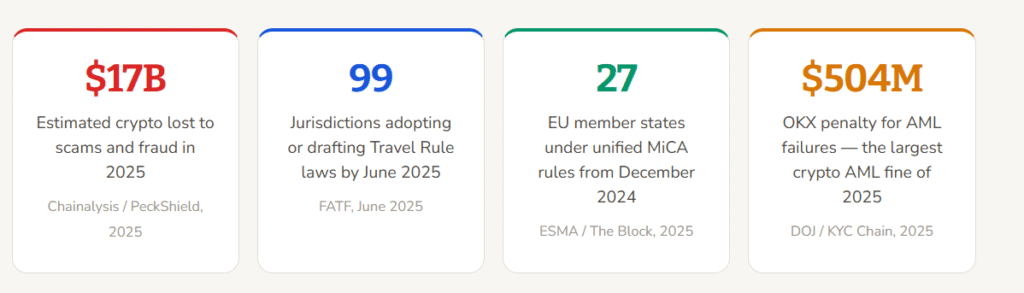
In 2025, the Financial Action Task Force (FATF) found that while 99 jurisdictions had adopted or were drafting legislation to enforce the Travel Rule, only around 40 were largely compliant in practice.
Nearly 60% of jurisdictions had passed laws without meaningful enforcement mechanisms in place.
This gap between legislation and implementation is exactly the kind of regulatory arbitrage that bad actors exploit and that responsible businesses must navigate carefully.

Regulatory Status by Key Jurisdiction — 2025/2026
| Jurisdiction | Framework | Key Development (2025/2026) | Status |
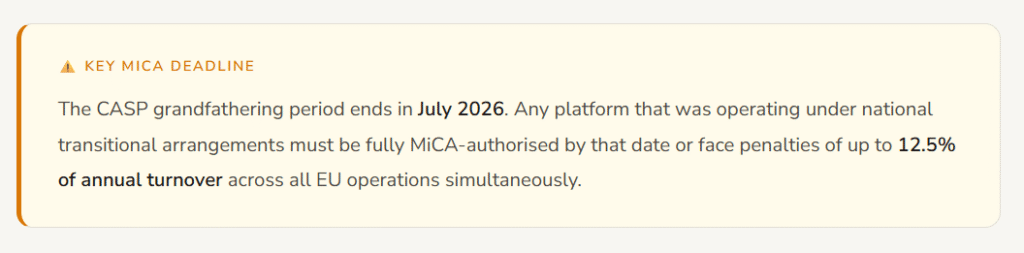
| European Union | MiCA (Markets in Crypto-Assets Regulation) | Full enforcement from December 30, 2024. CASP grandfathering deadline July 2026. Fines up to 12.5% of annual turnover. | Active |
| United States | GENIUS Act (stablecoins); CLARITY Act (market structure, Senate pending) | GENIUS Act signed July 18, 2025. SEC halted 12 enforcement cases including Binance and Coinbase. Project Crypto joint SEC-CFTC oversight launched January 2026. | Active |
| Hong Kong | HKMA Stablecoin Framework (August 2025) | Launched as regional benchmark. Clear reserve, capital, and AML/CFT standards. Sandbox-tested before rollout. | Active |
| Singapore | Digital Token Service Provider rules under FSMA | Rapid rollout prompted compliance scramble. MAS continues active licensing and enforcement. | Active |
| Nigeria | Investments and Securities Act (March 2025) | Cryptocurrencies recognised as securities under SEC authority. High adoption rate but inconsistent enforcement history. | Emerging |
| Japan | FSA proposed legislation to treat select crypto as financial products | New rules target insider trading and market manipulation. Tax reform proposal: flat 20% rate on crypto gains under consideration. | Evolving |
| UAE | FSRA (ADGM) + CBUAE; Travel Rule adopted 2023 | 2025 guidance requiring firms to avoid anonymous counterparties. Positioning as a compliant global crypto hub. | Active |
| United Kingdom | FCA registration under Money Laundering Regulations | Travel Rule enforced since September 2023. Broad crypto framework consultation underway for 2026. £42M fine for Barclays; £21M for Monzo in July 2025. | Evolving |
What Does MiCA Mean for Cryptocurrency Businesses Operating in Europe?
The EU’s Markets in Crypto Assets Regulation is the world’s first comprehensive legal framework for digital assets, and it entered full enforcement mode at the close of 2024.
For any business touching European customers, including platforms headquartered outside the EU, MiCA is now a defining operational reality.
Under MiCA, every Crypto-Asset Service Provider must obtain a unified CASP licence valid across all 27 EU member states.
This passporting right is a genuine benefit for legitimate businesses, eliminating the prior need to obtain separate national licences in each country.
The trade-off is a rigorous authorisation process: businesses must demonstrate robust AML/KYC controls, maintain specific capital reserves, publish standardised white papers for token offerings, and comply with strict stablecoin reserve requirements.
The stablecoin provisions have been particularly consequential. MiCA distinguishes between Asset-Referenced Tokens and Electronic Money Tokens, imposing strict one-to-one reserve backing for both.
Major issuers, including Tether, faced scrutiny under these requirements, accelerating a structural reorganisation of Europe’s stablecoin market.
CASPs were generally restricted from offering non-MiCA-compliant stablecoins, driving a rotation toward compliant alternatives.
A 2025 PwC report noted that divergent national interpretations across member states continue to challenge businesses, meaning that while the rules are unified on paper, their practical application still requires jurisdiction-by-jurisdiction due diligence.
For businesses building cross-border compliance programmes in Europe, working with a regulated crypto payment provider that already holds MiCA authorisation, like UPay, significantly reduces this burden.
How Does the US GENIUS Act Change Stablecoin Regulation?
Signed into law on July 18, 2025, the Guiding and Establishing National Innovation for U.S. Stablecoins Act is the most significant piece of American crypto legislation in the industry’s history.
It creates the first federal framework specifically governing payment stablecoins, ending years of regulatory ambiguity that had blocked meaningful institutional participation in the US market.
The GENIUS Act is anchored in clear structural requirements. Stablecoin issuers must maintain 100% reserve backing with liquid assets such as US dollars or short-term Treasury securities.
Monthly public disclosures of reserve composition are mandatory. Strict AML and sanctions compliance programmes are required.
Issuers with outstanding stablecoins above $10 billion graduate from state oversight to direct federal supervision by either the Federal Reserve, the OCC, or the NCUA.
Importantly, the Act also empowers the Treasury to pursue regulatory passporting with comparable jurisdictions, opening the door for US-regulated stablecoin issuers to expand internationally without building entirely new regulatory relationships in each country.
This mirrors the passporting framework already established by MiCA in Europe, creating the early architecture of a genuinely aligned transatlantic regulatory standard.
What Are the AML, KYC, and Travel Rule Requirements for Crypto Businesses?
Anti-money laundering and KYC (Know Your Customer) requirements are the most universally enforced dimension of crypto regulation globally and the area where enforcement actions have been most severe.
In late 2025, the Department of Justice fined OKX more than $500 million for AML failures, including weak KYC checks and billions in suspicious transactions.
In November 2025, the Central Bank of Ireland issued its first-ever crypto enforcement action, fining Coinbase Europe Limited €21.5 million for breaching AML and counter-financing of terrorism obligations across four years.
These are not edge cases.
They represent a clear signal from regulators on both sides of the Atlantic: the era of treating KYC as an optional onboarding formality is over.
For any business operating as a Virtual Asset Service Provider, an exchange, custody platform, crypto payment processor, or wallet provider, the expectations are now equivalent to those placed on traditional financial institutions.
How Are Regulators Approaching DeFi and AML?
Decentralised finance presents a structural challenge to the AML framework because there is often no clear legal entity that qualifies as the obliged party.
FATF guidance treats DeFi protocols with admin keys, governance tokens held by identifiable entities, or profit-sharing arrangements as functionally operating VASPs, making them subject to AML requirements.
Regulators globally are moving toward broader classification, and 2026 is expected to bring more targeted enforcement against DeFi projects with identifiable controlling parties.
Striking the right balance between regulatory compliance and user privacy remains a challenge.
DeFi Compliance Puzzle
DeFi is the final frontier for regulators, and the puzzle is simple: how do you regulate a protocol that has no boss?
While these platforms are built to be autonomous, regulators are now hunting for control points like development teams with admin keys or revenue-sharing governance tokens to slap them with the same rules as traditional banks.
With the market projected to hit $637 billion by 2032, the days of operating under the radar are over.
Conclusion
The wait-and-see phase of crypto regulation is officially in the rear-view mirror.
In just a year, we’ve gone from vague warnings to a world where the US GENIUS Act and the EU’s MiCA are setting the pace for the global economy.
By getting a handle on these rules now, you aren’t just staying out of trouble, you’re giving your business the authority to operate where others can’t.