


Chiunque può acquistare Bitcoin on an exchange in five minutes.
Knowing when to buy, when to hold, and when to step aside is an entirely different skill, and that is precisely where technical analysis in crypto trading comes in.
It will not give you a crystal ball, and anyone who tells you otherwise is selling something.
What it does give you is a structured, data-driven framework for reading price action, identifying momentum shifts, managing risk, and making decisions based on evidence rather than emotion.
To be frank, the trading world is full of noise. This guide takes you back to the basics with core principles, what really matters: indicators, chart patterns, e.t.c.
Letture correlate: Regulatory Challenges in the Cryptocurrency Industry, factors affecting crypto to fiat conversion rates.
What Is Technical Analysis and Why Does It Matter in Crypto?
Technical analysis (TA) is the practice of evaluating an asset’s future price behaviour by studying its historical price movements, trading volume, and market patterns.
It rests on three foundational principles that have underpinned market analysis since Charles Dow first articulated them in the late 19th century and that remain entirely relevant to Bitcoin and Ethereum charts today.
The first principle is that the market discounts everything.
All known information, news events, regulatory decisions, whale movements, and earnings are already reflected in the current price.
You do not need to know why Bitcoin dropped; you need to know what the chart says about where it is likely going next.
Il secondo è quello i prezzi si muovono nelle tendenze.
Markets do not move randomly; they establish directional momentum that tends to persist until a clear reversal signal appears.
The third is that history repeats. Human psicologia del mercato è consistente.
The same fear and greed patterns that formed a head-and-shoulders top in 2018 continue to form similar structures today, giving observant traders a probabilistic edge.
What Are the Most Important Technical Indicators for Crypto Trading
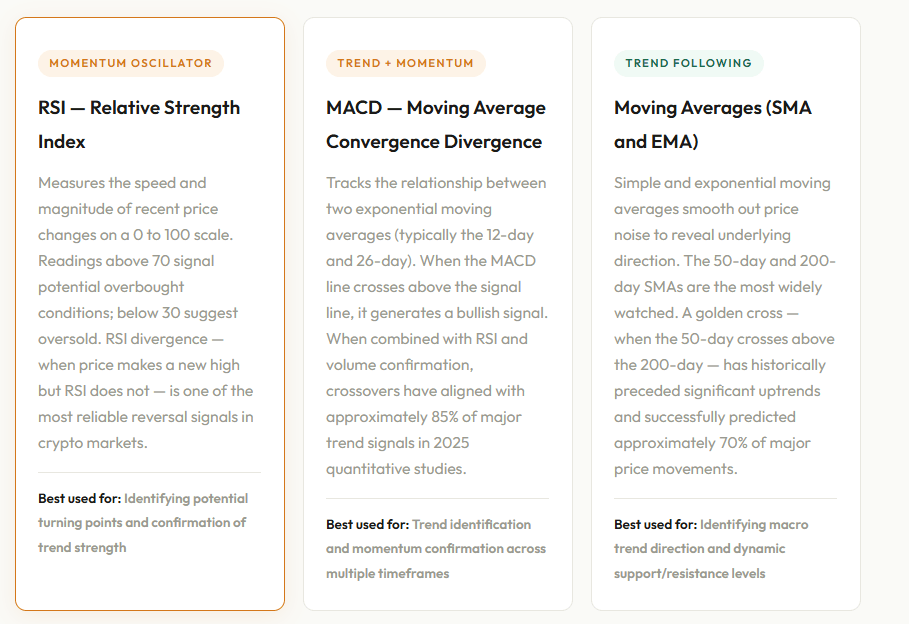
Indicators fall into four broad categories: trend-following tools that identify directional momentum, oscillators that flag overbought or oversold conditions, volume indicators that confirm or challenge price moves, and volatility tools that measure the size of price swings.
Knowing each category prevents the common mistake of stacking five indicators that all say the same thing.
Ottieni la carta UPay Crypto
Scopri il meglio dei pagamenti online e delle transazioni crittografiche senza interruzioni.
Registrati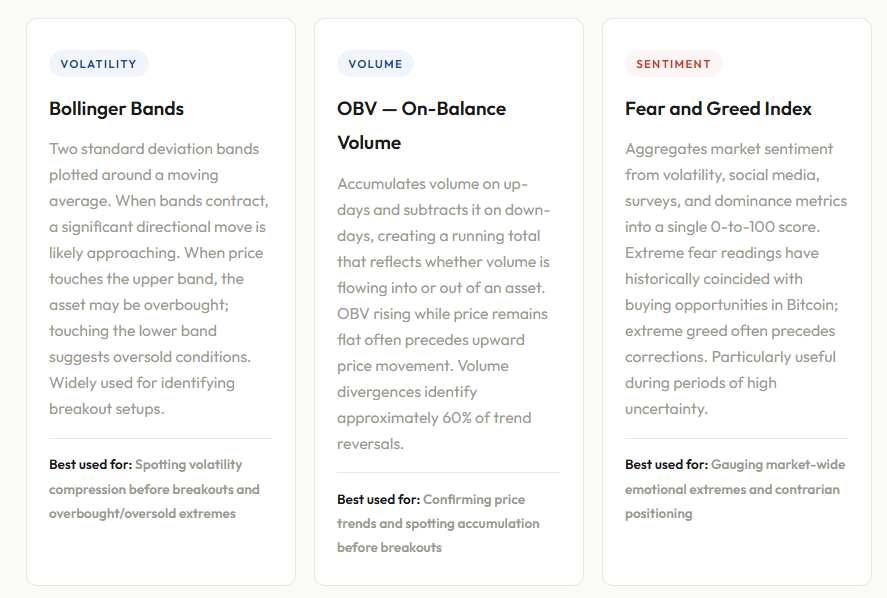
What Chart Patterns Should Crypto Traders Recognise
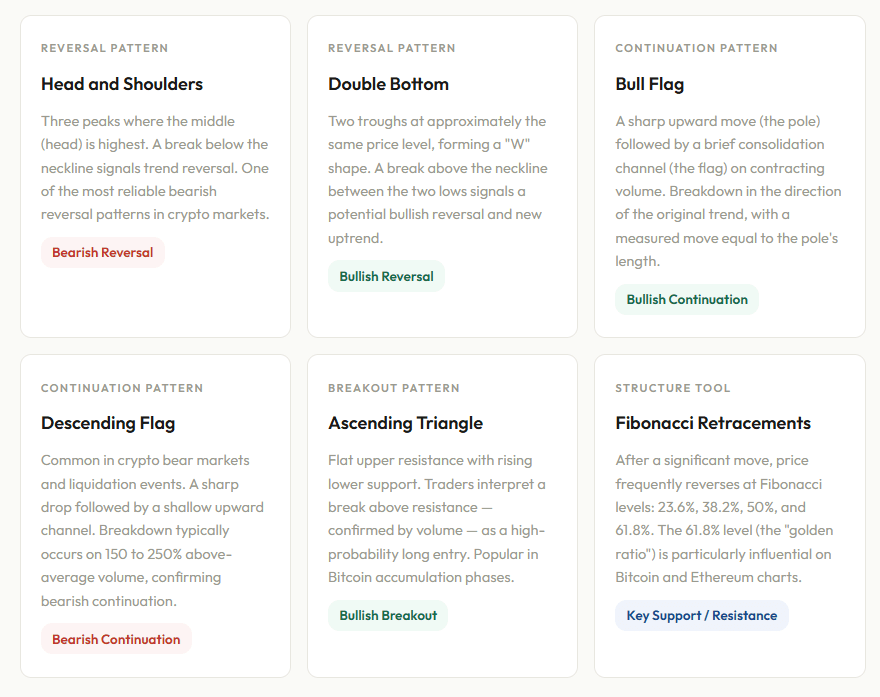
Chart patterns are formations in price action that repeat across markets and timeframes because they reflect consistent human psychology cycles of accumulation, distribution, fear, and greed that play out predictably.
Chart patterns are formations in price action that repeat across markets and timeframes because they reflect consistent human psychology cycles of accumulation, distribution, fear, and greed that play out predictably.
Higher timeframe patterns (daily and weekly charts) carry significantly more weight than patterns on shorter timeframes, and genuine breakouts are almost always confirmed by expanding volume of 150 to 250% above average.
How Do You Build a Technical Analysis Strategy for Crypto?
1. Choose Your Timeframe and Market First
Day traders analyse 15-minute and 1-hour charts. Swing traders focus on the 4-hour and daily. Long-term position traders study weekly charts.
Each timeframe requires a different indicator setup and risk tolerance.
Bitcoin and Ethereum provide the strongest and most reliable TA signals due to their deep liquidity and extensive historical data, start here before moving to altcoins.
2. Identify Trend Direction Before Anything Else
Determine whether the asset is in an uptrend (higher highs and higher lows), downtrend (lower highs and lower lows), or consolidation.
The 50-day and 200-day moving averages provide an immediate macro picture.
Trading in the direction of the prevailing trend significantly improves the probability of any individual trade working out.
3. Add Two to Three Confluence Indicators
Select one trend indicator (such as moving averages or MACD), one momentum oscillator (RSI is the most widely trusted), and one volume tool (OBV or simple volume bars)
Look for setups where all three align in the same direction.
A bullish RSI reading, rising OBV, and a golden cross moving average setup carry significantly more weight than any single signal in isolation.
4. Define Entry, Stop-Loss, and Target Before You Trade
This is where most retail traders fail. A complete trade setup specifies the entry price, the stop-loss level (typically just below a key support level), and the take-profit target.
5. Backtest and Review Every Trade
Apply your strategy to historical price data before risking real capital.
Most charting platforms including TradingView allow you to scroll back through charts and simulate your entries and exits.
Keep a trade journal recording your rationale, the indicators that triggered your entry, and the outcome. Patterns in your journal both profitable and unprofitable reveal refinements to your strategy over time.
How Does Technical Analysis Connect to Crypto Payments and Business Use?
If you run a business that accepts cryptocurrency, understanding technical analysis has a practical commercial application beyond personal trading.
Knowing when Bitcoin or Ethereum are in periods of elevated volatility helps you decide whether to hold received crypto or convert to fiat immediately.
Many businesses use crypto payment gateways that offer automatic fiat conversion at the point of sale removing price risk entirely but for those who choose to hold a portion of their digital receipts, a working knowledge of market conditions is genuinely valuable.
Piattaforme come PAga give businesses the tools to accept crypto from customers and manage settlement intelligently converting to local currency when market conditions call for it, or holding digital assets in a business wallet when the technical picture favours appreciation.
Is AI and Algorithmic Tool (s) Replacing Traditional Technical Analysis?
Not replacing, augmenting.
AI-driven trading systems in 2025 typically merge price and volume data with on-chain metrics and social sentiment analysis into models that update in real time.
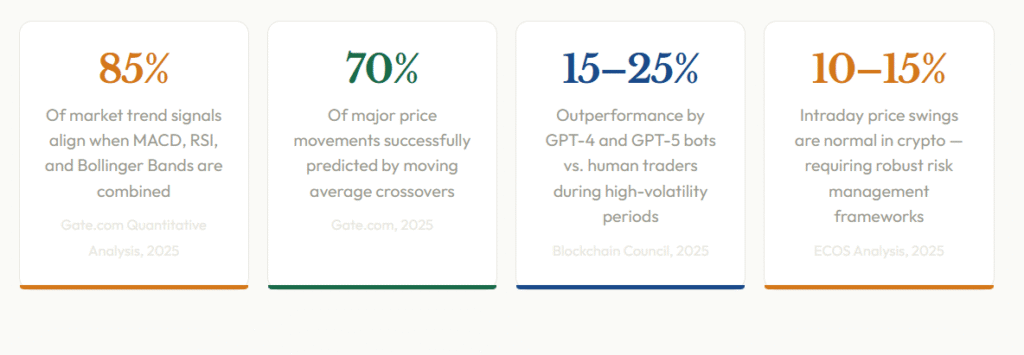
Research findings suggest that GPT-4 and GPT-5 powered algorithmic funds outperformed human traders by 15 to 25% during certain high-volatility periods in 2025.
However, these results are highly strategy-specific and come with significant caveats: overfitting to historical data, vulnerability to market manipulation and wash trading, and the irreplaceable need for human judgment when market conditions shift in unprecedented ways.
Ottieni la carta UPay Crypto
Scopri il meglio dei pagamenti online e delle transazioni crittografiche senza interruzioni.
RegistratiVantaggi dell'analisi tecnica per il trading di criptovalute
L'analisi tecnica offre diversi vantaggi per il trading di criptovalute, tra cui:
Identificazione della tendenza dei prezzi
Technical analysis helps identify and understand price trends in the cryptocurrency market.
Traders can recognize upward, downward, or sideways trends, enabling them to align their trading strategies accordingly.
Punti di entrata e di uscita
By analyzing price patterns, support and resistance levels, and indicators, technical analysis assists traders in identifying optimal entry and exit points for their trades.
This helps improve timing and potentially maximize profits while minimizing risks.
Risk Management
Technical analysis provides tools for implementing risk management strategies.
Traders can set stop-loss orders and determine risk-reward ratios based on support and resistance levels, helping to protect their capital and manage potential losses.
Approfondimenti sulla psicologia del mercato
Technical analysis examines historical price data and patterns, which reflect market psychology and sentiment.
Traders can gain insights into market participants’ behavior, such as fear, greed, or indecision, and adjust their trading strategies accordingly.
Conferma dell'analisi fondamentale
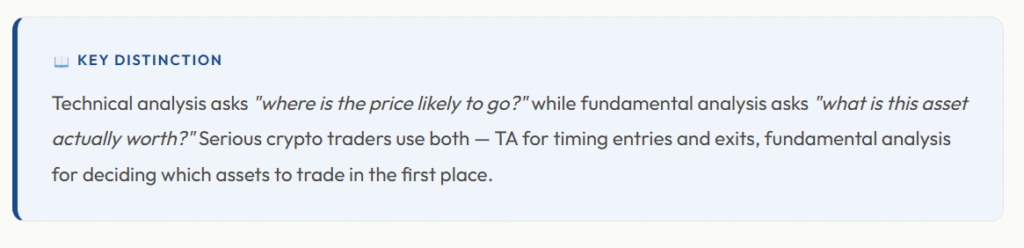
Technical analysis can complement fundamental analysis by confirming or validating the impact of news, events, or fundamental factors on cryptocurrency prices.
It helps traders make more informed decisions by considering both technical and fundamental perspectives.
Limitazioni dell'analisi tecnica per il trading di criptovalute
Sebbene l'analisi tecnica sia un approccio ampiamente utilizzato nel trading di criptovalute, è importante esserne consapevoli dei limiti. Ecco alcuni dei principali svantaggi e sfide associati all'analisi tecnica per il trading di criptovalute:
Sentimento del mercato e impatto delle notizie
L'analisi tecnica si basa principalmente sui dati storici di prezzi e volumi. Tuttavia, notizie improvvise che influenzano il mercato o cambiamenti nel sentiment possono portare a movimenti di prezzo inaspettati che l'analisi tecnica potrebbe non cogliere appieno.
Potere predittivo limitato
L'analisi tecnica non è infallibile e non garantisce previsioni accurate. Le condizioni di mercato possono cambiare rapidamente e gli andamenti storici potrebbero non ripetersi sempre.
Eccessiva enfasi sui dati storici
L'analisi tecnica si basa sui movimenti storici dei prezzi e alcuni critici sostengono che questa attenzione al passato potrebbe non riflettere necessariamente le attuali dinamiche di mercato, soprattutto nel settore delle criptovalute in rapida evoluzione.
Mancanza di analisi fondamentale
The Analysis does not consider the underlying fundamentals of a cryptocurrency, such as its technology, team, partnerships, or use case.
Events like regulatory developments or changes in the project’s fundamentals may significantly impact the price, and technical analysis alone may not capture these factors.
Ottieni la carta UPay Crypto
Scopri il meglio dei pagamenti online e delle transazioni crittografiche senza interruzioni.
RegistratiAnalisi del volume
Technical analysis considers trading volume alongside price movements.
Increased volume during price breakouts or significant price movements can indicate the strength of a trend or potential market turning points. Traders can use volume analysis to validate signals and assess market participation.
Backtesting e sviluppo di strategie
Traders can use historical price data and technical analysis tools to backtest trading strategies.
By analyzing past market behavior and the performance of indicators, traders can refine their strategies, optimize parameters, and assess the historical effectiveness of their approach.
Conclusione
At the end of the day, anyone can hit a buy button, but surviving the markets long-term requires a strategy.
Technical Analysis in Crypto Trading isn’t about predicting the future with 100% certainty, it’s about playing the probabilities.
Once you’ve got a solid handle on what a technical analysis, it’s worth looking at how the rest of the pieces fit together. You might want to explore resources such as liquidità di criptovaluta, dinamica delle tariffe del gas.