


Visa Teams With BVNK To Power Stablecoin Infrastructure, Letting Businesses Fund and Send Stablecoin Payouts Straight to Wallets

Visa has taken another concrete step toward integrating stablecoins into mainstream payments, announcing a partnership with London-based stablecoin infrastructure firm BVNK that will allow businesses to fund and send payouts directly in stablecoins through Visa Direct. The collaboration expands Visa Direct’s capabilities beyond traditional fiat rails, giving select enterprise customers the option to pre-fund payouts using stablecoins and send funds straight to recipients’ digital wallets. Visa Direct already processes about $1.7 trillion in annual payment volume, making the move one of the most significant endorsements yet of stablecoins as a settlement layer for global payments. According to Visa, the rollout will initially focus on approved markets where demand for digital asset payments is already strong, with broader expansion planned as customer demand grows and regulators give the green light. Key Takeaways Stablecoins Enter Visa’s Core Payment Rails Visa’s global head of product for commercial and money movement solutions, Mark Nelsen, framed the partnership as a practical response to long-standing inefficiencies in cross-border payments. “Stablecoins are an exciting opportunity for global payments,” Nelsen said, pointing to their ability to operate “during weekends, holidays, and when banks are closed.” That always-on settlement capability is central to the appeal. Traditional payment systems often rely on correspondent banking networks that introduce delays, limited operating hours, and layered fees. Stablecoin-funded payouts, by contrast, can settle nearly instantly, regardless of time zones or banking holidays. Under the new setup, BVNK will provide the infrastructure that allows Visa Direct to support stablecoin payouts in compliant jurisdictions. Recipients can receive funds directly into their stablecoin wallets, typically in dollar-backed assets such as USDC, while businesses can choose whether to fund payouts using fiat or stablecoins. From Investment to Implementation The announcement marks a clear progression in Visa’s relationship with BVNK. In May 2025, Visa’s venture arm participated in BVNK’s $50 million Series B funding round, followed months later by a strategic investment from Citigroup. Now, Visa is actively deploying the infrastructure it backed. BVNK already processes more than $30 billion in stablecoin payments annually, a figure that, while small compared to Visa’s overall volume, demonstrates real usage at scale. For Visa, the partnership provides a ready-made bridge between its existing payment network and blockchain-based settlement. A BVNK spokesperson described the deal as evidence that stablecoins are moving beyond niche use cases. The partnership is a “clear sign that stablecoins are becoming a mainstream, complementary payment rail,” the spokesperson said, adding that BVNK is working with a “limited set of Visa Direct enterprise clients,” including payment service providers, marketplaces, and platforms. The company plans to expand to more corridors, currencies, and stablecoins as regulations and customer needs allow. Speed Shifts the Payment Equation Industry observers say the real impact of stablecoin payouts lies in what they remove from the payment process. “Stablecoin payouts remove the biggest operational bottleneck in global payment, which is time,” said Jayanand Sagar, co-founder of Hyperbola Network. “When value can move instantly, 24/7, the traditional advantage of banking systems shifts away from speed and efficiency toward compliance and trust.” That shift reframes the competition. Banks and payment networks are no longer racing to be faster than blockchains; instead, they are positioning themselves as trusted gateways that sit on top of new rails. Brian Mehler, CEO of Stable, echoed that view, arguing that distribution alone won’t determine which stablecoins succeed. Payment networks may influence adoption, he said, but the deciding factor will be “whether the underlying infrastructure can deliver predictable fees, deterministic settlement, and the operational reliability institutions need.” Regulation Shapes the Playing Field Visa’s move also comes as regulatory frameworks for stablecoins begin to solidify, particularly in the United States. The GENIUS Act establishes federal standards for payment stablecoins, narrowing the range of tokens that large payment networks can legally support. According to Axis COO Jimmy Xue, this has changed the role of companies like Visa. Their power, he said, is now “tethered to federal standards,” shifting their influence from picking token winners to defining the “invisible plumbing” of global finance, where institutional trust and fraud protection matter more than brand recognition. Visa has already been testing these waters. Last November, the company began piloting stablecoin wallet payouts, allowing fiat-denominated payments to settle in dollar-pegged stablecoins. Wider access to those services is expected in the second half of 2026, depending on local regulations. Why It Matters For businesses, especially platforms paying creators, freelancers, and cross-border partners, stablecoin payouts offer a way to bypass slow settlement cycles and currency friction. Visa’s own research shows that a majority of creators want faster access to funds, something traditional banking systems still struggle to provide consistently. For recipients in regions with limited access to dollar banking, receiving USD-backed stablecoins directly into a wallet can be a meaningful upgrade. The BVNK partnership doesn’t replace Visa’s existing rails, but it adds a new option alongside them. As regulatory clarity improves, Visa appears intent on making stablecoins a standard part of its payment toolkit rather than an experimental side project. For now, the rollout remains limited. But by plugging stablecoins directly into Visa Direct, Visa is signaling that blockchain-based settlement is no longer just adjacent to global payments—it’s being wired into the system itself.
Ripple Wins Preliminary EMI Approval in Luxembourg, Advancing Regulated EU Payments Under MiCA
Regulation isn’t killing crypto. It’s onboarding it. Ripple has taken another decisive step in embedding blockchain payments into the mainstream financial system after securing preliminary approval for an Electronic Money Institution (EMI) license in Luxembourg. The authorization, issued by the country’s financial regulator, the Commission de Surveillance du Secteur Financier (CSSF), positions Ripple to significantly expand its regulated payments business across the European Union once final conditions are met. The approval was delivered through what Ripple described as a “green light letter,” signaling regulatory confidence in the firm’s operations and compliance framework. While not yet a full license, the decision allows Ripple to move closer to offering stablecoin and digital asset-based payment services across EU member states under passporting rules. This development comes at a pivotal moment for Europe’s crypto market, as firms prepare to operate under the European Union’s Markets in Crypto-Assets (MiCA) regime, which is reshaping how digital asset companies engage with banks, payment providers, and institutional clients. Key Takeaways Luxembourg Adds Weight to Ripple’s European Strategy Luxembourg has long positioned itself as a hub for cross-border finance, and Ripple’s progress there strengthens its regulatory footing within the bloc. Once finalized, the EMI license would allow Ripple to issue and manage electronic money, support stablecoin-enabled payments, and provide regulated infrastructure to financial institutions across the EU. Cassie Craddock, Ripple’s managing director for the UK and Europe, framed the move as more than a box-ticking exercise. “Luxembourg’s supervisory framework offers the legal certainty needed for financial innovation,” she said, describing the preliminary approval as a key step toward delivering compliant blockchain infrastructure across Europe. Ripple has emphasized that regulatory clarity is what allows blockchain tools to move beyond pilot programs and into real-world financial plumbing. Europe, with its harmonized rules and institution-friendly stance, has become central to that strategy. Back-to-Back Wins in the UK and EU The Luxembourg approval follows closely on Ripple’s regulatory breakthrough in the United Kingdom. Just days earlier, the UK Financial Conduct Authority granted Ripple Markets UK both an EMI license and cryptoasset registration, allowing the company to operate regulated payment and digital asset services in one of Europe’s largest financial centers. Together, the UK and Luxembourg authorizations give Ripple licensed footholds in two of the most influential jurisdictions shaping crypto policy in Europe. Ripple President Monica Long said this regulatory momentum is giving financial institutions the confidence they need to adopt blockchain at scale. “Europe’s approach has enabled banks to move blockchain beyond experimentation,” Long noted, adding that Ripple’s growing licensing portfolio supports an end-to-end payments model combining stablecoins with onchain liquidity. Ripple Payments, the company’s flagship cross-border payments platform, manages transaction flows on behalf of banks and payment providers while connecting them to a global payout network. By absorbing the technical and operational complexity internally, Ripple allows institutions to offer digital asset-powered services without rebuilding their infrastructure. According to the company, Ripple Payments has processed more than $95 billion in transaction volume and now touches over 90% of global daily foreign exchange markets. Aligning With MiCA, Not Racing Around It Beyond national approvals, Ripple is actively pursuing full compliance under MiCA, the EU’s comprehensive crypto framework. The firm plans to secure a crypto asset service provider (CASP) license in the coming months, which would allow it to operate seamlessly across all EU member states. Craddock has been clear about why this matters. “Regulatory clarity forms the foundation of institutional adoption,” she said, arguing that MiCA-compliant operations give European businesses the confidence to participate in financial innovation without legal uncertainty. Ripple currently holds more than 75 licenses and registrations worldwide, including money transmitter licenses across 43 U.S. states and territories, as well as approvals in Singapore, Dubai, and the Cayman Islands. Additional regulatory reach has come through acquisitions such as Layer2 Financial and Hidden Road, further cementing Ripple’s status as one of the most licensed companies in the digital asset sector. Global Momentum Beyond Europe Ripple’s regulatory progress is not limited to Europe. In the Middle East, the company recently secured approval for its dollar-backed stablecoin, RLUSD, in Abu Dhabi. The token was recognized as an accepted fiat-referenced token within the Abu Dhabi Global Market (ADGM), allowing licensed firms to use it for regulated financial activities. The approval followed earlier wins in Dubai and Abu Dhabi and coincided with new partnerships, including collaborations with Zand Bank and fintech firm Mamo. These moves underline Ripple’s broader ambition to provide compliant, institution-grade stablecoin infrastructure across major financial regions. Ripple is also exploring further expansion of its blockchain capabilities. The company has indicated it is weighing the introduction of staking on the XRP Ledger, a move that could push the network deeper into decentralized finance while maintaining a compliance-first posture. Regulation as a Competitive Advantage Ripple now operates 15 offices globally, including London, Dublin, Luxembourg, Geneva, and Reykjavik, and continues to frame regulation not as a constraint but as a differentiator. As governments tighten oversight of digital assets, firms that can meet institutional standards are gaining an edge. The preliminary EMI approval in Luxembourg does not mark the end of Ripple’s regulatory journey in Europe, but it does signal where the market is heading. For banks and payment providers looking to modernize cross-border transfers with stablecoins and blockchain rails, regulated players are no longer optional—they are essential. And in that environment, regulation isn’t pushing crypto out. It’s letting it in.
Hyperliquid Leads All Chains in 24H Revenue, With Edgex and Solana Following
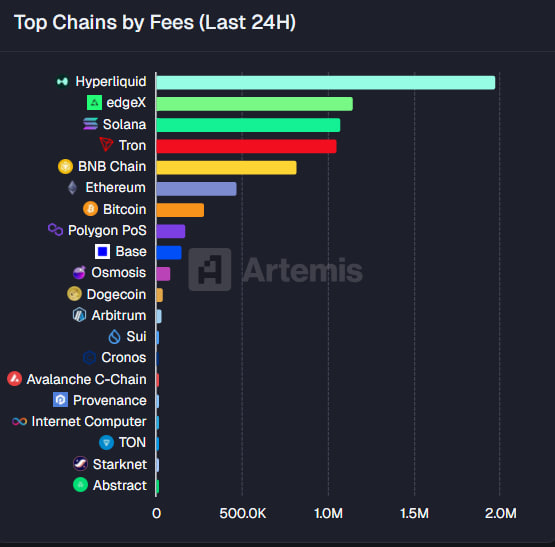
Blockchain revenue dynamics shifted sharply over the past 24 hours as Hyperliquid emerged as the highest-fee-generating network, outpacing both established and emerging chains amid heightened trading activity. Fresh data tracking fees collected across major blockchains shows Hyperliquid firmly in the lead, generating roughly $2 million in fees over the last 24 hours. The figure places the derivatives-focused chain ahead of Edgex and Solana, which followed closely behind, underscoring a notable change in where user activity and transaction demand are currently concentrated. Key Takeaways Hyperliquid’s Fee Surge Reflects Trading Intensity Hyperliquid’s top position is closely tied to its growing dominance in on-chain perpetual futures trading. The protocol has attracted traders seeking deep liquidity, low latency execution, and transparent order books, driving a surge in transaction volume and, in turn, fee generation. Unlike general-purpose smart contract networks, Hyperliquid’s revenue is largely derived from trading-related activity rather than decentralized application usage. This makes its leading position particularly notable, as it surpassed multi-ecosystem chains that support NFTs, DeFi, and payments simultaneously. Market observers note that elevated volatility across crypto markets tends to benefit derivatives platforms, where frequent position adjustments and liquidations translate directly into higher fee income. Edgex and Solana Maintain Strong Positions Following Hyperliquid, Edgex secured second place in 24-hour fee generation. While still relatively new compared to legacy networks, Edgex’s performance suggests growing traction, likely driven by concentrated application usage and rising user engagement within its ecosystem. Solana, long recognized for its high throughput and low transaction costs, ranked third. Despite its reputation for inexpensive fees, Solana’s placement highlights the scale of its activity, with large volumes compensating for lower per-transaction costs. The network continues to benefit from strong adoption across DeFi, NFTs, and consumer-facing applications. How Major Chains Compare Beyond the top three, Tron and BNB Chain also recorded substantial fee totals, reflecting steady usage in payments, stablecoin transfers, and decentralized finance. Ethereum, while no longer leading daily fee charts, maintained a solid mid-tier position, supported by Layer 2 activity and ongoing demand for blockspace. Bitcoin appeared lower on the list, consistent with its role as a settlement-focused network rather than a high-frequency transaction platform. Several Layer 2 and alternative chains, including Polygon PoS, Base, Arbitrum, and Sui, generated smaller but consistent fee volumes, pointing to fragmented yet persistent user activity across the broader ecosystem. What the Data Signals Daily fee rankings offer a real-time snapshot of where users are most active and willing to pay for blockspace. Hyperliquid’s rise to the top suggests a growing preference for specialized trading platforms during periods of heightened market engagement. At the same time, the strong showing from Solana and other high-throughput networks indicates that general-purpose chains continue to play a critical role, even as niche platforms capture outsized revenue during specific market conditions. As market momentum shifts, fee data will remain a key indicator of underlying demand, competitive positioning, and the real economic activity driving blockchain networks forward.
Buying Property with Crypto in Turkey: All You Need To Know In 2026
Key Highlights The State of Cryptocurrencies In Turkey Source: Pexels Turkey has emerged as one of the world’s most crypto-engaged nations, driven by a combination of currency volatility, tech-savvy demographics, and a desire to hedge against inflation. Over 50% of the population has used cryptocurrency in some form, for savings, trading, or transactions. With trading volumes exceeding $1 trillion USD, Turkey’s crypto market is anything but a rounding error on the global stage. The regulatory landscape for cryptocurrencies in Turkey underwent significant transformation in 2024-2025. In July 2024, Turkey enacted its first comprehensive crypto legislation through Law No. 7518, which amended the Capital Markets Law to establish definitions and frameworks for crypto assets, wallets, trading platforms, and Crypto Asset Service Providers (CASPs). This marked a decisive step toward institutionalizing the crypto market. On March 13, 2025, the Capital Markets Board (CMB) published two regulatory documents establishing detailed rules for CASPs, including exchanges, custodians, and wallet providers. Key requirements include: minimum capital of $4.1 million for exchanges and $13.7 million for custodians; mandatory licensing from the CMB; private keys must be stored within Turkey; platforms must hold liquid reserves equal to 3% of customer assets; and strict listing standards for crypto assets. The Travel Rule was also fully implemented on February 25, 2025, enforced by MASAK (Financial Crimes Investigation Board). All crypto transactions exceeding 15,000 TRY (approximately $425) now require complete identity verification for both sender and receiver. Turkey imposes a 0.03% transaction tax on crypto trades. The most commonly used cryptocurrencies in Turkey include Bitcoin (BTC), which accounts for roughly 60% of real estate-related crypto payments, USDT and USDC (Stablecoins), and Ethereum. Major Turkish crypto exchanges include Binance TR, BTCTurk, and Paribu, while services like Papara provide easy on/off ramps between Lira and crypto. Regarding taxation, Turkey currently has no specific crypto tax law. However, profits from trading or mining are generally considered taxable under existing income tax regulations. For real estate purchases, there is no additional tax when using crypto as the funding source, although standard property transaction taxes apply regardless of how the purchase is funded. Buying Real Estate With Crypto In Turkey Source::Piramal Realty Turkey has pioneered crypto-facilitated real estate transactions, with the first known Bitcoin property sale occurring in September 2017 when Bayram Tekçe, chairman of Antalya Homes, accepted 20 BTC (then worth approximately $80,000) for an apartment in Antalya. Since then, the practice has become routine, with dozens of agencies now accepting cryptocurrency payments. The process works through a conversion mechanism involving buyers transferring cryptocurrency to the agency’s international wallet, which then converts it to fiat currency (typically USD or EUR) and subsequently to Turkish Lira for the official property registration. The seller receives TRY, and the Tapu (Land Registry) records the transaction in local currency as required by law. Most crypto-friendly agencies recommend stablecoins (particularly USDT) for transactions under $1 million to avoid price volatility between agreement and closing. For larger transactions, the daily exchange limit of $1,000,000 USD means the conversion process can take anywhere from one day to a week, depending on the property value. Real Estate Agencies Accepting Cryptocurrency in Turkey Agency Name Crypto Accepted Payment Method Details Antalya Homes BTC, ETH, USDT, USDC, BCH, LTC, XRP, XLM Pioneer of crypto real estate (first sale 2017). Wallet-to-wallet transfer to the company’s international crypto account, converted to fiat at live market rates. Istanbul Homes BTC, ETH, USDT, USDC, BCH, LTC, XRP, XLM Same parent company as Antalya Homes. KYC documents are required before transfer. Crypto is converted to USD/EUR, then to TRY for the seller. Full citizenship by investment support is available. Tekçe Real Estate BTC, ETH, USDT (primary); all exchangeable cryptocurrencies accepted Exchange crypto for Turkish Lira at the actual market value. Lawyer-supervised transactions in complex jurisdictions. Antalya Homes About The Company Antalya Homes is the leading real estate company in Turkey that conducted probably the first real estate sale with Bitcoin in the world in September 2017. Chairman Bayram Tekçe accepted 20 BTC for an apartment in Antalya, pioneering crypto adoption in real estate. Cryptocurrencies Accepted BTC, ETH, USDT, USDC, BCH, LTC, XRP, XLM Transaction Process Send cryptocurrency to Antalya Homes’ international crypto accounts after KYC documents are approved. They convert crypto to fiat at live market rates with your approval for timing. Money is transferred via international banks, and you receive the title deed after the seller has made payment. Istanbul Homes About The Company Istanbul Homes, part of the same parent company as Antalya Homes, offers flexibility for property buyers and investors in Turkey. Their chairman, Bayram Tekçe, managed the first property sale with Bitcoin globally in 2017, establishing a trusted crypto payment process. Cryptocurrencies Accepted BTC, ETH, USDT, USDC, BCH, LTC, XRP, XLM Transaction Process After KYC documents are received, send cryptocurrency to Istanbul Homes’ accounts abroad. They convert crypto to fiat at real market prices with your permission for timing and exchange rate. USD swift arrives in 2-3 days, EURO in 5-7 days, and then the title deed is issued. Tekçe Real Estate About The Company TEKCE is an international real estate company with 20 offices in 5 countries, 250+ professional agents speaking 30+ languages. Since 2017, they have finalized over 2,500 sales paid by Bitcoin, Ethereum, and USDT, making crypto payments a daily routine. Cryptocurrencies Accepted BTC, ETH, USDT (primary); all exchangeable cryptocurrencies Transaction Process Notify the agent of the crypto payment before the sales agreement, sign the KYC form, and the payment agreement. Transfer crypto to TEKCE’s company wallet. Payment is exchanged at actual market value upon receipt, then fiat is sent to the seller’s bank account per the agreement conditions. What Regions Are The Hottest For Real Estate In Turkey? Istanbul Source: Wikipedia Turkey’s largest city and a major global hub straddling Europe and Asia, Istanbul dominates the real estate market with approximately 15.7 million residents and over 14 million visitors in 2024. Property prices in prime districts such as Beşiktaş, Kadıköy, and Şişli average around $1,295 per square meter, with prices rising
Buying Property with Crypto in Spain: All You Need To Know In 2026
Spain’s real estate market continues to attract international buyers, combining Mediterranean lifestyle appeal with strong investment fundamentals. As cryptocurrency adoption grows and regulatory frameworks mature, purchasing Spanish property with digital assets has become an increasingly viable option. This guide provides a detailed analysis of the economic conditions, regulatory environment, and practical considerations for crypto-based property transactions in Spain. The State Of The Economy For Citizens & Foreigners Related To Acquiring Property In Spain? Source: Idealista Spain’s economy demonstrates robust growth in 2025. The European Commission projects GDP growth of 2.6% for 2025 and 2.0% for 2026, supported by strong labor market performance and continued implementation of the Recovery and Resilience Plan. Banco de España forecasts align with these projections, anticipating 2.6% growth in 2025 and 1.8% in 2026. Inflation stood at 3.1% in October 2025, driven primarily by energy costs in the electricity and transport sectors. Unemployment has declined to approximately 11.5%, continuing a positive trend. Tourism remains a significant economic driver, contributing approximately 12% to the national GDP. Spain’s housing market is also experiencing its strongest growth since 2007. According to the Instituto Nacional de Estadística (INE), property prices rose 12.8% year-on-year in Q3 2025, marking the highest increase in 18 years. The market has recorded positive growth for 46 consecutive quarters. Key Market Statistics Foreign nationals face no legal restrictions on property ownership in Spain. Standard acquisition costs include: Spain’s Golden Visa program Source: LetsLaw Spain’s Golden Visa program, which allowed non-EU nationals to obtain residency through property investment of €500,000 or more, officially ended on April 3, 2025. The law was published in the Official State Gazette (BOE) on January 3, 2025, following Congressional approval in December 2024. Key points: The Spanish government cited housing affordability concerns, particularly in Madrid and Barcelona, as the primary reason for discontinuing the real estate investment pathway. Alternative residency options remain available, including the Non-Lucrative Visa for passive income earners and the Digital Nomad Visa. The State of Cryptocurrencies In Spain Source: Bitcoin.com Spain operates under the EU’s Markets in Crypto-Assets (MiCA) regulation, which became fully applicable on December 30, 2024. Spain accelerated its implementation timeline, with full adoption by December 31, 2025, six months ahead of the EU’s June 2026 deadline. Regulatory structure The grandfathering period allows existing crypto-asset service providers registered with the Bank of Spain before December 30, 2024, to continue operations until December 30, 2025, while transitioning to MiCA authorization. BBVA became the first entity to obtain a MiCA license in Spain. The Transfer of Funds Regulation (TFR), effective December 30, 2024, mandates traceability requirements for crypto-asset transfers, requiring CASPs to collect and verify originator and beneficiary information. Cryptocurrency Taxation The Agencia Tributaria (AEAT) classifies cryptocurrencies as digital assets subject to taxation. Understanding tax obligations is essential when using crypto for property purchases. Capital Gains Tax (Savings Income Tax): Progressive rates apply to gains from selling, trading, or spending cryptocurrency: Other Crypto Income: Reporting Requirements: Spain uses the FIFO (First-In, First-Out) method for calculating cost basis on cryptocurrency disposals. Buying Real Estate With Crypto In Spain Source: Bitira Crypto-based property purchases in Spain require conversion to euros prior to deed registration. Spanish notaries do not accept cryptocurrency directly; transactions must be completed in fiat currency for Land Registry compliance. The process involves: Stablecoins such as USDT and USDC are commonly used to mitigate volatility during the transaction period. Blockchain forensic analysis may be required for transactions exceeding €200,000, which can add 2-4 weeks to closing timelines. Real Estate Agencies Accepting Cryptocurrencies In Spain Several Spanish real estate agencies have established processes for crypto-based transactions: Agency Name Crypto Accepted Payment Method Details Spain Homes BTC, ETH, major cryptocurrencies Binance Pay partnership for direct payments; full AML/KYC with legal team, euro conversion pre-notary for deed registration. Vicox Legal BTC, ETH, USDT, USDC, stablecoins Tailored for international crypto buys; coordinates notary AML, fiat conversion via Banxa for seamless high-value transactions (e.g., Marbella villas). Alicante Real Estate BTC, ETH, Stablecoins Accepts for any property type; documented wallet transfers with reputation-backed AML, ideal for diversified crypto portfolios. Costa Blanca Hills BTC, ETH, USDT Conversion to euros pre-transaction; supports pricing in crypto or fiat equivalent, with third-party services for rate locks. Spain Homes About The Company Spain Homes (Tekce Overseas SA) made the first real estate sale in Spain with crypto in 2022 and works with Binance Pay for online crypto payments. Registered in the Malaga Chamber of Commerce, they offer service in 10 languages with a customer-centric excellence approach. Cryptocurrencies Accepted BTC, ETH, major cryptocurrencies Transaction Process After the inquiry and KYC process, conduct online or physical viewing tours. Legal team handles AML process, proof of income documentation, and Power of Attorney. Payment sent directly to their Binance Pay wallet, with OTC process managed by experienced legal consultants. Vicox Legal About The Company Vicox Legal is a specialized firm helping clients purchase real estate using cryptocurrencies across Spain, Portugal, Dubai, Miami, and Oman. They operate in key cities including Malaga, Marbella, Alicante, Madrid, Barcelona, Valencia, and Lisbon. Cryptocurrencies Accepted BTC, ETH, USDT, USDC, Stablecoins Transaction Process Complete onboarding with KYC/AML compliance, sign a private contract, and reserve the property. Their cryptocurrency exchange service handles conversion to fiat upon request. Notarial signing, tax payments, and property registration are all coordinated by their legal team. Alicante Real Estate About The Company Alicante Real Estate is a leading Costa Blanca agency with 20+ affiliate partners from 10+ European countries and an in-house real estate lawyer. They began transacting real estate in cryptocurrencies in 2019 with an impeccable reputation for secure transactions. Cryptocurrencies Accepted BTC, ETH, Stablecoins Transaction Process A legal agreement is concluded between the owner and buyer establishing the cryptocurrency-to-euro exchange at a fixed rate and time. The transaction is documented, wallet addresses are verified for compliance, and the purchase is completed with full legal protection. Costa Blanca Hills About The Company Costa Blanca Hills is an experienced real estate agency in Spain specializing in cryptocurrency property transactions. They collaborate with licensed Spanish