



The State of Crypto Adoption in Costa Rica

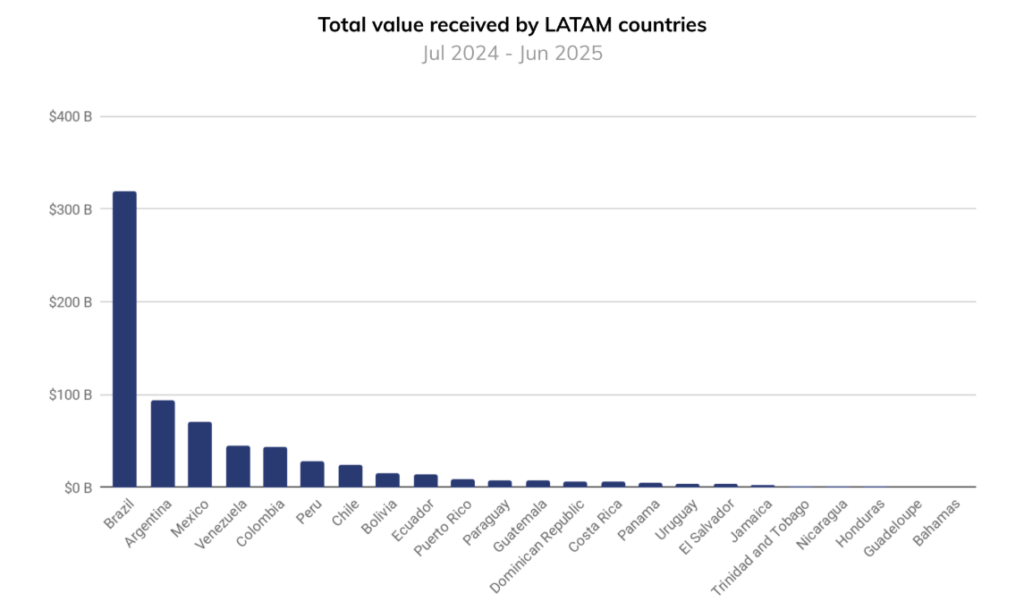
Apart from having a relatively small population of just over 5 million people in 2025, Costa Rica is showing interesting progress in cryptocurrency adoption.
The country is expected to have 567,1280 crypto users by 2026, with about 4.58% of the population using cryptocurrencies. This might seem small, but Costa Rica has some unique features that make it stand out.
The country has embraced crypto in practical ways—there are now 8 Bitcoin ATMs across the country, and some workers can still receive part of their salary in cryptocurrency. Local businesses are increasingly accepting digital currencies as payment, showing that crypto is becoming part of everyday life, not just an investment vehicle.
Source: Chainanalysis
Costa Rica is also building a strong crypto community. Groups like Asos Blockchain bring together people who work with blockchain technology, and they organize events like the Tico Blockchain Conference. These activities help people learn about and get involved with cryptocurrencies.
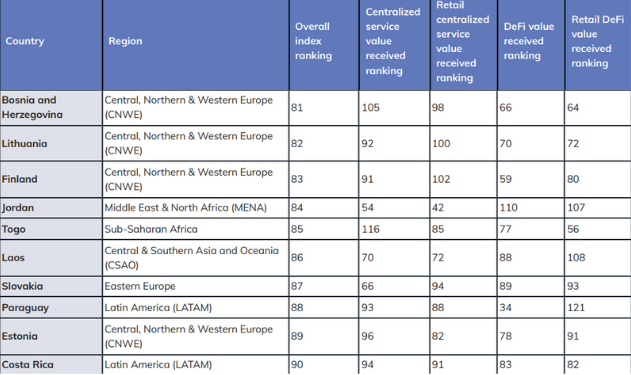
Looking at the numbers, Costa Rica ranked 90th globally in crypto adoption according to the Chainalysis 2024 report, and the crypto market is expected to see some changes, with a slight increase in revenue from US$20.3million in 2025 to US$23.8million in 2026 if the annual growth rate (CAGR 2025-2026) remains at 17.52%.
Source: Chainanalysis
Despite this, the country continues to position itself as a friendly place for cryptocurrency development and use in Latin America.
Crypto Law In Costa Rica

Source: Envato
At the regulatory level, Costa Rica maintains what local media has termed a “vigilant tolerance” approach.
The Central Bank of Costa Rica (BCCR) has established a framework through three key directives issued in 2017, 2019, and 2021, though cryptocurrencies remain largely unregulated by a specific, comprehensive law.
The BCCR explicitly states that cryptocurrencies are not classified as legal tender, monetary currency, or foreign currency. However, they may qualify as “quasi-money” or “means of payment” under Costa Rican law, particularly given their widespread acceptance in commerce.
One of Costa Rica’s most distinctive legal features is the permission for employers to pay salaries in cryptocurrency, stemming from Article 166 of the Labor Code, which allows payment in “commonly accepted assets.”
This provision comes with important caveats:
- The legal minimum wage must be paid in traditional currency
- Employers must calculate social security contributions based on the cryptocurrency’s daily value
- Workers retain the right to refuse cryptocurrency payments.
The banking sector maintains a conservative stance, with financial institutions refusing to recognize cryptocurrency-derived income or accept deposits from cryptocurrency transactions. This creates an interesting dichotomy where cryptocurrencies are widely used in commerce but remain outside the traditional banking system. The National System of Electronic Payment (SINPE) does not process cryptocurrency transactions, forcing users to operate through alternative channels.
The Central Bank of Costa Rica (CBCR) declared that cryptocurrencies are not “legal tender,” “monetary currency,” or “foreign currency.” Nevertheless, cryptocurrencies may be classified as “quasi-money” or as a “means of payment” under Costa Rican law
The anti-money laundering framework presents some legal uncertainties. The primary AML regulation, Law 8204, was designed for traditional currencies, and its application to cryptocurrencies remains unclear.
This regulatory gap has prompted the government to study international practices, particularly those of the Financial Action Task Force (FATF), to develop appropriate regulations.
The Ministry of Finance has explicitly ruled out accepting cryptocurrencies for tax payments, citing volatility concerns.
Meanwhile, the National Council for the Supervision of the Financial System (Conassif) and various financial sector superintendencies monitor cryptocurrency’s evolution to assess potential risks to financial stability and monetary policy implementation.
Obtaining a Crypto License in Costa Rica

The process of obtaining a crypto license in Costa Rica involves several key steps:
Company Registration
The first step is to register a company in Costa Rica. This requires preparing the necessary incorporation documents and obtaining a legal address within the country.
Bank Account
Once the company is registered, it’s essential to open a corporate bank account for financial transactions. While Costa Rica doesn’t enforce strict economic substance requirements, having a bank account can streamline operations.
Compliance with AML/CFT Requirements
Companies must develop and implement robust policies and procedures to prevent their services from being used for money laundering or terrorist financing. Adherence to international standards, such as the Financial Action Task Force (FATF) recommendations, is crucial.
Licensing
Depending on the nature of the crypto activities, a specialized license or authorization from the relevant financial authorities might be required. This is particularly applicable to companies involved in the exchange or storage of significant amounts of cryptocurrencies.
Timeline
The duration of the process can vary from a week to six weeks, depending on the complexity of the setup. The process generally involves:
- Legal Preparation: Drafting necessary documents like company policies, compliance guidelines, and legal disclaimers.
- Company Formation: Registering the company and completing corporate structuring.
- Bank Account Opening: Establishing a corporate bank account.
Crypto Taxation in Costa Rica

Initially, there was no clear guidance on how to tax cryptocurrencies, leading to a range of interpretations. However, recent developments, including a private letter ruling and proposed legislation, have brought more clarity to the matter.
According to the current understanding, cryptocurrencies are considered virtual or intangible assets in Costa Rica. This means that they are subject to taxation depending on the type of transaction performed.
Taxable Events: The primary taxable events related to cryptocurrencies in Costa Rica are:
- Capital Gains: Profits from the sale of cryptocurrencies held as personal investments.
- Business Income: Profits from cryptocurrency-related activities if they are considered part of a business.
- Service Fees: Income from providing services related to cryptocurrencies, such as mining, exchange, or custody.
For example, if a person buys and sells cryptocurrencies for personal gain, they may be subject to capital gains tax. On the other hand, if a business uses cryptocurrencies for commercial purposes, the profits derived from such activities would be subject to corporate income tax.
Since cryptocurrencies are an exchange mechanism, that even generates profits for those who use them, they must be subject to the payment of Value Added Tax (VAT) and income tax.
The recent private letter ruling provides further guidance on the taxation of cryptocurrencies. It clarifies that the collection of fees for transactions or activities related to the organization, verification, or exchange of virtual assets is subject to both corporate income tax and value-added tax (VAT).
Government Regulations and Policies

Costa Rica’s government is taking proactive steps to formalize crypto regulations. The proposed Crypto Assets Market Law (MECA) is currently in an advanced stage of legislative review and is awaiting final debate and approval. This law aims to establish a clear framework for cryptocurrencies, providing investor protection and fostering a favorable environment for crypto businesses.
While the Central Bank doesn’t regulate cryptocurrencies, they are legal and recognized as a means of payment. The government’s approach aligns with its goal of attracting foreign investment and promoting growth, particularly in the technology and tourism sectors.
However, the U.S. government has raised concerns about the potential use of cryptocurrencies for illegal activities, emphasizing the need for Costa Rica to carefully consider regulatory measures to mitigate risks.
We are concerned that money moves narcotics trafficking, human trafficking, cybercrime, and governments that want to get away without sanctions to enforce standards of behavior.
The MECA legislation, if passed, would formally allow Bitcoin and other cryptocurrencies to be accepted as payment options, further legitimizing their use in the country.
Challenges to Crypto Adoption In Costa Rica

Several challenges hinder the widespread adoption of crypto in Costa Rica
Regulatory Uncertainty
One of the primary obstacles is the lack of clear and comprehensive regulations governing cryptocurrencies. The government’s ambiguous stance has created a sense of uncertainty among investors and businesses, making them hesitant to embrace cryptocurrencies.
Security Concerns
While blockchain technology is generally considered secure, the nascent nature of the cryptocurrency market exposes it to various security risks. The potential for hacking, phishing attacks, and other cyber threats can erode investor confidence.
Potential Benefits of Crypto Adoption In Costa Rica

Costa Rica’s adoption of cryptocurrencies could present numerous benefits for its economy and society. One significant advantage is the potential to attract foreign investment, while the others are:
Profit Potential
Investing in cryptocurrencies in Costa Rica offers significant profit potential due to the dynamic nature of the market. This can lead to substantial returns on investment, attracting both individuals and businesses looking for lucrative opportunities.
Transaction Security
Cryptocurrency transactions offer enhanced security. Each transaction is recorded on a blockchain, providing a digital track record that is virtually tamper-proof. This ensures secure, irreversible payments, which can boost confidence in financial dealings within Costa Rica.
Multinational Transactions
Cryptocurrencies are inherently borderless, making them ideal for international transactions. Costa Rican businesses and individuals can benefit from simplified currency exchanges and lower fees for cross-border payments, enhancing their global economic interactions.
Conclusion
Costa Rica, a small yet progressive country, is making strides in legalizing cryptocurrency.
While the regulatory environment remains uncertain, the country’s embrace of cryptocurrencies as a means of payment and its growing crypto community demonstrate its potential to become a hub for crypto innovation in Latin America.
As Costa Rica continues to navigate the challenges and opportunities presented by cryptocurrencies, its future in the digital asset world appears promising.


