


Current Economic Situation in Mauritania
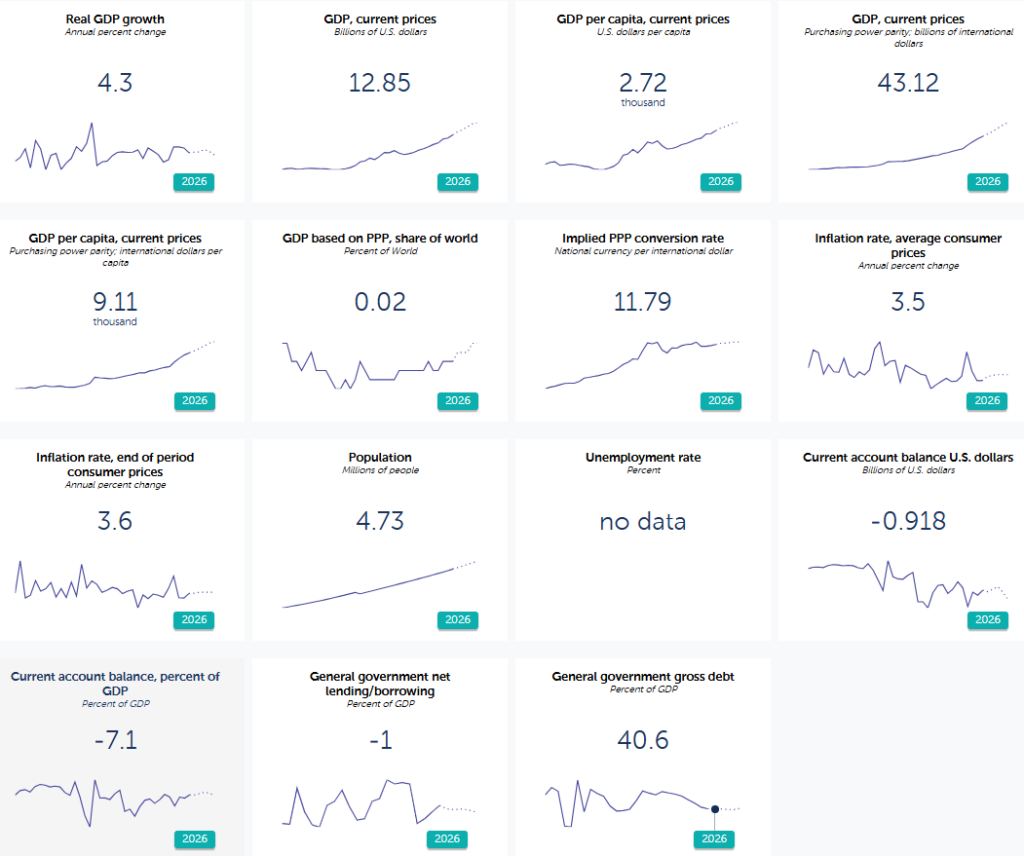
Source: IMF DataMapper
Mauritania’s economy continues to demonstrate resilience amid global economic challenges. According to the IMF’s World Economic Outlook (October 2025), real GDP growth is projected at 4.3% for 2026, representing a recovery from recent years. The country’s GDP is estimated at $12.85 billion in current prices for 2026, with GDP per capita reaching $2,720.
Inflation has moderated significantly to 3.5% for 2026, down from 5% in 2023 and 9.6% in 2022, reflecting improved monetary policy and stabilized food prices. The budget deficit has continued improving, declining from 2.3% of GDP in 2023 to a projected 1% in 2026. Tax revenue has strengthened, rising to approximately 14% of GDP.
Public debt has been reduced to 40.6% of GDP in 2026, following a debt restructuring agreement with Saudi Arabia that lowered the risk of debt distress from high to moderate. The current account deficit is projected at 7.1% of GDP in 2026, improving from 9.8% in 2023, driven by rising export values, particularly from iron ore and the new LNG exports.
The extreme poverty rate stood at 6.3% in 2022, with youth unemployment remaining elevated at around 24%. However, the economic outlook is strengthened by the Greater Tortue Ahmeyim (GTA) gas project, which achieved first gas in December 2024 and began LNG exports in April 2025. Annual gas revenues are projected to exceed $1.5 billion within the next five years, fundamentally transforming the country’s economic landscape.
In this context, cryptocurrency could play a significant role in Mauritania’s economic landscape, providing new financial opportunities and helping reduce some of the economic challenges the country faces.
Crypto Adoption in Mauritania
As of 2026, cryptocurrency is not considered legal tender in Mauritania, meaning it isn’t officially recognized as a valid form of currency like the national currency, the Mauritanian Ouguiya (MRU). The government and the Central Bank of Mauritania (CBM) have maintained a cautious approach towards cryptocurrencies, similar to many countries in the region, emphasizing the importance of stability in financial systems.
While the CBM has not explicitly banned the use or trade of cryptocurrencies, it has not introduced any specific regulations to govern their use either. Concerns often highlighted include the volatility of crypto markets, their potential for enabling illicit transactions, and the risks they pose to users unfamiliar with digital asset security. These concerns align with broader regional hesitations about integrating cryptocurrency into formal financial systems.
Notably, cryptocurrency mining has become legal in Mauritania as of 2025. According to industry reports, the sector has contributed approximately 2% to the national GDP, with the number of registered crypto mining companies growing by 40% since 2021. This represents a significant shift in the country’s approach to digital assets, though comprehensive regulatory frameworks remain absent.
Efforts like the partnership between the CBM and Giesecke+Devrient, announced in April 2024, to develop a Central Bank Digital Currency (CBDC) suggest that the government is exploring safer, more controlled ways of integrating digital finance into the economy.
The digital Ouguiya, as it’s known, is currently in the exploratory and testing phase, with G+D providing technical solutions for initial use case testing. However, this initiative does not extend to decentralized cryptocurrencies like Bitcoin or Ethereum. Instead, Mauritanians using or trading crypto do so informally, often relying on global platforms that are not directly regulated within the country.
Crypto Laws in Mauritania

Key developments in Mauritania’s crypto law are:
Current Legal Landscape
Cryptocurrency remains in a legal gray area in Mauritania. The government has not established clear regulations to either endorse or ban the use of digital currencies. While crypto transactions and investments are not explicitly illegal, they are also not officially recognized under Mauritanian law.
This lack of regulation leaves users without legal protection for disputes, scams, or losses associated with cryptocurrency dealings. As of 2025, there have been no significant changes to this regulatory stance, with Mauritania appearing on IMF surveys as a country with no available data on CBDC interest or cryptocurrency regulatory frameworks.
Government Stance
The Central Bank of Mauritania has expressed caution regarding the risks of cryptocurrencies, including concerns about fraud, market volatility, and illicit activities. However, rather than imposing a strict ban, Mauritania seems to be adopting a “wait-and-see” approach, closely monitoring global trends and the regulatory practices of neighboring countries.
A significant development occurred in August 2024 when the government approved a draft law creating a close-out netting regime for financial transactions. This framework, drawn up by Jones Day, will provide businesses with effective tools for hedging risks (market risk, interest rate risk, counterparty risk).
The regime applies to derivatives transactions, repurchase transactions, securities lending transactions, and FX spot transactions, and includes provisions for the protection of collateral. The draft law was expected to be submitted to Parliament in subsequent sessions.
Additionally, in November 2025, the Ministry of Digital Transformation and Administration Modernization advanced a national blockchain policy to modernize digital infrastructure. This initiative, developed in partnership with the United Nations Economic and Social Commission for Western Asia (ESCWA), aims to create more transparent and efficient public services through secure data systems.
The ministry stated that blockchain adoption >will contribute to the protection of rights, the fight against corruption, and the reduction of conflicts, while creating an attractive investment environment for domestic and international investors in digital finance and innovation.
Role of Financial Institutions
Mauritania’s financial institutions have yet to integrate cryptocurrencies into the formal banking system. The absence of partnerships between banks and crypto platforms limits access for potential users. This is partly due to the risk-averse nature of local banks and the unclear legal status of digital currencies.
However, the country’s digital transformation initiatives show promise. In April 2025, the government launched Khidmaty, a digital platform integrated with the national digital identity system Houwiyeti, enabling investors to establish businesses, register for tax and social security, and apply for investment accreditation.
This digital infrastructure could potentially support future crypto-related services.
Benefits of Cryptocurrency Integration in Mauritania
This section covers the potential benefits of integrating cryptocurrency into Mauritania’s economy.
1. Enhanced Financial Inclusion
Mauritania has a high percentage of unbanked citizens, with over 75% of its 4.73 million residents lacking access to formal banking services, particularly in rural areas where traditional banking infrastructure is limited. According to the Digital 2026 report, internet penetration stood at 37.4% at the end of 2025, with 2.00 million internet users and 1.87 million social media users.
Cryptocurrencies can provide an alternative financial infrastructure that does not rely on banks. Crypto platforms could facilitate peer-to-peer transactions, allowing small traders and farmers to conduct business without needing bank accounts. Mobile wallets, enabled by blockchain, could become a vital tool for these communities, enabling them to receive payments securely and efficiently.
By using simple mobile devices, even those without smartphones (smartphone penetration is estimated at around 20%) can potentially access cryptocurrency solutions through SMS-based systems, as seen in some East African countries.
2. Cost-Efficient Remittance Transfers
Mauritanians working abroad send significant remittances back home, which form a crucial part of household income for many families. According to the World Bank, global remittance flows to low- and middle-income countries grew by 4.6% in 2024, reaching approximately $905 billion, with projections of $690 billion specifically to LMICs by 2025.
Currently, traditional remittance services charge fees that can range from 6.4% to 7.9% for Sub-Saharan Africa, well above the Sustainable Development Goal target of 3%. Cryptocurrencies could significantly reduce these costs. For example, a $100 remittance via Bitcoin or stablecoins could cost under $1 in transaction fees, depending on network traffic.
Settlement times are often faster, completed in minutes compared to days for conventional banking channels. This would allow families to receive funds more quickly during emergencies or for daily expenses. The crypto remittance market is estimated at $25 billion annually in 2025, demonstrating growing adoption globally.
3. Economic Diversification
Mauritania’s economy is heavily dependent on mining (especially iron ore) and natural gas exports. The GTA LNG project, which began commercial operations in 2025, produces approximately 2.3 million tonnes per annum of LNG, with revenues expected to exceed $1.5 billion within five years.
Blockchain and cryptocurrency-related industries could introduce new opportunities, such as fintech startups, blockchain-based supply chain solutions, and smart contracts for exports.
For instance, blockchain could track iron ore and LNG shipments from extraction to export, ensuring transparency and reducing inefficiencies. This can boost investor confidence and attract international trade partners.
Cryptocurrencies can also create new avenues for local entrepreneurship, such as crypto exchanges or blockchain consultancies tailored to Mauritania’s unique needs.
4. Increased Transparency and Security
Corruption and mismanagement of public funds are long-standing issues in Mauritania, which currently ranks 165th globally on the UN E-Government Development Index (EGDI) with a score of 0.3491. Blockchain technology, with its immutable ledger system, can help mitigate these problems by ensuring transparent record-keeping.
The national blockchain policy advanced in November 2025 specifically targets improvements in land management, commerce, public procurement, and natural resource tracking. Government aid programs could use blockchain to ensure that funds reach intended beneficiaries directly, bypassing intermediaries.
Decentralized finance (DeFi) platforms could provide a secure method for citizens to access loans or savings, which are less prone to fraud due to the public nature of blockchain records.
5. Pioneering Digital Finance with a CBDC
Mauritania’s partnership with Giesecke+Devrient to develop a Central Bank Digital Currency (CBDC) reflects its efforts to modernize its financial infrastructure. The agreement, signed in April 2024 during the IMF and World Bank Spring Meetings, aims to explore how a digital Ouguiya could benefit society and the country’s economy.
According to Mohamed Lemine Ould Dhehby, Governor of the Central Bank of Mauritania:
The Banque Centrale de Mauritanie has strategically positioned itself for the potential launch of a digital currency. Through the exploratory work we have now agreed on, we are expanding our knowledge base, skills, and experience. G+D’s expertise in this innovative, rapidly developing field will help us to bring it to life for the benefit of the whole country.
A digital Ouguiya could complement traditional banking by offering a secure and regulated alternative to cryptocurrencies, making digital finance more mainstream. A CBDC could enable faster payments between citizens, businesses, and the government.
For instance, tax collections could become more efficient, as payments would be instant and trackable. By introducing a CBDC, Mauritania could integrate more easily with global digital finance networks, boosting trade and investment.
Challenges of Cryptocurrency Integration in Mauritania
This section covers the challenges of integrating cryptocurrency into Mauritania’s economy.
1. Lack of Regulatory Framework
Mauritania currently lacks specific regulations for cryptocurrencies. This creates legal uncertainty, discouraging businesses and individuals from adopting crypto. Without clear tax guidelines, users may fear potential penalties or legal issues related to undeclared crypto earnings.
Regulatory ambiguity also leaves room for scams or fraudulent schemes. According to the 2025 global crypto regulation trends, countries without clear frameworks face higher risks of illicit activities.
Governments in other African nations, such as Nigeria and Morocco, have faced similar issues. Morocco, for instance, only lifted its eight-year crypto ban in 2025, implementing comprehensive legislation that legalized crypto as a financial asset (though not for payments).
2. Limited Digital Literacy
Many Mauritanians are unfamiliar with digital tools and financial technologies. With internet penetration at only 37.4% and smartphone penetration estimated at around 20%, this lack of awareness and access could lead to misuse or vulnerability to scams, particularly in rural areas where education levels are lower.
Programs focused on teaching blockchain basics, such as those implemented in Rwanda and Kenya, could serve as examples for Mauritania. The national blockchain policy’s provision to update university curricula and launch pilot projects represents a step in this direction. Training workshops for small business owners and educational campaigns on social media could help bridge the knowledge gap.
3. Energy Constraints
Cryptocurrency mining, particularly for energy-intensive coins like Bitcoin, poses challenges for Mauritania’s energy infrastructure. While electricity consumption for cryptocurrency mining has increased by an estimated 25% since 2023, the country still struggles with reliable electricity access, especially in rural areas.
However, Mauritania’s vast desert landscapes make it ideal for solar farms, which could not only support crypto mining but also boost overall energy availability. The government has introduced a regulatory framework for green hydrogen, which further supports energy sector investment and could potentially power sustainable crypto mining operations.
4. Volatility and Financial Instability
Cryptocurrency values are highly volatile. A sudden drop in Bitcoin‘s price could lead to financial losses for users, particularly those new to the technology. For instance, if a farmer uses Bitcoin for savings and the value drops by 30% overnight, it could jeopardize their financial security.
To address this, stablecoins like USDC or DAI, which are pegged to fiat currencies, could be promoted. Global stablecoin supply recorded a 54% year-on-year growth in 2025, with 161 million stablecoin holders worldwide. However, these still require regulatory oversight to ensure consumer protection, particularly given Mauritania’s lack of clear crypto regulations.
5. Risk of Illicit Activities
Cryptocurrencies’ decentralized nature makes them attractive for illegal activities like money laundering or terrorism financing. Without robust Know Your Customer (KYC) and Anti-Money Laundering (AML) policies, Mauritania could face increased risks.
The Financial Action Task Force (FATF) issued updated guidance in 2025 on stablecoins and virtual assets, with analysis scheduled for the first quarter of 2026. Collaborating with international organizations like the FATF could help Mauritania implement best practices.
Additionally, monitoring crypto exchanges operating within the country would be crucial to mitigate misuse. The country’s low digital literacy and limited regulatory capacity make it particularly vulnerable to crypto-enabled fraud and scams.
Future Prospects and Trends for Cryptocurrency Adoption in Mauritania
The future of cryptocurrency in Mauritania presents promising opportunities. Here’s a detailed look at potential trends and prospects:
1. Rising Global Crypto Adoption as a Model
Globally, cryptocurrency adoption continues to rise, with approximately 861 million people (11.02% of the global population) using crypto in 2025, according to Statista. The global cryptocurrency market cap reached $3.6 trillion in 2025, with projections suggesting continued growth despite regulatory challenges.
Mauritania, sharing similar characteristics with other developing countries, could experience a similar trajectory as its population gains awareness of crypto as a tool for financial inclusion and investment.
According to the Chainalysis 2025 Global Crypto Adoption Index, Sub-Saharan Africa remains a region of significant grassroots adoption, receiving over $205 billion in on-chain value between July 2024 and June 2025, up roughly 52% from the previous year.
2. Potential Use of Cryptocurrency to Improve Financial Inclusion
Mauritania faces significant challenges with financial inclusion, with over 75% of its population remaining unbanked. Cryptocurrencies could serve as an alternative financial solution by offering decentralized and easily accessible financial services.
According to DataReportal’s Digital 2026 report, 6.37 million cellular mobile connections were active in Mauritania in late 2025 (119% of the population), with 89% connecting via broadband networks.
This mobile infrastructure provides a foundation for mobile-based crypto platforms. Initiatives in countries like Kenya and Nigeria, where mobile-based crypto platforms have bridged financial gaps, could inspire similar developments in Mauritania.
3. Integration of Cryptocurrency in Key Sectors
Mauritania’s reliance on natural resources, particularly the new LNG sector and traditional iron ore exports, could see blockchain and cryptocurrency technology being used for supply chain tracking and secure, low-cost cross-border transactions.
The Greater Tortue Ahmeyim project, which won the Gas Monetization Strategy of the Year Award at African Energy Week 2025, demonstrates the country’s capacity for large-scale international partnerships.
The National E-Commerce Strategy (2026-2030), approved in October 2025, aims to build an inclusive and competitive e-commerce sector targeting women, youth, and small traders. This digital integration creates potential pathways for cryptocurrency adoption in commerce and trading.
4. Regulatory Progress as a Catalyst
Although Mauritania currently lacks formal regulation for cryptocurrencies, there is growing awareness among policymakers about the need to engage with emerging technology. The national blockchain policy initiative in November 2025 and the close-out netting regime approved in August 2024 signal increasing governmental engagement with financial innovation.
Neighboring countries’ regulatory developments, such as Nigeria’s eNaira and Morocco’s 2025 crypto legislation (following an eight-year ban), may encourage Mauritania to establish clearer frameworks.
According to 2025 global crypto regulation trends, comprehensive regulatory clarity is becoming increasingly important as institutional participation reaches new heights.
5. Influence of Emerging Technologies
The potential introduction of the digital Ouguiya CBDC could significantly impact Mauritania’s crypto landscape. G+D’s CBDC platform (G+D Filia) is being tested for initial use cases, though the technology foundation and timeline for full implementation remain undefined.
CBDCs might coexist with decentralized cryptocurrencies, creating a hybrid ecosystem that accommodates both traditional and innovative financial instruments.
The Ministry of Digital Transformation’s broader agenda, which includes updating university curricula, launching pilot projects, and creating opportunities for youth engagement in digital ventures, positions Mauritania to potentially become a regional model for digital transformation.
6. Youth-Driven Innovation
With a median age of just 19 years and a population of 4.73 million projected for 2026, Mauritania is well-positioned to benefit from a tech-savvy generation. Social media penetration reached 34.9% in October 2025, indicating growing digital engagement among young people.
Crypto education initiatives and entrepreneurial ventures in fintech could harness this demographic dividend, driving adoption and innovation. The National E-Commerce Strategy specifically targets youth job creation through freelancing and digital platforms, which could naturally integrate cryptocurrency solutions.
According to global trends, cryptocurrency adoption among younger demographics continues to accelerate, with blockchain gaming and DeFi platforms showing particular growth.
Conclusion
Crypto adoption in Mauritania offers an opportunity to improve financial inclusion and boost industries like remittances and trade, but success depends on addressing critical gaps. Clear regulations are necessary to protect users from risks such as fraud and volatility, while public education can empower citizens to make informed decisions about digital assets.
The government’s recent initiatives demonstrate increasing openness to digital financial innovation. The successful launch of the GTA LNG project in 2025, generating projected annual revenues exceeding $1.5 billion, provides fiscal space that could support investments in digital infrastructure.
At the same time, investment in infrastructure, such as expanding internet access (currently at 37.4%) and digital tools, is important to support widespread adoption. With mobile connections reaching 119% of the population and 89% connecting via broadband networks, the foundation for mobile-first crypto solutions exists.
Mauritania can harness the potential of cryptocurrencies while minimizing associated challenges by taking coordinated steps across regulation, education, and infrastructure development.
As global crypto adoption reaches 11.02% (861 million users) in 2025 and Sub-Saharan Africa demonstrates 52% year-over-year growth in crypto activity, Mauritania has the opportunity to position itself strategically in the evolving digital finance landscape.


