


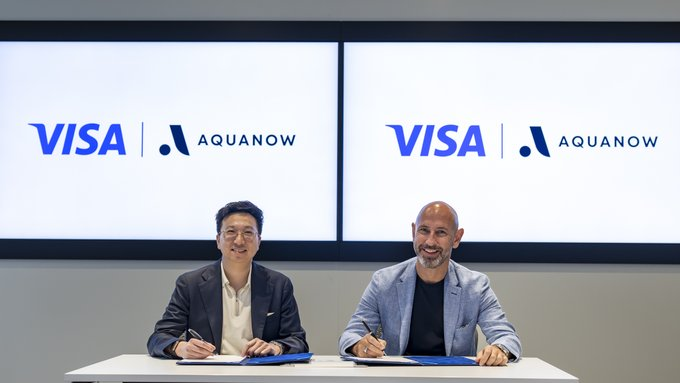
Visa has taken another major step into digital currency payments with the announcement of a new partnership with Aquanow, a global digital asset infrastructure provider.
This collaboration expands Visa’s stablecoin settlement capabilities across Central and Eastern Europe, the Middle East, and Africa (CEMEA), marking one of the company’s most significant advancements since it began experimenting with stablecoin systems in 2023.
Visa confirmed that its integration with Aquanow will allow issuers and acquirers across the region to settle transactions using approved stablecoins like USDC. According to the company, using blockchain-based settlement systems will help reduce operational costs, accelerate settlement times, and simplify the movement of money between financial institutions.
“By harnessing the power of stablecoins and pairing them with our trusted global technology, we are enabling financial institutions in CEMEA to experience faster and simpler settlements,” said Godfrey Sullivan, Head of Product and Solutions for CEMEA at Visa.
Key Takeaways
- Visa’s partnership with Aquanow enables financial institutions in CEMEA to settle payments using stablecoins like USDC with real-time transaction speed.
- The new settlement system works 24/7, eliminating delays caused by weekends and traditional banking hours.
- Visa’s stablecoin settlement program has already scaled to more than a $2.5 billion annualized run rate since its first pilot in 2023.
- Aquanow brings extensive crypto infrastructure expertise, serving over 300 clients and processing billions in digital transactions monthly.
- Regulatory clarity, including frameworks like MiCA in Europe and the GENIUS Act in the U.S., plays a crucial role in enabling broader adoption of stablecoin-based payments.
Driving Faster Global Payments
Cross-border payments have traditionally been one of the slowest segments of financial settlement due to legacy infrastructure and intermediary banks. Traditional wire transfers can take anywhere from three to seven business days—or longer—with added fees along the way.
Stablecoins solve several of those issues. Backed by real-world assets such as the U.S. dollar, they enable near-instant transfers across blockchain networks at a fraction of the cost.
The new Visa–Aquanow system operates seven days a week, including weekends and holidays, eliminating one of the biggest limitations of conventional banking rails. With USDC and other approved tokens, financial players in the region can now settle transactions in real time rather than waiting for traditional clearing cycles.
Aquanow CEO Phil Sham emphasized the efficiency benefits, stating that the partnership enables settlements with “the speed and transparency of the internet.”
Building on Visa’s Stablecoin Momentum
Visa first started testing stablecoin settlement with approved corporate partners in 2023. Since then, the program has grown rapidly, now surpassing a $2.5 billion annualized transaction run rate. The company has expanded support to multiple stablecoins and blockchain networks through its multicoin infrastructure strategy.
Earlier this year, Visa surpassed $200 million in cumulative stablecoin settlement volume, before expanding further into African markets and developing its seven-day settlement system.
“Our partnership with Aquanow is another key step in modernizing the back-end rails of payments, reducing reliance on traditional systems with multiple intermediaries, and preparing institutions for the future of money movement,” Sullivan noted.
At the same time, Visa CEO Ryan McInerney has stressed the need for clearer regulatory frameworks before stablecoins can be used at full scale across the global banking system. Countries are increasingly moving in that direction.
Europe’s MiCA regulation now provides stablecoin standards, and the U.S. created federal-level guidelines with the GENIUS Act, passed in July 2025.
Who Is Aquanow?

Founded in 2018, Aquanow has built one of the most advanced infrastructure layers for institutional crypto services. The company serves more than 300 clients in over 50 countries and processes billions of dollars in crypto transactions each month.
Its explosive growth—over 3,000% in four years—earned it recognition on Deloitte’s Technology Fast 500 list for consecutive years. Aquanow also holds regulatory licensing in Dubai via the Virtual Assets Regulatory Authority, enabling it to operate under a compliance-focused framework in one of the world’s fastest-growing fintech hubs.
“Visa’s reliable global network has long moved money securely and efficiently,” said Aquanow CEO Phil Sham. “Together, Visa and Aquanow are unlocking new ways for institutions to participate in the digital economy.”
Why This Partnership Matters
The CEMEA region handles enormous volumes of cross-border payments, remittances, and digital commerce. Many local businesses—especially in regions like Sub-Saharan Africa—suffer from delayed international settlements that restrict liquidity and reduce operational efficiency.
With this partnership:
- Banks can settle obligations nearly instantly
- Fees for cross-border transfers drop significantly
- Settlement no longer stops on weekends or holidays
Institutions can access blockchain-based financial tools without directly managing blockchain infrastructure
Visa acts as the bridge between traditional financial institutions and digital asset technology, while Aquanow provides the technical rails for stablecoin settlement.
A Turning Point for Digital Currencies
Once seen as experimental, stablecoins are now becoming foundational in global commerce. Overnight, we are moving from a world where blockchain-based settlements were niche, to one where they coexist directly with the world’s largest payment networks.
Visa already supports more than 25 global fiat currencies, and with stablecoins now part of its settlement mechanisms, digital and traditional finance systems are becoming deeply interconnected.
The partnership with Aquanow represents one of the clearest signals yet that digital asset settlement is no longer speculative—it’s operational and scaling.
With faster settlement, lower costs, and greater transparency, this move could redefine how businesses move money internationally—and accelerate the shift toward a digital-first financial system.