One of the common mistakes parents make is assuming cryptocurrency is only for adults. But kids are already engaging with digital assets through blockchain games, NFT rewards, and online platforms that promote token-based learning.
The earlier children understand how money works in a digital economy, the better prepared they’ll be for the future of finance.
Crypto education doesn’t have to start in college. It can begin right at home, with a simple tool: a crypto wallet. Setting up a wallet for your child isn’t just about access. It’s an opportunity to teach real-world financial skills through hands-on experience.
Let’s walk you through how to set up crypto wallets for your child—securely, responsibly, and with long-term value in mind.
Key Takeaways
- Setting up a child-friendly crypto wallet creates opportunities to teach digital finance skills through supervised, hands-on experience.
- Choosing between custodial and non-custodial wallets is essential for balancing parental control with a child’s learning freedom.
- Funding a wallet with small amounts of Ethereum allows kids to explore blockchain games, NFT collectibles, and educational dApps safely.
- Prioritizing wallet security, private key protection, and scam awareness reduces the risks associated with introducing minors to cryptocurrency.
- Legal ownership of crypto by children often requires parental involvement to meet exchange requirements and maintain responsible oversight.
What is a Crypto Wallet?
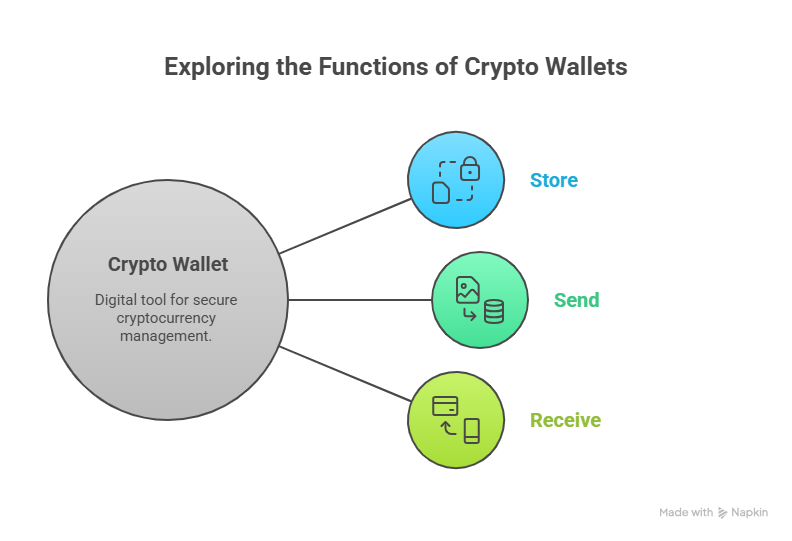
A crypto wallet is a digital tool that allows users to store, send, and receive cryptocurrencies securely. Unlike a physical wallet that holds cash, a crypto wallet doesn’t actually store coins inside it. Instead, it keeps the private keys—special codes that grant access to your digital assets on the blockchain.
There are two main types:
- Hot wallets (online, like MetaMask or Trust Wallet) for quick transactions.
- Cold wallets (offline, like Ledger or Trezor) for long-term storage and extra security.
For a child, a crypto wallet becomes the gateway to exploring blockchain games, NFT collectibles, and digital financial literacy.
Step-by-Step Guide on How To Set Up Crypto Wallets for Your Child
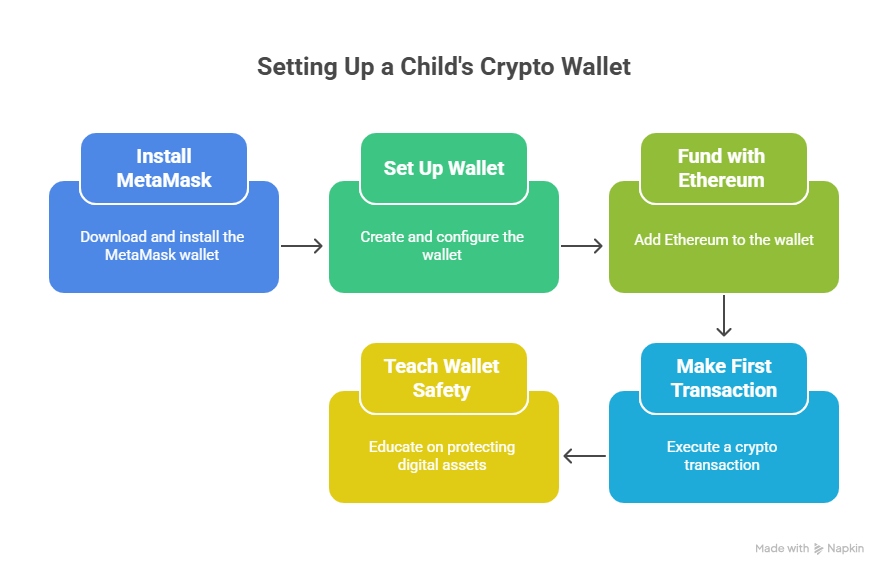
Helping your child get started with a crypto wallet is more than just a tech setup—it’s a chance to introduce them to digital finance in a safe, controlled way.
Here is a detailed guide covering the essential steps, from installing MetaMask to teaching online security.
Installing and Setting Up MetaMask for Your Child
MetaMask is one of the most user-friendly crypto wallets, making it perfect for beginners. It can be installed as a browser extension (Chrome, Firefox, Edge) or a mobile app (iOS, Android).
Here’s how to go about it:
- Download MetaMask from the official website or app store to avoid counterfeit versions.
- Create a new wallet by choosing the “Create a Wallet” option. Set a strong, memorable password—ideally something you and your child both know but that’s not easy to guess.
- Secure the recovery phrase (also called a seed phrase). Write it down on paper and store it in a safe place—never on a device connected to the internet. This is the key to recovering the wallet if something goes wrong.
Funding the Wallet with Ethereum
Since MetaMask runs on the Ethereum network, ETH (Ethereum) is the most common first asset to add.
- Purchase Ethereum from a trusted exchange like UEEx, Coinbase, Binance, or Kraken.
- Transfer ETH to your child’s wallet address (found by clicking “Account” in MetaMask).
- Keep the initial amount small, just enough for basic transactions or exploring blockchain games to minimize risk while learning.
This step is a good moment to explain transaction fees (“gas fees”) and how they work.
Making Their First Crypto Transaction
Practical experience is the best teacher, and a small, supervised transaction can build confidence.
- Have your child send a tiny amount of ETH to another wallet you control or to a friend’s wallet.
- Let them watch how the transaction appears in MetaMask and track its confirmation on Etherscan, a blockchain explorer.
- Encourage them to test receiving crypto too, so they understand both sides of a transaction.
You can also use Ethereum test networks (with free test ETH) for practice without risking real money.
Teaching Wallet Safety and Online Security
Once the wallet is active, it’s crucial to make sure your child understands the responsibility that comes with it.
- Private keys and seed phrases must remain private—even friends shouldn’t know them.
- Warn against phishing sites and fake apps. Teach them to always check website URLs and only use official sources.
- Encourage regular checks of the wallet balance and transaction history.
- Set a rule that all transactions are discussed before sending crypto to anyone.
By integrating these habits early, you’ll help your child treat their wallet like a real financial account, not just a game tool.
Exploring Blockchain Gaming and Learning Tools
Blockchain gaming has introduced a new way for children to interact with technology—by combining entertainment, ownership, and financial education.
At the heart of this experience is the crypto wallet, which acts as the key to accessing these games and their rewards.
How Crypto Wallets Unlock Blockchain-Based Games for Kids
Many blockchain games require players to connect a crypto wallet before they can participate. The wallet serves as a digital identity, storing game-related assets like NFTs (characters, skins, and weapons) and in-game currencies.
For kids, this means they can truly own their virtual items, trade them with others, or use them across multiple games that support the same blockchain network. Without a wallet, these experiences remain locked.
Examples of Educational NFT Games and Token-Earning Platforms
Some blockchain games go beyond fun; they teach problem-solving, digital asset management, and even basic economics.
Examples include:
- CryptoKitties: A collectible NFT game where players learn about scarcity and breeding mechanics.
- Axie Infinity (Scholarship Mode): Teaches resource management while allowing supervised earning of tokens.
- The Sandbox: A virtual world where players can create, own, and monetize their experiences, introducing them to digital entrepreneurship.
- Upland: A property trading game linked to real-world maps, helping kids understand market value and location-based economics.
These games blend entertainment with real-world skills, giving children early exposure to concepts like investment, supply and demand, and digital asset protection.
Encouraging Curiosity in Decentralized Apps (dApps)
Beyond gaming, crypto wallets connect children to decentralized applications (dApps)—platforms that operate without centralized control. This could mean exploring educational marketplaces, blockchain-based art platforms, or even charity projects where kids can donate tokens.
Encouraging exploration of these dApps, under guidance, fosters digital literacy, creativity, and a sense of responsibility in managing online resources.
Choosing the Right Type of Crypto Wallet
Before setting up a wallet for your child, it’s important to understand the available options and decide which one best suits their needs.
The choice between custodial and non-custodial wallets will shape how much control you and your child have over the funds.
Custodial vs. Non-Custodial Wallets
Custodial wallets are managed by a third party (such as an exchange). They store the private keys for you, making recovery easier if login details are lost. This option is often safer for minors because parents can maintain account control.
Non-custodial wallets give full control of the private keys to the user. This means greater independence but also greater responsibility—if the keys are lost, access to the funds is gone forever. For younger children, a custodial wallet or a parent-managed non-custodial wallet is generally more secure.
Different Wallet Types
Mobile Wallet
- Installed as apps on smartphones (e.g., MetaMask, Trust Wallet).
- Convenient for quick transactions and connecting to blockchain games.
- Require strong device security and parental supervision.
Hardware Wallets
- Physical devices (e.g., Ledger, Trezor) that store private keys offline.
- Best for long-term storage and maximum protection against hacks.
- Less suited for very young users who need frequent access.
Web-Based Wallets
- Accessible through browsers without installing additional software.
- Easy to set up but can be more vulnerable to phishing attacks.
- Should only be used with strong passwords and two-factor authentication.
Features to Look for in a Child-Friendly Wallet
- Parental control or multi-signature access so both you and your child must approve transactions.
- User-friendly interface with clear navigation and visual cues.
- Strong security features, including biometric login and two-factor authentication.
- Compatibility with educational dApps and blockchain games your child might use.
- Backup and recovery options that are simple to manage.
Common Mistakes to Avoid When Introducing Kids to Crypto
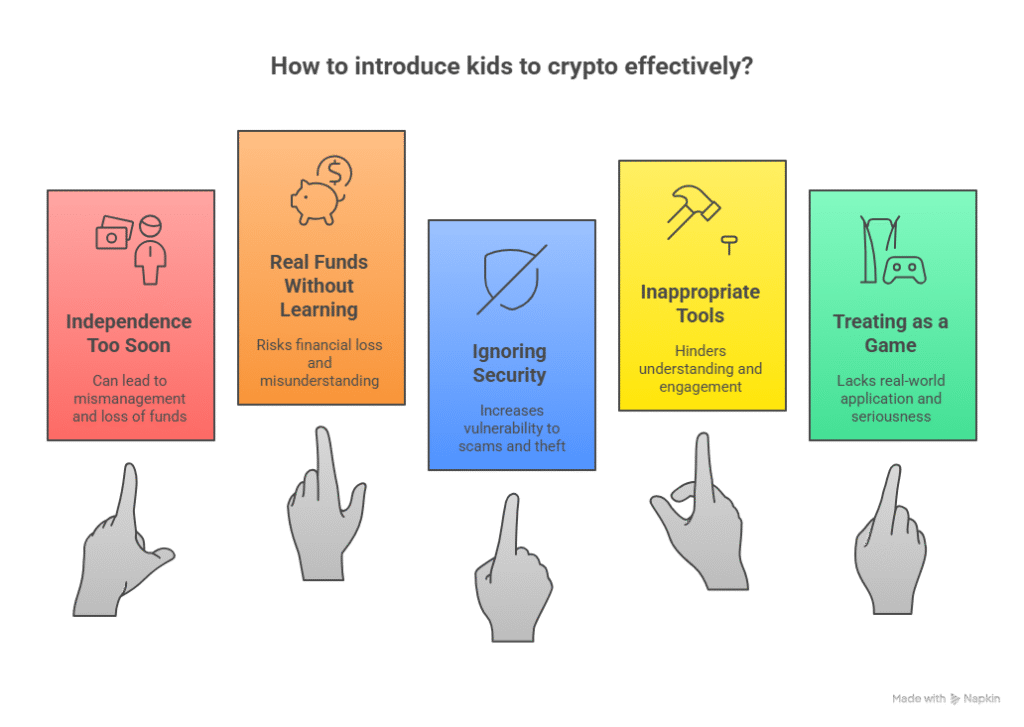
Alt text: Common mistakes to avoid when introducing kids to crypto
Introducing children to cryptocurrency can be an exciting and educational experience, but it also comes with potential pitfalls.
These mistakes are:
Skipping the Basics
Jumping straight into wallets and transactions without explaining what cryptocurrency is can leave children confused. Begin with simple concepts, such as digital money, blockchain, and transaction processes, before progressing to more technical steps.
Giving Too Much Independence Too Soon
Allowing unsupervised access to a wallet can lead to accidental loss of funds or exposure to scams. For minors, always maintain joint control or use parental oversight tools until they fully understand security practices.
Using Real Funds Without a Learning Phase
Handing over actual cryptocurrency before practicing with test networks (like Ethereum’s testnet) increases the risk of costly mistakes. Let kids experiment in a zero-risk environment first.
Ignoring Security Education
Failing to teach about phishing scams, fake apps, and private key safety leaves children vulnerable. Make security awareness part of every lesson.
Overlooking Age-Appropriate Tools
Some wallets, exchanges, or dApps have complex interfaces not suitable for young users. Choose child-friendly platforms that are simple, intuitive, and safe.
Treating It Like a Game Without Real-World Context
While blockchain games can be engaging, they should be paired with discussions about real-world finance. Otherwise, kids may not grasp the value or responsibility behind digital assets.
Is It Legal and Safe for a Child to Own Crypto?
Whether a child can legally own cryptocurrency depends largely on where you live. Most countries have no specific laws prohibiting minors from holding crypto, but many regulated exchanges require users to be 18 or older to open an account.
This means children often can’t buy crypto directly—they typically need a parent or guardian to set up and manage the wallet on their behalf.
From a safety perspective, crypto ownership for minors is less about age and more about supervision and security practices. With proper parental oversight, small amounts of cryptocurrency can be a valuable learning tool.
However, the risks are real—loss of private keys, exposure to scams, and the emotional impact of price volatility should all be considered before getting started.
The safest approach is to treat a child’s crypto wallet as a joint account—with parents handling purchases, approvals, and security measures while the child focuses on learning how the technology works. This ensures they gain practical experience without the full burden of financial risk.
Final Thoughts
Setting up a crypto wallet for your child is more than a technical task—it’s a step toward building digital financial literacy. With the right tools, supervision, and security habits, children can explore blockchain games, NFTs, and decentralized apps while learning how digital money works.
Start small, focus on education, and keep parental controls in place to ensure a safe experience. By guiding them through each step, you’re giving them the skills to use crypto responsibly and preparing them for opportunities in the growing digital economy.
Frequently Asked Questions
Can a 14 Year Old Have a Crypto Wallet?
Yes, a 14-year-old can have a crypto wallet, but it should be set up and managed under parental supervision to ensure safety and compliance with platform rules.
How To Do Crypto as a Kid?
Kids can learn crypto by using a parent-managed wallet, starting with small amounts, exploring blockchain games or educational dApps, and practicing safe security habits under adult supervision.
Can I Gift Crypto to My Kids?
Yes — you can gift crypto to your kids, but it’s best to store it in a parent-managed wallet to ensure security and compliance with age restrictions.
Can I Set Up a Crypto Wallet for My Child?
Yes, you can set up a crypto wallet for your child, but it should be managed under your supervision to ensure safety, legal compliance, and responsible use.
Can I Use Coinbase Under 18?
No, Coinbase requires users to be at least 18 years old, so minors can only access it through a parent or guardian’s account.