


Imagine placing a crypto trade, only to see someone else sneak ahead of you, buy first, and leave you with a worse price. That’s front running, and it happens more often than most traders realize.
Front running is when someone takes advantage of seeing your transaction before it’s confirmed. In traditional finance, this often involves insider information. In crypto, it’s powered by the open design of blockchains, where pending trades are visible in the mempool for anyone or any bot to exploit.
Front running is not new, it exists in traditional finance too but in crypto it works differently. Because blockchain transactions are public before they are confirmed, bots and advanced traders can scan the mempool (the waiting room for transactions) and reorder trades for their own gain.
Key Takeaway
- Front running in crypto happens when someone spots your pending trade before it’s confirmed on the blockchain and quickly jumps ahead of you to profit from it.
- Unlike traditional markets where order books are private, most blockchains have transparent mempools
- A sandwich attack is the most well-known type of front running in crypto. It happens when a bot places one transaction just before yours.
- In Ethereum and similar blockchains, bots compete through priority gas auctions (PGAs).
- Front running isn’t limited to tokens. During popular NFT mints, bots try to jump ahead of real users to grab rare NFTs before they sell out
What is front running in crypto?
Front running in crypto happens when someone spots your pending trade before it’s confirmed on the blockchain and quickly jumps ahead of you to profit from it.
In traditional finance, front running usually means a broker or insider uses non-public client information to trade first, which is illegal under most market abuse laws.
In crypto, the situation is different. Transactions sit in a public waiting area called the mempool before they are finalized. Anyone can see these pending transactions, including bots and validators. This transparency makes it possible to copy or reorder trades without needing “insider” access.
Where the term fits inside MEV (Maximal Extractable Value)
Front running is just one piece of the broader concept of MEV (Maximal Extractable Value), the extra profit that can be extracted by reordering or inserting transactions into a block.
- Front running: Someone jumps ahead of your order to benefit from the price movement you are about to cause.
- Backrunning: Instead of jumping in front, a trader follows your transaction to capture profit from predictable price changes that happen right after.
- Sandwiching: The attacker places one trade before and one after yours, trapping your order in between to skim profit from the price difference.
Why crypto is uniquely vulnerable
Unlike traditional markets where order books are private, most blockchains have transparent mempools. This means pending trades are visible to everyone before they are finalized. While transparency helps with decentralization, it also gives attackers a chance to plan and execute front running strategies in real time.
How Front Running Works On-Chain (Step-by-Step)
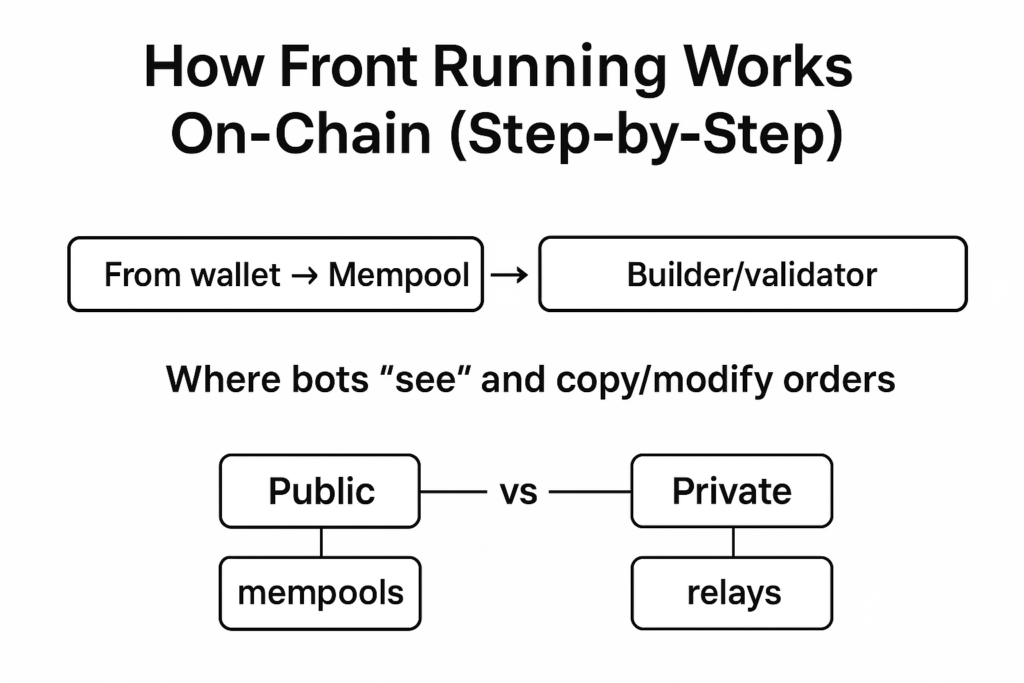
When you make a trade on a decentralized exchange (DEX), your wallet creates a transaction and broadcasts it to the blockchain network. Before it is finalized, the transaction sits in a mempool, a public waiting room.
From there, specialized actors called block builders or validators decide which transactions go into the next block. Finally, once included, the trade becomes permanent on the blockchain.
Because the mempool is public, anyone (including trading bots) can see your order before it’s finalized. Bots quickly analyze these pending transactions, spot profitable ones, and then copy, reorder, or insert their own trades just before yours.
This is how front running and sandwich attacks are executed in real time.
Proposer-Builder Separation (PBS), relays, and MEV-Boost
To reduce centralization risks, Ethereum introduced Proposer-Builder Separation (PBS). In this system, block proposers (validators) don’t decide transaction order directly. Instead, builders assemble blocks, and relays deliver these to validators.
MEV-Boost is software that lets validators outsource block building, increasing efficiency but also giving rise to specialized MEV markets where searchers compete for transaction ordering.
Public vs private transaction pathways
When transactions go through the public mempool, everyone can see them. This visibility is good for transparency but bad for protection, it gives bots a chance to act before you. That’s why most front running happens in public mempools.
To fight this, some wallets and protocols now offer private transaction routes. These use protected RPCs (Remote Procedure Calls) or relays that send your transaction directly to a block builder or validator without exposing it to the public mempool.
This keeps bots from seeing your trade in advance and helps avoid sandwiches or copycat attacks.
Common Types of Front Running (and Related MEV Tactics)
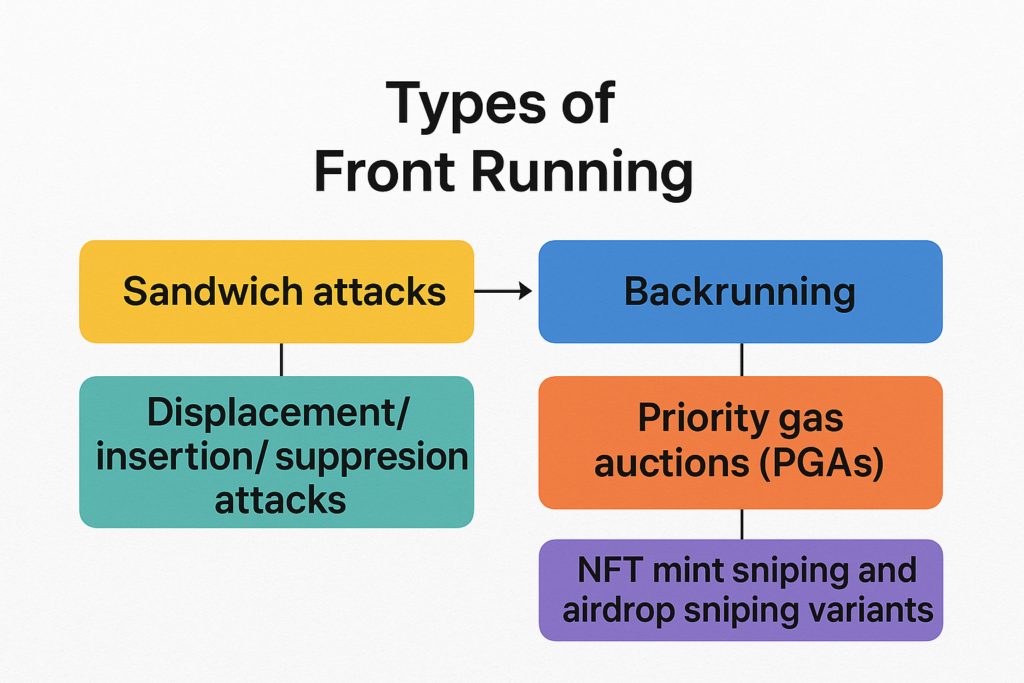
Front running in crypto doesn’t always look the same, it takes different forms depending on how bots and validators exploit transaction visibility. These tactics, often grouped under MEV (Maximal Extractable Value), range from classic sandwich attacks to more advanced strategies like backrunning, displacement, and even NFT sniping.
Sandwich attacks (classic “buy-then-sell around you”)
A sandwich attack is the most well-known type of front running in crypto. It happens when a bot places one transaction just before yours and another one right after, “sandwiching” your order in the middle. This lets the attacker profit from the price movement your trade creates.
Backrunning (capturing predictable post-trade price moves)
Instead of jumping in front of you, backrunning means entering right after your transaction to capture predictable effects. For example, if your large trade pushes a token’s price up, a bot can buy the token immediately after your order and then sell to arbitrage across another exchange.
Displacement/insertion/suppression attacks (transaction reordering)
These are variations of how attackers reorder the blockchain’s transaction list:
- Displacement: An attacker replaces your profitable transaction with their own.
- Insertion: They insert their transaction between a sequence of trades to extract value.
- Suppression: They deliberately delay or block your trade by spamming the network with higher-fee transactions.
Priority gas auctions (PGAs) and copy-trading bots
In Ethereum and similar blockchains, bots compete through priority gas auctions (PGAs). They raise gas fees higher and higher to make sure their transactions are included before yours.
This often happens with arbitrage or memecoin pumps. Similarly, copy-trading bots scan for wallet addresses with good trading records and try to instantly copy their moves, sometimes beating them to execution.
NFT mint sniping and airdrop sniping variants
Front running isn’t limited to tokens. During popular NFT mints, bots try to jump ahead of real users to grab rare NFTs before they sell out. Similarly, in airdrop sniping, bots monitor airdrop claim contracts and rush in to claim rewards before legitimate users, or they immediately sell tokens to profit from the hype.
“The best way to protect yourself is by using MEV-protected routes, setting tighter slippage, and trading in smaller, less obvious sizes.”
Is Front Running Illegal in Crypto?
One of the biggest questions traders have is whether front running in crypto is illegal. The answer isn’t simple, it depends on where you are, how the front running is done, and how regulators interpret the rules.
In traditional finance, front running is clearly illegal because it usually involves insider information (a broker trading ahead of clients). But in crypto, the situation is different. Transactions in the mempool are publicly visible, not private information. This raises the question: can trading on public data be considered market abuse?
Different countries have different answers. In some places, regulators argue that even though mempool data is public, using it unfairly still harms market integrity. In others, it’s seen as a technical problem, not a legal one.
United States
In the U.S., regulators like the Department of Justice (DOJ) and the Securities and Exchange Commission (SEC) are paying closer attention to MEV (Maximal Extractable Value). While there hasn’t been a blanket ban on front running in DeFi, prosecutors have started targeting cases where front running looks like fraud or manipulation, especially if it involves:
- Exploiting users in deceptive ways (e.g., sandwiching retail trades).
- Misusing privileged access to trading systems.
- Market manipulation schemes tied to MEV bots.
United Kingdom
The UK’s Financial Conduct Authority (FCA) has signaled that it wants to bring crypto trading under rules similar to traditional market abuse laws. Between 2024 and 2026, its roadmap includes:
- Applying insider trading and market manipulation standards to crypto.
- Studying how MEV and front running impact market fairness.
- Pushing for clearer guidelines on what is considered illegal behavior on both centralized and decentralized platforms.
European Union & MiCA (interaction with market-abuse regimes)
The EU’s Markets in Crypto-Assets (MiCA) regulation, which came into effect in 2024, includes measures against market abuse in crypto. On paper, this covers practices like front running and manipulation. However, enforcement is tricky:
- Blockchain transactions are global and borderless.
- It’s hard to prove intent when bots trade on public mempool data.
- Regulators need technical tools to detect and trace MEV attacks.
Japan
Japan’s Financial Services Agency (FSA) began a new review in 2025 to address crypto market integrity. Part of this involves studying how MEV affects user protection. The FSA is considering rules that could restrict harmful front running practices, especially on exchanges and DeFi protocols used by retail investors.
The Impact of Front Running
Front running doesn’t just affect individual traders, it has ripple effects across users, liquidity providers, protocols, and even entire blockchain networks.
On users (worse prices, failed tx, higher slippage)
For everyday traders, the impact is direct and painful:
- Worse prices: If a bot jumps ahead of your trade, you end up buying at a higher price or selling at a lower one.
- Failed transactions: Sometimes, bots push up gas fees so much that your transaction fails, but you still lose money on gas.
- Higher slippage: Front running creates sudden price swings. This means you may get far less (or more) than expected when your order is filled.
On networks (spam, congestion, fee dynamics)
At the network level, front running impacts performance and costs:
- Spam: Bots often flood the mempool with competing transactions, trying to outbid each other.
- Congestion: This extra traffic clogs the network, slowing down confirmations for everyone.
- Fee dynamics: Priority gas auctions (PGAs) drive fees higher, making the blockchain more expensive for regular users.
The result is a network that feels less efficient and more costly, which can hurt the overall ecosystem’s reputation.
On LPs and protocols (toxic flow, inventory risk)
Liquidity providers (LPs) and DeFi protocols also suffer:
- Toxic flow: LPs often end up trading against bots that have better information. This leads to losses because LPs are effectively “picked off” by faster traders.
- Inventory risk: Constant sandwiching or backrunning can drain value from liquidity pools, making it harder for LPs to stay profitable.
- Protocol credibility: If a DEX becomes known as a front-running hotspot, users may leave, hurting long-term adoption.
This creates a cycle where protocols struggle to retain liquidity and trust.
How to Detect and Measure Front Running
Front running can be hard to notice while it happens, but because blockchains are transparent, it’s possible to spot patterns and measure the damage after the fact.
On-chain signatures of sandwiches and reordering
One of the easiest ways to spot front running is by looking at what happens to prices before and after a transaction. In a sandwich attack, the price will suddenly move against the trader just before their order, then bounce back right after.
This creates unusual slippage, the user ends up paying more or getting less than they expected.
By analyzing transaction history, you’ll often see the attacker’s trades sitting just before and after the victim’s trade in the same block.
Open dashboards, research hubs, and analytics providers
Because front running is so common, researchers have built tools to track it:
- Flashbots: Provides dashboards and data showing how much value is extracted from users through MEV (including front running).
- Community dashboards: Independent developers often share trackers that highlight suspicious trade patterns on Ethereum, Solana, and other chains.
- Academic studies: Universities and blockchain researchers have studied Proposer-Builder Separation (PBS) and MEV, publishing insights on how transaction reordering affects fairness.
These tools don’t just help measure front running — they also give developers and policymakers data to design better protections for users.
How to Protect Yourself (User-Level)
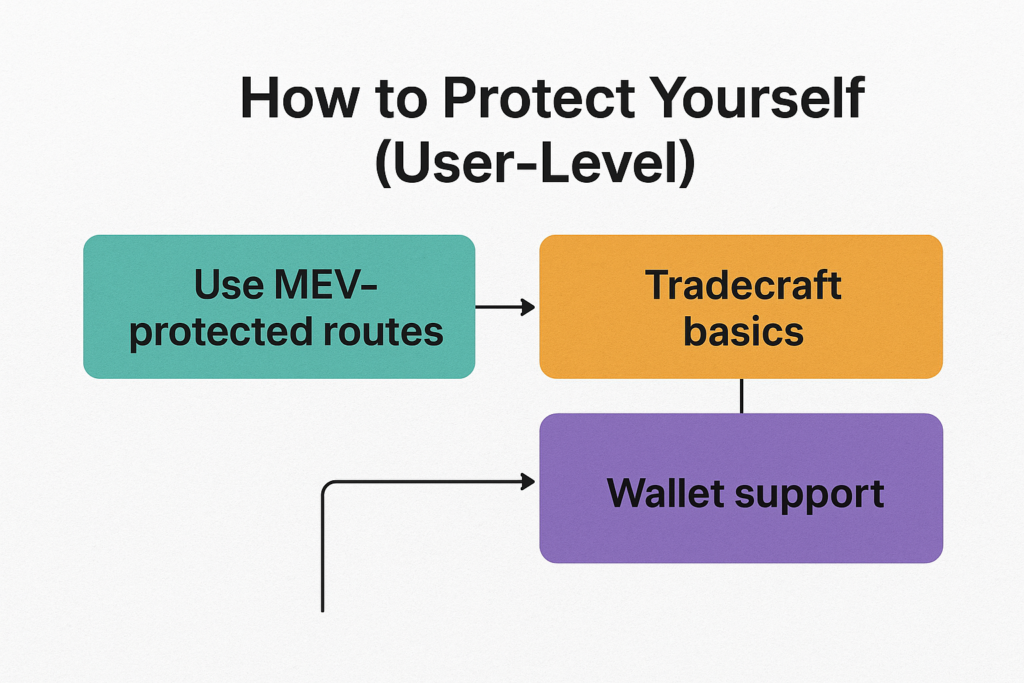
The good news is that you don’t have to be helpless against front running. While it can’t be eliminated completely, there are practical steps you can take to reduce your risk.
Use MEV-protected routes
Instead of sending your trades through the public mempool, you can route them through protected RPC services.
Examples include MEV Blocker and Flashbots Protect. These services send your transaction directly to block builders or validators without exposing it publicly.
This makes it much harder for bots to see your trade in advance, protecting you from sandwich attacks and other common forms of front running.
Wallet support
Some wallets are now building MEV protection directly into their apps. This means when you send a transaction, the wallet automatically routes it through a protected RPC.
- What it does: Stops your trade from being visible in the public mempool, reducing the chance of sandwiches.
- What it doesn’t do: It can’t stop all forms of MEV, especially if they happen inside block building or across chains.
Tradecraft basics
You can also adjust how you trade:
- Tighter slippage: Set lower slippage limits so your trade won’t execute if the price moves too far.
- Smaller clips: Avoid trading very large amounts in one go, since big orders attract more bots.
- Split orders: Break up large trades into smaller chunks to fly under the radar.
- Avoid obvious on-chain RFQs: Requests for quotes (RFQs) that sit in the mempool can be easy targets. Try to use trusted DEXs with protections built in.
Conclusion
Front running in crypto is the practice of having your transaction been seen before it’s confirmed and jumping ahead to profit from it. Unlike traditional finance, this happens not through secret insider tips but through the open nature of blockchains, where all pending transactions sit in public before being included in a block.
We’ve seen how front running works, the many tactics involved and the real impacts it has on users, protocols, and networks. While regulators are still figuring out how to treat it, the crypto community is already building defenses from MEV-protected routes like Flashbots Protect to new DEX models that make trading fairer.
FAQs
What is front running in crypto?
It’s when someone spots your pending trade on the blockchain and jumps ahead of you to profit, often leaving you with a worse deal.
How is it different from traditional finance?
In traditional finance, front running often relies on insider information. In crypto, it happens because pending transactions are public in the mempool.
Is front running illegal in crypto?
It depends. Rules vary by country, and regulators are still deciding how to handle it. Some cases may be treated like market abuse.
How can I protect myself from front running?
Use MEV-protected wallets or RPCs, set tighter slippage, trade in smaller amounts, and try DEXs that use batch auctions or intents.
Does front running affect only traders?
No. It also impacts liquidity providers, protocols, and networks, causing risks like higher costs, toxic flow, and chain congestion.
Will front running ever go away?
Probably not fully. But new tools, better wallets, and fairer DEX models are making it less harmful over time,