

Over the past few years, peer-to-peer (P2P) crypto trading has grown from a niche option into one of the most important pillars of the global digital asset economy. As governments tighten regulations on centralized exchanges (CEXs) and as millions of users in emerging markets seek direct access to crypto, P2P platforms have become the bridge connecting traditional money to the blockchain world.
Unlike centralized exchanges, where trades are matched automatically by an order book, P2P exchanges connect buyers and sellers directly allowing them to negotiate prices, choose payment methods, and transact securely using escrow protection. This human-to-human model makes it possible to buy or sell crypto with local payment rails like bank transfers, mobile money, cash, or even gift cards, in over 200 countries.
The appeal is simple: greater flexibility, privacy, and accessibility. P2P platforms empower users to set their own terms, find better rates than typical exchanges, and trade freely without relying on a middleman to custody their funds. For users in regions with limited banking access or crypto restrictions, P2P trading often serves as their only reliable on-ramp or off-ramp to the crypto industry.
Key Takeaway
- A P2P crypto exchange is a platform that connects buyers and sellers of cryptocurrency directly, allowing them to negotiate and settle trades
- One of the biggest selling points of P2P exchanges is the range of payment methods. Unlike centralized platforms that mostly support bank deposits
- In competitive fiat markets, buyers may find crypto below global average rates, saving money compared to using a centralized exchange.
- By contrast, P2P marketplaces do not take long-term custody of funds
- One of the biggest selling points of P2P exchanges is the range of payment methods.
“Trust is the real currency in P2P trading. The more transparent and verified your counterparties, the safer and smoother every transaction becomes.”
What is P2P Crypto Exchange?
A P2P crypto exchange is a platform that connects buyers and sellers of cryptocurrency directly, allowing them to negotiate and settle trades without the need for an intermediary to take custody of funds. Instead of placing trades against a centralized order book or automated pool, users transact directly with one another, usually with the help of an escrow mechanism to ensure fairness and safety.
P2P exchanges emerged as a solution to two common challenges: lack of banking access in certain regions and the need for flexible payment options. They empower users to buy and sell crypto in exchange for local fiat currencies, gift cards, mobile money, PayPal, or even cash methods not typically supported on centralized trading platforms.
Centralized Exchanges (CEX) vs P2P Marketplaces: Custody and Role of Escrow
On a centralized exchange (CEX) like Coinbase, Binance, or Kraken, trades are executed through a company-managed order book. The exchange holds custody of both fiat and crypto assets, meaning users must deposit funds before trading. While this model provides deep liquidity and fast execution, it also introduces custodial risk: if the platform is hacked, mismanages funds, or faces regulatory seizure, user assets may be at risk.
By contrast, P2P marketplaces do not take long-term custody of funds. Instead, they use an escrow system to temporarily lock the seller’s cryptocurrency until the buyer confirms payment. Once payment is verified, escrow releases the crypto to the buyer. This approach limits custodial risk while enabling more personalized payment methods between traders.
Decentralized Exchanges (Order Books / AMMs) vs P2P: On-chain vs Off-chain Flows
Decentralized exchanges (DEXs) like Uniswap or dYdX rely on smart contracts and blockchain technology to match buyers and sellers. Trades happen on-chain, typically through automated market makers (AMMs) or decentralized order books, and users keep control of their private keys throughout the process. While this guarantees non-custodial security, DEXs are usually limited to crypto-to-crypto trades and require users to already own crypto and pay blockchain fees.
In contrast, P2P platforms operate off-chain, with escrow holding crypto temporarily while buyers send fiat payments through traditional banking or alternative payment systems. This makes P2P exchanges particularly attractive for on-ramping (buying crypto with fiat) and off-ramping (cashing out crypto to fiat) in regions where centralized exchanges struggle to provide reliable services.
Typical Payment Flows & Escrow Models
Exchange-Held Escrow (Custodial Escrow): Most mainstream P2P exchanges, such as Binance P2P and Paxful, use a custodial escrow system. When a trade begins, the seller’s crypto is locked by the exchange. If the buyer makes payment and the seller fails to release, the buyer can open a dispute. The platform’s moderators verify evidence (such as transaction receipts) and release funds fairly.
This model balances user control with platform accountability, but it requires some level of trust in the exchange’s moderation process.
Non-Custodial / Multisig Escrow: Privacy-focused platforms like HodlHodl and Bisq use non-custodial escrow mechanisms. These rely on multi-signature (multisig) wallets where both the buyer and seller, along with the platform, hold keys. The crypto is not stored in a centralized hot wallet but locked on-chain, making it harder for the platform or a hacker to misappropriate funds.
While this model is more secure and censorship-resistant, it can be less user-friendly, often requiring a higher technical understanding of wallets and multisig operations.
Face-to-Face (Cash) P2P Considerations: Some P2P exchanges and communities also facilitate face-to-face trades where buyers and sellers meet in person to exchange crypto for cash. While this method can provide total privacy and avoid reliance on banks, it carries significant personal safety risks and requires strict precautionary measures such as meeting in public spaces, bringing a trusted companion, and confirming crypto transfer before parting ways.
“As crypto regulation grows, P2P exchanges will remain the bridge connecting local economies to the global digital marketplace”
Why Choose P2P? Benefits & Tradeoffs
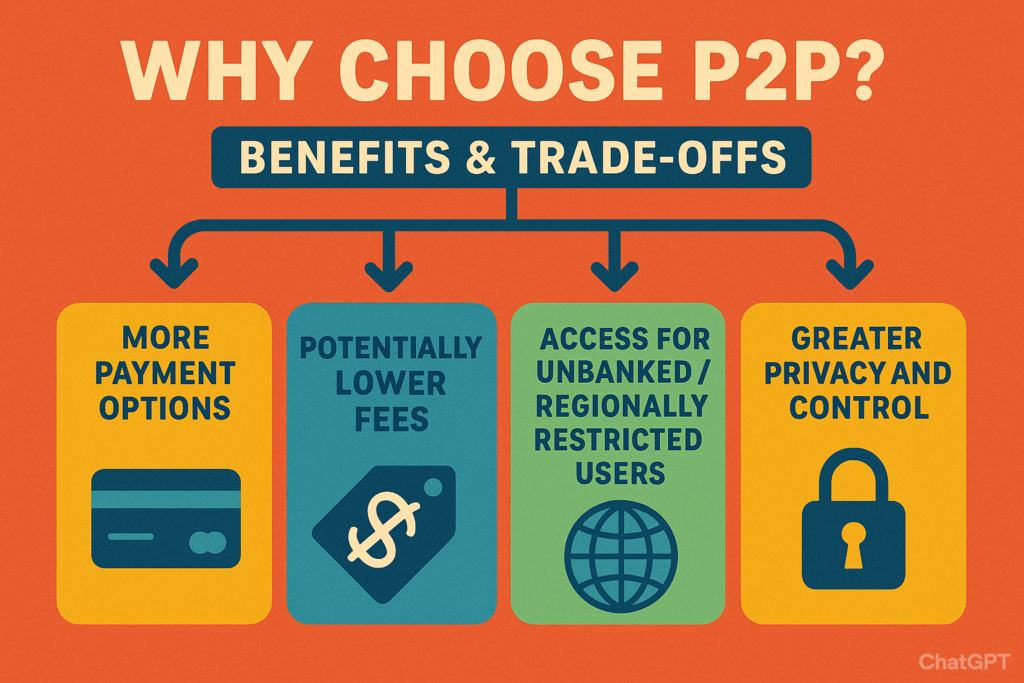
Peer-to-peer (P2P) crypto exchanges have carved out an important niche in the digital asset economy. While centralized exchanges (CEXs) dominate with liquidity and professional tools, P2P marketplaces provide flexibility, accessibility, and alternative payment rails that are unmatched elsewhere.
For many users, especially in regions with banking restrictions or currency volatility, P2P is the only reliable way to buy, sell, and move crypto. That said, P2P also comes with risks from scams to liquidity challenges that traders should weigh carefully. Let’s review both sides.
More Payment Options (Bank Transfer, Mobile Money, Gift Cards, Cash, PayPal, etc.)
One of the biggest selling points of P2P exchanges is the range of payment methods. Unlike centralized platforms that mostly support bank deposits or credit cards, P2P marketplaces let buyers and sellers decide how to settle transactions. Depending on the region, you’ll find offers supporting:
- Bank transfers (local or international wires, ACH, SEPA, UPI, etc.)
- Mobile money services (M-Pesa in Kenya, GCash in the Philippines, MTN Mobile Money in West Africa, etc.)
- E-wallets and online payment systems (PayPal, Revolut, CashApp)
- Gift cards and vouchers (Amazon, iTunes, Steam, etc.)
- Cash in person for face-to-face exchanges
This flexibility makes P2P exchanges particularly useful for remittances, informal economies, and crypto access in cash-heavy societies.
Potentially Lower Fees and Better Local Rates
CEXs typically charge maker/taker fees on every trade, along with deposit and withdrawal fees. P2P platforms, on the other hand, often charge zero trading fees to buyers (sellers usually pay a small margin fee). In addition, local market dynamics can sometimes create better rates than global exchanges.
For example:
In countries with foreign exchange restrictions, crypto may trade at a premium compared to global markets. Sellers benefit from higher margins, while buyers may still consider it cheaper than black-market currency rates.
In competitive fiat markets, buyers may find crypto below global average rates, saving money compared to using a centralized exchange. This “local premium/discount” dynamic is why many arbitrage traders actively use P2P platforms.
Access for Unbanked / Regionally Restricted Users
P2P exchanges offer a gateway to the digital economy by accepting cash, mobile money, or other informal payment methods.
P2P also thrives in restricted regions where centralized exchanges are unavailable or banned. For example, in countries facing capital controls or sanctions, people often turn to P2P marketplaces as a lifeline to buy stablecoins, protect savings, or receive remittances.
Greater Privacy and Control
Unlike most CEXs, many P2P exchanges offer optional or limited KYC thresholds. While large transactions usually require identity verification, smaller trades can sometimes be done with minimal personal information.
Additionally, P2P trading gives users more direct control over how and when they transact. No need to deposit funds into a centralized exchange wallet. The escrow system ensures temporary protection without long-term custody risks.
Buyers and sellers can decide who they want to trade with, adding a personal element of trust-building. For users concerned with surveillance, data leaks, or overregulation, P2P often feels more private and autonomous.
Main Risks and Downsides of P2P Exchange
Counterparty Risk, Scams (Chargebacks, Coin-Locking)
The biggest drawback of P2P trading is counterparty risk. Unlike trading on a CEX where a system automatically matches orders, P2P relies on human participants who may act dishonestly.
Some common scams include:
- Chargebacks: A buyer pays via PayPal or credit card, receives crypto, then reverses the payment.
- Coin-locking: A buyer initiates a trade but never pays, locking the seller’s coins in escrow until the order times out.
- Fake receipts: Fraudsters upload falsified proof of payment, hoping to trick sellers into releasing funds.
While escrow and dispute systems reduce these risks, resolving disputes can take time and cause stress.
Liquidity & Price Slippage vs Major CEX Orderbook
Centralized exchanges typically handle millions (or billions) in daily trading volume, ensuring deep liquidity and minimal price differences. P2P markets, however, depend on the number of active buyers and sellers.
Potential issues include:
- Low liquidity in smaller fiat currencies, making it hard to buy/sell larger amounts.
- Wider spreads between offers, which may eat into profits.
- Slower execution times compared to instant CEX order matching.
For small retail trades, this may not matter. But for professional traders or institutions, liquidity limitations can be a dealbreaker.
KYC / Legal/Regulatory Uncertainty by Jurisdiction
Finally, legal uncertainty is a major concern. Some governments actively monitor or restrict P2P exchanges, while others embrace them as financial innovation. The rules vary widely:
In some countries, small trades on P2P platforms can still be done without full KYC. In others, regulators have forced exchanges to introduce mandatory identity checks, reducing privacy.
Certain jurisdictions consider crypto-to-cash P2P trades as money laundering risks, exposing users to penalties if they’re not compliant. This patchwork of laws means P2P users must research local regulations carefully before trading.
Top P2P Crypto Exchanges to Consider
Choosing the right peer-to-peer (P2P) crypto exchange can make all the difference from getting better local rates to ensuring safe, escrow-protected transactions. Below is an updated shortlist of the most reliable and widely used P2P platforms in 2025, covering their core strengths, supported regions, and best use cases.
| Exchange | Escrow Model | KYC Required | Fees (avg %) | Top Fiat Rails | Best Use Case |
| Binance P2P | Custodial escrow via Binance wallet | Yes (Tiered) | 0.00% buyer / 0.20% seller | Bank transfer, Mobile money, PayPal | Best for high-volume traders & global reach |
| LocalBitcoins | Custodial escrow (Bitcoin only) | Yes (Basic ID) | 1.00% seller | Bank transfer, Cash, PayPal | Best for BTC-only peer trades |
| HodlHodl | Non-custodial 2-of-3 multisig escrow | No | 0.60% shared | Bank transfer, Cash | Best for privacy-focused users |
| Bisq | Fully decentralized multisig escrow | No | 0.50–0.70% shared | Bank transfer (SEPA, Zelle, etc.) | Best for no-KYC, open-source trading |
| OKX P2P | Custodial escrow (CEX integrated) | Yes | 0.00–0.10% seller | Bank transfer, UPI, Wallets | Best for seamless bridge to CEX/Spot |
| Bybit P2P | Custodial escrow (CEX integrated) | Yes | 0.00–0.20% | Bank transfer, Wallet apps | Best for arbitrage and low-fee transfers |
| Huobi P2P | Custodial escrow | Yes | 0.00–0.20% | Bank transfer, Alipay, PayNow | Best for Asian fiat rails |
| MEXC P2P | Custodial escrow (regional focus) | Yes | 0.00–0.10% | Bank transfer, Local wallets | Best for local fiat rails & smaller regions |
| LocalCryptos | Non-custodial smart-contract escrow | Optional | 0.25–0.75% seller | Bank transfer, PayPal, ETH tokens | Best for ETH & stablecoin P2P |
| LocalCoinSwap | Non-custodial, multi-asset escrow | Optional | 0.50% | Bank transfer, Stablecoins | Best for multi-coin peer trading |
Binance P2P
Best for: Users wanting high liquidity, trusted escrow, and direct integration with Binance’s centralized exchange
Binance P2P is one of the largest and most active P2P marketplaces in the world. As part of the Binance ecosystem, it connects millions of verified buyers and sellers across over 100 countries. Users can buy and sell major cryptocurrencies such as BTC, USDT, ETH, BNB, and USDC using a wide variety of local payment methods — including bank transfers, mobile money, and cash payments.
The platform uses a secure escrow system to protect both parties. When a trade starts, the seller’s crypto is held by Binance until the buyer confirms payment. Binance’s moderators handle disputes quickly, and transactions are usually completed within minutes.
Key Highlights:
- Zero fees for buyers (sellers pay a small margin fee).
- Integrated directly into the main Binance app and website.
- 700+ payment methods supported globally.
- Fast trade resolution and 24/7 customer support.
- Supports fiat-to-crypto and crypto-to-fiat conversions across multiple region.
Pros:
- High global liquidity with fast trade matching
- Zero trading fees for buyers and sellers
- Wide range of payment methods (bank transfer, cash, mobile money, etc.)
- Strong escrow protection and dispute resolution
Cons:
- Requires full KYC verification
- Some reports of slow dispute handling in high-volume trades
- Limited privacy due to centralized control
LocalBitcoins
Best for: Users who value a legacy, trusted marketplace with broad global reach.
Launched in 2012, LocalBitcoins was one of the first major P2P platforms to make crypto accessible globally. Although competition has increased, its simple interface and large Bitcoin user base still make it a go-to choice for BTC-focused traders.
LocalBitcoins supports bank transfers, cash, PayPal, and other regional methods. All trades are protected via escrow, and users can check each counterparty’s trading history and feedback.
Key Highlights:
- Bitcoin-only trading (BTC).
- Veteran reputation and established user trust.
- Global network of local traders.
- Escrow system ensures fund safety during transactions.
Pros:
- One of the earliest and most trusted Bitcoin-only P2P platforms
- Simple user interface, good for beginners
- Solid reputation system and long user history
- Global presence with many fiat options
Cons:
- Supports only Bitcoin (no altcoins or stablecoins)
- Declining liquidity due to regulatory pressure
- KYC requirements have become stricter over time
HodlHodl
Best for: Privacy-minded traders who prefer non-custodial control and minimal KYC exposure.
Hodl is a non-custodial P2P exchange that uses multisignature (multisig) smart contracts for escrow instead of centralized custody. This means funds are never stored by the exchange — only by the buyer and seller with a third key held by the platform to mediate disputes.
Because trades happen off-exchange wallets, HodlHodl does not require KYC, making it highly appealing to privacy-conscious users. It supports both Bitcoin and the Lightning Network for faster transactions.
Key Highlights:
- Non-custodial escrow via 2-of-3 multisig smart contracts.
- No mandatory KYC for most transactions.
- BTC and Lightning Network support.
- Competitive fees and strong focus on user privacy.
Pros:
- Non-custodial, multisig escrow ensures you keep control of your crypto
- No KYC required for trading
- Transparent and privacy-friendly design
Cons:
- Lower liquidity than centralized platforms
- Interface may feel technical for beginners
- Limited fiat onramps and payment integrations
OKX P2P
Best for: Users seeking a trusted, globally recognized P2P marketplace with instant access to OKX’s full trading ecosystem.
OKX P2P has become one of the fastest-growing P2P platforms globally, offering a wide range of fiat currencies and crypto assets including USDT, BTC, ETH, and SOL. It is integrated into the OKX centralized exchange, allowing users to instantly transfer funds between their P2P wallet and trading account.
The platform supports multiple payment methods across Asia, Africa, and Europe — from traditional bank transfers to regional payment gateways and mobile wallets. OKX also implements escrow protection for all trades, ensuring funds remain safe until the transaction is completed.
Key Highlights:
- 0% trading fees on most P2P transactions.
- More than 40 supported local currencies.
- Escrow protection with verified merchant badges.
- Instant transfer between P2P and spot accounts.
- Active user base across Asia, the Middle East, and Africa.
Pros:
- Deep liquidity and integration with OKX exchange
- Supports multiple fiat currencies and payment methods
- No trading fees for users
- Escrow protection ensures secure transactions
Cons:
- Requires KYC for trading and withdrawals
- Limited regional payment options in some countries
- Dispute resolution can take time during busy periods
Bybit P2P
Best for: Users wanting fast, reliable P2P transactions with tight pricing and direct CEX access through Bybit.
Bybit P2P is designed for speed, simplicity, and low-cost trading. It has gained traction among traders looking for tight spreads and quick settlement times, especially in regions like Southeast Asia, Eastern Europe, and Africa.
Users can buy and sell popular cryptocurrencies such as USDT, BTC, and ETH using dozens of local payment methods. Bybit’s user interface is streamlined, allowing beginners to execute trades with minimal effort. An integrated escrow mechanism ensures safe transactions, while a merchant program helps maintain liquidity and user confidence.
Key Highlights:
- Competitive exchange rates and small spreads.
- Instant notifications and fast dispute resolution.
- Escrow protection for all trades.
- Trusted merchant program and ID verification system.
- Direct access to Bybit’s trading products (spot, futures, earn).
Pros:
- Simple, beginner-friendly interface
- No trading fees and fast settlements
- Integrated with Bybit’s trading ecosystem
Cons:
- KYC mandatory for all traders
- Fewer payment methods than Binance or Paxful
- Lower trade volume in smaller regions
Huobi P2P
Best for: Traders in Asia and Latin America looking for a well established, high-liquidity P2P marketplace backed by a major exchange.
Huobi P2P (now part of HTX Global) is a long-standing P2P trading platform that serves millions of users, particularly in Asia, Latin America, and Africa. It provides access to major cryptocurrencies like BTC, ETH, USDT, and TRX, paired with a range of regional fiat currencies.
Huobi P2P’s strength lies in its large merchant base, which keeps spreads low and trade fulfillment quick. The platform also includes zero-fee trading, 24/7 multilingual support, and strong identity verification for added security.
Key Highlights:
- Deep liquidity in Asian markets (notably Southeast Asia).
- Zero fees for both buyers and sellers.
- Hundreds of verified merchants to ensure reliability.
- Escrow and dispute resolution support built into the app.
- Integrated with the Huobi (HTX) main exchange.
Pros:
- Large user base in Asia and emerging markets
- Secure escrow and low or zero trading fees
- Integrated with Huobi’s spot exchange
Cons:
- Requires KYC verification
- Some liquidity concentration in Asian markets
- Interface less intuitive compared to competitors
WazirX P2P (India)
Best for: Indian crypto users who want a secure, fast, and compliant way to convert INR to USDT and access global markets via Binance.
WazirX P2P is India’s most widely used peer-to-peer crypto marketplace, built to simplify INR-to-crypto conversions. Since traditional banking restrictions make direct fiat deposits challenging in India, WazirX P2P bridges the gap by allowing users to buy and sell USDT with Indian Rupees using bank transfers.
The platform automatically matches buyers and sellers, eliminating manual order searching. Once payment is verified, USDT is released instantly to the buyer’s wallet. As part of the Binance ecosystem, users can easily transfer assets between WazirX and Binance accounts.
Key Highlights:
- INR-focused marketplace with auto-matching engine.
- Escrow protection for secure transactions.
- Direct bridge to Binance for asset transfers.
- 0% fees on P2P trades.
- Mobile-friendly and compliant with Indian KYC norms.
Pros:
- Tailored for Indian users with INR support
- Direct bank transfer payment options
- Integrated with WazirX and Binance ecosystems
- No trading fees
Cons:
- Limited to Indian market (INR only)
- KYC required for all users
- Slower settlements during banking downtimes
Bisq P2P
Best for: Users seeking maximum decentralization, anonymity, and no KYC requirements.
Bisq is a fully decentralized, open-source desktop application that enables users to buy and sell Bitcoin (and some altcoins) using fiat money — without relying on a centralized intermediary. Everything on Bisq runs via Tor-based communication for enhanced anonymity.
Unlike other P2P platforms, Bisq doesn’t even hold escrow funds itself. It uses a multi-signature deposit system and a network of community arbitrators for dispute resolution. While this setup offers maximum decentralization, it also requires more technical setup and slower trade speeds.
Key Highlights:
- 100% decentralized; no account sign-up or central server.
- Private by default (uses Tor and local wallets).
- Multisig-based escrow and decentralized arbitration.
- Ideal for advanced users prioritizing security and censorship resistance.
Pros:
- Fully decentralized, open-source, and non-custodial
- Ideal for privacy-focused users
- Works globally with fiat and crypto pairs
Cons:
- Slower trades and higher learning curve
- Requires software installation (desktop app)
- Lower liquidity compared to CEX-linked platforms
MEXC P2P
Best for: Regional fiat support and integration with the MEXC exchange.
MEXC P2P is part of the larger MEXC Exchange ecosystem, offering users a simple way to buy and sell crypto directly with local currencies. It’s ideal for those who want to combine P2P flexibility with access to spot and futures markets.
Pros:
- Seamless connection to MEXC trading tools
- Zero fees for P2P trades
- Multiple payment options and fiat currencies
- Escrow protection for safe transactions
Cons:
- Smaller P2P market than Binance or OKX
- KYC verification required
- Regional liquidity can be inconsistent
LocalCryptos
Best for: Privacy-first users who prefer decentralized, direct trades.
LocalCryptos is a privacy-focused, non-custodial marketplace where users can trade Bitcoin, Ethereum, and more directly through smart contracts — without intermediaries or mandatory KYC.
Pros:
- Smart contract-based non-custodial escrow
- No KYC requirements
- Easy-to-use interface
- Strong privacy and user control
Cons:
- Lower liquidity than major exchanges
- Slower settlements during off-peak hours
- Limited customer support
LocalCoinSwap
Best for: Multi-asset traders and users who value community-driven platforms.
LocalCoinSwap is a community-driven P2P exchange supporting multiple cryptocurrencies and fiat options. It emphasizes decentralization, user governance, and inclusive global access.
Pros:
- Wide range of crypto and fiat support
- Community ownership and profit sharing
- Optional KYC for small trades
- Supportive user community
Cons:
- Smaller user base limits liquidity
- Interface less refined than mainstream competitors
- Dispute resolutions can be slow
Step-by-Step Guide: How to Make Your First P2P Trade (Beginner Friendly)
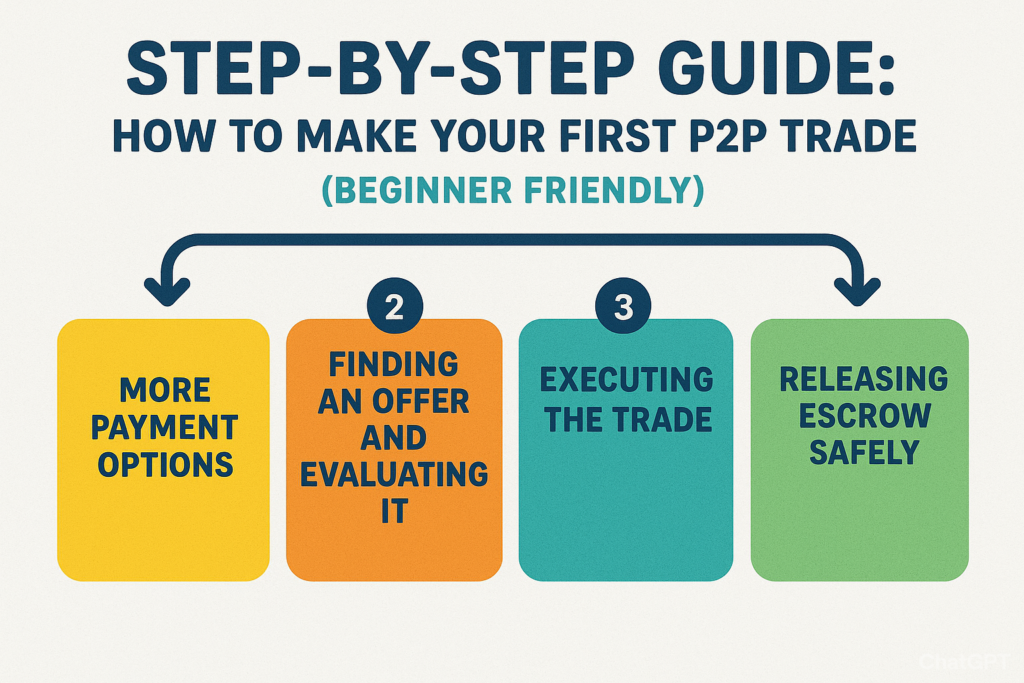
Getting started with peer-to-peer (P2P) crypto trading can feel intimidating at first, but once you understand how the process works, it’s straightforward and empowering. This section walks you through every step, from preparing your account to safely completing your first trade.
Preparation: Identity & Safety Checklist
Before you start trading on any P2P platform, take time to secure your account and understand the safety basics. Confirm exchange reputation, read trader reviews, set 2FA
- Choose a trusted platform: Stick to recognized exchanges like Binance P2P, OKX P2P, or Paxful. Check community reviews and confirm that the platform uses escrow protection.
- Verify your profile (if required): Most exchanges will require basic KYC (Know Your Customer) before you can trade. Completing this step helps you access higher trade limits and dispute protection.
- Enable two-factor authentication (2FA): Always secure your wallet and exchange account with Google Authenticator or SMS 2FA. This adds a second layer of defense against unauthorized access.
- Check trader ratings: Before trading, review the other party’s feedback score, completed trades, and response rate. High-rated traders (98%+) are generally safer to transact with.
Finding an Offer and Evaluating It
Once your account is secure, the next step is to find the right trade offer for your currency and region. Price vs market price, payment window, seller’s trade limit, feedback score
- Compare prices carefully: Every P2P offer lists a crypto price. Check if it’s close to the market rate on platforms like CoinMarketCap or Binance. Extremely high or low prices can be red flags.
- Check payment methods: Choose a payment option you already use (bank transfer, mobile money, PayPal, or cash). Avoid unfamiliar payment rails for your first few trades.
- Review the payment window: This is how long you have to complete the payment. Typical windows range from 10 to 45 minutes. Pick offers with enough time for you to make a transfer.
- Note the seller’s trade limits: Every offer has a minimum and maximum trade amount. Make sure your transaction fits within those limits.
- Feedback score & trade history: Prioritize traders with high completion rates (95%+) and many successful trades. New or low-rated accounts carry higher risk.
Executing the Trade
Once you’ve chosen an offer that fits your needs, you’re ready to execute the trade. Starting trade chat, following terms, uploading proof (receipts)
- Initiate the trade: Click “Buy” or “Sell” to start. Your crypto (or the seller’s) will be locked in escrow by the platform.
- Read the offer terms carefully: Each seller may have specific requirements e.g., naming format for bank transfers or proof of identity during the trade.
- Make payment as instructed: Send the agreed amount within the payment window and ensure the transfer details match exactly.
- Upload proof: Take a screenshot or receipt of your payment and upload it via the chat window. Avoid sending screenshots over external channels like WhatsApp or Telegram.
Releasing escrow safely
Once the seller confirms receipt of payment, the platform will release the crypto from escrow to your wallet.
- Never click “Payment Completed” unless you’ve actually made the transfer.
- Do not release crypto until you’ve received funds if you’re the seller.
- Once the trade is complete, leave feedback for your counterparty to help other traders.
What to Do if Something Goes Wrong: Dispute Flow
Even on the best exchanges, issues can occur payments delayed, traders unresponsive, or misunderstandings. That’s where the dispute process comes in. When to raise a dispute, proof to gather, timelines
- When to raise a dispute: If your counterparty fails to confirm payment or tries to back out after you’ve paid, use the “Dispute” button on the trade page.
- Provide solid evidence: Gather screenshots, receipts, bank statements, chat logs, and timestamps to prove your case.
- Escrow freeze: During a dispute, the crypto remains locked in escrow until the exchange’s moderation team resolves the issue.
- Timelines: Dispute resolution can take from a few hours to several days, depending on evidence and platform workload. Always cooperate promptly with support staff.
Advanced P2P Strategies & Best Practices
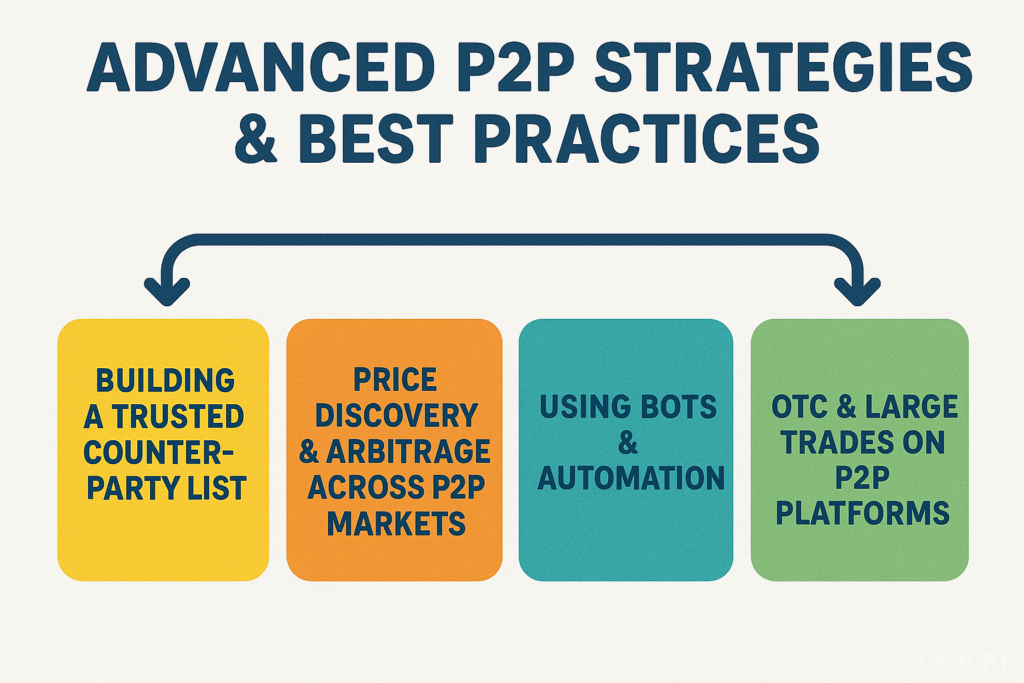
Once you’ve mastered the basics of peer-to-peer crypto trading, you can start optimizing your approach, improving reliability, minimizing risk, and even spotting profit opportunities. These advanced strategies help serious traders build consistency and scale safely.
Building a Trusted Counterparty List
Trust is the foundation of sustainable P2P trading. Over time, building a reliable network of repeat partners can dramatically improve your trading efficiency and reduce dispute risks. Repeat trading, setting private trade terms, trade history tracking
Focus on building relationships with reliable traders by saving their usernames or adding them to your trusted list for future private deals. With consistent partners, you can negotiate better rates, flexible payment windows, or bulk discounts, and some platforms even allow private listings for verified users.
Keep a personal trade log to track performance, settlement times, and dispute frequency to identify dependable counterparties. Joining reputable P2P trading communities on platforms like Telegram or Discord can also help expand your network, though it’s important to stay alert for potential scams.
Price Discovery & Arbitrage Across P2P Markets
P2P crypto prices constantly shift based on local demand, payment methods, and regional liquidity, creating profitable arbitrage opportunities for observant traders. By tracking local premiums, FX spreads, and market timing, traders can buy crypto cheaply in one region and sell it higher in another, always using secure escrow.
It’s also important to compare rates across multiple platforms like Binance P2P, Paxful, and OKX to spot pricing gaps. For example, purchasing USDT at a slight discount on OKX and reselling it to gift-card buyers on Paxful can yield small but consistent profits, typically around one to three percent after fees.
Using Bots & Automation (Where Allowed)
Automation can be a powerful tool for professional P2P traders looking to scale their operations, but it must be applied with caution to avoid compliance issues or costly mistakes. Some major exchanges like Binance and OKX provide limited API access for vetted users, allowing them to automate pricing or monitor offers, though full trade execution is typically restricted to prevent abuse.
Many experienced traders use rate adjustment scripts to keep their listings competitive and maintain profit margins, but improper configuration can lead to serious risks such as auto-releasing escrowed crypto or confirming payments prematurely. To stay compliant, you must ensure your automation practices align with exchange policies and anti-money-laundering rules, as excessive automation without proper oversight can result in account suspension. It’s always best to test any scripts or bots in controlled or low-value environments before scaling to larger, live trades.
OTC & Large Trades on P2P Platforms
For traders dealing with high-value transactions typically above $10,000 per trade, standard P2P listings may not provide the efficiency or security required. To accommodate this, many exchanges and brokers now offer Over-the-Counter (OTC) trading desks or tailored escrow arrangements designed for bulk trades.
These setups often include enhanced verification, faster settlement, and dedicated support teams that ensure both parties meet their obligations. Major platforms like Binance, OKX, and Huobi operate professional OTC services with KYC verification and settlement guarantees, catering to institutions and large-volume traders seeking reliability and reduced counterparty risk.
Read Also: A Simple Guide on How to Use a Crypto Exchange
Conclusion
Peer-to-peer crypto exchanges have revolutionized how people access and trade digital assets. What began as a niche alternative to centralized platforms has evolved into a vital part of the global crypto ecosystem, allowing millions to buy, sell, and transfer crypto through familiar local payment methods.
The ideal P2P platform depends on your goals and trading style some users prefer high-liquidity exchanges like Binance P2P, OKX, and Bybit for reliability and escrow protection, while others gravitate toward privacy-focused options like Bisq and HodlHodl for their non-custodial, no-KYC approach. For those in emerging or restricted markets, Paxful and WazirX P2P stand out for their flexibility and accessibility.
Regardless of the platform you choose, success in P2P trading hinges on security, reputation, and careful verification of counterparties. Always use escrow, confirm payments before releasing funds, and avoid transactions outside secure channels. With time and consistency, you can build trusted trading relationships, improve your pricing strategy, and make P2P trading a sustainable, cost-effective part of your crypto routine.
FAQ
What is a P2P crypto exchange?
A P2P (peer-to-peer) crypto exchange allows users to buy and sell digital assets directly with each other instead of trading through a centralized intermediary. Trades are often protected by escrow systems that hold crypto until payment is confirmed.
Are P2P crypto exchanges safe to use?
Yes, when used properly. Safety depends on the platform’s escrow system, dispute resolution process, and trader reputation. Always verify counterparties, confirm payment before releasing escrow, and avoid trading outside the platform.
Do I need KYC to trade on P2P exchanges?
It depends on the platform. Some, like Binance P2P or OKX P2P, require KYC verification, while others like Bisq and HodlHodl allow anonymous trading without identity checks.
Which P2P exchange has the lowest fees?
Platforms like Binance P2P and OKX P2P typically charge no trading fees for buyers or sellers, though payment processors might impose transfer costs. Always review fee terms before initiating trades.
Can I trade with cash or mobile money on P2P exchanges?
Yes. Most major P2P exchanges support local payment options such as cash deposits, bank transfers, PayPal, and mobile money. Availability depends on your country and counterparties’ preferences.
What’s the best P2P crypto exchange for beginners?
Binance P2P and Paxful are great starting points due to their user-friendly interfaces, strong escrow systems, and wide payment method support. Beginners should start small and build trust gradually.