


Compared to traditional payment systems with high fees and slow settlement times, crypto payment solutions offer small businesses faster, cheaper, and more flexible options to accept money globally.
Customers today expect convenient ways to pay, and digital currencies are gradually becoming part of everyday transactions. For small businesses, this means reduced costs, broader reach, and the ability to keep up with modern consumer behavior.
At the same time, not every crypto payment processor works the same. Some focus on simple integrations for e-commerce, while others prioritize Bitcoin Lightning payments or seamless fiat conversion. Choosing the right fit can directly impact how efficiently a business operates.
In this article, we’ll explore the 8 best crypto payment solutions for small businesses, breaking down what each platform is best for, how they work, and why they can help future-proof your business.
What Are the Crypto Payment Solutions?
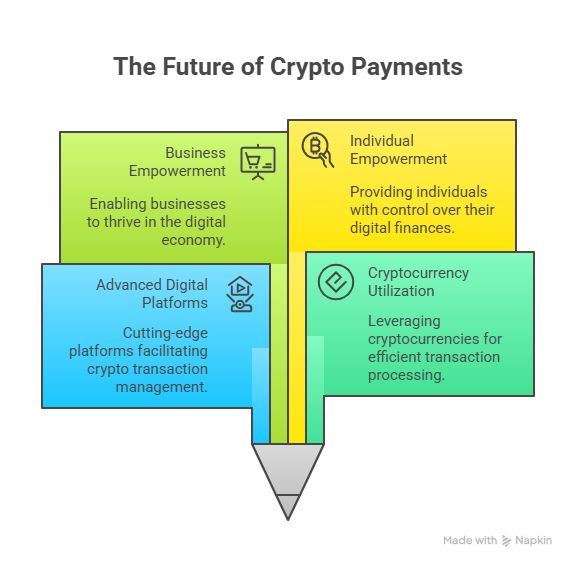
Crypto payment solutions are digital platforms and gateways that allow businesses and individuals to accept, process, and settle transactions using cryptocurrencies.
These solutions act as bridges between traditional finance and blockchain-based payments, making it easier for merchants to get paid in Bitcoin, Ethereum, stablecoins, and many other digital assets.
Instead of relying solely on banks or credit card processors, crypto payment providers handle everything from invoice generation and checkout integration to automatic currency conversion into fiat if needed. They also help manage transaction security, reduce payment delays, and cut down on high fees associated with international transfers.
For small businesses, freelancers, and e-commerce brands, crypto payment solutions mean faster transactions, global customer access, and greater financial flexibility.
Key Takeaways
- Crypto payment solutions help small businesses reduce costs, speed up settlements, and attract global customers more efficiently.
- Choosing the right processor depends on factors like supported cryptocurrencies, integration options, fees, and compliance standards.
- Platforms such as UPAY, NOWPayments, and BitPay offer user-friendly tools tailored for e-commerce, Bitcoin transactions, and secure global payments.
- Combining crypto and fiat options while educating staff and customers ensures smoother adoption and long-term trust in digital transactions.
- Regularly reviewing transaction data and platform performance helps businesses refine their crypto payment strategy for maximum growth and security.
Top 8 Crypto Payment Solutions for Small Businesses
| Platform | Supported Crypto / Assets | Integration & Settlement Options | Fee / Monetization Highlights | Security & Compliance | Best Use Case / Fit | Trade-offs / Limitations |
| UPay | Supports major cryptos (BTC, ETH, USDT etc.), tied to card & wallet use | Card + wallet + API integration; Apple Pay / Google Pay support | 1% transaction fee, 0% cross-border, activation / withdrawal fees | 2FA, custodial / non-custodial hybrid, card KYC controls | Businesses wanting unified card + crypto wallet solution | Card activation cost, country restrictions, ATM withdrawal fees |
| NOWPayments | 300+ cryptocurrencies | API, plugins, invoices, widgets, mass payouts | 0.5% for mono payments, 1% for conversion payments | AML system, optional KYC, withdrawal whitelisting | SMEs wanting non-custodial, full crypto support | Conversion fees when using mixed coins, KYC triggers |
| Coinbase Commerce | Hundreds of tokens on Ethereum, Polygon, Base, etc. | API, plugins (WooCommerce & others), hosted pages | 1% transaction fee, auto conversion to USDC | Under Coinbase’s compliance, onchain conversion | Startups / merchants needing easy onboarding | Gas / network fees still apply, limited custody flexibility |
| BitPay | 300+ supported coins | APIs, POS integrations, plugins, invoices; fiat settlement | 1% base fee, adjustable for risk / volume | KYC/AML, multi-sign, encryption, self-custody | Established merchants wanting reliability & scale | Higher fees for high-risk sectors, less nimble for micro businesses |
| Transak | 136 cryptocurrencies, 45 blockchains | SDKs, widget, white label APIs, fiat on/off ramps | Fees vary by payment method and region | FCA (UK), MSB (US), shared KYC, fraud engine | Businesses needing robust fiat <> crypto flow | Variable fees, technical setup required, geographic limits |
| CoinGate | 70+ cryptocurrencies (BTC, ETH, USDC, etc.) | Plugins, API, invoice, POS, auto fiat settlement | <1% typical transaction fee | AML/KYC compliance tools, refund capabilities | E-commerce sites focusing on plugin integration | Some region restrictions, limited altcoin support |
| PayPal | Selected major cryptos + PYUSD stablecoin | Integration via PayPal Wallet / Checkout | Crypto purchase fees 1.5–2.2%; merchant fees 2.29–3.49%+ | Encryption, anti-fraud monitoring, 2FA | Businesses needing seamless fiat + crypto capability | Centralized control, limited crypto support vs pure crypto platforms |
| OpenNode | Bitcoin (onchain + Lightning) | API, plugins, hosted pages, payouts | Free Bitcoin ↔ fiat conversion | 2FA, IP whitelisting, regulated MSB / compliance | Firms focused on fast Bitcoin/Lightning payments | Only supports Bitcoin (not altcoins), network dependence, regional access may vary |
UPAY – Best Overall Crypto Payment Solution
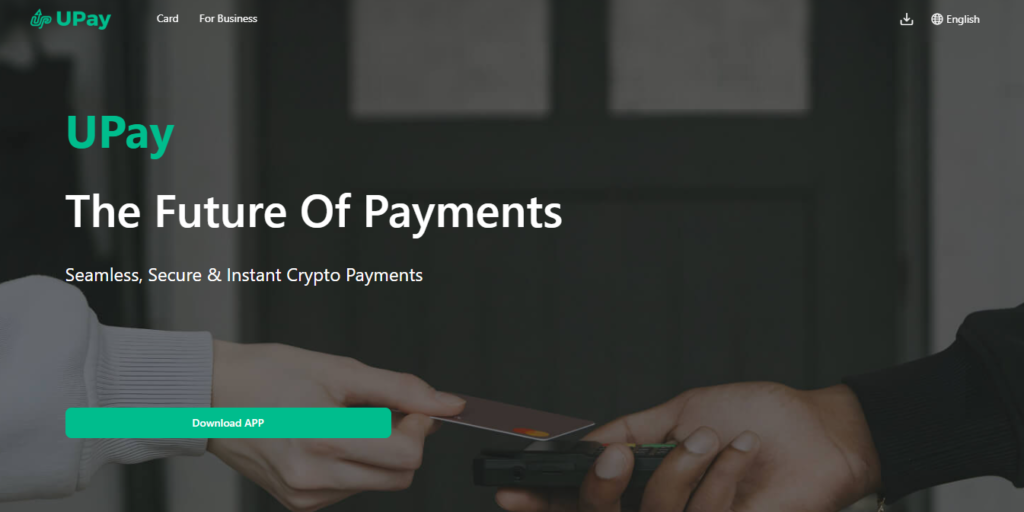
UPay is positioned as the best overall crypto payment solution for small businesses, delivering a seamless bridge between digital assets and real-world spending. With over 20K+ cards issued, 30M+ total spending, and 55M+ supported merchants, UPay combines scale with reliability.
Integration is simple through the UPay wallet and card, which work with Apple Pay and Google Pay, making it easy for small businesses to adopt. Fees are transparent—1% transaction fee, 0% cross-border charges, and a 2% ATM withdrawal fee. Security is reinforced by top-tier safeguards and Google Authenticator 2FA.
Pros
- Supports major cryptocurrencies like BTC, ETH, and USDT for flexible payments.
- Provides instant crypto-to-fiat conversion at competitive rates.
- Offers seamless integration with Apple Pay and Google Pay.
- Ensures high transaction limits suitable for businesses.
- Features transparent and low transaction fees for global spending.
- Grants worldwide acceptance at over 55M merchants and ATMs.
- Enhances security with Google Authenticator 2FA and advanced safeguards.
Cons
- Requires a 10 USDT activation fee for the card.
- Limits access in multiple restricted countries and regions.
- Relies on KYC approval, which may be declined for high-risk flags.
NOWPayments – Best Non-Custodial Payment Solution for SMEs
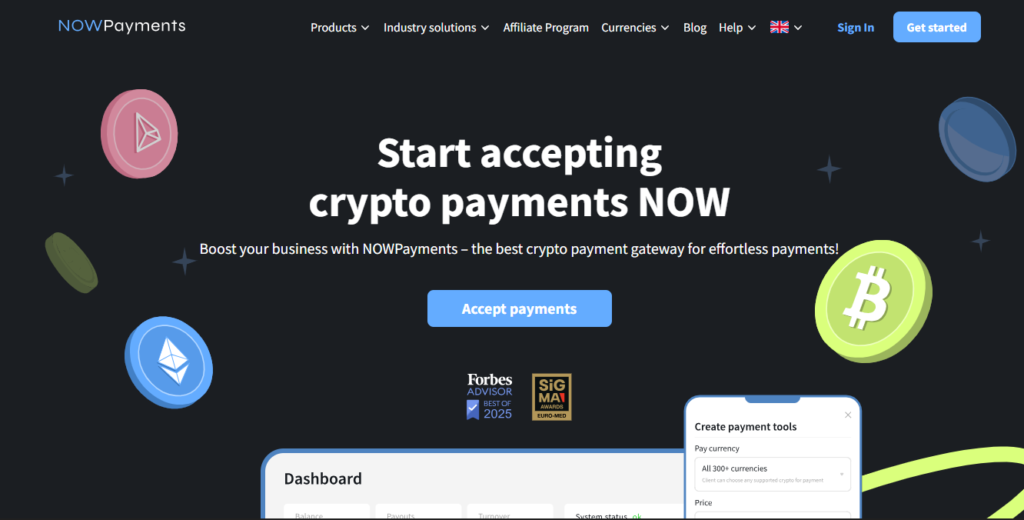
For small and medium-sized enterprises, NOWPayments delivers the most flexible non-custodial crypto payment solution.
Supporting over 300 cryptocurrencies and more than 75 fiat options, it enables businesses to accept Bitcoin, Ethereum, stablecoins, and altcoins with ease. With over 30 million monthly transactions and $10 billion processed since 2019, NOWPayments has proven reliability at scale.
Integration is simple through APIs, e-commerce plugins, invoices, POS systems, donation tools, and payment widgets, allowing SMEs to adopt crypto payments quickly. Fees remain highly competitive with a 0.5% commission for monocurrency payments and 1% for payments with conversion, excluding network costs.
Security is strengthened with AML measures, two-step verification, whitelisting, and multi-account role management, ensuring safe and transparent operations. As a non-custodial gateway, merchants maintain control over their funds while benefiting from auto-conversion, mass payouts, and 24/7 support.
NOWPayments is ideal for SMEs across e-commerce, SaaS, marketplaces, and global services seeking low-cost, borderless payment solutions.
Pros
- Supports over 300 cryptocurrencies and 75 fiat currencies for maximum flexibility.
- Provides simple integration through APIs, plugins, POS, invoices, and widgets.
- Charges competitive fees of just 0.5%–1% per transaction.
- Processes more than 30 million transactions monthly with proven reliability.
- Offers auto-conversion of crypto to fiat at favorable rates.
- Strengthens security with AML measures, 2FA, and wallet whitelisting.
- Enables merchants to stay in full control of funds with its non-custodial model.
- Includes mass payouts, donation tools, and subscription features for SMEs.
Cons
- Relies on third-party fiat providers with varying KYC requirements.
- Offers limited fiat off-ramp options compared to some competitors.
Coinbase Commerce – Best for Startups and Merchants Who Want Simple Onboarding
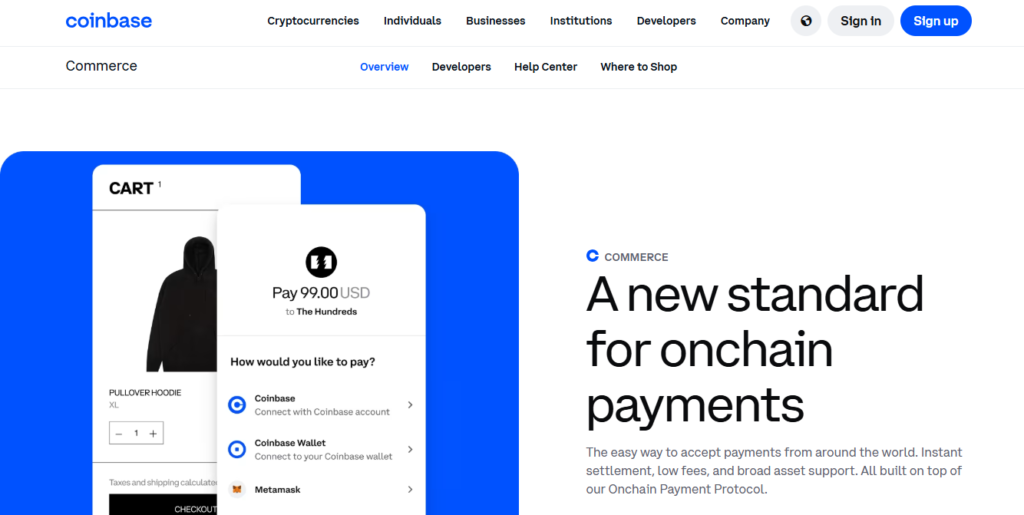
Coinbase Commerce is designed for startups and small merchants who need a fast, simple way to start accepting crypto payments.
With support for hundreds of cryptocurrencies across Base, Ethereum, and Polygon, customers can pay directly from their preferred wallet with no manual input required. The platform makes onboarding effortless, offering ready-made integrations with WooCommerce, Jumpseller, Primer, and APIs for custom builds.
To protect businesses from market volatility, payments are automatically converted into USDC for stable settlement, while maintaining instant and error-free transaction confirmations. Fees remain low at 1% per transaction, and there are no chargebacks, helping merchants reduce operational risks.
Security is backed by Coinbase’s reputation as a publicly listed U.S. company, holding customer assets 1:1, with state-of-the-art encryption, multi-approval withdrawals, and built-in 2FA.
With 24/7 support and real-time payment validation, Coinbase Commerce is the go-to choice for entrepreneurs who want quick setup, stability, and trusted infrastructure for crypto payments.
Pros
- Supports hundreds of cryptocurrencies across Base, Ethereum, and Polygon networks.
- Provides automatic conversion of payments into USDC to avoid volatility.
- Enables instant settlement with real-time payment confirmation.
- Offers easy onboarding with out-of-the-box integrations like WooCommerce and Jumpseller.
- Charges a flat and transparent 1% transaction fee with no chargebacks.
- Delivers enterprise-level security backed by Coinbase’s audited, public company status.
- Simplifies payments with pre-configured transaction details sent directly to wallets.
- Provides reliable customer support with 24/7 assistance options
Cons
- Restricts access in countries where Coinbase services are limited.
- Charges a higher fee than some competitors offering 0.5% rates.
- Relies heavily on stablecoin settlement, limiting direct multi-coin custody for merchants.
BitPay – Best for Established Businesses Seeking Reliability
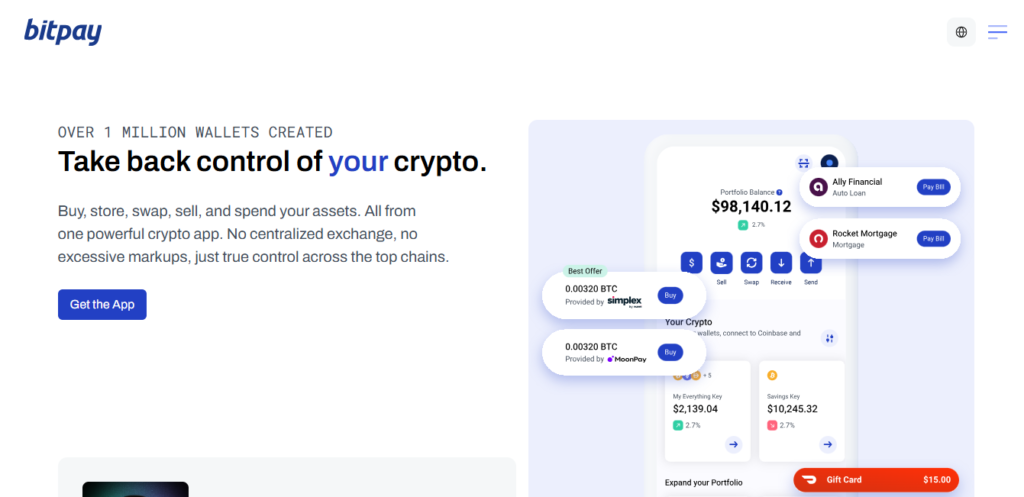
As one of the earliest crypto payment providers, BitPay has been trusted by merchants since 2011, making it the most reliable choice for established businesses.
Supporting 300+ cryptocurrencies including Bitcoin, Ethereum, USDT, and Solana, BitPay allows companies to accept, swap, and settle payments with ease. Integration options include APIs, plugins, invoices, and POS systems, making it adaptable for e-commerce stores, service providers, and global enterprises.
Merchants benefit from daily fiat settlements directly to their bank accounts, while enjoying 1% transaction fees and no fraud-related chargebacks.
Security is built into the platform with 2FA, biometric authentication, encrypted passwords, and multisig protection, alongside strict KYC and compliance standards.
With millions of users worldwide and a self-custody wallet that offers full control over assets, BitPay is best suited for businesses looking for long-term dependability. From crypto bill payments to gift card integrations, BitPay delivers a proven, transparent, and secure payment solution at scale.
Pros
- Provides daily fiat settlements directly into bank accounts.
- Charges a flat 1% transaction fee with no fraud-related chargebacks.
- Offers multiple integration options such as APIs, POS systems, and plugins.
- Enhances security with 2FA, biometric authentication, multisig, and encryption.
- Operates a trusted self-custody wallet giving users full control of assets.
- Allows businesses and individuals to pay bills or buy gift cards with crypto.
Cons
- Applies higher fees for businesses in high-risk industries.
- Requires full KYC and compliance processes for merchant onboarding.
- Limits customization compared to some newer crypto gateways.
Transak – Best for Global Fiat-to-Crypto On/Off Ramps
Transak is the go-to solution for businesses seeking reliable global fiat-to-crypto and crypto-to-fiat ramps, supporting 136 cryptocurrencies, 45 blockchains, and availability across 64 countries.
With seamless integration options like customizable SDKs, widgets, and white-label APIs, it enables developers to embed crypto onboarding into apps, websites, and platforms effortlessly.
Businesses benefit from seven supported payment methods, including debit cards, bank transfers, and local payment solutions, ensuring accessibility for users worldwide.
Security is reinforced through FCA authorization in the UK, MSB compliance in the US, and a robust risk engine that maintains less than a 0.05% fraud rate. Transak’s shared KYC system simplifies user onboarding while liquidity sourced from 10+ exchanges guarantees competitive prices.
The partner dashboard offers post-integration management, making operations smooth and scalable. With over 450+ apps powered by its infrastructure, Transak stands out as a highly flexible, compliant, and globally connected payment solution for small businesses that need reliable fiat-to-crypto coverage at variable but competitive transaction fees.
Pros
- Supports 136 cryptocurrencies and 45 blockchains for wide accessibility.
- Provides coverage in 64 countries with multiple local payment options.
- Offers seven payment methods including debit cards and bank transfers.
- Features customizable SDKs, widgets, and white-label APIs for smooth integration.
- Ensures compliance with FCA in the UK and MSB in the US.
- Reduces fraud risk with a robust engine boasting less than 0.05% fraud rate..
Cons
- Charges vary depending on payment method, making fees less predictable.
- Developer-focused setup may feel complex for non-technical businesses.
- Dependence on third-party liquidity providers could impact pricing stability.
CoinGate – Best for E-commerce Plugin Integrations
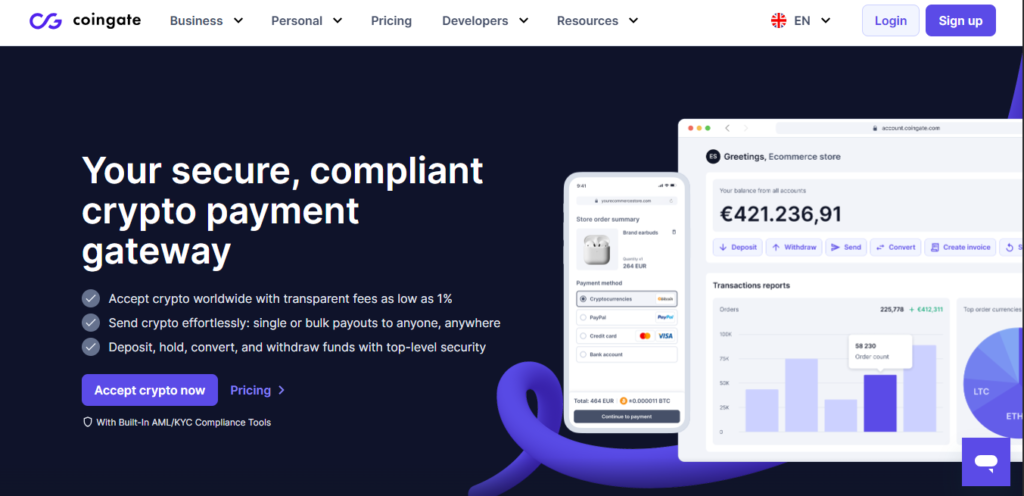
Built for merchants ready to expand into digital payments, CoinGate is the best crypto payment solution for e-commerce plugin integrations. Supporting major cryptocurrencies like Bitcoin, Ethereum, USDC, and more across networks such as Lightning, Polygon, Solana, and Binance Smart Chain, CoinGate gives businesses flexible and fast payment options.
It seamlessly integrates with popular platforms via plugins, APIs, and invoicing systems, making it easy to accept and process crypto payments globally.
Merchants benefit from instant Bitcoin-to-fiat settlements in USD, EUR, or GBP, protecting against price volatility and simplifying accounting. With transparent fees below 1%, automatic withdrawals, and built-in AML/KYC compliance tools, it offers both affordability and regulatory safety.
CoinGate also ensures top-tier security through encryption and real-time settlement monitoring, while supporting payments in over 170 countries. Ideal for online retailers, SaaS providers, and digital merchants, CoinGate turns crypto acceptance into a simple, scalable part of everyday business.
Pros
- Supports dozens of leading cryptocurrencies including BTC, ETH, USDC, and more across multiple blockchains.
- Offers integration options through APIs, plugins, and invoicing for easy setup.
- Provides instant Bitcoin-to-fiat settlements in USD, EUR, and GBP.
- Charges transparent and low transaction fees under 1%.
- Includes built-in AML and KYC compliance tools for regulatory assurance.
- Enables fast global payments across 170+ countries.
- Features automatic withdrawals and refunds for smooth transaction management.
- Supports the Bitcoin Lightning Network for faster, cheaper payments.
Cons
- Limited fiat settlement options to only a few major currencies.
- Advanced API integrations may require developer assistance.
- Some altcoins and newer tokens are not yet supported.
PayPal – Best Hybrid Solution for Crypto and Fiat Payments
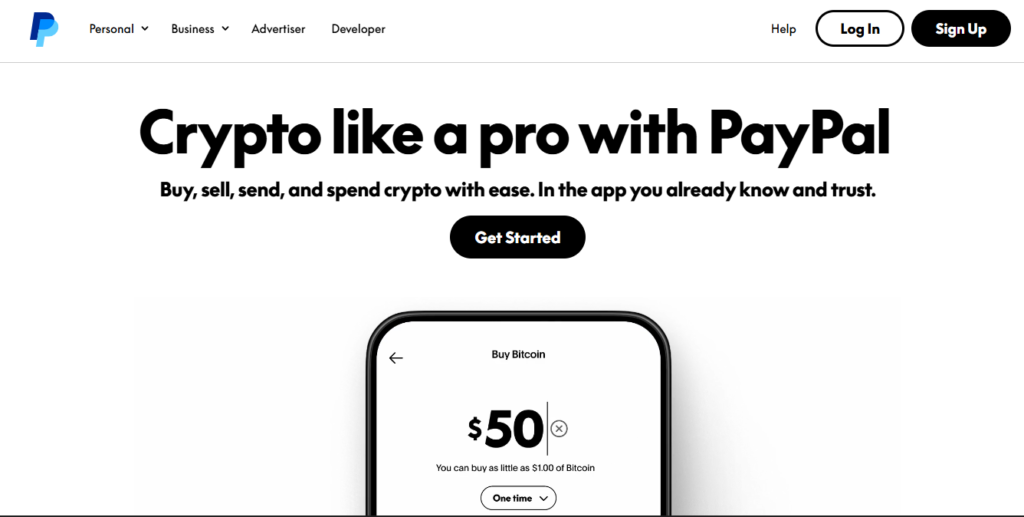
As one of the most recognized payment platforms in the world, PayPal offers a seamless hybrid solution for both crypto and fiat transactions, ideal for small businesses seeking versatility and trust.
Through the PayPal app, users can buy, sell, send, and spend multiple cryptocurrencies, including Bitcoin, Ethereum, and its stablecoin PYUSD, which is pegged to the U.S. dollar for stability.
Businesses can accept crypto payments and instantly convert them into fiat for simplified accounting. Integration is effortless via the PayPal Wallet and Checkout, connecting millions of merchants globally.
Transaction fees for cryptocurrency purchases range from 1.5% to 2.2%, while standard merchant fees vary between 2.29% and 3.49% + fixed rates, depending on the payment method.
With end-to-end encryption, anti-fraud monitoring, and two-factor authentication, PayPal ensures strong security. Its familiar interface, compliance standards, and global merchant network make it a reliable choice for SMEs looking to bridge digital and traditional finance.
Pros
- Supports both crypto and fiat payments in one platform for seamless hybrid transactions.
- Offers easy access to Bitcoin, Ethereum, and stablecoin PYUSD directly from the PayPal app.
- Instantly converts crypto payments into fiat, minimizing volatility risks.
- Provides global merchant acceptance across millions of online and in-store businesses.
- Ensures top-tier security with encryption, anti-fraud monitoring, and two-factor authentication.
- Features an intuitive interface familiar to most users and merchants.
- Allows easy integration with existing PayPal Checkout and Wallet systems.
- Supports recurring payments and subscription management for businesses.
- Offers cashback rewards and flexible debit card options for everyday spending.
Cons
- Charges higher transaction fees compared to dedicated crypto payment gateways.
- Restricts crypto withdrawals or transfers in some regions and account types.
- Maintains centralized control over user funds, limiting full self-custody.
- Provides limited cryptocurrency support compared to specialized crypto platforms.
OpenNode – Best for Bitcoin & Lightning Network Transactions
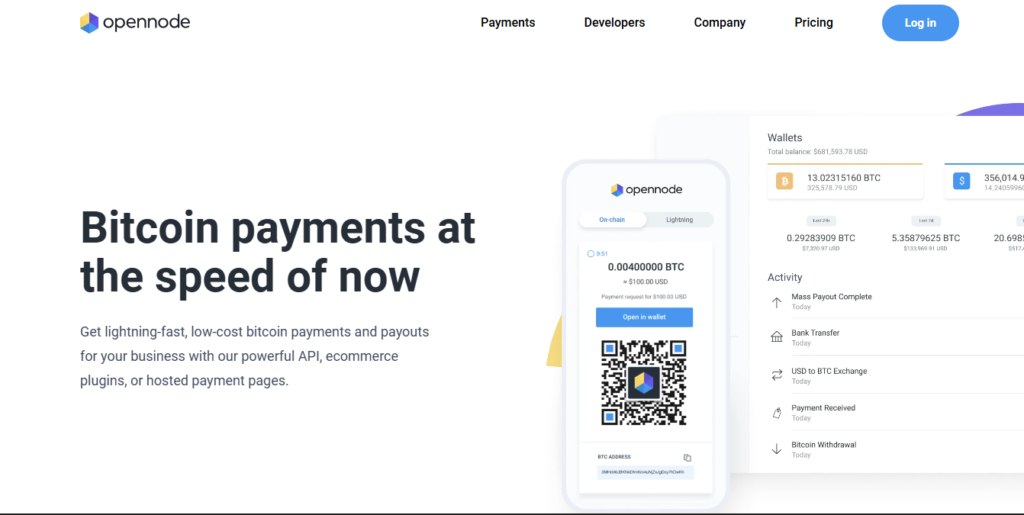
OpenNode delivers one of the most efficient Bitcoin and Lightning Network payment infrastructures for small businesses. Operating in over 120 countries with more than 14,000 registered users, it enables instant, low-cost Bitcoin payments and payouts through APIs, hosted payment pages, and eCommerce plugins.
Businesses can accept Bitcoin and automatically convert it to local currencies like USD, EUR, or GBP—free of charge—eliminating volatility risks. Its platform supports online, in-person, and invoiced payments, along with global payroll and instant settlements. OpenNode prioritizes security with two-factor authentication, IP whitelisting, and encrypted blockchain-based transactions.
With no chargebacks or hidden fees, it’s ideal for startups, eCommerce platforms, and global merchants looking for reliable, lightning-fast Bitcoin transactions. The platform’s developer-friendly APIs make integration simple, while regulatory compliance ensures safe and transparent operations across all payment activities.
Pros
- Enables instant and low-cost Bitcoin payments through the Lightning Network.
- Supports seamless conversion between Bitcoin and multiple fiat currencies like USD, EUR, and GBP.
- Offers free Bitcoin-to-fiat conversion with no hidden fees.
- Provides API, plugin, and hosted page integrations for flexible business use.
- Eliminates chargebacks and fraud through irreversible Bitcoin transactions.
- Ensures strong security with two-factor authentication, IP whitelisting, and withdrawal limits.
- Complies with AML, OFAC, and other financial regulations for safe, transparent operations.
Cons
- Exclusively supports Bitcoin, limiting multi-crypto flexibility.
- Requires some technical setup for advanced API integrations.
- Relies on internet and Lightning Network connectivity for smooth operation.
How to Choose the Right Crypto Payment Processor for Your Business
Choosing the right crypto payment processor depends on understanding how each solution fits your business model and operational needs.
Match Solutions with Your Business Model
Different payment processors cater to different business types. For instance, OpenNode is perfect for Bitcoin-only merchants and eCommerce stores wanting lightning-fast payments, while NOWPayments suits SMEs that prefer a non-custodial setup for flexible crypto management.
Established brands may prefer BitPay, which offers reliability and scalability for high transaction volumes.
Review Supported Cryptocurrencies & Stablecoins
If your customers use various coins, go for platforms with broad support. NOWPayments and Transak support over 300 cryptocurrencies, while PayPal focuses on popular assets like Bitcoin, Ethereum, and PYUSD for hybrid fiat-crypto transactions.
Integration With Your Website or POS System
Ease of integration is key. CoinGate provides plugins for WooCommerce and Shopify, making it ideal for online stores. Coinbase Commerce integrates seamlessly with WooCommerce, Jumpseller, and custom APIs, allowing startups to begin accepting crypto in minutes.
Evaluate Fees and Conversion Rates
Transaction costs can vary widely. Upay charges no fees for cross-border payment and a transparent 1% transaction fee. NOWPayments charges as low as 0.5%, one of the lowest in the industry, while BitPay and CoinGate stay competitive around 1%.
Some platforms, like OpenNode, even offer free Bitcoin-to-fiat conversion, which helps reduce volatility risk.
Security & Compliance Considerations
Security and compliance are non-negotiable. Coinbase Commerce offers institutional-grade protection with 2FA and cold storage options. BitPay and Transak also prioritize compliance, meeting FCA and MSB standards.
For businesses seeking decentralized control, NOWPayments offers full self-custody, ensuring funds remain in your control at all times.
Advantages of Using Crypto Payment Solutions for Small Businesses
Adopting crypto payment solutions can significantly enhance how small businesses operate, transact, and connect with customers.
Reduced Transaction Costs vs. Traditional Payment Methods
Crypto payment gateways like NOWPayments and CoinGate offer transaction fees as low as 0.5%—far below the 2–4% charged by credit card processors. This cost efficiency helps small businesses retain more profit, especially for cross-border transactions that typically attract additional bank or exchange fees.
Attracting Tech-Savvy and International Customers
By accepting cryptocurrencies, businesses open their doors to a global audience of digital-first consumers. UPAY supports over 55 million merchants. Platforms like Transak and PayPal allow payments from over 60 countries and support multiple crypto and fiat currencies, making international sales easier and faster.
Faster Settlements and Less Chargeback Risk
Solutions such as OpenNode and BitPay enable instant settlements via the Lightning Network or blockchain confirmations, removing the need for slow intermediaries. Moreover, crypto payments are irreversible, eliminating costly chargeback disputes.
Brand Image and Innovation Advantage
Integrating crypto payments signals forward-thinking and adaptability. Businesses that adopt tools like Coinbase Commerce or NOWPayments position themselves as modern, customer-centric, and ready for the future of digital finance—enhancing trust and competitive edge in a tech-driven market.
Best Practices for Integrating Cryptocurrency Payments
Integrating cryptocurrency payments can transform how your business operates—but doing it effectively requires the right strategy and execution.
Choosing the Right Platform for Your Niche
Select a payment processor that aligns with your business model and customer base. For instance, UPay suits global retailers needing seamless crypto-to-fiat conversions, while OpenNode works best for Bitcoin-focused businesses seeking Lightning Network speed.
CoinGate is ideal for e-commerce stores due to its plugin support for WooCommerce and Shopify.
Offering Multiple Payment Options
Flexibility is key. Combine crypto and traditional payment options to cater to all customer preferences. Platforms like PayPal and Transak enable hybrid payments, accepting crypto while still supporting local fiat currencies, helping you reach wider audiences.
Educating Staff and Customers
Provide training and clear guidance to employees and customers. Explain how to use wallets, confirm transactions, and handle refunds. BitPay, for example, offers detailed tutorials for merchants to ensure smooth onboarding.
Monitoring Adoption and Adjusting Strategies
Track customer behavior, transaction volume, and conversion trends regularly. If crypto usage increases, expand accepted currencies or offer loyalty rewards. Use analytics tools from providers like NOWPayments to adapt your strategy and maximize efficiency as digital payments evolve.
Final Thoughts
Cryptocurrency payment solutions are becoming essential tools for small businesses aiming to operate smarter, faster, and globally. By choosing reliable processors like UPAY, CoinGate, OpenNode, or BitPay, businesses can cut transaction costs, improve checkout efficiency, and attract a wider customer base.
Integrating crypto alongside traditional payments gives customers more freedom and strengthens brand credibility.
Success lies in selecting the right processor, prioritizing security, and staying flexible as adoption grows. Small businesses that act now will not only future-proof their payment systems but also position themselves for greater financial efficiency and long-term growth in digital commerce.
Frequently Asked Questions
Which Payment Gateway Is Best for Cryptocurrency?
UPAY is one of the best payment gateways for cryptocurrency, offering fast settlements, multi-coin support, and easy integration for businesses, while other strong options include CoinGate, BitPay, and OpenNode depending on your specific needs.
Is Crypto Trading Profitable?
Yes, crypto trading can be profitable, but success depends on market knowledge, risk management, and timing, as volatility remains high.
What Is the Best Platform To Receive Crypto Payments?
The best platform to receive crypto payments depends on your business needs — BitPay is ideal for multi-crypto support, CoinGate suits global merchants, and OpenNode excels for Bitcoin and Lightning Network transactions.
How Do I Accept Crypto Payments for My Business?
You can accept crypto payments by choosing a trusted payment processor like CoinGate, BitPay, or OpenNode, integrating it with your website or POS system, selecting supported cryptocurrencies, and setting up automatic conversions to fiat if desired.
Can I Use NOWPayments for My Business?
Yes — you can use NOWPayments for your business. It supports 300+ cryptocurrencies, offers easy integration via APIs and plugins, and lets you accept payments while maintaining full control of your funds.