

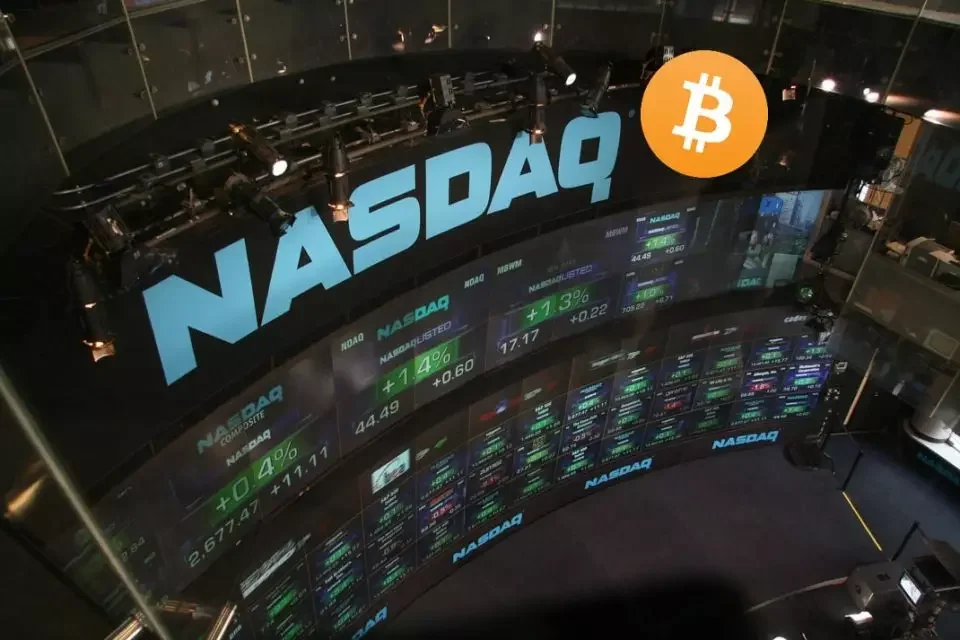
Crypto derivatives are steadily moving out of specialized trading desks and into mainstream financial infrastructure, and Nasdaq may now be preparing one of the clearest examples of that transition.
The exchange operator has received conditional approval from the U.S. Securities and Exchange Commission SEC to list cash settled bitcoin index options under the ticker QBTC, a product that could significantly simplify how investors access bitcoin volatility trading and hedging strategies.
If the launch receives final approval from the Commodity Futures Trading Commission CFTC, the contracts would allow market participants to trade bitcoin linked options through standard brokerage accounts instead of relying on separate crypto derivatives platforms or institutional futures infrastructure.
The proposal reflects a broader shift taking shape across financial markets. Bitcoin is no longer being treated solely as a speculative digital asset. It is increasingly being embedded into the same risk frameworks, trading systems, and portfolio tools used across equities, commodities, and foreign exchange.
For years, advanced crypto derivatives remained largely inaccessible to retail investors due to operational complexity, fragmented infrastructure, and high capital requirements. Nasdaq’s QBTC contracts aim to reduce that friction by embedding bitcoin options directly into familiar brokerage environments.
The result could reshape how both retail and institutional investors manage exposure to crypto volatility.
Key Takeaways
- Nasdaq received conditional SEC approval to list bitcoin index options under the ticker QBTC.
- Contracts would trade through standard brokerage accounts without separate derivatives infrastructure.
- Each QBTC contract represents exposure to 1 BTC, making it more accessible than existing institutional products.
- The launch signals deeper integration between crypto markets and regulated financial systems.
Bitcoin options move closer to mainstream trading
Bitcoin options are not new, with established markets already operating through venues such as CME Group. However, access has historically been concentrated among hedge funds, proprietary trading firms, and large asset managers with dedicated derivatives infrastructure.
Nasdaq’s proposal changes that dynamic by embedding bitcoin options into the same trading systems used for equities and traditional derivatives. Investors would be able to access BTC linked contracts through existing brokerage accounts rather than opening separate futures accounts.
That shift matters because much of the barrier to crypto derivatives trading has not been demand, but infrastructure. Fragmented settlement systems, unfamiliar venues, and additional compliance layers have limited broader participation. Integrating bitcoin options into established brokerage ecosystems removes much of that friction and pushes crypto further into regulated financial infrastructure.
Why contract sizing could matter
One of the key differences in Nasdaq’s QBTC proposal is contract size.
Each contract represents exposure to 1 BTC. By contrast, CME bitcoin options are typically tied to 5 BTC, creating significantly larger notional exposure and higher capital requirements.
That difference matters for portfolio construction.
Smaller sizing allows more precise position management. A long term bitcoin holder could use put options for downside protection without overcommitting capital. Traders could also structure volatility positions around macro events such as Federal Reserve decisions or ETF flows with far more flexibility.
While the risk remains, the accessibility profile changes meaningfully.
How the contracts work
The QBTC contracts are structured as cash settled European style options tied to the CME CF Bitcoin Real Time Index.
Cash settlement means no bitcoin is delivered at expiry. Instead, gains or losses are paid in U.S. dollars based on the difference between the strike price and final index value. This eliminates custody complexity and keeps settlement fully within traditional financial rails.
European style execution also means contracts can only be exercised at expiration, not before. That reduces assignment risk and simplifies risk management compared to American style options. Together, these features align the product with traditional derivatives while maintaining exposure to bitcoin price action.
The growing role of crypto derivatives
The expansion of bitcoin options reflects a broader shift in how digital asset markets are evolving. As crypto adoption deepens, investors increasingly require tools for hedging, volatility positioning, and structured exposure rather than simple spot ownership. That demand has driven rapid growth in derivatives markets over recent years.
At the same time, regulatory acceptance has gradually expanded, particularly with the approval of spot bitcoin ETFs and regulated futures products.
Rather than remaining isolated in crypto native venues, derivatives exposure is now being integrated into conventional financial infrastructure.
This trend is reducing fragmentation and increasing the depth of liquidity available across bitcoin markets.
Regulation remains central
Despite progress, the product still requires final approval from the CFTC before trading can begin. Regulators are expected to focus on settlement integrity, surveillance frameworks, and market manipulation safeguards before granting approval.
These considerations reflect a broader challenge as crypto products move deeper into regulated environments, where innovation must align with investor protection and systemic risk oversight.
A broader shift in financial infrastructure
Nasdaq’s bitcoin options proposal is not just a product expansion. It reflects a structural shift in how crypto markets are being absorbed into traditional finance. Tools that once required specialized exchanges and complex onboarding may soon be accessible through standard brokerage accounts used for equities and ETFs.
That shift has implications for liquidity, participation, and long term market behavior.
Crypto markets are no longer developing on the edges of finance. They are increasingly being built into its core infrastructure.
And as that integration continues, the separation between digital asset markets and traditional trading systems is becoming harder to define.
No related posts.