What is a crypto exchange, exactly? You’ve probably heard the old saying, the trend is your friend, but you can’t really follow that trend if you don’t have a place to trade.
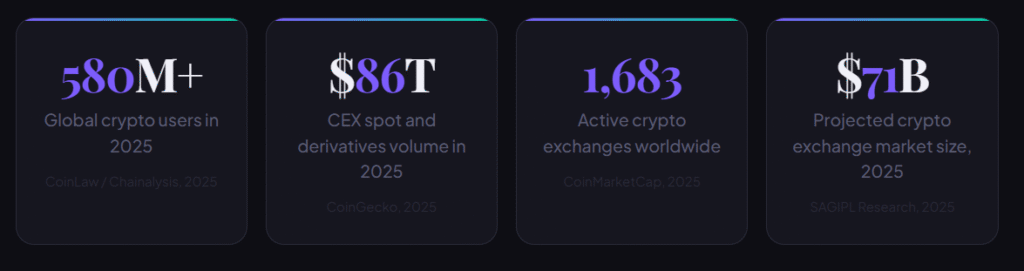
In 2025, global crypto users surpassed 580 million, up roughly 34% year over year, and the combined spot and derivatives trading volume on centralised exchanges alone reached approximately $86 trillion for the year.
Getting to know how exchanges function is no longer a niche concern reserved for traders.
For business owners, freelancers, and everyday consumers, knowing how these platforms work is the foundation of navigating the digital economy with confidence.
Read Also: A Comprehensive Analysis of 10 Top Crypto Gainers
What Is a Crypto Exchange and Why Does It Exist?
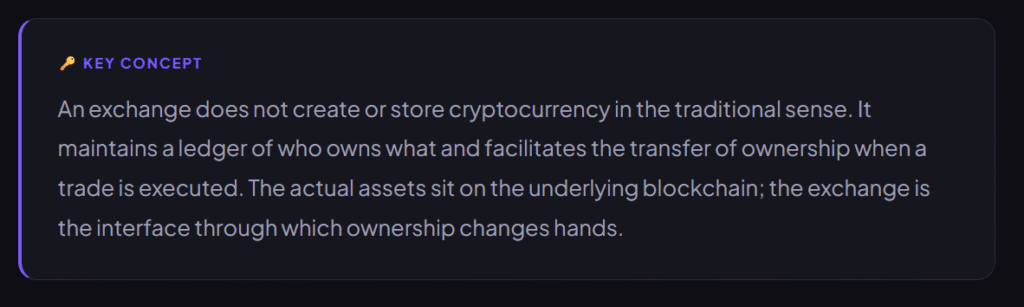
A cryptocurrency exchange is a digital platform that facilitates the buying, selling, and trading of crypto assets.
Before exchanges existed, early Bitcoin holders had to find counterparties manually through forums like Bitcointalk or conduct in-person cash trades.
The first true crypto exchange, BitcoinMarket, launched on 17 March 2010, and the industry has never looked back.
Exchanges exist to solve a fundamental problem: price discovery and liquidity.
Without a central marketplace, how would a buyer in Lagos know the fair price of Ethereum, and how would they find a willing seller in seconds?
Exchanges aggregate demand and supply, publishing live prices and enabling instant trade execution. They are the plumbing that makes a liquid, global cryptocurrency market possible.
How Does a Crypto Exchange Work Step by Step?
If you’re trading Bitcoin for cash or swapping Ethereum, the mechanics follow a predictable sequence. Here is what happens behind the scenes when you place an order on a centralised exchange.
1. Account Creation and Identity Verification
You register with an email address and complete KYC (Know Your Customer) verification by submitting a government-issued ID.
This is a regulatory requirement in most jurisdictions under Anti-Money Laundering (AML) rules and applies to all major centralised exchanges, including Coinbase, Binance, and Kraken.
2. Funding Your Account
You deposit funds via bank transfer, credit card, or by sending crypto from an external wallet.
Centralised exchanges maintain custodial wallets on your behalf, meaning they hold your private keys and manage your balances internally until you withdraw.
3. Placing an Order
You submit a buy or sell order. A market order executes immediately at the current price.
A limit order specifies a price at which you are willing to trade and waits until the market reaches that level. The exchange’s matching engine pairs buyers with sellers from its central order book.
4. Trade Execution and Settlement
Once matched, the trade executes. On a centralised exchange, this happens in the exchange’s internal ledger almost instantly.
The blockchain is only updated when you withdraw funds to an external wallet, which is when a transaction is actually broadcast to the network and confirmed.
5. Withdrawal to Your Wallet
You can withdraw your crypto to a personal crypto wallet at any time.
This triggers an on-chain transaction that is signed with the exchange’s private key and broadcast to the relevant blockchain, where it receives network confirmations and becomes final and irreversible.
What Are the Different Types of Crypto Exchanges?
Not all exchanges work the same way.
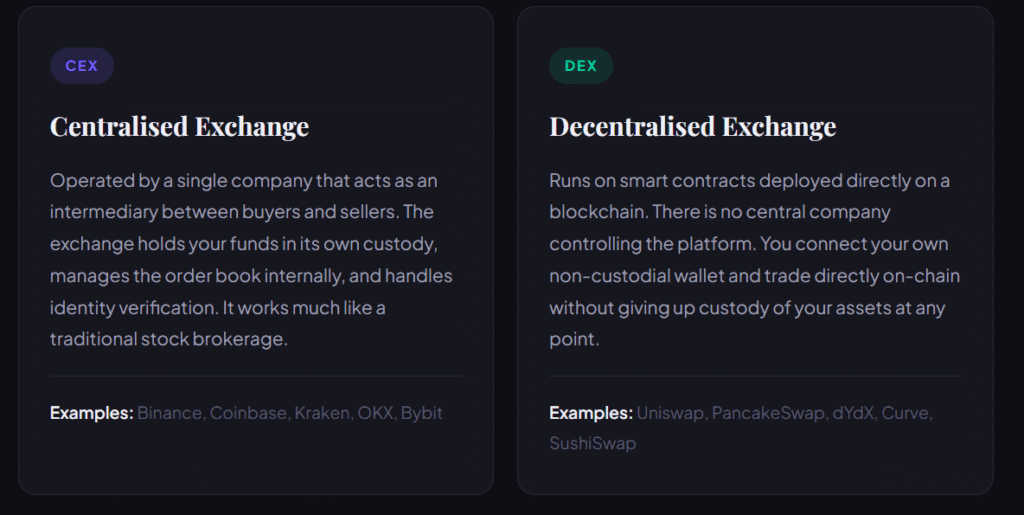
The two fundamental models are Centralised Exchanges (CEXs) and Decentralised Exchanges (DEXs), and each reflects a very different philosophy about who should control your assets.
What Is the Difference Between a CEX and a DEX?
The core distinction is custody. On a centralised exchange, the platform holds your funds on your behalf, much like a bank holds your deposits.
On a decentralised exchange, your private keys never leave your possession. As the old crypto saying goes: not your keys, not your crypto.
| Feature | Centralised Exchange (CEX) | Decentralised Exchange (DEX) |
| Asset Custody | Exchange holds your funds | You retain full control |
| Identity Verification | KYC required | No sign-up needed |
| Fiat On-Ramp | Yes | Crypto |
| Liquidity | Very high, aggregated order book | Lower, relies on liquidity pools |
| Speed | Near-instant, off-chain matching | Slower, every trade is on-chain |
| Fees | Trading fees (0.05% to 0.5%) | Gas fees + swap fee (variable) |
| Privacy | Low (full KYC) | High (pseudonymous) |
| Customer Support | Available | None |
| Hacking Risk | Centralised target (higher risk) | Smart contract bugs (different risk) |
| Best For | Beginners, fiat conversion, high volume | DeFi users, privacy, new tokens |
Which Are the Biggest Crypto Exchanges?
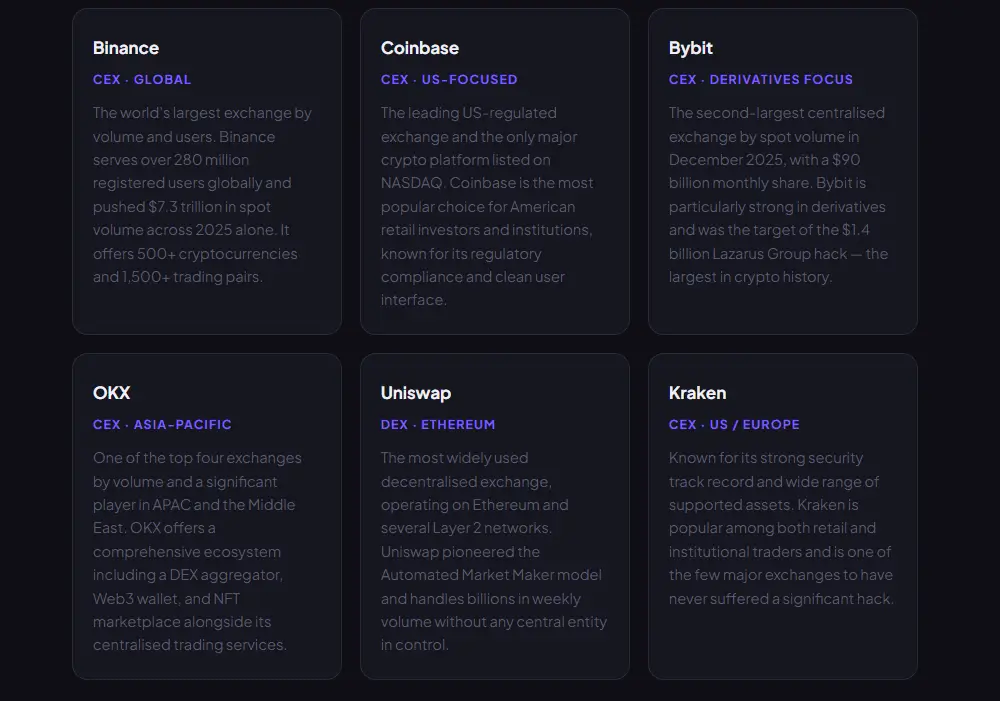
The centralised exchange is highly concentrated.
The top four platforms handle approximately 68% of all global spot trading volume, with Binance maintaining its dominant position at roughly 39% market share in 2025. Here is a snapshot of the major players.
How Do Crypto Exchanges Make Money?
Knowing how exchanges generate revenue matters because it directly affects the fees you pay.
The primary income source for most centralised exchanges is trading fees, typically charged as a percentage of each transaction.
Binance, for example, charges as low as 0.1% for spot trades, with discounts available for holding its native BNB token or reaching higher volume tiers.
Beyond trading fees, exchanges earn revenue through withdrawal fees, which cover blockchain network costs and often include a margin.
Many platforms also collect listing fees from new crypto projects seeking to be listed on their platform, a controversial practice given the influence it gives exchanges over which projects gain visibility.
Many platforms also collect listing fees from new crypto projects seeking to be listed on their platform, a controversial practice given the influence it gives exchanges over which projects gain visibility.
Lending and staking products, premium API access for institutional traders, and futures funding rates are additional revenue streams that have grown significantly for larger platforms.
What Fees Can You Expect to Pay on a Crypto Exchange?
Fee structures vary considerably between platforms.
Maker fees (for placing orders that add liquidity to the order book) are typically lower than taker fees (for orders that immediately match existing ones).
Some exchanges like MEXC pursued aggressive zero-fee policies on spot trading in 2025, capturing significant market share and growing their volume by 90.9% year over year as a result.
For DEXs, fees work differently. You pay a swap fee to liquidity providers (typically 0.3% on Uniswap) plus a network gas fee that fluctuates based on blockchain congestion.
On the Ethereum mainnet, gas fees can spike substantially during periods of high demand, though Layer 2 networks like Arbitrum and Optimism have brought these costs down dramatically.
What Security Practices Should You Follow on a Crypto Exchange?
Exchange security is a legitimate concern, and the statistics support healthy caution.
The Bybit hack of February 2025, in which North Korea’s Lazarus Group stole approximately $1.4 to $1.5 billion in Ethereum, was the largest crypto theft in history and served as a stark reminder that centralised exchanges, regardless of their size, remain targets.
In total, 2025 saw over $3.4 billion in crypto stolen, with centralised service compromises accounting for the majority of losses by value.
Leading exchanges now publish regular Proof of Reserves, demonstrating they hold sufficient assets to cover all user balances.
Regulatory frameworks, including the EU’s MiCA regulation (now in full effect) and the US GENIUS Act, have raised the compliance bar significantly, requiring licensing, consumer protections, and AML controls across major markets.
How Does a Crypto Exchange Differ From a Crypto Payment Gateway?
This is a question businesses ask frequently, and the distinction matters enormously in practice. A crypto exchange is a marketplace for trading digital assets.
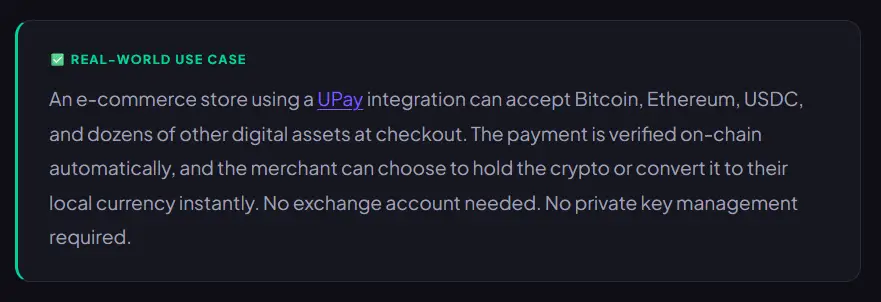
A crypto payment gateway is a service that enables businesses to receive cryptocurrency from customers as payment for goods or services.
If you are a merchant who wants to accept Bitcoin or USDC from customers, you do not need to set up an exchange account for your business. You need a payment gateway.
The gateway handles the technical complexity of receiving, verifying, and optionally converting crypto payments into fiat currency, all without requiring you to manage wallets, private keys, or on-chain transactions manually.
Frequently Asked Questions About Crypto Exchanges
Is Binance the best crypto exchange
Binance is the largest crypto exchange in the world by both users and trading volume, with 280 million registered users and roughly a 39% share of centralised exchange spot volume.
However, the best exchange for you depends on your location, regulatory requirements, the currencies you want to trade, and your experience level.
Coinbase is generally considered the most beginner-friendly and regulatory-compliant option for US users, while Kraken is highly regarded for security.
What happens if a crypto exchange goes bankrupt?
If a centralised exchange becomes insolvent, users’ funds held on the platform may be at risk, as demonstrated by the FTX collapse in 2022.
See it this way: exchanges are where crypto moves between individuals as an asset. Payment gateways are where crypto moves from customers to businesses as payment.
Both are vital parts of the digital asset ecosystem, but they serve different purposes and different audiences.
Conclusion
With over 580 million users and trillions in trading volume, digital assets are no longer just for tech enthusiasts.
For business owners and freelancers alike, learning the ropes of what a crypto exchange is the first step toward navigating this massive global economy with confidence.
Once you’ve got a solid handle on what a crypto exchange is, it’s worth looking at how the rest of the pieces fit together. You might want to explore resources such as cryptocurrency payment gateways and the risks of trading cryptocurrency.