


Cryptocurrency earnings have matured far beyond the get-rich-quick schemes of the past. Earnings from cryptocurrency now represent the new frontier of digital yield.
The climate has changed considerably in the past year. Regulatory clarity arrived in the form of new IRS reporting rules.
This is not a guide full of wild yield promises.
It is an honest, structured breakdown of every established method for generating income from digital assets, backed by current data and practical guidance you can act on today.

What Are Cryptocurrency Earnings?
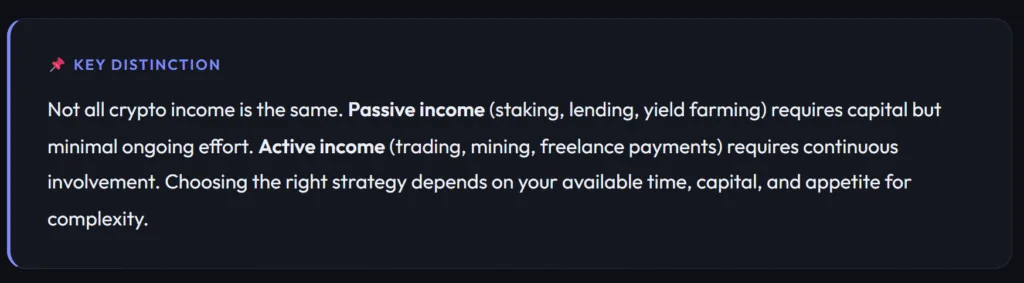
Cryptocurrency earnings is a broad term that covers any income generated through digital assets.
Related Reads: Virtual cards in crypto, risks of trading cryptocurrency.
Whether that is yield earned by locking tokens in a proof-of-stake network, interest received from lending crypto to borrowers, trading profits, payments received in Bitcoin or stablecoins for goods and services, or mining rewards earned by contributing computational power to secure a blockchain.
Each of these methods has a distinct risk profile, technical complexity, and return potential. What unifies them is the underlying technology: the blockchain.
Every reward, interest payment, or transaction is recorded on a decentralised ledger, giving participants transparent, verifiable proof of their income.
That same transparency, incidentally, is why the IRS now requires mandatory reporting of digital asset transactions starting from the 2025 tax year.
What Are the Main Ways to Generate Cryptocurrency Earnings
The major income-generating strategies in crypto can be grouped into six categories.
The following breakdown gives you an honest look at each one, including the typical return range, who it suits, and the real risks involved.

Is Crypto Staking a Reliable Source of Income?
Staking is one of the most discussed forms of cryptocurrency earnings because it resembles interest on a savings account, you hold an asset and earn yield without actively trading.
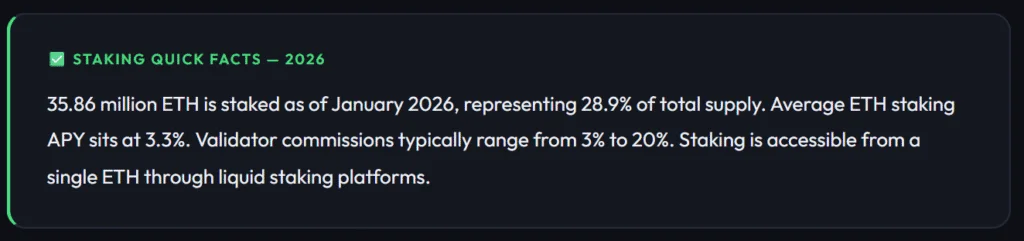
As of November 2025, more than 33 million ETH tokens worth roughly $100 billion were staked on the Ethereum network alone.
That scale reflects genuine confidence in staking as a long-term income strategy.
Major proof-of-stake networks typically offer staking yields ranging from 3% to 18% APY, depending on the asset, the total amount staked on that network, validator commissions, and current network conditions.
Ethereum specifically sits at around 3.3% APY as of January 2026, reflecting the high participation rate.
Networks with lower participation tend to offer higher per-staker rewards. Solana, Cardano, and Cosmos each offer different yield profiles and different technical requirements.
Liquid staking protocols such as Lido and Rocket Pool have made staking more accessible by allowing users to stake without meeting the 32 ETH minimum required to run an Ethereum validator node and without losing access to liquidity during the staking period.
How Does Yield Farming Differ From Simple Staking?
Yield farming goes a step further than basic staking. Instead of locking tokens to support a single network, yield farmers provide liquidity to trading pools on decentralised exchanges.
They deposit pairs of tokens, for example, ETH and USDC, on Uniswap and earn a share of the fees every trader pays when swapping between those assets.
Some protocols also offer additional governance token rewards on top of base trading fees, which is how yields can reach 20 to 30% on certain pairs during periods of high market activity.
The trade-off is impermanent loss. If the relative prices of the two deposited assets change significantly while your funds are in the pool, you may withdraw less value than you would have earned simply by holding those assets.
What Are the Risks of Different Cryptocurrency Income Strategies?
No honest guide to cryptocurrency earnings would be complete without a clear-eyed look at what can go wrong.
The risk profile varies dramatically across different income methods, and what suits one investor may be entirely inappropriate for another.
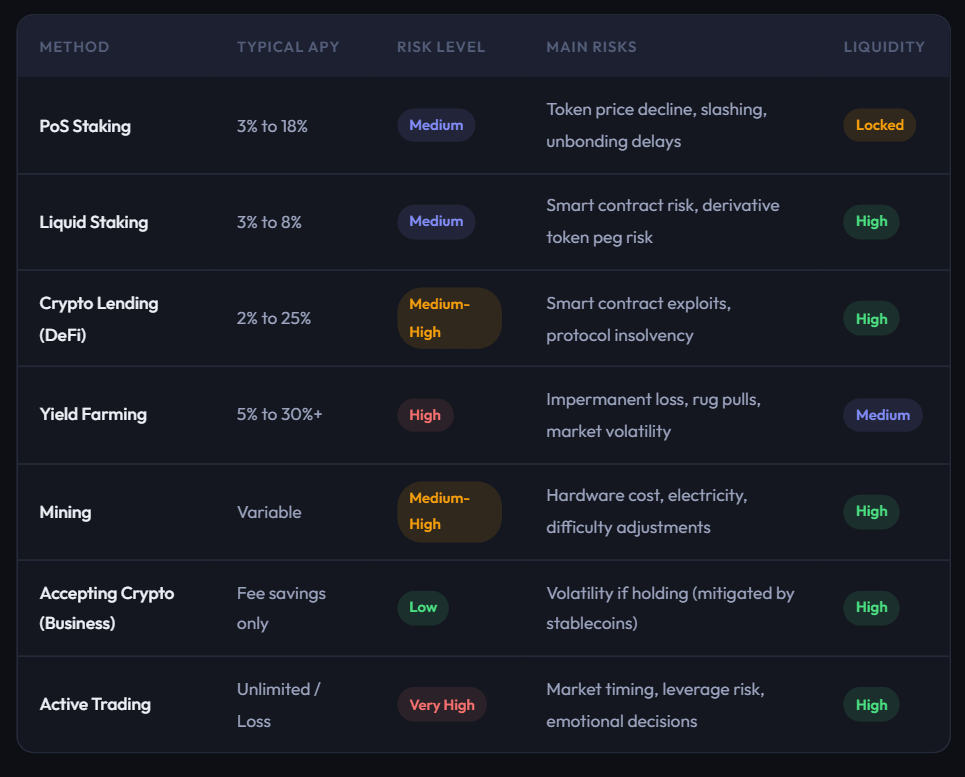
Kindly Note: Platforms promising 50% or 100% APY are red flag (s), not an opportunity. Sustainable cryptocurrency earnings range from roughly 3% to 18% established protocols.
Anything significantly above that typically carries commensurate risks of total loss.
How Are Cryptocurrency Earnings Taxed
Tax treatment is one of the most important and most misunderstood aspects of cryptocurrency earnings.
As of 2025, the IRS has introduced significant reporting changes that affect every participant in the crypto ecosystem, from individual stakers to businesses accepting Bitcoin.
What Did the IRS Change for Crypto Taxation in 2025?
The most significant change is the introduction of Form 1099-DA, a new tax form specific to digital assets.
Starting with transactions on or after January 1, 2025, brokers, including centralised exchanges like Coinbase, are required to report the gross proceeds of all digital asset sales and exchanges to both the taxpayer and the IRS.
A second major change is the shift from universal to wallet-by-wallet cost basis accounting.
Prior to 2025, investors could use a universal method to calculate cost basis across all their holdings.
From 2025 onwards, basis must be tracked per wallet or account, making good record-keeping more important than ever.

How Do You Protect a Digital Wallet Holding Income?
Never store significant funds on an exchange long-term. Use a non-custodial wallet for assets you intend to hold, and enable two-factor authentication everywhere possible.
Back up your seed phrase in a physical location, not in a cloud service or screenshot.
For staking or DeFi activity, research every protocol before depositing: check audit history, team credibility, and total value locked as a measure of market confidence.
Use separate wallets for separate purposes, one for staking, one for trading, one for receiving business payments to limit exposure from any single point of failure.
For businesses accepting crypto, working with a regulated crypto payment gateway like UPay means professional custody infrastructure handles the security of funds on your behalf, removing the burden of self-custody entirely.
Frequently Asked Questions
Can beginners realistically earn passive income from cryptocurrency?
Yes, with appropriate expectations.
Read also: The 9 Best Crypto Trading Strategies Every Trader Should Know
Conclusion
As we round up, the most successful participants are those who treat their portfolios like a business, focusing on sustainable strategies rather than speculative gambles.
After all, in this high-tech economy, the early bird gets the worm, and by positioning yourself now to maximize your cryptocurrency earnings, you are securing a front-row seat to the future of global finance.