


If you have typed ” Is crypto a good investment?” into a search bar recently, you are in a very large company.
The answer has never been simple, and in 2026? it became even more layered.
Bitcoin crossed $126,000 and set a new all-time high. BlackRock, Harvard’s endowment, and Abu Dhabi sovereign wealth funds all disclosed Bitcoin ETF positions.
Meanwhile, the same asset closed the year approximately 44% below its peak, and fraud losses involving cryptocurrency hit $11.3 billion in the United States alone.
So which version of the story is true? Both. That is the honest answer, and this article is built around it.
Related Reads: 5 Unavoidable Risks of Trading Cryptocurrency, what is a crypto exchange?
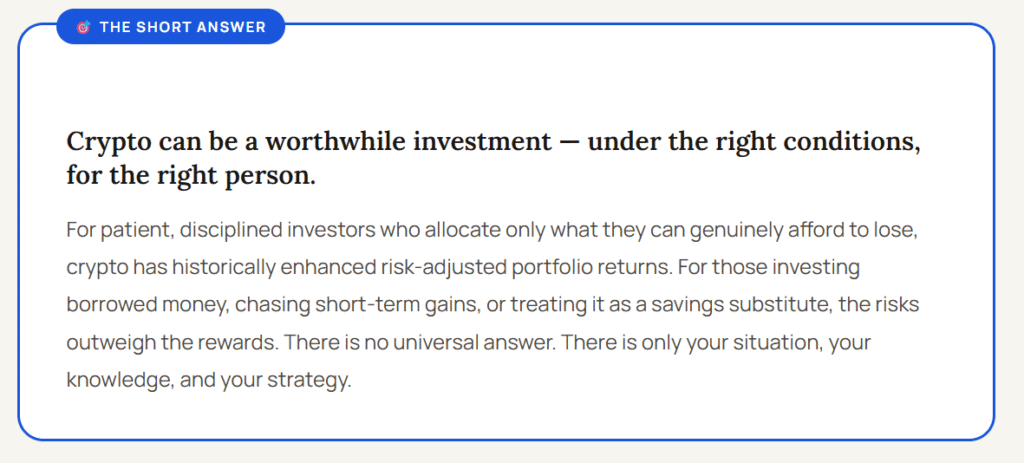
What Happened to Crypto Markets in 2025?
Context matters when evaluating any investment, and 2025 delivered some of the most significant contexts the digital asset space has ever seen, both positive and painful.
The year opened with Bitcoin crossing $100,000 for the first time in history, driven by the momentum of spot Bitcoin ETF approvals in early 2024, a new US administration that explicitly endorsed digital assets, and continued institutional accumulation.
By October, Bitcoin surged to a record high above $126,000, powered by institutional demand through ETF vehicles, growing corporate treasury adoption, and supportive macroeconomic signals, including gradual interest rate cuts.
At least 172 publicly traded companies held Bitcoin in Q3 2025, up 40% quarter-over-quarter according to Bitwise, with those companies collectively holding around one million BTC, roughly 5% of all circulating supply.
Then the market exhaled. Bitcoin closed the year down approximately 6% from January levels, sitting about 44% below its October peak.
Ethereum and Solana followed similar trajectories, strong mid-year rallies, then sharp corrections as risk appetite faded and macro uncertainty crept back in.
The US passed the GENIUS Act establishing a federal stablecoin framework, which was the most significant piece of crypto legislation in American history.
Regulation in the EU matured under MiCA. And yet the market rewarded and punished in equal measure, as it always has.
What Are the Genuine Arguments for Crypto as an Investment?
Has Bitcoin Actually Generated Strong Long-Term Returns?
Measured over any extended period, Bitcoin’s return profile is extraordinary by the standards of any asset class.
A simple buy-and-hold strategy on Bitcoin returned over 120% in 2025 alone, outperforming the average actively managed crypto hedge fund, which returned approximately 36% over the same period.
Over a ten-year horizon, Bitcoin has outperformed equities, gold, real estate, and bonds by a significant margin, despite suffering multiple drawdowns of 50% or more along the way.
Matt Hougan, Chief Investment Officer at Bitwise Asset Management, put it plainly in early 2026:
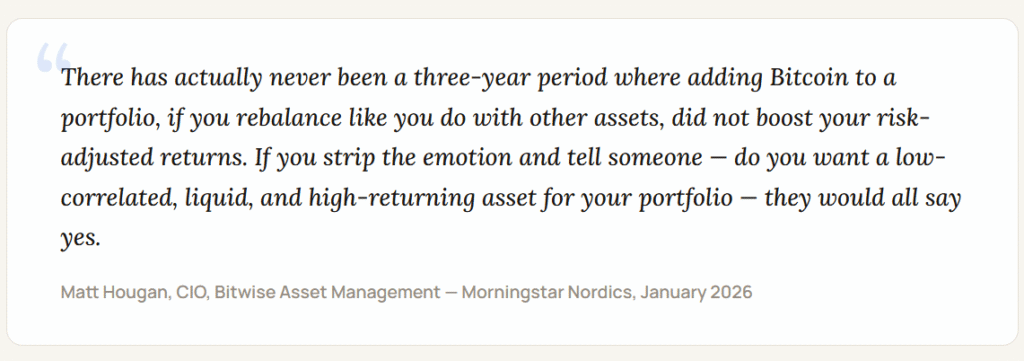
That observation sits at the heart of why professional allocators have shifted their view.
The data does not say crypto is safe. It is saying that a small, disciplined allocation historically improves portfolio-level performance not because of the asset’s stability, but despite its volatility.
Does Institutional Adoption Change the Investment Case?
Yes, materially. It is fundamentally different from the one that existed even three years ago.
Harvard’s endowment, Brown University, Emory University, Mubadala Investment (Abu Dhabi’s sovereign wealth fund), and Al Warda Investments all disclosed Bitcoin ETF positions during 2025.
Strategy formerly MicroStrategy held over $33 billion worth of Bitcoin on its balance sheet by September 2025. Tesla retained $1.24 billion in Bitcoin.
JPMorgan began planning to accept Bitcoin and Ether as collateral.
This matters for retail investors because institutional capital tends to be patient, data-driven, and long-term in nature.
Unlike retail speculation, which can vanish overnight, institutional positions in regulated ETF vehicles tend to provide a more stable demand floor.
Bitcoin ETF inflows of over $21 billion in net inflows remained in place even after the market’s significant late-year correction, a signal that institutional conviction survived the volatility.
How Does Crypto Fit Into a Diversified Portfolio?
Bitcoin’s five-year average correlation with the S&P 500 sits around 0.38, and its correlation with bonds is near zero, meaning it does not move in lockstep with traditional assets.
In portfolio construction terms, that is genuinely valuable.
A standard institutional framework now allocates 60 to 70% of a crypto position to Bitcoin and Ethereum as core holdings, 20 to 30% to large-cap altcoins and DeFi tokens, and 5 to 10% to stablecoins for liquidity management.
These are not speculative allocations, they are the considered positions of pension advisers and wealth managers doing proper due diligence.
What Are the Honest Risks of Investing in Cryptocurrency?
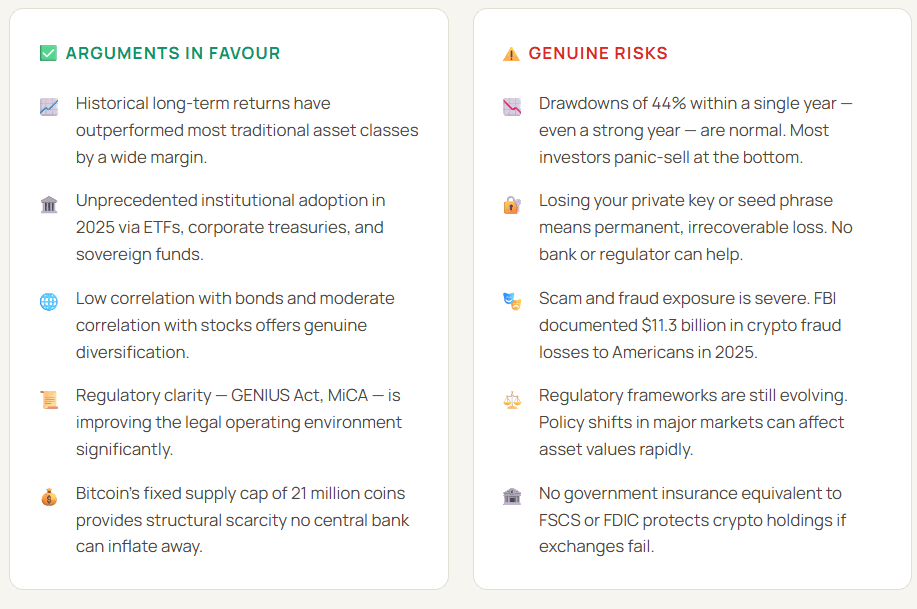
No balanced article on this topic can stop at the upside. The risks of crypto investment are specific, significant, and often underestimated by first-time buyers.
Knowing them is not optional, it is the precondition for investing responsibly.
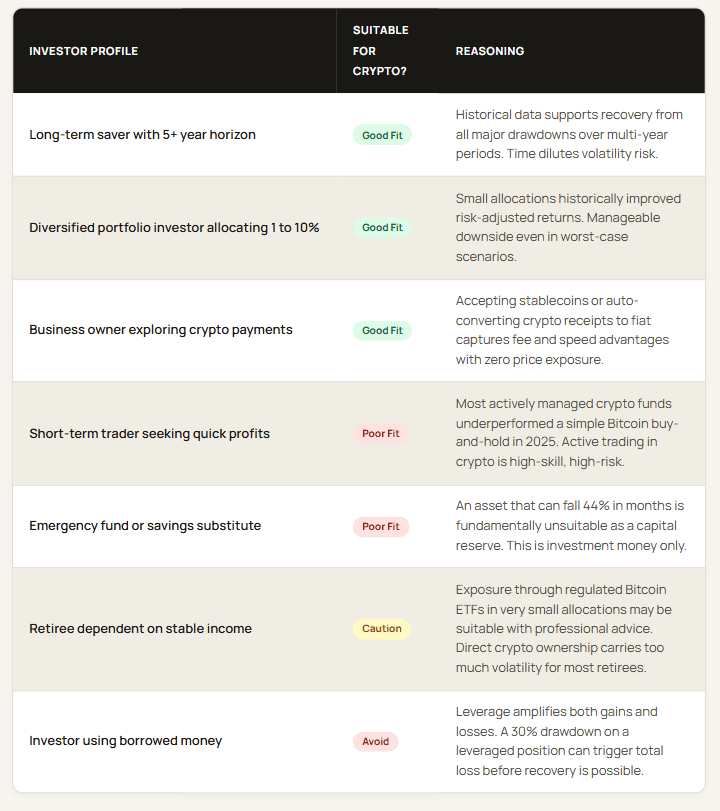
Who Should Consider Investing in Cryptocurrency and Who Should Not?
What Steps Should a First-Time Crypto Investor Follow?
- Educate Yourself Before Spending Anything:
Understand what a blockchain is, how private keys work, what a crypto wallet does, and the difference between centralised exchanges and self-custody. Ignorance is the most expensive thing in this market. - Decide Your Allocation and Risk Tolerance First
Before touching a single asset, decide what percentage of your investable assets, not your total net worth, you are comfortable losing entirely.
Institutional frameworks suggest 1 to 10%. No more than you can genuinely afford to lose. - Use a Regulated, Reputable Platform
Choose a regulated exchange or ETF provider, not any platform promising extraordinary returns or operating in a regulatory grey zone.
Verify independently, check FCA or SEC registration where applicable, and use two-factor authentication from day one. - Start With Bitcoin or Ethereum, Not Speculative Altcoins
The two most established digital assets have the deepest liquidity, the clearest regulatory status, the most institutional backing, and the longest track records.
Altcoins can play a role in a more experienced portfolio, not in the first position. - Secure Your Holdings Properly
If you hold crypto directly rather than through an ETF, store your seed phrase physically in multiple secure locations. Consider a hardware wallet for meaningful holdings.
Never store your private key digitally, and never share it with any third party. - Rebalance and Resist Emotional Decisions
Set a schedule, quarterly or semi-annually, to rebalance your crypto allocation relative to your target percentage. When prices surge, take profits back to your target. When prices fall, do not panic-sell. The data consistently rewards the patient and punishes the reactive.
Conclusion
As we wrap it up, we have moved past the cycle of binary ”yes or no” answers.
The truth is, the market doesn’t care about your expectations, it rewards your preparation.
So, is crypto a good investment? Only if you treat it like a serious financial discipline rather than a lottery ticket. The tools, the data, and the legal frameworks are finally here; the rest is up to your strategy.