


Cryptocurrency liquidity is one of those concepts that sounds technical until the moment you try to sell a position quickly and watch the price move against you with every click.
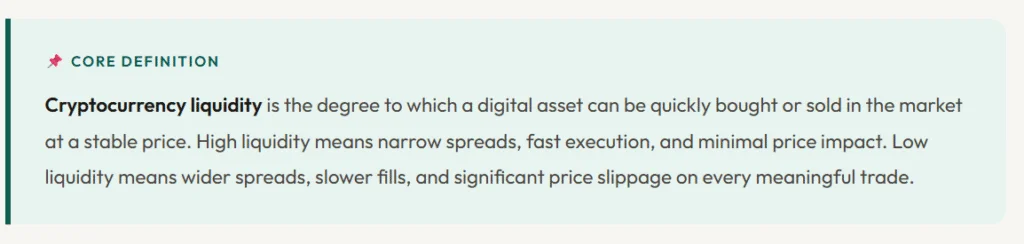
At its core, liquidity describes how easily a digital asset can be bought or sold at a stable, fair market price without that act of trading itself causing a significant shift in price.
In this guide, we’re breaking down how crypto liquidity actually moves, how to measure it, and why it’s such a big deal for both day traders and businesses.
What Is Cryptocurrency Liquidity and Why Does It Matter?
Liquidity in any financial market refers to how efficiently and cheaply an asset can be converted into cash or another asset without causing a significant change in its market price.
In the context of cryptocurrency, liquidity measures how readily you can trade a digital asset on an exchange, whether centralised or decentralised, at a price close to what the market is currently showing you.
See it this way: Bitcoin is highly liquid because millions of buyers and sellers participate globally every hour, 24 hours a day.
A small-cap altcoin listed on a single exchange with minimal trading activity is ill-iquid. Attempting to sell even a modest position may push the price down significantly before you find enough buyers to fill your order.
The difference between those two experiences is liquidity, and it has very real financial consequences.
How Does Liquidity Affect the Price You Actually Pay?
When you place a market order on a centralised exchange, your order moves through the order book, a live record of all outstanding buy and sell orders at various price levels.
If there is deep liquidity at your target price, your order fills quickly at something close to the quoted rate.
If the book is thin, your order walks through available sell orders at increasingly worse prices until it is filled.
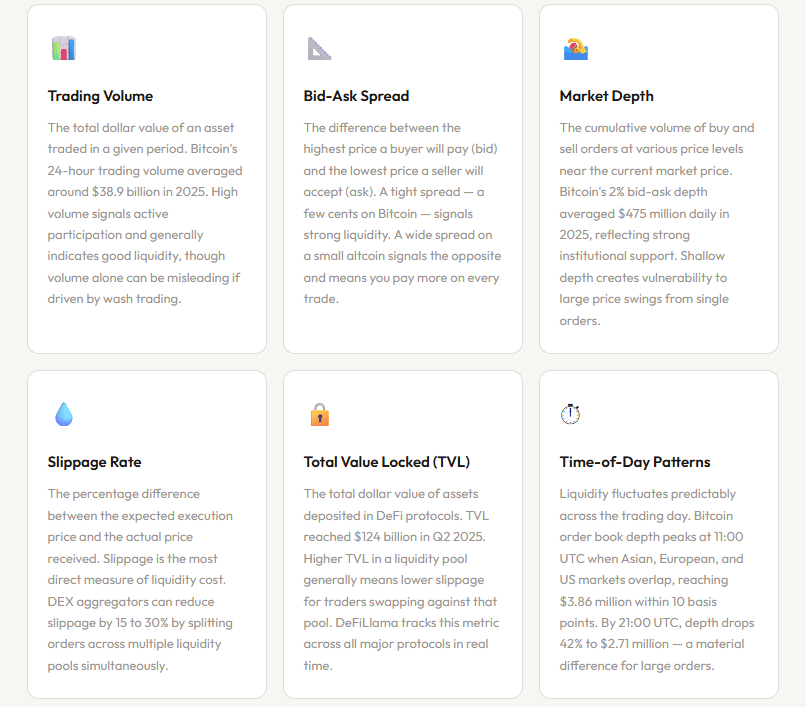
That difference between the price you expected and the price you got is called slippage.
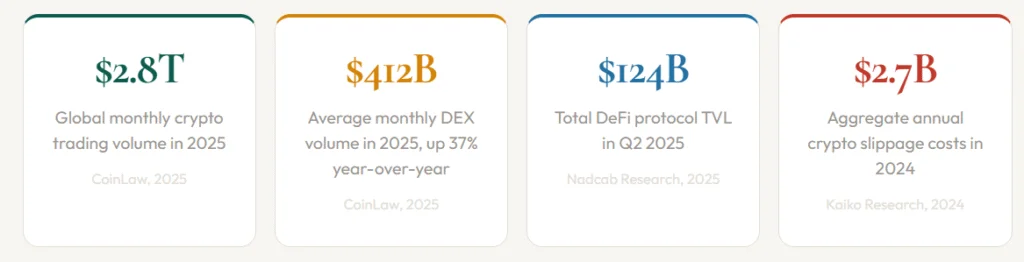
Aggregate slippage costs reached $2.7 billion in 2024, a 34% increase from the prior year, demonstrating that even in a maturing market, the cost of poor liquidity is enormous and growing with trading volumes.
For institutional traders moving millions, this is a constant operational concern.
For retail traders making regular purchases, it quietly erodes returns on every transaction.
Related Reads: What is a crypto exchange? how cryptopayments work?
How Is Cryptocurrency Liquidity Measured and Analysed?
Professional traders and researchers use several overlapping metrics to assess the liquidity of a digital asset or market.
Knowing these gives you a more accurate picture of whether a trade will execute cleanly or whether you are about to encounter hidden friction.
What Is the Difference Between CEX Liquidity and DEX Liquidity?
This is one of the most practically important distinctions in crypto market structure, and it directly affects how you trade, what fees you pay, and how much control you retain over your assets.
How Do Centralised Exchanges Manage Liquidity?
Centralised exchanges (CEXs) like Binance, Coinbase, and Kraken operate traditional order book systems.
Professional market makers place large volumes of buy and sell orders across tight price ranges, profiting from the bid-ask spread.
The trade-off is custody: when you trade on a CEX, you are entrusting your assets to the exchange’s control.
Your private keys are held by the platform. The collapse of FTX in 2022 remains the definitive reminder of what that counterparty risk can cost.
CEX liquidity is deep but comes with custodial risk and regulatory exposure.
How Do Decentralised Exchanges Create Liquidity Without Order Books?
Decentralised exchanges (DEXs) solved a fundamental problem: traditional order book matching requires a central authority, which defeats the purpose of a decentralised system.
The solution was the Automated Market Maker (AMM) a smart contract that holds reserves of two tokens and uses a mathematical formula to price trades between them automatically.
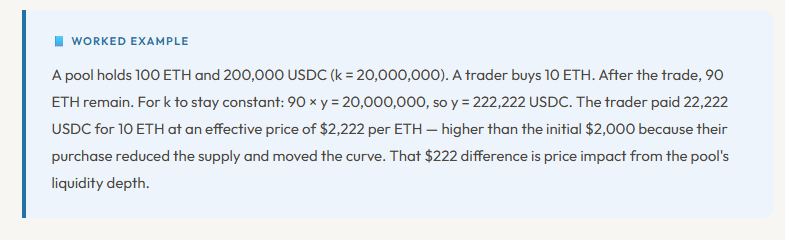
The most famous AMM formula, pioneered by Uniswap, is the constant product formula: x × y = k.
In this equation, x and y represent the quantities of two tokens in the pool, and k is a constant that must be preserved after every trade.
When you buy token A from the pool, you decrease its supply (x falls), which forces y to rise to maintain k, automatically increasing the price of A.
No human market maker is needed, the algorithm prices every trade in real time based on pool reserves.
What Is a Liquidity Pool and How Do Liquidity Providers Earn Returns?
A liquidity pool is a smart contract holding reserves of two or more tokens that traders can swap against.
Read also on data/information concerning Liquidity pools
What Are the Most Common Liquidity Mistakes Crypto Traders Make?
Ignoring Slippage:
Many traders only look at the sticker price. On smaller tokens, a single trade can swing the price by 5% to 10% before it even finishes.
Always check the price impact on your DEX before hitting.
Sticking to One Exchange:
Liquidity is spread thin across dozens of platforms.
If you only trade in one spot, you’re missing better prices elsewhere and risking a total lockout if that one exchange goes down.
The Passive Income Trap:
Providing liquidity isn’t free money.
If the price of your tokens shifts significantly, impermanent loss can actually leave you with less value than if you had just held the coins in your wallet.
Frequently Asked Questions
What is impermanent loss?
Impermanent loss occurs when the price ratio of your tokens changes after depositing them into an AMM pool, leaving you with a less favourable mix than if you had simply held them.
How to avoid impermanent loss?
You can reduce this risk by providing liquidity in stablecoin-only pools (like Curve’s 3pool), using concentrated liquidity ranges on Uniswap v3 only when you are confident in a price range, or selecting high-volume pools where trading fees significantly offset any divergence losses.
Conclusion
Cryptocurrency liquidity is the invisible force that determines whether you’re actually in control of your capital or just along for the ride.
In a market that never sleeps, having the exit door wide open is just as important as finding the right entry.