


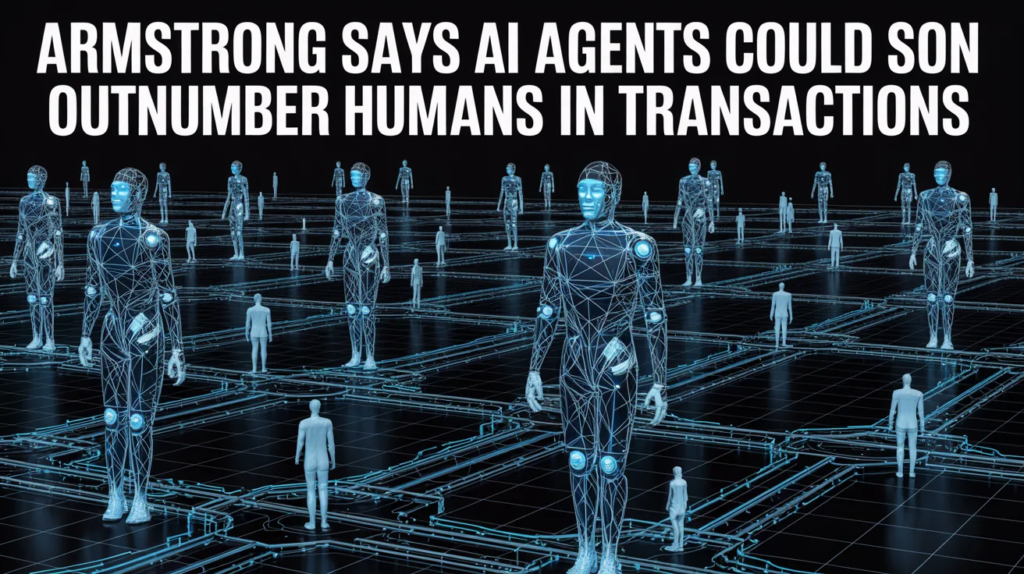
The next major wave of financial activity on the internet may be driven entirely by machines. According to Brian Armstrong, autonomous artificial intelligence agents could soon become the most active participants in digital transactions — and cryptocurrency infrastructure may be the only system currently capable of supporting them at scale.
Armstrong recently argued that AI agents will soon perform more financial transactions than humans, largely because traditional banking systems are not designed for software entities. Cryptocurrencies, however, allow these agents to operate independently through digital wallets.
His comments highlight a growing discussion across both the technology and crypto sectors: as software becomes capable of acting autonomously, the financial infrastructure supporting it must change as well.
Key Takeaways
- Autonomous AI agents are expected to conduct more financial transactions than humans as their capabilities expand across digital services and automated workflows.
- Crypto wallets provide a practical financial infrastructure for AI agents because they can be created instantly without the identity requirements imposed by traditional banking systems.
- Industry leaders such as Brian Armstrong and Changpeng Zhao believe machine-to-machine commerce could generate exponentially higher payment volumes than human-driven transactions.
- Traditional financial institutions face structural limitations in serving AI agents because regulatory frameworks require accounts to be linked to verified individuals or legal entities.
- Technology companies and crypto platforms are already developing infrastructure that allows AI agents to hold digital assets and execute autonomous payments.
AI Agents as Economic Participants
AI agents are software programs capable of completing complex tasks with limited human oversight. Instead of simply responding to commands, they can plan steps, interact with online services, and execute actions to achieve a goal.
As these systems grow more sophisticated, many of their tasks require access to financial resources. For example, an AI tasked with deploying a website may need to purchase cloud storage, acquire datasets, or pay for computing power.
Traditionally, such payments must be made through bank accounts owned by humans or corporations. But that model creates friction when software itself is the decision-maker.
Armstrong’s argument is that blockchain networks solve this limitation because wallets can be created instantly through cryptographic keys without identity checks. An AI agent can generate a wallet address, hold digital assets, and interact with smart contracts without relying on a bank.
This capability opens the door to machine-to-machine commerce where software autonomously pays for services such as data access, bandwidth, computing power, or task execution.
CZ Predicts Massive Payment Volumes
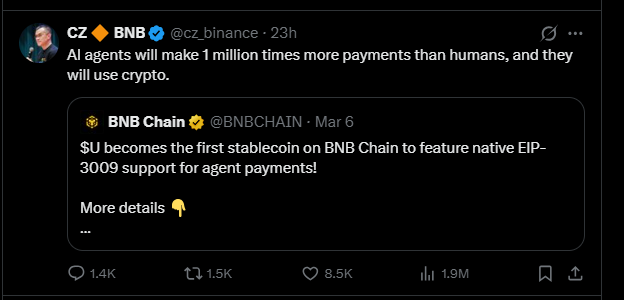
The idea that AI could reshape financial activity is also gaining traction among other crypto leaders. Changpeng Zhao, widely known as CZ and the founder of Binance, recently suggested the scale of machine-driven payments could dwarf human activity.
While the figure is speculative, the broader point reflects a structural shift already underway. Automated systems are increasingly performing tasks that previously required human intervention, from trading algorithms to logistics scheduling and customer service operations.
If these systems begin paying each other directly for digital services, transaction volumes could rise dramatically — especially if payments occur in small increments at high frequency.
Cryptocurrency networks, particularly those supporting stablecoins and programmable wallets, are well-suited for this type of activity.
Why Traditional Banking Struggles with AI
The current financial system was built around identifiable individuals and legally registered organizations. Banking regulations typically require institutions to verify the identity of account holders and track beneficial ownership.
For instance, guidance from the Financial Crimes Enforcement Network states that financial institutions must identify their customers and verify their identities when accounts are opened. In the case of businesses, banks must also determine the beneficial owners behind those entities.
Even when intermediaries or agents act on someone’s behalf, the account must ultimately trace back to a human or legally recognized organization.
That requirement makes it difficult for standalone software programs to interact directly with banks. An AI agent cannot independently pass Know Your Customer (KYC) checks or provide government-issued identification.
Banks can still support automated systems indirectly through corporate accounts, custodians, and API-based services. But the structure always ties back to a legal entity.
Crypto wallets, by contrast, are not bound to this framework. Control of funds is determined by possession of a private key rather than a verified identity.
This difference explains why blockchain networks are emerging as the preferred payment rails for machine-driven transactions.
Coinbase and BNB Ecosystem Build AI Payment Tools
Infrastructure designed specifically for AI-driven commerce is already appearing.
Coinbase has introduced “Agentic Wallets,” a system designed to give autonomous AI programs their blockchain wallets. These wallets allow agents to hold assets and execute transactions automatically while interacting with decentralized applications.
Meanwhile, infrastructure tied to the BNB Chain ecosystem is experimenting with new payment flows built around standards like EIP-3009. These systems aim to simplify programmable transactions and machine-to-machine payments.
The goal is to create a financial environment where software agents can transact continuously without manual intervention.
Microsoft Signals a Similar Direction
The shift toward autonomous digital actors is not limited to the crypto industry.
During a recent technology conference, Satya Nadella described a future where software agents function as full participants within digital workplaces.
According to Nadella, these “digital workers” will have their identities, tools, and computing environments.
Microsoft increasingly views these agents as a new category of user—similar to how companies once transitioned from desktop computing to mobile-first software ecosystems.
If businesses begin deploying large numbers of these agents to perform tasks such as coding, data analysis, or automated research, each agent could potentially require access to payment infrastructure.
Challenges Still Remain
Despite the optimism from crypto executives, the idea of autonomous financial actors raises several unresolved issues.
Legal responsibility becomes complex when software makes financial decisions independently. Questions surrounding fraud, taxation, sanctions compliance, and consumer protection are far from settled.
Governments and regulators will likely need to rethink how accountability works when machines can initiate transactions without direct human approval.
There are also questions about the commercial viability of large-scale agentic systems. Research firm Gartner warned in 2025 that more than 40% of agentic AI projects could be canceled before 2027 due to high costs, limited business value, or insufficient risk management.
A New Category of Financial User
Still, the momentum behind AI-driven automation continues to grow.
If autonomous agents become common across industries — from software development to logistics and digital services — they will need a way to pay for resources instantly and globally.
Crypto proponents argue that blockchain networks already provide the infrastructure for that future.
Armstrong’s prediction may sound ambitious, but it reflects a broader transformation in how digital systems interact with the economy. In a world where machines increasingly perform tasks on behalf of humans, financial networks designed for human identity alone may struggle to keep up.
If autonomous software becomes a major economic player, the wallet—not the bank account— could become the primary gateway to financial participation.