
In Latin America, Uruguay is one of the few countries whose cryptocurrency landscape is considered “progressive”. Some neighboring countries that wear this similar badge are the Dominican Republic, Chile, and Paraguay.
This progressive label is due to the government’s proactive stance in promoting blockchain technology and exploring the potential of digital currencies. This is visible with the establishment of a comprehensive legal framework for cryptocurrencies in October 2024, eliminating the “grey area” effect and boosting confidence in virtual currencies.
This has led to impressive growth in crypto adoption by market size and user base. Statista reports US$5.9 million market revenue was generated in 2024, while a negative growth of US$5.7 million is forecasted for 2025. The number of users of cryptocurrencies or should I say spenders, is expected to reach about 164,400 in 2025.
This data reflects the growing market of cryptocurrencies in Uruguay and why you should consider it as a crypto hub. In this article, we will take a trip to the world of these spenders, showing you the best places where they spend cryptocurrencies in Uruguay and why you should join them.
Key Takeaways
- Cryptocurrencies are legal and regulated, but their tax implications remain unstated.
- The two leading cities where you can spend crypto in Uruguay are Punta del Este and Montevideo.
- This is because they are tourist-attractive and tech-savvy hotspots.
- Hotels, restaurants, cafés, and tech companies lead businesses that accept cryptocurrencies.
- At least one Bitcoin ATM exists in Punta del Este.
Where to Spend Crypto in Uruguay
Tourism, real estate and remittances are the leading sectors accepting cryptocurrencies as payment in Uruguay. Statista reports that the tourism sector will generate US$272,660,000 in 2025 with a 6.18% increase to about US$346,580,000 through 2029.
Uruguay is a popular and beautiful tourist destination in South America with two major cities being the most attractive spots. These cities are no other than Punta del Este and Montevideo. Let’s proceed to explore these cities and the best spots where you can spend crypto.
1. Punta del Este – Tourism and Hospitality
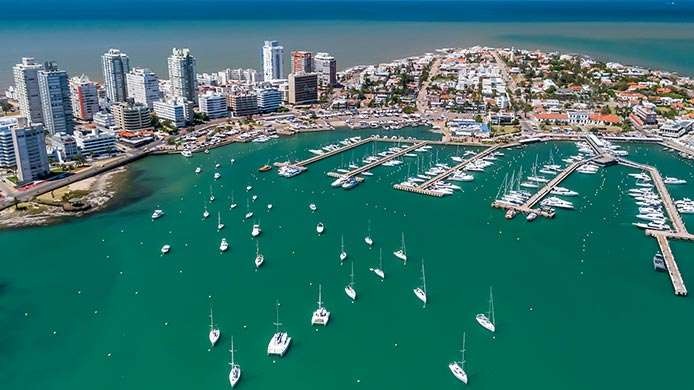
This is a stunning resort town on Uruguay’s southern coast, where the Río de la Plata (river) meets the Atlantic Ocean. It is popularly known as the “St. Tropez of South America,” and it boasts beautiful beaches like Playa Mansa and Playa Brava.
Source: costacruises.co.uk
Punta del Este has iconic landmarks such as La Mano sculpture, and a mix of modern and colonial charm. It is a tourist destination due to its golden sands, vibrant nightlife, luxury yachts, and cultural gems like Casapueblo, offering a perfect blend of relaxation, adventure, and sophistication.
As a leading tourist destination, there are many businesses in Punta del Este that accept cryptocurrencies. Some of these are:
1. The Grand Hotel Punta Del Este, Punta del Este, Uruguay
2. Sunset Beach Hotel, Punta del Este
3. Park Hotel, Punta del Este
2. Montevideo – Urban and Tech-Savvy Spots
Montevideo is the largest and capital city in Uruguay. It also doubles as the financial capital with the presence of multiple mega-businesses. When you think of Montevideo, the first thing that comes to mind is its laid-back beach atmosphere, café culture, and well-preserved old town.
It is situated on the southern coast, on the northeastern bank of the Río de la Plata, making it a major port and a centre for education and business, with industries including food processing, wool, oil, and cement.
These many businesses with hundreds and thousands of tourist clients have created a market for crypto transactions. Let’s take a glance at some of these businesses that accept crypto.
To juggle your memory, here’s a summary recap of all the places listed above and their location:
| S/N | Place | Business/Service | Location |
| 1 | Bitcoin ATM | Exchange | Punta del Este |
| 2 | Urubit | Logistics | Punta del Este |
| 3 | Iniberto | Tech startup | Punta del Este |
| 4 | The Grand Hotel | Hotel | Punta del Este |
| 5 | Sunset Beach Hotel | Hotel | Punta del Este |
| 6 | Park Hotel | Hotel | Punta del Este |
| 7 | Bulka Café | Café | Montevideo |
| 8 | Puerto Mercado Hotel | Hotel | Montevideo |
| 9 | Alfa Suites | Hotel | Montevideo |
Tips for Spending Crypto in Uruguay
Spending cryptocurrencies in Uruguay can be fun and thrilling if you are fully informed about these tips:
Understand the Legal Landscape
Cryptocurrency is legal in Uruguay and well-regulated. In October 2024, law 20.345 was enacted, recognizing crypto as virtual assets and giving the Central Bank regulatory oversight.
This framework supports its use, but it is not legal tender like in El Salvador, so acceptance depends on individual merchants. Do remember such regulations may change or be updated in future. Do well to always be informed.
Be Aware of Tax Implications
The Uruguay crypto law 20.345 was quiet about tax implications but either way, you are advised to keep records of your transactions in case of a potential tax obligation.
Gains from selling or spending crypto may be subject to capital gains tax in the future. You should consult a local tax professional if you’re unsure for better guidance.
Find Crypto-Friendly Merchants
From the list of businesses above, you can notice they are all in two major cities—Montevideo and Punta del Este. Secondly you can also notice the businesses are either hotels, restaurants, or tech companies. Businesses in the aforementioned places are your best bet to spend crypto in Uruguay.
You could also find a local guide to help you in your quest or check online directories and forums for up-to-date lists of merchants.
Use Crypto Debit Cards
Now this is a smart one! You could simply use your ByBit virtual debit card to make payments. These cards convert your crypto to Uruguayan Pesos (UYU) at the point of sale, allowing you to use it anywhere cards are accepted. Be sure to check for cards with low conversion fees and ensure they support Uruguay’s payment networks.
Leverage Bitcoin ATMs
This should not be something new to you as we have talked about earlier and even dropped its location in Punta del Este. This ATM allows you to convert crypto to cash (UYU) for spending.
Opt for Peer-to-Peer Transactions
If other options fail, this should be your fallback plan. You can basically patronize any exchange P2P service, convert your crypto to fiat and make payments, especially for businesses that do not accept cryptocurrencies.
Plan for Volatility
Now you want to be very careful with this one. This is basically one of the reasons why some small businesses find it difficult to adopt cryptocurrencies. If you’re spending directly, ensure the merchant locks in the exchange rate at the time of purchase to avoid surprises. For conversions to UYU, consider timing your sales during stable market periods to maximize value.
Start Small and Test
In the words of Vincent Van Gogh:
“Great things are not done by impulse, but by a series of small things brought together”
You should begin with small transactions to understand the process, fees, and merchant reliability. For instance, buy a coffee or a souvenir with Bitcoin to get comfortable before larger purchases.
Stay Secure
Use a trusted wallet to store your crypto, and enable two-factor authentication (2FA) on any apps or exchanges. When spending, avoid public Wi-Fi to reduce security risks, and double-check wallet addresses to prevent errors or fraud.
Challenges of Spending Crypto in Uruguay
Now that you have know places to spend crypto in Uruguay and tips to ensure a smooth ride, here are some potential problems you may likely still encounter:
Limited Merchant Adoption
I do not need to say much here because the list above says it all. Aside from the service sector and some tech companies, you may find it difficult to locate companies outside these sectors that accept cryptocurrency. Most especially, the selected companies are usually located in Punta del Este or Montevideo.
Dependence on Intermediaries
For the hotels listed above, you could see that they had to rely on online booking companies, such as Travala to accept cryptocurrencies. While this is impressive, it will cost you more. Remember that these booking companies also charge for their services. This may also be the case with other businesses.
Price Volatility
Cryptocurrencies are notoriously volatile. If you’re spending directly, a sudden drop in value between selecting an item and completing the transaction could leave you short. Merchants who accept crypto might not always lock in the exchange rate instantly, adding uncertainty. Converting to UYU beforehand means you’re at the mercy of market swings during the sale.
High Transaction Fees
On-chain transactions, especially with Bitcoin, can come with crazy network fees during peak times. This would make small purchases inefficient unless you’re using a Layer 2 solution like the Lightning Network, which may not be universally supported by Uruguayan merchants yet.
Technical Barriers
Spending crypto requires some tech literacy—managing wallets, scanning QR codes, or navigating exchange apps. For newcomers or less tech-savvy users, this can be overwhelming. Mistakes like sending funds to the wrong address (irreversible in most cases) or losing private keys could discourage future transactions.
Internet Reliability
Crypto transactions rely on internet access, so if the internet ever gets down while you intend to make a transaction you have no other option than to wait. This might be embarrassing or discomforting especially if you have a busy schedule.
Infrastructure Gaps
Yes! There’s a Bitcoin ATM in Punta del Este, but so far that has been the only one I could verify (while writing this article). It is scarce, and expansion has been slow. Crypto debit cards are a workaround, but not all international providers operate seamlessly in Uruguay, and local issuance is limited. Without robust infrastructure, you’re often stuck with fewer convenient options.
These challenges don’t make spending crypto impossible but they can be exhausting and disturbing, anyways, you can always find your way around them, why? You are a crypto believer. How did I come to that conclusion? Because you are reading this article now.
Conclusion
To spend crypto in Uruguay, just head straight to Punta del Este or Montevideo and be prepared as your options are limited. From hotels, restaurants, and tech companies, you may not get the luxury to do so in other sectors.
While this challenge lingers, Uruguay presents numerous options to still make use of these digital assets—from its Bitcoin ATM to peer-to-peer transactions, to virtual debit crypto cards, you are indeed limitless!
FAQs
1. Is cryptocurrency legal in Uruguay?
Yes, cryptocurrency is legal under Law 20.345, enacted in October 2024. It’s classified as a virtual asset, regulated by the Central Bank of Uruguay, but it’s not legal tender like the Uruguayan Peso (UYU).
2. Where can I spend crypto directly in Uruguay?
You can spend crypto at selected merchants in Punta del Este (especially luxury retail and dining), Montevideo (cafés), and tourist spots like hotels or tour operators. Real estate agencies may often accept it too.
3. What’s the best city for crypto spending?
Punta del Este stands out due to its Bitcoin ATM and tourist-driven adoption. Montevideo follows as the capital with a growing tech-savvy scene.
4. Can I use a crypto debit card in Uruguay?
Yes, cards from providers like ByBit and Binance convert crypto to UYU and work at most card-accepting merchants. Check for compatibility and fees.
5. Are there Bitcoin ATMs in Uruguay?
Yes, there is at least one in Punta del Este at Smart Point on Gorlero Avenue. There are talks for more especially in cities like Montevideo, but at the time of writing, we could only verify one.
6. How do I find crypto-friendly businesses?
Look for crypto payment logos (e.g., Bitcoin or Ethereum symbols), ask merchants directly, or search online directories and local crypto forums. Your best bets are tourist areas and real estate markets.