

One of the downsides of Web 2 is the lack of proper control over personal data; platforms collect, store, and often monetize user information without meaningful consent. Blockchain promised a solution by enabling decentralized transactions, but most networks remain public, leaving addresses and transfers traceable. This gap created the need for blockchain projects that prioritize user anonymity without compromising security.
In blockchain technology, privacy-preserving networks use cryptographic tools like zero-knowledge proofs, ring signatures, and stealth addresses to secure financial data from unwanted exposure. These protocols help ensure transactions remain verifiable yet shielded from prying eyes.
As adoption grows, identifying the most reliable privacy-focused blockchains becomes essential for anyone prioritizing confidentiality in crypto transactions.
Key Takeaways
- Privacy-preserving blockchains use advanced cryptographic tools like zero-knowledge proofs, ring signatures, and stealth addresses to secure transactions and protect user identities.
- Leading platforms such as Monero, Zcash, Secret Network, Oasis, Horizen, Firo, Dusk Network, and PIVX each offer unique approaches to confidentiality, scalability, and regulatory alignment.
- Factors like transaction anonymity strength, scalability, adoption, compliance, and security history are critical when evaluating privacy-focused blockchain networks.
- Real-world applications range from private peer-to-peer payments and DeFi trading to enterprise data management and anonymous crowdfunding.
- Growing adoption of privacy-centric blockchains highlights their role in creating secure, censorship-resistant, and confidential digital ecosystems.
What are Privacy-Preserving Blockchains
Privacy-preserving Blockchains are decentralized networks designed to protect user identity, transaction details, and wallet balances from public exposure while still maintaining the integrity and security of the ledger.
Unlike conventional blockchains such as Bitcoin or Ethereum—where all transactions are visible on-chain—these networks use advanced cryptographic methods to keep sensitive information hidden without compromising verification.
Technologies like zero-knowledge proofs (ZKPs), ring signatures, stealth addresses, and confidential transactions enable this level of anonymity. This makes them ideal for users seeking confidentiality in payments, DeFi activities, or data storage, while still benefiting from decentralization, immutability, and resistance to censorship.
Best Privacy Preserving Blockchain Platforms
Monero (XMR)
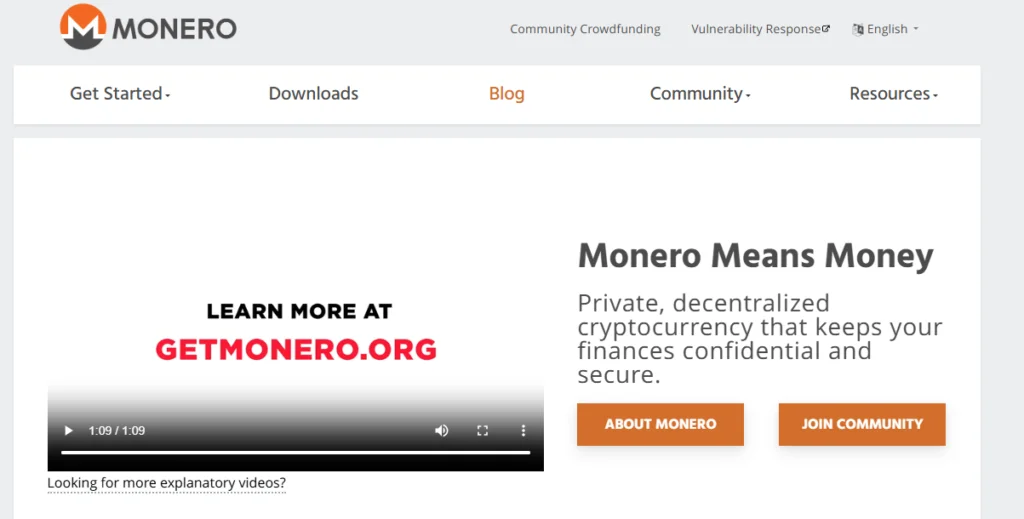
Monero (XMR) is one of the most trusted privacy-focused blockchain platforms, built to deliver fully confidential and censorship-resistant transactions.
Unlike Bitcoin or Ethereum, where transaction details are publicly visible, Monero ensures every transaction is private by default.
It uses advanced technologies like stealth addresses to hide recipient details, ring signatures to obfuscate senders, and RingCT to conceal transaction amounts. This guarantees fungibility, meaning no coin can be blacklisted based on its history.
With its decentralized nature and strong community support, Monero remains a leading choice for users and merchants seeking secure, untraceable, and truly anonymous digital payments.
Key Features
- Uses stealth addresses to hide the recipient’s wallet address from public view.
- Employs ring signatures to mix a sender’s transaction with others, obscuring its origin.
- Implements RingCT (Ring Confidential Transactions) to conceal the transaction amount.
- Ensures default privacy, meaning every transaction is anonymous without manual settings.
- Offers fungibility, preventing coins from being blacklisted based on past usage.
- Maintains decentralization with an open-source and community-driven development model.
- Supports cross-platform wallets for seamless access on various devices.
- Provides censorship resistance, allowing transactions without reliance on centralized authorities.
Zcash (ZEC)
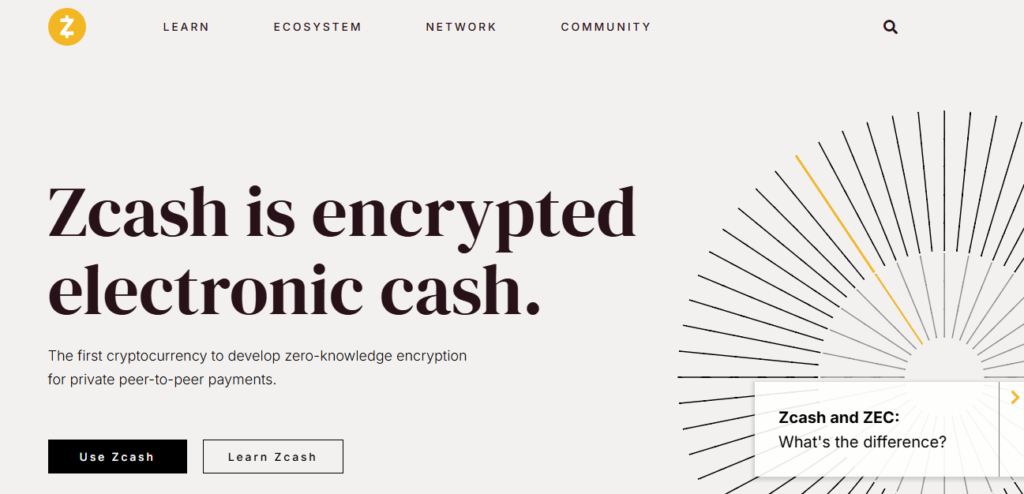
Zcash (ZEC) is a leading privacy-preserving blockchain designed to provide users with secure, encrypted digital payments. It pioneered the use of Zero-Knowledge Proofs (zk-SNARKs), enabling transactions to be verified without revealing the sender, receiver, or amount.
Unlike fully transparent blockchains, Zcash offers users the choice between public and shielded transactions, giving flexibility without compromising confidentiality.
With fast transaction speeds, low fees, and broad exchange support, Zcash is widely accessible for both everyday payments and long-term storage. Its decentralized development model continues to enhance usability, ensuring ZEC remains a trusted option for individuals who prioritize financial privacy and security.
Key Features
- Uses zk-SNARKs to verify transactions without exposing the sender, receiver, or amount.
- Provides selective transparency, allowing users to choose between public and shielded transactions.
- Ensures end-to-end encryption for stronger financial privacy.
- Supports fast transaction speeds with fees significantly lower than Bitcoin.
- Operates as a decentralized protocol, giving users full control over their funds.
- Enables private messages to be included alongside transactions.
- Funds ongoing development through a self-sustaining model that rewards contributors.
Secret Network (SCRT)
If you are looking for a blockchain that combines privacy with smart contract functionality, Secret Network (SCRT) delivers a powerful solution. Launched in 2020, it is the first mainnet to support privacy-preserving smart contracts, allowing developers to build decentralized applications that protect sensitive user data.
With end-to-end encryption and tools like Secret Bridges and the SNIP-20 token standard, the network enables privacy for any token while maintaining interoperability across chains.
Positioned as a confidential computing hub for Web3 and AI, Secret Network also introduces infrastructure for secure large-scale AI models, making it a versatile platform for private, data-driven innovation.
Key Features
- Supports privacy-preserving smart contracts that protect sensitive user data.
- Uses end-to-end encryption to secure transactions and application logic.
- Offers Secret Bridges to enable cross-chain interoperability with privacy.
- Provides the SNIP-20 standard, making any token privacy-enabled.
- Functions as a confidential computing hub, integrating Web3 with secure AI infrastructure.
- Enables large-scale GPU processing for AI models inside trusted execution environments.
Oasis Network (ROSE)
Oasis Network (ROSE) is a privacy-first blockchain designed to power confidential Web3 applications and AI. With its Sapphire confidential EVM, developers can deploy encrypted smart contracts in a familiar environment while ensuring sensitive data remains protected. Its Oasis Privacy Layer (OPL) allows any EVM-based blockchain to integrate privacy without leaving the native chain, while ROFL introduces scalable, verifiable off-chain computation.
Use cases range from DeFi with MEV protection to gaming, NFTs, DAOs, and responsible AI. Powered by the ROSE token, the network supports secure data handling, confidentiality, and scalable decentralized applications built for the future of Web3.
Key Features
- Provides the Sapphire confidential EVM for deploying encrypted smart contracts with on-chain privacy.
- Integrates the Oasis Privacy Layer (OPL) to add configurable privacy to any EVM-based blockchain.
- Utilizes ROFL (confidential off-chain computation) for scalable, verifiable processing.
- Enhances DeFi with confidential smart contracts and MEV protection.
- Supports responsible AI by securing data in crowd-sourced, on-chain AI models.
- Powers on-chain gaming and NFTs with strategic secrecy and metadata protection.
- Enables private governance and voting for DAOs to ensure fair participation.
- Secures its ecosystem with the ROSE token, used for transactions and staking.
Horizen (ZEN)
Launched in 2017, Horizen (ZEN) is a privacy-first blockchain platform now relaunched on Base as an ERC-20 token to power scalable, privacy-ready applications. With its built-in zero-knowledge proof generation layer, Horizen enables developers to integrate privacy by default into DeFi, gaming, and AI tools without additional complexity.
Its ecosystem supports private DeFi, privacy pools, and seamless verification using advanced ZK proof protocols.
Backed by major exchanges like Coinbase and Binance and accessible through the Grayscale Horizen Trust, ZEN combines privacy, scalability, and compliance-friendly technology, making it a trusted blockchain for individuals, developers, and businesses seeking secure digital interactions.
Key Features
- Uses a native zero-knowledge proof generation layer to provide privacy by default.
- Supports private DeFi and privacy pools for confidential asset management.
- Delivers fast and seamless verification through advanced ZK proof protocols.
- Enables scalable privacy apps across DeFi, gaming, and AI use cases.
- Maintains a fixed supply of 21 million ZEN, similar to Bitcoin.
- Ensures broad accessibility through major exchange listings like Coinbase, Binance, and Uniswap.
- Provides institutional exposure via the Grayscale Horizen Trust.
- Focuses on privacy, innovation, and verifiable compliance, empowering secure and trusted dApp development.
Firo (FIRO)
Firo (FIRO) is a privacy-preserving cryptocurrency built to provide trustless, on-chain anonymity and secure digital payments.
Using the Lelantus Spark protocol, Firo ensures transactions remain confidential with hidden amounts and unlinkable addresses, while Dandelion++ protects users at the network layer.
Its hybrid consensus model combining Proof-of-Work (FiroPoW) with LLMQ Chainlocks defends against 51% attacks and offers near-instant transaction finality. Beyond payments, Firo expands privacy to Spark Assets, enabling confidential tokens for applications like private voting or asset transfers.
With continuous research and innovations adopted by other projects, Firo remains a leading privacy-first blockchain supporting both scalability and security.
Key Features
- Uses the Lelantus Spark protocol to deliver trustless, on-chain privacy with hidden amounts and unlinkable addresses.
- Implements Dandelion++ to provide network-layer anonymity by concealing transaction origins.
- Employs a hybrid PoW and LLMQ Chainlocks system for strong security and resistance against 51% attacks.
- Ensures near-instant block and transaction finality through Chainlocks.
- Maintains a 21.4 million total supply with tail emission for long-term sustainability.
- Leverages FiroPoW, a GPU-friendly mining algorithm designed for decentralization.
- Operates with 3900+ masternodes, supporting network stability and governance.
- Introduces Spark Assets to extend privacy to tokens and asset transfers.
Dusk Network (DUSK)
When you talk about privacy in regulated finance, Dusk Network (DUSK) offers a unique blockchain solution built for compliance and confidentiality. As a Layer 1 platform, it enables privacy-preserving smart contracts through its Succinct Attestation Proof-of-Stake consensus, ensuring fast settlement finality for financial transactions.
Dusk introduces the XSC Confidential Security Contract for issuing privacy-enabled tokenized securities, bridging traditional assets with blockchain. Its Zero-Knowledge Utility Tokens maintain both privacy and compliance while supporting businesses, institutions, and users with scalable, regulation-ready applications.
By combining confidentiality with institutional-level features, Dusk empowers enterprises to securely access financing, automate processes, and bring real-world assets on-chain.
Key Features
- Enables confidential smart contracts that protect transaction and user data.
- Uses the Succinct Attestation Proof-of-Stake consensus to deliver fast settlement finality.
- Introduces the XSC Confidential Security Contract standard for tokenized securities.
- Supports zero-knowledge utility tokens to combine privacy with regulatory compliance.
- Provides institution-ready infrastructure for financing, settlement, and automated compliance.
- Functions as a Layer 1 blockchain, allowing developers to deploy privacy-focused financial applications.
- Facilitates security token exchanges for trading and custody of regulated assets.
- Targets businesses, institutions, and users by bringing traditional finance assets securely on-chain.
PIVX
PIVX is a privacy-focused proof-of-stake blockchain designed to provide users with freedom, security, and full control of their funds.
Through its SHIELD protocol, PIVX offers optional privacy, allowing transactions to remain confidential while giving users the choice of transparency when needed. The network delivers lightning-fast and secure transactions are supported by a second-layer protocol, while features like cold staking and masternodes strengthen decentralization and reward participation.
With a strong commitment to sustainable economics and decentralized governance, PIVX empowers its community to shape development while maintaining privacy as a fundamental right, making it a reliable platform for secure digital payments.
Key Features
- Utilizes the SHIELD protocol to provide optional privacy for transactions.
- Operates on a proof-of-stake consensus for energy efficiency and security.
- Supports cold staking, allowing users to earn rewards while keeping funds offline.
- Employs a masternode network to enhance decentralization and transaction validation.
- Ensures instant transactions through a second-layer protocol for speed and reliability.
- Implements decentralized governance, enabling the community to direct project development.
- Promotes sustainable economics to maintain long-term network stability.
- Prioritizes user choice and privacy rights, giving individuals full control over their financial data.
Key Technologies Powering Private Transactions
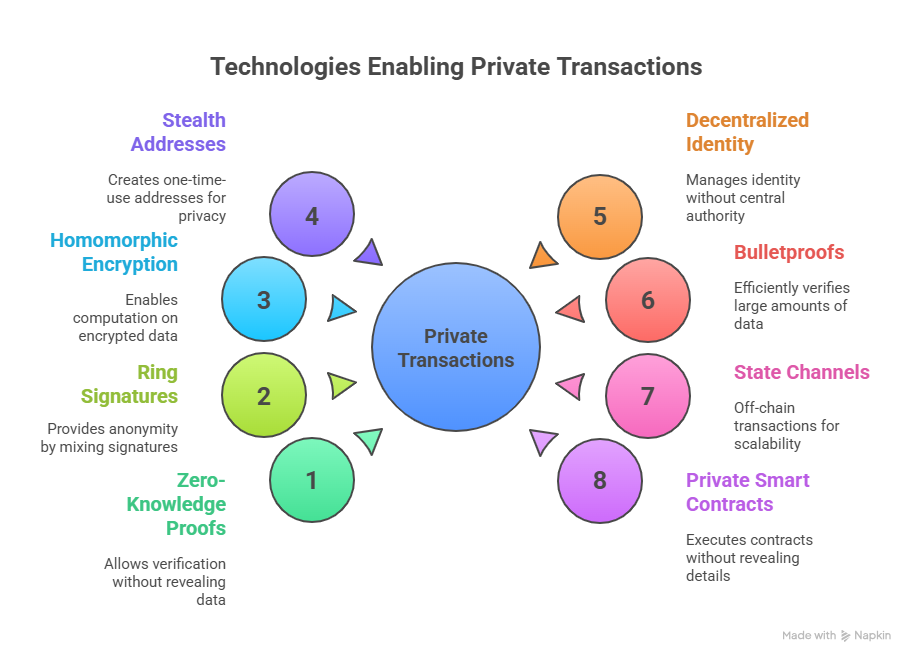
As blockchain adoption expands, privacy technologies play a critical role in protecting sensitive financial data and ensuring user confidentiality. Several cryptographic and architectural solutions have been developed to enable private transactions while maintaining trust and verifiability.
Below are the key technologies driving privacy in decentralized systems:
Zero-Knowledge Proofs (ZKPs)
Zero-knowledge proofs allow one party to prove they know specific information without revealing the actual data. In blockchain, this enables transaction validation, such as confirming funds exist, without disclosing the sender, receiver, or amounts. ZK-SNARKs and ZK-STARKs are widely used forms, powering platforms like Zcash.
Ring Signatures
Ring signatures mix a user’s digital signature with a group of possible signers, making it impossible to determine the true sender. Monero relies heavily on this technique, ensuring that each transaction could have originated from multiple participants.
Homomorphic Encryption
Homomorphic encryption allows computations to be performed on encrypted data without decrypting it first. This means blockchain nodes can validate and process private transactions without ever seeing the underlying information, adding a powerful layer of confidentiality.
Stealth Addresses
Stealth addresses generate one-time wallet addresses for every transaction, hiding the recipient’s actual public address. This prevents outside observers from linking multiple transactions to the same user, enhancing anonymity.
Decentralized Identity (DID)
Decentralized identity solutions give users ownership of their digital identities without relying on centralized authorities. In privacy-preserving blockchains, DID allows users to verify their identity when needed while keeping personal details confidential.
Bulletproofs
Bulletproofs are short, efficient cryptographic proofs used to verify confidential transactions without revealing amounts. They improve scalability and reduce transaction size compared to earlier zero-knowledge methods, making them ideal for privacy-focused blockchains like Monero.
State Channels and Sidechains
State channels allow users to conduct transactions off-chain privately, settling only the final result on the main blockchain. Sidechains provide dedicated blockchains that can run privacy features separately, reducing congestion and enhancing transaction confidentiality.
Private Smart Contracts
Private smart contracts use encrypted inputs, states, and outputs to ensure that contract logic runs securely without exposing sensitive details. Networks like Secret Network and Oasis enable developers to build decentralized apps where user data and interactions remain confidential.
Factors to Consider When Choosing a Privacy-Centric Blockchain
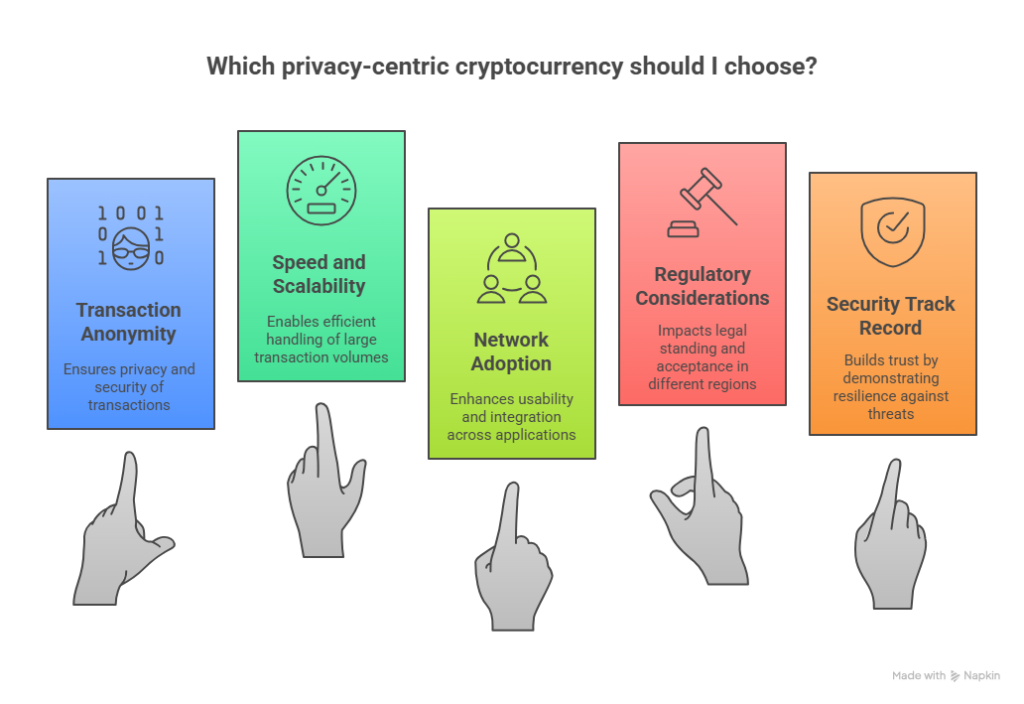
Selecting the right privacy-focused blockchain requires more than just looking at anonymity features—it involves evaluating multiple factors that influence usability, security, and long-term value.
Here are the key considerations:
Transaction Anonymity Strength
Not all privacy solutions provide the same level of protection. Some blockchains use optional privacy, while others enforce default anonymity. Assess the underlying technologies, such as zero-knowledge proofs, ring signatures, or stealth addresses, to determine how well transactions are shielded from public analysis.
Speed and Scalability
Strong privacy should not come at the cost of usability. A blockchain must process transactions quickly and scale effectively to handle growing demand. Networks with optimized consensus mechanisms and lightweight cryptographic proofs ensure both privacy and performance.
Network Adoption and Ecosystem Support
A vibrant ecosystem increases trust and utility. When evaluating privacy-centric blockchains, consider wallet compatibility, exchange listings, developer activity, and integration with decentralized applications. Broader adoption often signals long-term viability.
Regulatory Considerations
Privacy coins and protocols face scrutiny from regulators worldwide. Choosing a blockchain that balances privacy with compliance through features like selective disclosure or regulatory-friendly mechanisms can be critical for businesses and institutions.
Security Track Record
Privacy features are only valuable if the network itself is secure. Review a blockchain’s history of attacks, response to vulnerabilities, and community-driven audits. A proven track record of maintaining security strengthens confidence in its long-term reliability.
Real-World Applications of Private Blockchain Networks
Privacy-preserving Blockchains are not only theoretical innovations—they serve practical purposes across industries.
By safeguarding sensitive data, they unlock secure and confidential use cases for individuals, businesses, and organizations.
Private Peer-to-Peer Payments
One of the most direct applications is enabling individuals to send and receive funds without exposing wallet addresses or transaction histories. This ensures financial confidentiality, making digital cash truly fungible while preventing coins from being blacklisted based on past use.
Privacy in DeFi Trading and Lending
Decentralized finance thrives on transparency but often exposes user activity to competitors and external observers. Privacy-focused protocols allow traders and lenders to execute transactions without revealing positions, strategies, or loan details—offering fairer participation while protecting sensitive financial information.
Confidential Enterprise Data Management
Businesses rely on secure handling of sensitive information, from contracts to customer records. Private blockchains enable enterprises to store, process, and share critical data through encrypted smart contracts, ensuring compliance with regulations while maintaining confidentiality in partnerships and transactions.
Anonymous Donations and Crowdfunding
Nonprofits, activists, and independent creators often require anonymity for donors who want to support causes without public exposure. Privacy-preserving blockchains allow contributions to remain confidential while maintaining transparency for fund usage, building trust between organizations and their communities.
Final Thoughts
The platforms building privacy-preserving blockchains are not just offering anonymity—they are redefining how financial freedom and data security can coexist in decentralized systems.
By integrating advanced cryptography, encrypted smart contracts, and confidential token standards, these networks create an environment where transactions remain secure while still verifiable. For users, this means more control over personal data and financial activity.
For businesses and institutions, it opens doors to compliant yet confidential blockchain solutions. As adoption expands across payments, DeFi, enterprise operations, and digital identity, privacy-first networks will play a decisive role in ensuring that blockchain technology remains both secure and truly user-centric.
Frequently Asked Questions
What Is the Best Blockchain for Privacy?
The best blockchain for privacy depends on your needs: Monero (XMR) is ideal for default anonymous payments, Zcash (ZEC) offers flexible shielded transactions, and Secret Network (SCRT) enables private smart contracts—making each strong in different privacy-focused use cases.
What Are the Privacy Preserving Techniques in Blockchain?
Privacy-preserving techniques in blockchain include Zero-Knowledge Proofs (ZKPs), ring signatures, stealth addresses, homomorphic encryption, bulletproofs, state channels/sidechains, and private smart contracts, all designed to hide transaction details, user identities, and sensitive data while keeping transactions verifiable.
Which Blockchain Platform Focuses on Providing Privacy?
Several blockchain platforms focus on privacy, with Monero (XMR), Zcash (ZEC), Secret Network (SCRT), and Oasis Network (ROSE) being among the most recognized for enabling secure, confidential, and untraceable transactions.
Is Zcash Better Than Monero?
Zcash and Monero both prioritize privacy but use different methods—Zcash offers optional privacy through zk-SNARKs, while Monero enforces default privacy with ring signatures and stealth addresses. Monero is stronger for guaranteed anonymity, while Zcash provides flexibility for users who may need transparency for compliance. The better choice depends on your use case.
What Is a Privacy Preserving Technique?
A privacy-preserving technique is a method or technology, such as zero-knowledge proofs or homomorphic encryption, that protects sensitive data by allowing its use or verification without exposing the underlying information.