


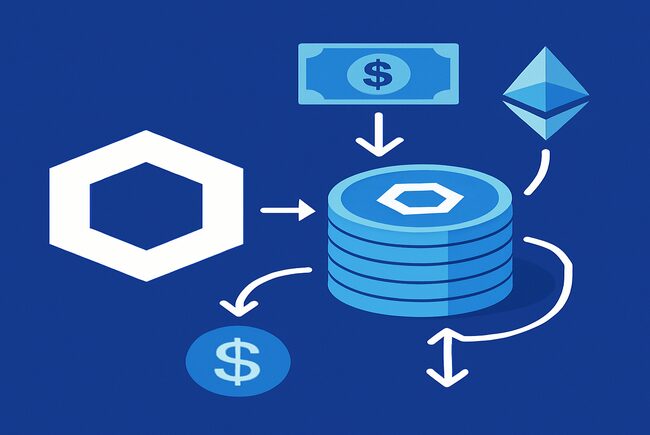
Chainlink has launched the Chainlink Reserve, a new mechanism designed to convert off-chain and on-chain revenue streams into LINK tokens, marking a strategic shift toward long-term sustainability for the decentralized oracle network.
The reserve, announced Thursday, will function as an on-chain holding pool built from revenue sources that include enterprise-level service payments and protocol usage. By using a system known as Payment Abstraction, the reserve enables the programmatic conversion of various payment types into LINK, the native token of the Chainlink ecosystem.
Revenue Converted to LINK Through Payment Abstraction
The Chainlink Reserve will be primarily funded through Payment Abstraction, a tool introduced earlier this year. The system allows Chainlink users—both enterprise and protocol-based—to pay for services using stablecoins, gas tokens, or other preferred currencies.
Those payments are then converted into LINK using a combination of Chainlink infrastructure and decentralized exchange mechanisms. In a development disclosed alongside the reserve launch, Chainlink confirmed that Payment Abstraction has now expanded to include offchain payment support.
This means the system can now convert revenue from external enterprise sources, even when payments are made outside the blockchain, into LINK tokens. According to the announcement, this includes existing contracts and future integrations.
Chainlink said the dual-channel funding approach—capturing both off-chain and on-chain revenue—would allow the reserve to gradually build up LINK holdings without requiring direct token issuance or secondary market purchases.
Focus on Network Sustainability and Decentralized Funding
The creation of the Chainlink Reserve signals a broader move by the network toward sustainability and reduced reliance on speculative market activity. By redirecting revenue into LINK and holding it in a programmatically managed reserve, Chainlink aims to support the long-term health of its ecosystem.
Although the organization did not provide details about the target size of the reserve or its deployment mechanisms, a spokesperson indicated that the model is designed to function as a self-reinforcing economic layer within the Chainlink protocol.
The company also emphasized that the reserve does not alter current service delivery or user-facing pricing structures. Instead, it operates as a behind-the-scenes financial infrastructure aimed at bolstering protocol incentives, node operator compensation, and potentially other undisclosed applications.