



Current Economic Situation in Iran

The Islamic Republic of Iran is the sixth-largest country in Asia, with a Muslim-majority population. Persia, as it is also called, is a multi-ethnic country with a population of over 88 million people.
The country comprises five regions with thirty-one provinces. The nation’s capital, Tehran, is the largest city and financial center of Iran.
The economy of Iran is driven by hydrocarbon, agricultural, and service sectors, as well as manufacturing and financial services. It is quite notable that Iran is the second country in the world with the most natural gas reserves, and fourth with proven crude oil reserves.
Although the government is working towards diversifying the economy, the country is still well dependent on its oil revenue, which makes it volatile, according to the World Bank. However, growth in the non-oil sector has been impressive, as it has led to a reduction in the unemployment rate.
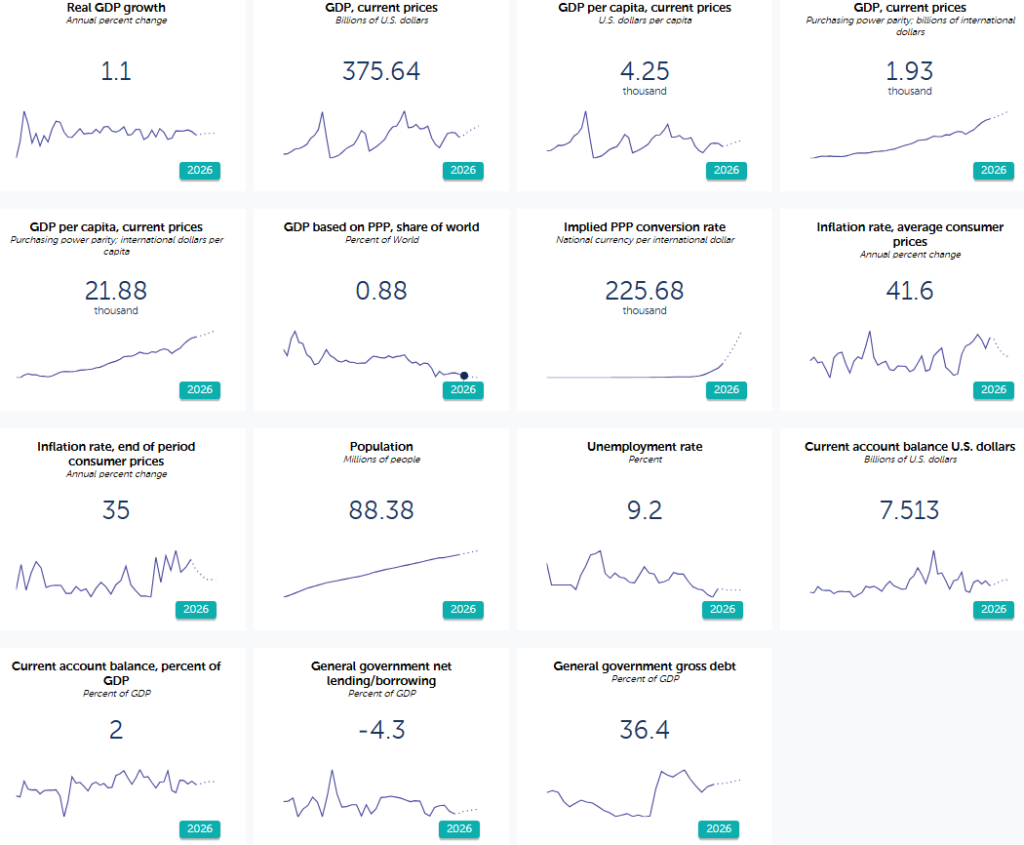
Source: IMF DataMapper
Iran’s economy is facing severe challenges in 2025-2026. The International Monetary Fund projects real GDP growth of just 0.3% for 2025, with further contraction in early 2026. Inflation has surged dramatically, reaching 48.6% in October 2025 and remaining at crisis levels of 40-50% throughout the period.
The Iranian rial has experienced catastrophic devaluation, losing approximately 95% of its value and trading at 1.25-1.42 million rials per U.S. dollar as of late 2025, effectively rendering it worthless in international markets.
The government’s tighter monetary policies have proven insufficient to address the crisis, leading the Iranian economy to be subject to significant risks, ranging from intensified international sanctions under renewed U.S. pressure, the expansion of conflict in the Middle East, weakening global oil demand, and the impact of climate change, causing extreme heat waves and power shortages.
For the international sanctions, Iran is using cryptocurrencies, most especially Bitcoin mining, to alleviate its isolation in global trade by generating revenue to purchase imports that would otherwise be restricted due to financial limitations.
Iran’s crypto ecosystem reached over $7.78 billion in 2025, having grown at a faster pace compared to the previous year despite severe economic headwinds.
The oil sector faces mounting pressure. The IMF estimates that Iran would need oil prices to reach $163 per barrel just to balance its 2025 budget, more than double the current global average.
Oil production and exports are projected to fall by 300,000 barrels per day in 2025, with China accounting for 90% of Iran’s oil sales at deeply discounted prices.
Crypto Law in Iran
Cryptocurrencies are legal in Iran, but there are significant restrictions, and the regulatory landscape has evolved dramatically through 2025-2026.

Source: Contractbar.com
Here are some highlights of the legal frameworks in Iran over the years:
In late April 2018, trading and possession of crypto were banned in Iran. This was due to money laundering and terrorism financing concerns. This ban affected all financial institutions, such as banks, credit institutions, and currency exchanges.
They were all prohibited from promoting it in any way. This conclusion was reached after the Central Bank of Iran (CBI )’s 30th meeting of the High Council of Anti-Money Laundering held on 30th December, 2017. The CBI issued this statement during the announcement of the ban:
Since a variety of virtual currencies have the capability of becoming instruments for money laundering and financing terrorism, as well as means of transferring the money of criminals, the supervisory entity of the central bank has notified the ban on employing virtual currencies to banks to prevent the occurrence of any crime.
In 2019, effects of international sanctions become worse on the Iranian economy and brought about the need for a new regulation, which allowed the possession and mining of cryptocurrencies but with exceptions for using digital currencies as payment instruments inside Iran.
This new regulation recognizes crypto mining as a legal economic sector and made Iran the first country to use cryptocurrency as reserves to pay for imports and exports.
It also authorizes initial coin offerings (ICOs), tokens, cryptocurrency wallets, cryptocurrency exchange bureaus, and mining, the process of generating cryptocurrencies through employing computing power, Al Jazeera reported.
Furthermore, the CBI, in a bid to strengthen the rial, barred Iranians from holding large amounts of cryptocurrencies, in the same way they are prohibited from holding more than 10,000 euros. This part of the regulation was the most controversial amongst Iranians.
In 2020, the CBI implemented a new requirement for all crypto miners to sell their cryptocurrencies directly to the CBI, which gets to use them to fund imports and exports.
To incentivize Iranians even more, the government provided cheaper power to over a thousand locally-based licensed miners.
In November 2022, the latest mining regulations of cryptocurrencies in Iran were approved, stating that mining equipment is permitted only by obtaining a license from the Ministry of Industry, Mining and Trade, and through legal commercial and customer procedures.
On December 27, 2024, the Iranian regime’s Central Bank effectively blocked all cryptocurrency-to-rial and vice versa payments through internet websites in Iran. This action was taken to stabilize the collapsing rial and control speculation in the Tether market.
However, just about a month later, in January 2025, the central bank began selectively unblocking crypto-to-fiat exchanges, but only through a government-controlled API requiring full access to user data. This marked a significant tightening of state surveillance over crypto transactions.
Recent enforcement measures intensified dramatically, with January 2025 crackdowns freezing over one million bank accounts linked to unauthorized crypto activity for 23 days.
The government established a rigorous licensing system for exchanges and OTC desks, with exclusive trade-purpose restrictions for approved platforms and severe penalties for illegal mining.
In August 2025, Iran enacted the Law on Taxation of Speculation and Profiteering, which for the first time imposed capital gains tax on cryptocurrency trading. This represents a significant shift toward treating crypto as a taxable investment asset.
By September 2025, the Central Bank of Iran approved the “Policy and Regulatory Framework for Cryptocurrencies,” reaffirming CBI as the primary regulator for digital assets. The framework emphasizes licensing crypto brokers and custodians to comply with AML/CTF regulations and tax obligations under CBI supervision.
President Masoud Pezeshkian stated in an official letter that the CBI is the sole authority responsible for regulating the cryptocurrency market.
As of early this year, 2026, crypto mining is now recognized as a legal industry requiring licenses from the Ministry of Industry.
However, licensed miners must sell their holdings to the Central Bank at below-market rates to fund imports. Using cryptocurrency for domestic payments remains strictly prohibited to protect the national currency. The government maintains 47 licensed mining operations, which face seasonal power restrictions and premium electricity tariffs. All crypto proceeds must flow through Central Bank channels at official exchange rates.
Current State of Crypto Adoption in Iran
Source: CNBC
Iranians are no strangers to cryptocurrencies. The revenue generated annually attests to this. However, the government’s continuous re-adjustments to the regulations keep affecting its adoption.
In 2020, the annual crypto revenue generated was USD 183.9 million, but after the government provided a cheaper power supply to licensed crypto miners, the number skyrocketed to USD 912.4 million in 2021.
By 2022, when the mining regulations were enforced, amongst other policies, the annual revenue dropped to USD 537.1 million. This shows the correlation of regulations on cryptocurrencies. As of 2024, the annual revenue reached USD 807.1 million.
In 2025, Iran’s cryptocurrency ecosystem surged dramatically to over $7.78 billion, representing an unprecedented acceleration in adoption despite, or perhaps because of, the severe economic crisis. The sector is projected to generate $1.5 billion in revenue by the end of 2025, growing at 23.7% annually, with forecasts suggesting it could reach $1.9 billion by 2026.
User adoption has expanded significantly. Approximately 22% of Iran’s population, around 10-12 million users, actively held or traded cryptocurrencies in late 2025. This represents a dramatic increase driven by the currency collapse and political instability.
The user penetration rate was 4.31% in early 2025 and is expected to increase to 6.73 million users by 2026, with penetration rising from 6.97% in 2025 to 7.23% in 2026.
The Islamic Revolutionary Guard Corps (IRGC) has become a dominant force in Iran’s cryptocurrency sector.
IRGC-linked on-chain activity represented approximately 50% of Iran’s total crypto ecosystem in Q4 of 2025. IRGC-affiliated wallets received more than $3 billion in 2025, up from over $2 billion in 2024. This figure is considered a lower-bound estimate, as it only includes publicly identified wallets through sanctions designations.
Nobitex remained Iran’s dominant exchange in 2025, handling more than 87% of all cryptocurrency transaction volume linked to Iranian entities.
Of the approximately $3 billion processed through Nobitex during the first seven months of 2025, around $2 billion flowed over the TRON network, primarily in TRC-20 USDT and TRX. However, on June 18, 2025, Nobitex suffered a massive $90 million hack by the pro-Israeli group Predatory Sparrow, significantly impacting market confidence.
During the mass protests in late 2025 and early 2026, there was a significant surge in Bitcoin withdrawals to personal wallets. Comparing activity before protests began with the period leading up to Iran’s nationwide internet blackout on January 8, 2026, there were sharp increases in both transaction volumes and transfers from Iranian exchanges to self-custodied Bitcoin wallets.
This behavior suggests Iranians increasingly use Bitcoin as a flight to safety amid accelerating currency collapse and political uncertainty.
Factors Driving Adoption
The need to maneuver the effects of Western sanctions on the Iranian economy, alongside government incentives, good internet connectivity, and the catastrophic currency collapse are driving the adoption of cryptocurrencies.
Western Sanctions
Cryptocurrencies provide an alternative to facilitate import and export in Iran due to the sanctions from the United States of America and other international communities.
These sanctions have intensified under renewed U.S. pressure in 2025, with President Trump’s administration imposing eight new packages of sanctions in April 2025 targeting tankers and trading networks that facilitate the sale of Iranian oil.
The role of politics and crypto has become increasingly intertwined. As previously built upon, these sanctions created the need for other sources of payment, which cryptocurrencies provided.
In 2023, the government officially authorized the use of cryptocurrency for cross-border trade to circumvent sanctions, including for importing sanctioned goods such as medical equipment and oil sector transactions.
Currency Collapse and Economic Crisis
The catastrophic devaluation of the Iranian rial has become the primary driver of crypto adoption in 2025-2026.
The rial lost 37% of its value against the dollar in 2024 alone, and by late 2025, it had lost approximately 95% of its value, effectively becoming worthless in international markets. With inflation running between 40-50% and the rial trading at 1.25-1.42 million per U.S. dollar, cryptocurrencies are widely used as stores of value and mediums for exchange.
For many Iranians facing hyperinflation and a government struggling to maintain economic order, cryptocurrencies represent not just a means to evade sanctions but a way to opt out of a failing financial system controlled by an increasingly desperate regime.
Government Incentives
Incentives such as the cheaper electricity supply to licensed crypto miners have made Iran an accommodating space for cryptocurrencies to thrive, though this advantage has diminished. Iran accounts for approximately 2-5% of global Bitcoin mining in early 2026, down from 4-8% in 2021 and 4.5% in mid-2021.
This decline is due to crackdowns, energy issues, internet blackouts during protests, and political instability.
The electricity used for mining in Iran costs between $0.01 and $0.05 per kilowatt-hour, making it incredibly cheap. However, this comes at a severe cost to the national grid.
Iranian officials report that approximately 427,000 active crypto mining devices operate across the country, with an estimated 400,000 illegal mining machines capitalizing on subsidized power rates and straining the grid.
This goes to show how big the impact of providing cheaper electricity has had in driving crypto adoption in Iran and how Iranians are embracing this technology, despite the mounting challenges.
Good Internet Connectivity
Iran has a good internet penetration rate of about 86.7% as of 2024, with 16.94 million households having internet access. This data reflects why Bitcoin mining is rampant, as it is an important requirement.
The 4G network coverage is estimated at about 4.33%, while 3G is about 88.63%, which is satisfactory for Bitcoin mining.
However, the government has increasingly used internet blackouts as a tool of political control. The nationwide internet blackout that began on January 8, 2026, during mass protests significantly disrupted mining operations, forcing nodes offline and temporarily halting Iran’s pool contributions to the global Bitcoin network.
Challenges Facing Crypto Adoption in Iran

Source: Forbes.com
Volatility
Due to the highly volatile nature of cryptocurrencies, it becomes paramount when used on a large scale, especially for import purposes, as in the case of Iran. A slight ‘dip’ may result in millions or billions of losses. Understanding the risks of trading cryptocurrency is crucial for both individual users and state actors.
The risk in this regard is very high, while the concerns that come with it are even greater. Bitcoin’s volatility and reliance on infrastructure limit its effectiveness as a complete solution to Iran’s economic challenges.
Energy Crisis
The energy situation has deteriorated dramatically in 2025-2026. Iran is experiencing one of the most severe power crises in its history, with widespread rolling blackouts and power outages affecting both residential and industrial sectors.
We all know how enormous the consumption of energy during crypto mining is. Currently, Iran is facing unprecedented challenges.
In early 2023, an Iranian energy spokesperson acknowledged that crypto mining was responsible for roughly 0.8 GW (800 MW) of Iran’s electricity demand. By November 2025, one official claimed that the Iranian government projects local power producers won’t even meet a third of the country’s power demand in 2026.
Extreme heat waves have made the demand for energy skyrocket causing several power outages and blackouts. The city of Ahvaz has recorded temperatures exceeding 50 degrees Celsius (122 Fahrenheit) over multiple days. People now need more electricity for cooling and industrial purposes.
This is creating a battle between demand for electricity for cooling or mining. Amidst this situation are the dire effects of illegal miners who are capitalizing on subsidized energy. In the first six months of 2025, authorities uncovered 80 unauthorized mining farms in Tehran alone, holding 1,300 illegal devices consuming enough electricity to power 8,000 households.
As of August 2024, more than 230,000 illegal cryptocurrency mining devices with a power consumption capacity of 800 to 900 megawatts have been discovered.
The Iranian government has offered bounties to identify illegal miners:
Opportunistic individuals have been exploiting subsidized electricity and public networks to mine cryptocurrencies without proper authorization. This unauthorized mining has led to an abnormal surge in electricity consumption, causing significant disruptions and problems within the country’s power grid.
In response to solve this problem, Rajabi announced:
“A bounty of one million toman (approximately $20) will be awarded to individuals who report every single unauthorized cryptocurrency mining equipment,” Rajabi said.
Rajabi further noted:
So far, more than 230,000 illegal cryptocurrency mining devices with a power consumption capacity of 800 to 900 megawatts have been discovered. Their electricity consumption is equivalent to that of the Markazi Province. Providing this amount of electricity would require the construction of a 1,300-megawatt power plant.
Iran’s heavily subsidized electricity (with rates as low as $0.01–0.05 per kilowatt-hour for some users) makes crypto mining exceptionally profitable, but the power grid is fragile, with about 13% of electricity lost during transmission.
Licensed miners must pay premium rates for electricity, pushing many to abandon legal operations for underground, unlicensed mining. Former president Hassan Rouhani admitted in 2021 that about 85% of mining in Iran was unlicensed.
These power outages caused by the heat wave and the effects of illegal miners pose a significant threat to the future of cryptocurrencies in Iran.
Political Instability and Internet Blackouts
The mass protests that began in late December 2025 and continued into early 2026 have created unprecedented challenges for crypto adoption.
The demonstrations erupted due to rising inflation and the sharp devaluation of the local currency against the dollar. The US-based Human Rights Activists News Agency (HRANA) estimates that more than 2,500 people have been killed during these protests.
The government’s response included a nationwide internet blackout beginning January 8, 2026. This blackout disconnected local Bitcoin miners from the global network, causing mining farms to pause operations as operators could not keep rigs online, submit shares, or coordinate with pool servers.
The outage severed links between Iranian miners and the rest of the network, and mining pools lost computing power within hours.
This political instability has accelerated the migration of mining operations to more stable regions like Kazakhstan or Russia, weakening Iran’s use of crypto as a sanctions-evasion tool. The disruption illustrated that miners now prioritize connectivity and political stability over cheap power alone.
In 2026, cheap electricity is no longer enough to keep Bitcoin miners competitive; they need reliable internet access, regulatory stability, and predictable operating conditions.
Regulatory Uncertainty
As seen earlier, government regulations hurt cryptocurrencies. The regulatory landscape in 2025-2026 has been characterized by sudden policy shifts, creating instability for both users and crypto service providers.
Key regulatory challenges include frequent policy changes, with sudden crackdowns and the December 2024 blocking of all crypto-to-rial payment gateways, followed by selective reopening in January 2025.
There are no clear rules for normal citizens using crypto, and banks block all crypto-related money transfers. The technology for tracking illegal crypto use is outdated, making it difficult for authorities to enforce regulations effectively.
In July 2025, Tether carried out its largest-ever freeze of Iranian-linked funds, freezing 42 cryptocurrency addresses—more than half with substantial exposure to Nobitex. This disrupted entrenched transaction patterns and triggered users to diversify settlement methods, moving toward alternatives like DAI via the Polygon network.
The stricter the law gets, the less annual market revenue is realized. Between January and July 2025, total cryptocurrency flows involving Iranian entities fell to USD 3.7 billion, an 11% decrease compared with the same period in 2024.
The sharpest declines occurred after April, with inflows in June falling more than 50% year-over-year, and July recording an even steeper drop of over 76%.
This goes to show that a more flexible and consistent crypto regulation is needed to foster sustainable adoption. Balanced regulation that encourages innovation while maintaining oversight is essential for the sector’s long-term viability.
International Enforcement and Cybersecurity Risks
Iran faces growing challenges from international enforcement agencies that have become increasingly sophisticated at tracking crypto transactions and disrupting Iranian financial networks. The country’s cryptocurrency infrastructure has become a target in geopolitical conflicts.
The June 18, 2025, hack of Nobitex by pro-Israeli group Predatory Sparrow, which resulted in the theft of over $90 million in various cryptocurrencies, demonstrated the vulnerability of Iran’s crypto infrastructure. The hackers sent the stolen funds to inaccessible wallet addresses containing anti-IRGC messages, effectively destroying the money as a political statement.
In 2024, sanctioned countries and entities, including Iran, received $15.8 billion in cryptocurrency, making up 39% of all illicit crypto transactions worldwide. Financial firms that offer services related to cryptocurrencies mined in Iran could be subjected to sanctions-related fines and penalties.
Additionally, crypto scams and market volatility pose significant threats to inexperienced investors. The lack of consumer protection and the prevalence of fraudulent schemes create additional barriers to safe crypto adoption.
The Potential for Cryptocurrency in Iran

Source: Rferl.org
Revenue Source
Economic Diversification: Cryptocurrencies provide an alternative to the oil-dependent economy of Iran. With the sector projected to generate $1.5 billion in revenue by 2025 and growing at 23.7% annually to reach $1.9 billion by 2026, crypto represents a significant diversification opportunity. Understanding factors for crypto investment becomes increasingly important for both individual and institutional participants.
Mining Operations: Despite the decline from 4.5% to 2-5% of global hashrate, Iran remains a notable force in crypto mining. The country controls about 4.2% of global Bitcoin mining power as of late 2025, ranking fifth worldwide behind the United States, Kazakhstan, Russia, and Canada. This gives the government the advantage to tap into this industry that is contributing billions to the Iranian economy. Understanding cryptocurrency accumulation indicators can help optimize mining strategies.
Taxation: With the August 2025 implementation of the Law on Taxation of Speculation and Profiteering imposing capital gains tax on cryptocurrency trading, the government can generate additional revenue from the crypto sector. Implementing a comprehensive tax structure and robust regulation on crypto transactions can help build state revenues.
Sanctions-Busting and International Trade
One of the greatest benefits of crypto in Iran is its use in bypassing Western sanctions, which have restricted access to the global financial system. The regulations explicitly allow licensed businesses to use cryptocurrencies (bought from the CBI) to pay for imported goods, particularly in sanctioned sectors like medicine and industrial equipment.
Cryptocurrencies are solving these problems by making it possible for international trade between sanctioned and/or sympathetic countries without having to rely on the global banking system.
The government has worked with Russia on a gold-backed stablecoin for cross-border payments. With more countries embracing this technology, it opens Iran to more opportunities to build its economy.
In August 2022, Iran completed its first official import order using crypto from China, signaling state-level adoption. This strategic use of crypto creates a financial bypass that exists outside traditional banking systems like SWIFT.
Financial Freedom and Resistance
For Iranians facing currency collapse and authoritarian controls, cryptocurrencies have become what analysts call an “element of resistance.” Bitcoin’s decentralized nature and censorship resistance provide citizens with financial mobility and optionality in an increasingly restricted economic environment.
For many Iranians, cryptocurrency provides a channel to protect savings from hyperinflation and the risk of asset seizure. Unlike conventional assets, which can be illiquid and vulnerable to state oversight, Bitcoin’s self-custody capabilities give individuals greater control over their wealth.
This flexibility is especially critical in situations where people may need to leave the country or rely on financial systems beyond government control.
The surge in Bitcoin withdrawals to personal wallets during the 2025-2026 protests reflects this pattern. This behavior mirrors Bitcoin adoption during crises elsewhere, where citizens turn to self-custody when trust in state institutions erodes.
Central Bank Digital Currency (CBDC)
Iran has been developing a national digital currency, the Digital Rial, which entered its trial phase in early March 2023. In January 2023, the CBI stated that the crypto-rial was past its pilot stage.
The CBDC is designed as electronic cash, essentially an electronic version of common banknotes in Iran, with its value attached to the existing traditional paper rial.
Unlike decentralized cryptocurrencies such as Bitcoin, the Digital Rial cannot be mined, and its supply will be regulated by the Central Bank.
The government may potentially launch fuller trials for this national digital currency aimed at domestic payments, addressing some of the challenges of the current system while maintaining state control.
Lending and Financial Services
As the crypto ecosystem matures, there is potential for developing cryptocurrency lending platforms and other financial services that could provide Iranians with access to credit and investment opportunities outside the traditional banking system.
This could be particularly valuable given the restrictions on Iran’s access to international financial markets.
International Competition and Influence
By positioning itself as a significant player in the crypto space, Iran could build alliances with other countries exploring this technology, particularly fellow sanctioned nations seeking alternative financial channels.
As these developments unfold, Iran is increasingly positioned to influence cryptocurrency adoption across Eurasian markets.
Investments in crypto infrastructure and research could enhance Iran’s technical capabilities, allowing it to compete in emerging financial technologies and services. However, this must be balanced against the risks of international sanctions and compliance issues with organizations like the Financial Action Task Force (FATF).
Conclusion
Iran’s cryptocurrency landscape in 2025-2026 presents a complex picture of both tremendous growth and significant challenges. The sector has evolved from generating $807.1 million in 2024 to reaching over $7.78 billion in 2025, representing an extraordinary surge driven by economic crisis, currency collapse, and political instability.
Cryptocurrencies have enabled Iran to evade sanctions, boost reserves, and participate in international trade with other countries, especially those under sanctions or in isolation. Through subsidized electricity incentives, the government has made the country a hub for crypto mining, though Iran’s share has declined from 4.5% in 2021 to 2-5% in early 2026 due to energy crises, internet blackouts, and political instability.
Looking ahead, Iran’s crypto economy faces a critical juncture. While the sector shows remarkable resilience and has become deeply embedded in the country’s financial system, its future depends on addressing structural challenges.
The government must balance economic benefits with energy management, regulatory consistency, and infrastructure stability.
For ordinary Iranians facing inflation rates of 40-50% and a rial that has lost 95% of its value, Bitcoin has become more than just an investment, providing liquidity and optionality in an increasingly restricted economic environment.
As global crypto adoption continues to evolve, Iran’s experience offers valuable lessons about how economic instability, sanctions, and limited financial access drive cryptocurrency adoption in emerging markets.


