



Current Economic Context in Liberia
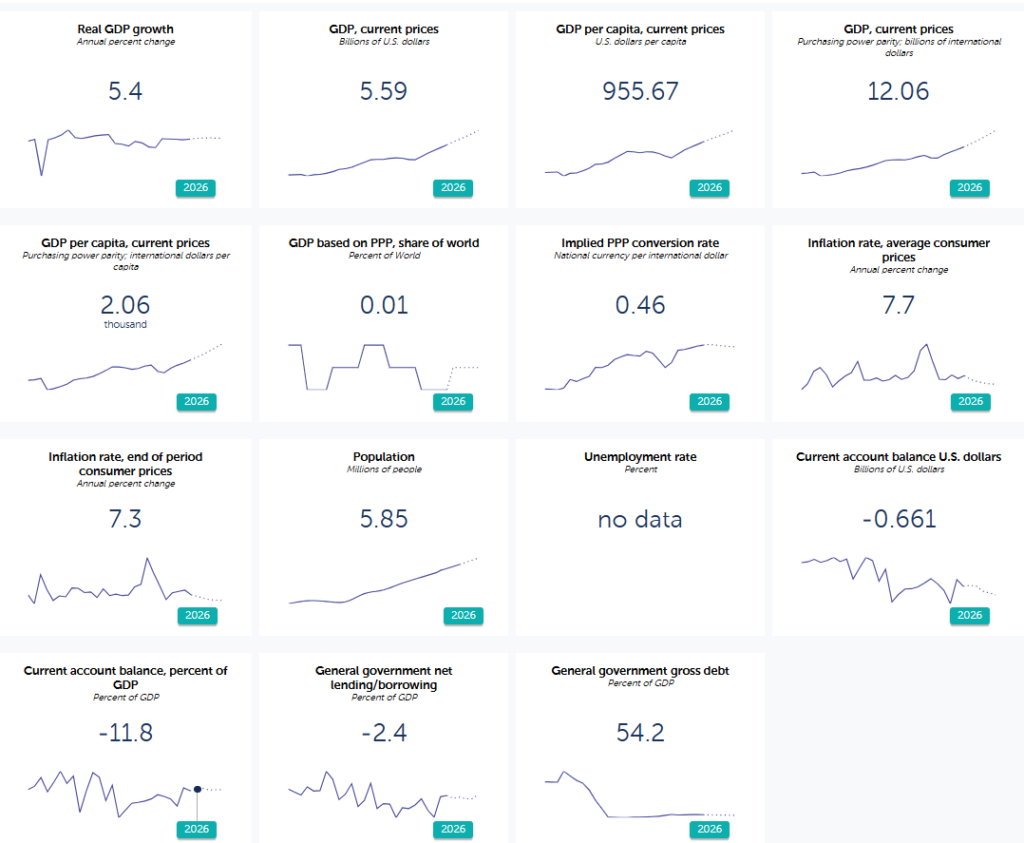
Source: IMF DataMapper
Liberia’s economy has shown resilience despite significant challenges. According to the International Monetary Fund, the country’s GDP stands at $5.18 billion in 2025, with real GDP growth projected at 5.6% for 2025 and 5.8% for 2026. The country’s GDP per capita reached $955.67 in 2026, though it remains among the world’s lowest-income nations.
Inflation has been a persistent challenge but has been improving. After peaking at 10.7% in 2024, inflation moderated significantly to 4% by the end of December 2025, according to Finance Minister Augustine Kpehe Ngafuan at the World Economic Forum in Davos. However, the IMF projects inflation to average 9.8% in 2026 due to currency pressures and import dependence.
Despite being rich in natural resources, the country struggles with high poverty rates and widespread financial exclusion. The Global Findex Database 2025 reveals that a significant portion of the population remains unbanked, limiting their ability to save, invest, and participate fully in the economy.
The country remains heavily reliant on remittances from Liberians working abroad. Remittances account for more than 10% of GDP, making the country one of the most remittance-dependent in Africa alongside the Gambia, Lesotho, and Comoros. This dependence makes efficient, low-cost transfer mechanisms particularly important for the economy.
In this context, financial inclusion becomes critical. Access to financial tools and services can help Liberia unlock its citizens’ potential and drive economic growth. Digital financial services, including cryptocurrencies, could play a transformative role.
By facilitating low-cost transactions, enabling micro-loans and savings opportunities, and promoting entrepreneurship, cryptocurrencies can help bridge the financial inclusion gap.
Crypto Adoption in Liberia

Source: WordAtlas
Despite the Central Bank of Liberia’s (CBL) cautious stance, there’s growing interest in cryptocurrencies among Liberians, particularly the younger, tech-savvy generation. This interest is fueled by the accessibility of foreign crypto exchanges like UEEx, Binance, and Kraken, where users can buy and trade digital assets.
According to global crypto adoption data from 2025, Sub-Saharan Africa saw 19.4% year-on-year growth in crypto adoption, with countries like Nigeria leading the continent. While Liberia lacks specific adoption statistics, anecdotal evidence and the presence of cryptocurrency initiatives suggest increasing curiosity and engagement, particularly in urban centers like Monrovia.
The regulatory landscape remains ambiguous. While not explicitly illegal, cryptocurrency use exists in what experts describe as a “legal gray area.” The CBL has not issued specific guidelines or directives regarding the use, trading, or mining of cryptocurrencies, but has urged the public to exercise caution due to volatility and associated risks of trading cryptocurrency.
The CBL’s intervention against The Abundance Community Coin (TACC) in 2021 highlighted the need for a clear regulatory framework. The bank denied TACC’s initial launch at the Antoinette Tubman Stadium, citing technical reasons and concerns that the cryptocurrency could undermine the country’s financial system. However, as of 2025, TACC has re-emerged with more ambitious proposals under the current Boakai administration.
Internet penetration, while improving, remains a significant barrier. As of January 2025, only 32.4% of Liberians (approximately 1.84 million people) use the internet, according to DataReportal. This is up from 19% in 2019, showing progress, but still means that 67.6% of the population remains offline. Mobile phone penetration is higher, providing potential pathways for mobile-based crypto adoption similar to mobile money services.
This situation mirrors challenges seen in other African countries with ambiguous regulatory frameworks, where individuals engage in crypto activities despite regulatory uncertainty. The key difference is Liberia’s exploration of blockchain technology through official channels, even as it maintains caution toward private cryptocurrencies.
Benefits and Challenges of Crypto Adoption in Liberia

Source: Freepik
Cryptocurrency adoption in Liberia presents both significant opportunities and substantial challenges that must be carefully navigated.
Potential Benefits
Enhanced Financial Inclusion
With the majority of Liberians still unbanked, cryptocurrencies could provide access to financial services without requiring traditional bank accounts. Digital wallets accessible via mobile phones could enable greater participation in the economy, particularly for those in rural areas where bank branches are scarce. The success of mobile money platforms in Africa demonstrates the potential for mobile-based financial services.
Improved Remittances
For a country where remittances exceed 10% of GDP, cryptocurrencies offer faster and cheaper cross-border transfer options. Traditional remittance services charge an average of 7.9% to send money to Sub-Saharan Africa, well above the UN Sustainable Development Goal target of 3%. Blockchain-based transfers could significantly reduce these costs, putting more money in the hands of receiving families and stimulating the local economy.
Economic Growth and Innovation
The growing global interest in blockchain technology presents opportunities for Liberia. Cryptocurrency-related businesses could attract foreign investment, support local startups, and promote technological innovation. The government’s engagement with blockchain initiatives, including CBDC exploration and TACC’s proposals, indicates recognition of this potential.
Increased Transparency and Efficiency
Blockchain technology can enhance transparency and efficiency in various sectors beyond finance, from supply chain management to public services and governance. This could help address corruption concerns and improve trust in financial systems.
Challenges to Overcome
Volatility
The inherent volatility of cryptocurrency markets poses substantial risk for investors and users. Price fluctuations can lead to significant financial losses, and this volatility is particularly concerning for a low-income population that cannot afford major losses. Educational initiatives about crypto investment factors and trading strategies are essential.
Regulatory Uncertainty
The lack of a comprehensive regulatory framework creates ambiguity and can hinder wider adoption. While 2024 saw the development of licensing systems for cryptocurrency exchanges in some African countries, Liberia has yet to implement such frameworks. Establishing clear guidelines to protect consumers and ensure the responsible development of the crypto ecosystem is crucial.
Infrastructure Limitations
Limited internet access remains a critical barrier. With only 32.4% internet penetration, widespread crypto adoption faces significant infrastructure hurdles. The ongoing efforts to expand fiber-optic connectivity through projects like the Africa Coast to Europe submarine cable, and investments by Orange Liberia ($200 million network expansion through 2031), are positive steps. However, challenges of affordability, coverage, and quality persist.
Power infrastructure is another concern. Unreliable electricity supply makes it difficult to maintain consistent internet connectivity and charge devices needed for crypto transactions.
Security Concerns
While blockchain technology is inherently secure, individual users remain vulnerable to crypto scams, crypto hacks, and security breaches. Educating users about safe crypto practices, recognizing scams, and implementing cybersecurity measures are essential for building trust in the technology. The risk is heightened in environments with low digital literacy.
Digital Literacy
Low levels of digital literacy compound the challenges. Many Liberians lack the knowledge and skills needed to safely navigate cryptocurrency platforms. Comprehensive education programs are necessary to ensure people understand how crypto payments work and can make informed decisions.
Liberia’s CBDC Ambitions
Source: Gluwa
Liberia’s exploration of a Central Bank Digital Currency (CBDC) represents a significant development in its relationship with digital finance. While maintaining caution toward private cryptocurrencies, the government’s pursuit of a CBDC suggests recognition of blockchain technology’s potential benefits within a controlled, regulated environment.
The partnership with Gluwa, a blockchain technology company with proven experience in Africa, positions Liberia strategically. Gluwa has worked on CBDC projects in Nigeria (eNaira) and Ghana, bringing valuable expertise to Liberia’s initiative. In March 2024, Gluwa CEO Tae Oh met with President Joseph Boakai to discuss the CBDC project, emphasizing the government’s commitment to economic growth through digital innovation.
Gluwa’s proposed approach involves integrating the CBDC with Liberia’s existing mobile money system, which has already achieved success in the country. This integration strategy could accelerate adoption by building on familiar infrastructure and user behaviors. The company also plans to address Liberia’s connectivity challenges through satellite internet solutions, particularly important given that many rural areas lack reliable terrestrial internet access.
The timing is significant. As of 2025, according to the Atlantic Council’s CBDC Tracker, 137 countries representing 98% of global GDP are exploring CBDCs, with 72 countries in advanced phases and 49 pilot projects worldwide. Emerging markets are driving retail CBDC growth to enhance financial inclusion, reduce cash dependency, and improve regulatory oversight.
Potential Benefits of a CBDC
Source: Business Today
A CBDC could address several of Liberia’s most pressing financial challenges. It could significantly promote financial inclusion by providing digital financial services access to the unbanked population. Unlike commercial bank accounts, a CBDC would be backed directly by the Central Bank of Liberia, offering a risk-free digital alternative to cash.
The CBDC could increase efficiency and transparency in government transactions, reducing corruption opportunities and streamlining public services. This aligns with governance reforms highlighted by Finance Minister Ngafuan, including expanded investigative powers for the Liberia Anti-Corruption Commission and more transparent public procurement through competitive bidding and e-procurement.
Enhanced monetary policy control is another potential benefit. A CBDC could give the central bank better oversight of the monetary system and more effective tools for implementing monetary policy. This could help manage inflation and exchange rate stability, persistent challenges for Liberia’s dual-currency economy.
For cross-border payments and remittances, a CBDC could reduce costs and increase speed, particularly important for a country heavily dependent on diaspora remittances. Integration with regional payment systems like the Pan-African Payment and Settlement System (PAPSS) could facilitate intra-African trade and financial flows.
CBDC and the Broader Crypto Ecosystem
An important question remains: Will Liberia’s CBDC coexist with private cryptocurrencies, or will it lead to further restrictions? The relationship between CBDCs and private digital assets varies globally. Some countries see CBDCs as complements to private cryptocurrencies, while others view them as substitutes that reduce the need for unregulated digital assets.
The CBDC could potentially act as a catalyst for greater acceptance of blockchain technology and digital finance broadly. By demonstrating the safety and utility of blockchain-based digital currencies in a regulated framework, it might increase public understanding and comfort with cryptocurrency concepts. This could create a more informed user base for both public and private digital assets.
Conversely, successful CBDC implementation might reduce demand for private cryptocurrencies for payments and remittances, their primary use cases in developing economies. This could lead authorities to maintain or even strengthen restrictions on private crypto, viewing the CBDC as sufficient for the population’s digital finance needs.
The experience of Nigeria, which launched the eNaira in 2021 while maintaining a cautious approach to private cryptocurrencies, offers insights. Despite the CBDC launch, Nigeria remains one of the world’s largest crypto markets, suggesting CBDCs and private crypto can coexist, albeit with ongoing regulatory tensions.
These questions will be addressed as Liberia develops and implements its CBDC. The country’s approach could signal broader attitudes toward financial innovation, technological adoption, and the balance between innovation and regulation.
The Abundance Community Coin (TACC) Initiative
In early 2025, the Abundance Community Coin (TACC) re-emerged with ambitious plans that signal both the opportunities and challenges of cryptocurrency adoption in Liberia.
Steve Williams, TACC’s CEO and an Antiguian national who arrived in Liberia in 2020, announced proposals to establish Maryland County as a technological innovation hub and launch a multi-billion-dollar solar energy project. Speaking at a February 2025 press conference in Paynesville City, Williams revealed that he initially pitched his blockchain initiative to then-Vice President Joseph N. Boakai, who endorsed the idea. Now serving as president, Boakai continues to support designating Maryland County as a technology-free zone for advancements in automation, robotics, artificial intelligence, blockchain, and cryptocurrency.
Williams emphasized the economic potential, stating:
This is a legacy that President Boakai can leave behind—an economic transformation that could establish Liberia as the ‘Dubai of Africa.’ TACC presents a unique opportunity for Liberia to actively participate in the 5th Industrial Revolution, rather than being mere spectators in the global digital economy.
The proposal includes several ambitious projects: construction of the Abundance Community Global Headquarters, development of a state-of-the-art medical university and hospital, infrastructure expansion, a student-focused TACC digital economy where every student in Maryland would have a TACC account, and development of an Abundance 5-star resort and manufacturing industrial complex.
Beyond cryptocurrency, Williams is spearheading a 1,500-megawatt solar energy project in collaboration with Supernova, a U.S.-based company. The project, valued at up to $5 billion and pre-financed through a joint venture, has secured four locations and aims to make Liberia a key energy exporter to neighboring countries, including Sierra Leone, Guinea, the Ivory Coast, Ghana, and Nigeria.
This project will create 10,000 high-paying jobs and provide 24/7 reliable electricity, making Liberia globally competitive, attracting new industries, and reducing the cost of living
Acknowledging concerns over cryptocurrency regulations and the potential for crypto scams, Williams assured he is working with Liberia’s legislature to implement proper safeguards. “The cryptocurrency space is vulnerable to scams, and we must ensure that Liberia embraces legitimate blockchain innovations while avoiding fraudulent schemes,” he said.
TACC Country Coordinator Daniel Siafa emphasized the growing importance of cryptocurrencies in global finance:
Cryptocurrencies are gaining global recognition in countries like the United States, the UK, Ghana, Niger, and Australia. Today, Liberia is part of this movement.
He highlighted Liberia’s involvement in the 21 Project Pac Exchange and the Super Level Initiative, a $5 billion cryptocurrency project designed to facilitate financial transactions and empower businesses.
However, Williams raised concerns about land disputes that threaten foreign investment. Despite investing nearly $1 million in his business, Higher Heights Group of Companies, which employs over 50 Liberians, ongoing legal battles over land ownership have resulted in an eviction notice and a case pending before the Supreme Court. “I legally acquired the land with a valid title, verified in the national archives, yet some individuals are now making counterclaims,” he lamented, warning that such legal uncertainties could deter investors.
The TACC initiative illustrates both the potential and pitfalls of cryptocurrency development in Liberia. While it represents a genuine interest in blockchain technology and significant proposed investment, it also highlights regulatory challenges, the need for clear legal frameworks, and the importance of investor protections.
As Liberia positions itself in blockchain and renewable energy, addressing these challenges will be crucial to unlocking the country’s full economic potential.
The Future of Crypto in Liberia

Source: Freepik
Liberia stands at a crossroads regarding cryptocurrency adoption. The path chosen could significantly impact its economic future and digital transformation.
Several scenarios could unfold. Continued regulatory uncertainty and lack of clear guidelines might result in crypto adoption remaining limited to tech-savvy individuals and those with access to international platforms. This scenario would miss opportunities for broader financial inclusion and economic development.
Alternatively, a proactive approach by policymakers—developing clear regulations, investing in digital infrastructure, and implementing public education programs—could enable wider adoption. This could drive financial inclusion, reduce remittance costs, and attract investment in the blockchain and fintech sectors.
The government’s modernization efforts are encouraging. Minister Ngafuan announced at the 2025 World Economic Forum that Liberia is progressing toward launching a National Payment Switch by the end of 2026, enabling interoperability across banks, fintech firms, and mobile money platforms. This digital infrastructure development could create a foundation for cryptocurrency integration.
Global regulatory trends may also influence Liberia’s approach. The year 2025 marked significant regulatory evolution worldwide, with the European Union’s full MiCA implementation, the U.S. GENIUS Act establishing comprehensive stablecoin regulations, and Hong Kong launching a regulatory framework for stablecoins. These developments demonstrate that regulation and innovation can coexist, providing models that Liberia could adapt.
The Need for Comprehensive Regulation
Liberia must develop a clear and comprehensive regulatory framework that fosters innovation while protecting consumers. This framework should address key aspects, including:
- Licensing requirements for crypto businesses and exchanges, ensuring only legitimate operators serve the market
- Anti-money laundering (AML) and counter-terrorism financing (CTF) measures align with international standards
- Consumer protection mechanisms, including dispute resolution and requirements for proof of reserves from exchanges
- Tax treatment of cryptocurrency transactions and holdings, providing clarity for investors
- Guidelines on custody and safeguarding of client assets
Lessons from countries like Nigeria, which implemented comprehensive digital asset regulations in 2024, and Ghana, which has developed frameworks for blockchain businesses, could inform Liberia’s approach.
Investing in Digital Infrastructure and Literacy
Expanding internet access is essential for wider crypto adoption. The government’s goals of reaching 90% internet penetration by 2030 and investments by companies like Orange Liberia are positive steps. However, this requires sustained commitment and an estimated $36 million annually through 2030.
Public education and awareness campaigns are equally critical. These should cover:
- Basic concepts of blockchain and cryptocurrency, including understanding Bitcoin or altcoins
- How to safely use cryptocurrency platforms and recognize crypto scams
- Factors to consider when choosing crypto for investment
- Understanding market risks and trading strategies
- Awareness of the cryptocurrency market efficiency and accumulation indicators
Digital literacy initiatives should extend beyond cryptocurrency to general digital skills, empowering citizens to participate effectively in the digital economy.
Learning from Regional and Global Examples
Liberia can learn from both successes and failures in crypto adoption globally. Countries like Nigeria have maintained their position as the second-largest crypto market globally despite regulatory restrictions, demonstrating strong grassroots demand. El Salvador’s experience with Bitcoin as legal tender offers lessons on both the challenges and opportunities of cryptocurrency integration.
In 2025, regulatory clarity has emerged as a key factor distinguishing successful crypto ecosystems from struggling ones. Switzerland, Singapore, and the UAE have built robust crypto industries through clear, balanced regulations. Their approaches demonstrate that proper regulation, rather than stifling innovation, can attract investment and talent.
The role of Central Bank Digital Currencies in the broader digital finance ecosystem also provides lessons. As noted by industry analysts, CBDCs can increase trust in digital currencies and help build infrastructure and digital literacy that benefits the entire ecosystem, including private cryptocurrencies.
Collaborative Approach
Ultimately, embracing cryptocurrency opportunity requires collective effort. Policymakers, regulators, businesses, civil society, and individuals all have roles in building a thriving crypto ecosystem in Liberia.
Government and regulators must provide clear, fair frameworks that protect consumers while allowing innovation. The private sector must build secure, user-friendly platforms and contribute to education efforts. Civil society organizations can help with digital literacy and advocacy. Individual citizens must educate themselves and engage responsibly with new technologies.
The intersection of politics and crypto continues to evolve globally, with crypto lawsuits and cryptocurrency lending platforms testing regulatory boundaries. Liberia has the opportunity to learn from these global experiences and craft an approach suited to its unique context.
Understanding whether people are still buying crypto globally demonstrates sustained and growing interest that Liberia cannot ignore.
The future of crypto in Liberia remains uncertain, but the potential is undeniable. With thoughtful policy, sustained investment in infrastructure and education, and commitment from all stakeholders, the country can chart a course toward a more inclusive and prosperous digital future.
Conclusion
Liberia faces a critical juncture in its relationship with cryptocurrency and digital finance. While challenges are substantial.
The opportunities for transformation are equally significant.
The country’s exploration of a CBDC, coupled with private initiatives like TACC’s ambitious blockchain and energy projects, signals recognition of digital finance’s transformative potential. Economic improvements, including 5.6% GDP growth in 2025 and inflation moderating to 4% by year-end, provide a more stable foundation for financial innovation.
For a nation where remittances exceed 10% of GDP and the majority remain unbanked, cryptocurrencies and digital financial services could be transformative tools for inclusion, economic empowerment, and growth. The key is developing an appropriate regulatory framework that protects consumers while fostering innovation.
The Central Bank of Liberia’s cautious approach is understandable given the risks and volatility inherent in cryptocurrency markets. However, as global regulatory frameworks mature and digital finance becomes increasingly mainstream, Liberia has opportunities to learn from international experiences and craft policies suited to its context.
Whether through CBDCs, regulated private cryptocurrencies, or hybrid approaches, digital finance will likely play an increasing role in Liberia’s economic future. The question is not whether to engage with these technologies, but how to do so in ways that maximize benefits while minimizing risks for Liberian citizens.
With sustained commitment to digital infrastructure development, comprehensive and clear regulation, robust public education, and collaborative approaches involving government, private sector, and civil society, Liberia can position itself to harness cryptocurrency and blockchain technology for inclusive economic development. The path forward requires balancing innovation with protection, ambition with prudence, and global trends with local realities.
Frequently Asked Questions (FAQ)
1. What is the current legal status of cryptocurrencies in Liberia?
Currently, Liberia maintains a cautious regulatory approach to cryptocurrencies. There are no specific laws explicitly prohibiting cryptocurrency use, but the Central Bank has issued warnings and discouraged adoption.
The market operates in a legal gray area, with no comprehensive licensing or regulatory framework in place as of 2025. However, ongoing discussions about blockchain initiatives and CBDC development suggest the regulatory landscape may evolve.
2. What is a CBDC, and how could it benefit Liberia?
A CBDC (Central Bank Digital Currency) is a digital version of a country’s national currency issued and backed by the central bank.
For Liberia, a CBDC could promote financial inclusion by providing access to digital financial services for the unbanked, increase efficiency and transparency in government transactions, enhance the central bank’s monetary policy tools, and reduce remittance costs for the diaspora.
Liberia is working with blockchain company Gluwa to develop its CBDC, with integration plans for the existing mobile money system and satellite internet to reach rural areas.
3. How can I buy cryptocurrencies in Liberia?
Despite regulatory caution, Liberians can access cryptocurrencies through international exchanges like Binance, Kraken, and UEEx.
However, users should exercise caution, understand the risks of trading cryptocurrency, be aware of crypto scams, consider factors when choosing crypto for investment, and understand how crypto payments work. Only invest what you can afford to lose, and seek educational resources about the benefits of cryptocurrency and the best crypto trading strategies.
4. What are the main challenges to crypto adoption in Liberia?
Key challenges include: limited internet access (only 32.4% of the population is online as of 2025), low digital literacy levels, regulatory uncertainty, and lack of clear legal frameworks, infrastructure constraints, including unreliable electricity, security concerns, and vulnerability to crypto hacks and scams, and cryptocurrency market volatility that poses risks for low-income users.
However, ongoing investments in digital infrastructure and growing interest in blockchain technology suggest these challenges may gradually be addressed.
5. What is The Abundance Community Coin (TACC) and what is its status in Liberia?
The Abundance Community Coin (TACC) is a blockchain initiative founded in 2019 by Steve Williams. In 2021, the Central Bank of Liberia denied its initial launch, citing technical concerns.
However, as of 2025, TACC has re-emerged with support from President Joseph Boakai, proposing to establish Maryland County as a technological innovation hub and free zone for blockchain, AI, and automation. The initiative includes a $5 billion solar energy project through partnerships with U.S.-based companies.
TACC represents one of the most ambitious private blockchain initiatives in Liberia, though it still requires legislative framework development to operate fully within the country’s regulatory environment.


