



The Current State of Crypto Adoption in The Principality of Monaco

Source: Freepik
The Principality of Monaco, known for its high concentration of wealth and reputation as a global luxury hub, is emerging as an active player in the world of cryptocurrency. The principality has seen an uptick in both individual and institutional interest in digital assets due to its progressive attitude toward financial innovation.
The 2025 Henley Crypto Adoption Index, which assesses crypto adoption and integration based on over 750 data points across 29 jurisdictions with investment migration programs, scores the Principality of Monaco at 34.4 out of 60.
According to the index, the Principality of Monaco offers zero income and capital gains taxes, uniquely attracting crypto investors. Accessibility is strong with high concentrations of crypto ATMs relative to size. Government initiatives under Extended Monaco support blockchain experimentation in tokenized securities and digital identity, positioning the Principality of Monaco distinctively for high-net-worth crypto opportunities.
Globally, cryptocurrency ownership has reached approximately 737 million people as of November 2025, with the total crypto market capitalization exceeding $4 trillion for the first time in 2025. The number of crypto millionaires has surged to 241,700 individuals worldwide, a remarkable 40% increase in just 12 months.
Residents and businesses in the Principality of Monaco are integrating cryptocurrencies into their financial strategies, using them for investments, real estate, and even day-to-day transactions. Some luxury retailers and real estate firms in the Principality of Monaco now accept cryptocurrencies like Bitcoin and Ethereum as payment options.
This trend has been especially popular among international investors and wealthy individuals seeking streamlined ways to make significant purchases without currency exchange complexities.
Moreover, the Principality of Monaco’s government is showing signs of support. The principality is working on regulations that allow digital currencies to operate within a legal framework. The country is setting a foundation that aligns with the Financial Action Task Force (FATF) standards on anti-money laundering (AML) and countering the financing of terrorism (CFT).
This regulatory support could prove pivotal as the Principality of Monaco aims to attract blockchain startups and become a European center for cryptocurrency innovation.
Crypto Law in Monaco

Source: Freepik
The Principality of Monaco’s Law 1,528, adopted on July 7, 2022, establishes a more defined legal framework for digital investors in the Principality. It introduces key definitions and regulates crypto asset services and ICOs, aligning with recent European legislation.
Law 1,528 describes “crypto-asset” as “the representation in digital form of a value, an asset or a right of a patrimonial nature, including in particular digital assets and financial tokens”
The Principality of Monaco’s law defines which crypto-related services and assets fall under regulated activities. The law also defines the metaverse as “a persistent and synchronous platform creating one or more virtual and immersive spaces offering products and online services to several users in the form of avatars, the latter being able to move and to interact socially and economically.”
The law distinguishes between services that require approval from the State Minister and those needing approval from the Commission de Contrôle des Activités Financières (CCAF).
State Minister Approval
This approval is mandatory for activities such as:
- Issuance, deposit, and administration of crypto assets
- Operating platforms for crypto asset trading
- Transfers involving digital assets or legal currency
Approval depends on conditions like Monaco registration, good management reputation, and AML compliance.
CCAF Approval
The CCAF oversees activities involving crypto investments, order execution, and advisory services. Some authorized providers may be exempt from re-approval but must inform regulators.
Financial providers already authorized by the CCAF to perform such financial activities in the Principality of Monaco are exempt from obtaining prior approval, subject to providing prior information to the regulator.
ICO Regulation Clarification
An Initial Coin Offering (ICO) in the Principality of Monaco requires prior administrative approval, applicable to both public and private offerings. Private ICOs must meet one of several criteria, including targeting qualified investors or those with significant investments.
Public offerings cannot use non-fungible tokens, and when targeting the public, offerings cannot involve financial tokens. The issuer must outline the token’s nature, issuance type, and nominal value.
The Principality of Monaco became the first country in the world to establish a dedicated legal framework for Security Token Offerings (STOs) in June 2020 through Act No. 1491.
Taxation of Crypto in The Principality of Monaco

Source: Freepik
The Principality of Monaco’s tax policies make it a popular choice for affluent residents, especially those seeking low or zero-income tax options. The principality has not imposed income tax on residents since 1869. Additionally, corporate income tax applies only to businesses operating largely outside of the Principality of Monaco.
The recent inclusion of cryptocurrency under its tax exemption policies has further attracted digital asset owners, as sales of cryptocurrency in the Principality of Monaco are untaxed. The country’s banking system is also familiar with crypto transactions, which supports this growing interest.
Residents in the country, except French nationals, face no personal income tax. There’s no tax on investment income, capital gains, dividends, or income from employment and freelancing. This setup appeals especially to entrepreneurs, those with personal or freelance businesses, patent holders, cryptocurrency investors, professional athletes, and e-sports competitors.
However, the Principality of Monaco is not a tax-free shelter. It charges nearly 20% value-added tax, collects stamp duties, and companies face a 33% tax on profits unless they can demonstrate that three-quarters of profits are generated within the principality.
Monaco’s favorable tax environment attracts ultra-wealthy crypto holders with zero personal income tax on investment income and capital gains, though French nationals are a notable exception under the France-Monaco tax arrangements.
The Principality of Monaco and the EU Strengthen Tax Transparency with a New Protocol
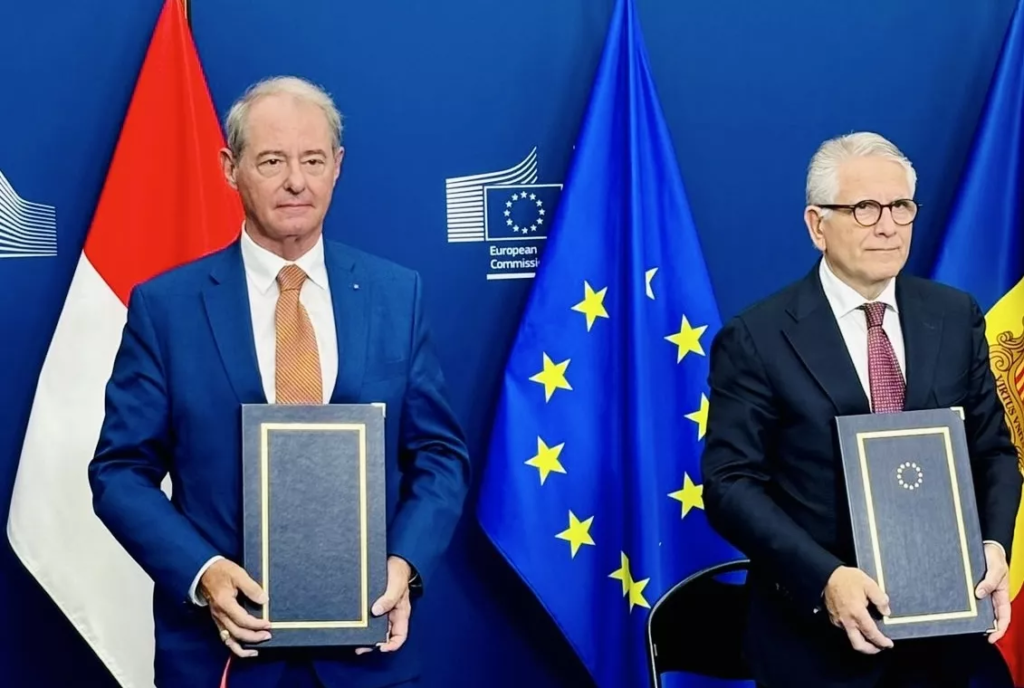
Source: monacolife
In October 2025, the Principality of Monaco and the European Union signed a protocol amending their 2016 agreement on the automatic exchange of financial account information, aligning Monaco’s framework with the OECD’s updated Common Reporting Standard (“CRS 2.0”).
The signing took place in Brussels on October 13, 2025, alongside similar updates with Andorra, Liechtenstein, and San Marino. The revised text integrates new reporting categories such as digital assets, e-money, and central-bank digital currencies, strengthens due-diligence duties for financial institutions, and updates data-protection references to ensure compliance with the EU’s GDPR.
These agreements underscore the EU’s commitment to transparency and international cooperation. By updating and aligning them with revised OECD standards, we are enhancing tax compliance and ensuring a level playing field internationally.
EU Taxation Director-General Gerassimos Thomas
According to the Principality of Monaco’s Minister of Finance and Economy, Pierre-André Chiappori, the protocol confirms the Principality’s “unwavering commitment to the highest international tax standards,” keeping pace with evolving OECD expectations while preserving the Principality of Monaco’s fiscal sovereignty.
The 2016 EU–Monaco Agreement
The original 2016 accord replaced a limited 2004 “Savings Directive” arrangement with a comprehensive system for automatic annual exchange of bank and investment account information between Monaco and all EU member states.
Each year, Monaco transmits to EU tax authorities identifying and financial data on accounts held by EU residents—balances, dividends, interest, and proceeds from asset sales—while receiving equivalent data for Monaco residents with EU accounts.
The agreement entered into force on January 1, 2017, marking a decisive end to traditional banking secrecy and integrating Monaco into the OECD’s global transparency network.
What are the 2025 Protocol Changes
The 2025 amendment primarily aligns the Monaco–EU framework with the OECD’s 2022 CRS revision, already transposed in the EU’s Directive on Administrative Cooperation (DAC8).
Key elements include:
- Wider asset coverage – reporting now extends to digital currencies and electronic-money products.
- Stronger verification – enhanced due-diligence rules for Financial Institutions to confirm clients’ tax residencies.
- More detailed reporting – granular account and transaction data to improve tax authority use.
- Modernized privacy safeguards – explicit integration of GDPR-level protections.
The protocol ensures that the Principality of Monaco’s financial institutions apply the same standards as those in EU states. It entered into force on January 1, 2026, governing exchanges of 2025 account data.
Historical and Policy Context
For decades, Monaco’s financial model relied on discretion and the absence of income tax. Under Prince Albert II, however, the Principality repositioned itself as a cooperative financial center. Since 2009, Monaco has signed numerous Tax Information Exchange Agreements, joined the OECD’s Global Forum on Transparency, and has consistently been rated compliant with international standards.
The 2016 agreement with the EU placed Monaco within Europe’s automatic-exchange network. Successive reforms of Monaco’s AML and tax laws (including implementation of the EU’s 6th AML Directive) have reinforced that stance. Monaco today appears on no EU or OECD tax blacklist, a point the government highlights as proof of its adherence to fair-tax principles.
Why the Update Matters
Financial innovation created new avenues for potential tax evasion. The OECD’s 2022 revision of the CRS closed those gaps; the EU then mirrored it in DAC8; and Monaco’s 2025 protocol now ensures full equivalence.
Without this update, the 2016 text risked falling behind global practice. By signing promptly, Monaco demonstrates continued cooperation with the EU and the G20 agenda against tax evasion and money-laundering.
For the EU, these micro-state protocols ensure that Europe’s immediate neighbors apply identical transparency standards, protecting the integrity of the single market. For Monaco, they secure recognition as a trusted, rules-based financial jurisdiction—vital for investor confidence and international reputation.
Regulatory Position on Crypto Assets in Monaco

Source: Freepik
Monaco’s Financial Supervisory Commission allows crypto activities within legal boundaries but highlights the high risk involved, as these assets lack regulatory guarantees. Investors are advised to:
- Verify the crypto issuer’s credibility, including registration, location, work permits, and management integrity.
- Understand the nature of the crypto assets involved.
- Evaluate associated risks and protection measures for stored assets.
- Assess liquidity potential and related risks.
General Licensing Requirements for Cryptocurrency Operations
Monaco’s approach mirrors European Union regulations and those of neighboring France. To launch a crypto exchange or similar service, companies must establish a local presence, including physical offices, and meet a minimum share capital of 150,000 euros. Key requirements include:
- Hiring experienced financial staff and directors.
- Opening a dedicated bank account for transactions.
- Appointing compliance staff to monitor anti-money laundering (AML) adherence.
- Submit hardware and software details to demonstrate operational capability.
- Providing Know Your Customer (KYC) documentation.
Steps for Licensing a Crypto Exchange in Monaco
The licensing process involves several stages:
- Company Formation: Register a legal entity with clear business goals, verify the founders’ and management’s credentials, secure a legal address, and form the authorized capital.
- Document Preparation: Develop operational policies, including compliance with local laws, then submit a licensing application along with the required documentation.
- Compliance and Approval: After company registration, submit all licensing documents for regulatory review and await approval.
Compliance Essentials
Monaco’s AML regulations mandate that licensed crypto firms:
- Assess risks related to the assets and transactions they handle.
- Create internal policies for crypto transactions.
- Assign personnel to ensure compliance with legal requirements.
- Monitor crypto transactions actively.
- Maintain detailed customer records and report suspicious activity to authorities.
- Train staff in identifying financial crime risks.
These rules provide a structured framework for crypto firms to manage risks and uphold transparency while operating in Monaco. The regulations help protect against crypto scams and crypto hacks.
These rules provide a structured framework for crypto firms to manage risks and uphold transparency while operating in Monaco.
Crypto Usage in Monaco

Source: Freepik
People in Monaco are using cryptocurrencies for a variety of activities, from investing and digital asset management to making daily transactions. Here are the main ways:
Real Estate Transactions
Real estate transactions in Monaco are among the most expensive in the world, and some firms now accept cryptocurrency as a payment option for high-value property purchases. This is particularly appealing to investors from regions with complex capital transfer regulations.
Crypto transactions in real estate also allow for fast settlement, often reducing the need for intermediaries like banks, which can slow down the process. A few real estate firms have started listing properties with Bitcoin or Ethereum prices, primarily targeting wealthy buyers and investors who hold substantial crypto portfolios.
Investments and Wealth Management
With Monaco’s reputation as a haven for high-net-worth individuals, many private wealth managers are beginning to include cryptocurrency in their portfolios. Cryptocurrency is increasingly viewed as a diversified asset class that offers high-reward potential, despite its volatility.
Some wealth management firms in Monaco are now working with clients to allocate portions of their portfolios to digital assets like Bitcoin and altcoins, as well as to crypto-focused funds. When choosing crypto for investment, investors should consider the biggest benefits of cryptocurrency alongside crypto trading strategies.
As global crypto adoption continues to grow, many wonder are people still buying crypto. The answer remains yes, with institutional adoption reaching new heights in 2025.
Cross-Border Payments and Remittances
Monaco’s international resident population benefits from cryptocurrency’s ability to facilitate cross-border remittances and payments. Digital assets provide a faster, more cost-effective alternative to traditional banking systems for international transfers.
Crypto Gambling / Crypto Casinos
Monaco, a global casino hub known for luxury gaming, is starting to see crypto gambling enter the scene. While most of the traditional casinos in Monaco still operate with conventional currency, a few online platforms associated with the region accept cryptocurrencies. These crypto casinos allow players to place bets and withdraw winnings in digital currencies like Bitcoin, Ethereum, and other popular cryptocurrencies.
Daily Payments and Purchases
While Monaco’s adoption of cryptocurrency for everyday transactions is limited, a few high-end retailers, luxury car dealerships, and restaurants have started accepting Bitcoin and other digital currencies. These establishments cater primarily to international tourists and wealthy residents who prefer crypto as a payment option.
Challenges to Cryptocurrency Adoption in Monaco

Source: Freepik
Despite the enthusiasm for digital assets, Monaco faces several key challenges in its journey toward widespread crypto adoption:
Regulatory Evolution and Compliance
While Monaco has established Law 1,528 in 2022 and aligned with EU standards through the October 2025 protocol, the regulatory landscape continues to evolve. Businesses must navigate cryptocurrency regulations and stay updated on crypto lawsuits and enforcement actions globally. Monaco must continue adapting to FATF standards and international best practices.
Security and Privacy Concerns
Like any digital asset, cryptocurrencies are susceptible to hacking and security breaches.
Monaco’s wealthy residents are particularly concerned with protecting their assets, and high-profile security breaches could deter new users. Privacy is also a concern, as crypto transactions can sometimes reveal sensitive financial data. Crypto exchanges’ proof-of-reserves have become increasingly important for building trust.
Limited Merchant Adoption
Although some high-end retailers and real estate firms accept cryptocurrency, adoption among everyday businesses remains limited. This restricts the utility of digital currencies for residents and tourists looking to make regular purchases using crypto, especially for small, frequent transactions.
Market Volatility
The fluctuating values of cryptocurrencies like Bitcoin and Ethereum make them challenging for everyday use. This volatility can lead to significant gains or losses for both businesses and consumers, discouraging some from using crypto for transactions. Understanding cryptocurrency market efficiency and cryptocurrency accumulation and distribution indicators can help investors navigate these challenges.
Banking and Conversion Issues
Converting between cryptocurrencies and traditional currencies can be complicated and expensive, with potential fees and delays. Some banks are still reluctant to integrate digital currency services, which can hinder seamless financial transactions.
Potential Benefits of Cryptocurrency Adoption in Monaco

Source: Freepik
Monaco’s journey into cryptocurrency adoption brings several potential benefits that could enhance its position as a financial and luxury destination:
Increased Economic Diversification
By embracing cryptocurrencies, Monaco can diversify its economy beyond tourism, luxury, and banking. Cryptocurrency adoption could attract blockchain startups, fintech companies, and tech investors looking for an innovation-friendly environment, creating new employment and investment opportunities.
Monaco’s GDP reached approximately $10 billion in 2023, with a GDP per capita of $256,581, one of the highest in the world. The government’s Extended Monaco initiative, launched in 2019, aims to use blockchain technology to improve the health system, economy, and mobility, transforming Monaco into a “Smart Principality.”
Enhanced Appeal for High-Net-Worth Individuals
Cryptocurrency adoption can strengthen Monaco’s appeal to wealthy individuals and digital nomads who often seek tax-friendly environments. With tax incentives and crypto-friendly services, Monaco could attract new residents interested in managing digital assets and financial portfolios from a stable base.
The number of crypto millionaires globally surged to 241,700 in 2025, a 40% increase in just 12 months. Monaco’s zero capital gains tax on crypto investments positions it as an attractive destination for this growing demographic.
Streamlined Cross-Border Transactions
With a high number of international residents, Monaco stands to benefit from the ease of cross-border transactions that cryptocurrencies enable. Crypto provides a simpler, faster, and often more cost-effective way to make global payments, an attractive feature for investors and expatriates conducting business abroad.
Boost to Real Estate and Luxury Sectors
By accepting cryptocurrency, Monaco’s luxury real estate and retail sectors can attract international buyers and investors. Crypto transactions eliminate the need for currency exchange, making high-value purchases more convenient for overseas buyers who might otherwise face currency conversion hassles.
Alignment with Global Innovation Trends
Monaco’s participation in the EU’s automatic exchange framework and adoption of the OECD’s updated Common Reporting Standard (CRS 2.0) positions it at the forefront of global financial transparency. This compliance enhances Monaco’s reputation as a trusted jurisdiction for digital asset management and cryptocurrency lending platforms.
Conclusion
Monaco’s progressive attitude toward cryptocurrencies indicates a strong interest in becoming a hub for digital finance in Europe. The October 2025 protocol with the EU, which took effect January 1, 2026, demonstrates Monaco’s commitment to maintaining the highest international standards while embracing financial innovation.
With the 2025 Henley Crypto Adoption Index score of 34.4 out of 60, Monaco has positioned itself as an attractive destination for crypto investors, particularly high-net-worth individuals seeking zero capital gains tax and sophisticated regulatory frameworks. The Extended Monaco initiative and the establishment of legal frameworks for ICOs and STOs show the government’s proactive stance on blockchain technology.
As the global cryptocurrency market exceeded $4 trillion in 2025 and crypto ownership reached 737 million people worldwide, Monaco’s carefully balanced approach makes it well-positioned to capture a significant share of the growing digital asset economy.
However, achieving widespread adoption will depend on the principality’s ability to address ongoing challenges around merchant acceptance, banking integration, and security concerns. Successful adoption will also require continued regulatory evolution and education to ensure that potential users feel secure.
The journey won’t be without challenges, but the potential for economic and social benefits, combined with Monaco’s unique position as a trusted, compliant jurisdiction with exceptional tax advantages, makes Monaco’s approach to cryptocurrency adoption worth watching closely in 2026 and beyond.


