


Economic Situation In Suriname

Source: Freepik
The economic situation in Suriname remains challenging as of 2026, with the country heavily reliant on its natural resources, particularly mining, which accounts for nearly half of public sector revenue.
However, this dependence makes Suriname vulnerable to external shocks, such as fluctuations in commodity prices. The country stands at a critical juncture as it prepares for the upcoming oil boom from Block 58 offshore development, expected to begin production in 2028 and potentially double real GDP by 2030.
According to the IMF’s November 2025 assessment, macroeconomic stability has been eroded. After achieving primary surpluses from 2022 to 2024, the fiscal position worsened significantly in 2025. A pre-election fiscal expansion drained government cash balances and created liquidity pressures that drove inflation from around 6% earlier in 2025 to over 10% by year-end. As of October 2025, inflation reached 11.9%, though this marks a substantial decline from the 59% peak experienced in recent years.
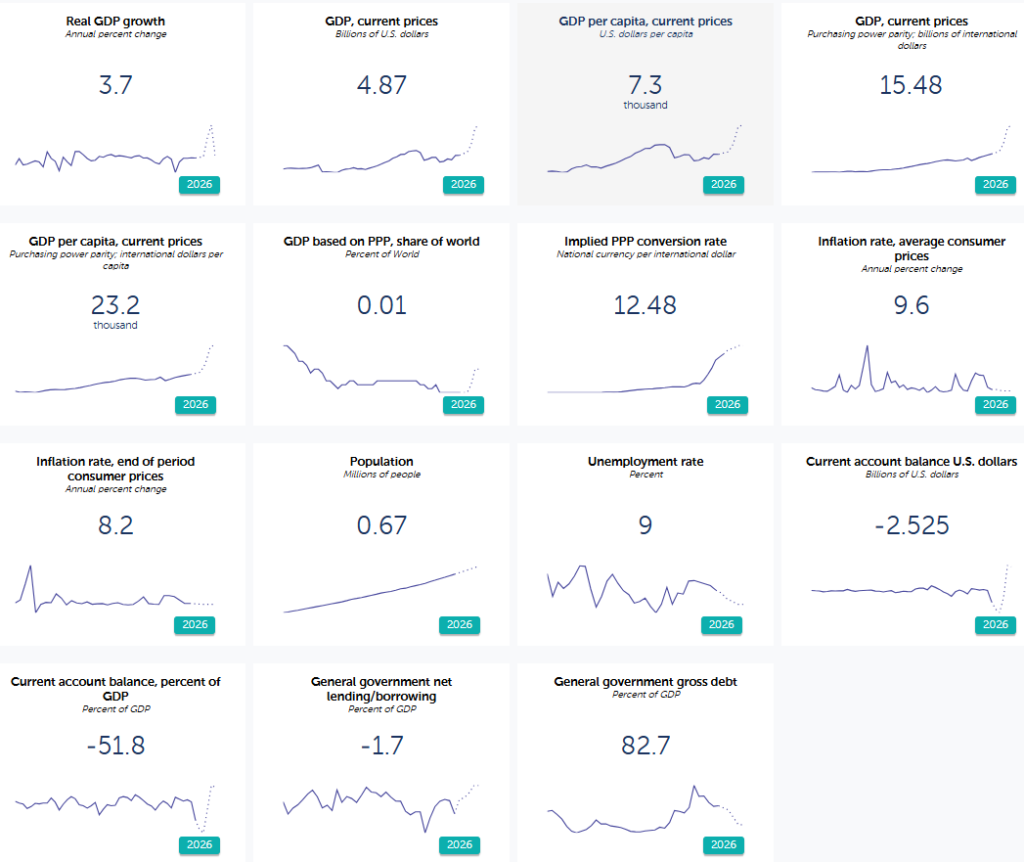
By 2026, the IMF projects real GDP growth of 3.7%, with GDP at current prices reaching US$4.87 billion. The country’s per capita GDP stands at approximately $7,300. However, Suriname continues to face significant challenges, including a projected inflation rate of 9.6% for 2026 and an unemployment rate of 9%.
Source: IMF DataMapper
The economic situation also features a substantial current account deficit of 51.8% of GDP ($2.525 billion) in 2026, though this is largely driven by import-intensive development of the Block 58 oil project and is being financed by FDI inflows.
Cryptocurrencies could offer several benefits to Suriname. They can provide an alternative financial system that is less dependent on traditional banking and can help reduce transaction costs, especially for remittances. Cryptocurrencies can also increase transparency in financial transactions, reducing the risk of fraud and corruption, a critical concern given the country’s ongoing governance challenges.
The State of Crypto Adoption in Suriname

According to the latest 2026 projections from Statista, Suriname’s cryptocurrency market demonstrates growing engagement despite its small size. The crypto market is expected to generate revenue of US$99,600 in 2026, reflecting an annual growth rate of 3.60% from the 2025 figure of US$96,100.
The market is projected to reach approximately 39,530 users by 2026, representing a user penetration rate of 6.18%. This growing adoption is particularly notable given Suriname’s economic uncertainty and high inflation environment. The average revenue per user in the cryptocurrency market for Suriname stands at approximately US$2.6.
When compared globally, the United States leads with the highest cryptocurrency market revenue, reaching approximately US$16.1 billion in 2025. Suriname’s gradual crypto adoption suggests a cautious but curious approach to emerging financial technologies, potentially driven by desires for economic diversification and financial resilience amid currency instability.
The country’s crypto adoption reflects a broader global trend, with cryptocurrencies increasingly viewed as alternative investment options. This growth is particularly significant in the context of Suriname’s projected 9.6% inflation rate for 2026, which continues to erode the purchasing power of the Surinamese dollar (SRD).
Bitcoin Adoption in Suriname

Source: Freepik
Maya Parbhoe’s Presidential Campaign and 2025 Election Results
Maya Parbhoe, a Bitcoin advocate and CEO of Daedalus Labs, ran as a candidate for the National Party of Suriname (NPS) in the May 25, 2025, elections with an ambitious plan to make Bitcoin legal tender. Her platform included gradually replacing the Surinamese dollar with Bitcoin within the first year, dismantling the central bank, cutting taxes, and creating an “open-source government” using Bitcoin’s transparency to combat corruption.
We’re also working on bringing Bitcoin mining facilities to the rural areas of Suriname, aiming to transform the country into a Bitcoin-producing nation, and with this initiative, we will create more job opportunities for Surinamese people to work and get paid in SATs.
However, the May 2025 elections resulted in no party securing a parliamentary majority. The National Democratic Party (NDP) won 18 seats, followed by the ruling Progressive Reform Party (VHP) with 17 seats, and smaller parties capturing the remaining 16 seats. The NPS, Parbhoe’s party, won 6 seats total in the coalition negotiations that followed.
On July 6, 2025, the National Assembly elected NDP leader Jennifer Geerlings-Simons as Suriname’s first female president, ending speculation about a Bitcoin-focused administration. Parbhoe’s specific Bitcoin legal tender proposals did not gain the traction needed for implementation at the national level.
Despite the electoral outcome, Parbhoe’s campaign significantly raised awareness about Bitcoin and cryptocurrency in Suriname, and she continues her work through Daedalus Labs and support for grassroots Bitcoin education initiatives.
Bitcoin Circular Economies Continue to Expand
Thanks to the efforts of hardworking Bitcoin advocates, Bitcoin circular economies continue to grow in Suriname. These economies, inspired by Bitcoin Beach in El Zonte, El Salvador, are small-scale jurisdictions where bitcoin is commonly used as currency among residents and merchants. They also include Bitcoin education centers and are led by locals who have earned the respect of their communities.
Suriname now has two established Bitcoin circular economies: Bitcoin Sranan in Paramaribo and Bitcoin Alfonsdorp in the rural northeast.
Bitcoin Sranan
Founded by Maya Parbhoe in 2021 after visiting El Salvador, Bitcoin Sranan has become a thriving community initiative. Terence Coronel, who took over day-to-day leadership, focuses on educating community members using the Mi Primer Bitcoin (My First Bitcoin) curriculum and onboarding merchants to accept Bitcoin payments.
Coronel’s approach involves direct outreach, visiting shops and households three times daily to introduce Bitcoin. He helps interested parties download the Blink Wallet, which enables payments via the Lightning Network, and conducts test transactions by sending them $3 worth of bitcoin.
The difficult part is getting them to come to and complete the Mi Primer Bitcoin course. It’s 10 weeks long. Some people have trouble finding transport, and some lose interest. Some also think that Bitcoin is about getting rich fast. Most ask ‘Can you teach us to trade?’ or ‘Can you teach us how to buy a car fast?’ Usually, I respond with ‘We’re not teaching trading. We’re not teaching people to get rich fast. We’re trying to create awareness around Bitcoin so people understand what Bitcoin is, how it works, and what it can mean for their future
As of January 2025, Bitcoin Sranan has successfully onboarded 113 merchants. These merchants are registered on BTC Map, the Blink app, and promoted on social media platforms including X (formerly Twitter), Facebook, and Telegram. Many merchants have received unexpected international donations through the Bitcoin network, which has strengthened their enthusiasm for participation.
Bitcoin Alfonsdorp
Terence Karijondomo, a technically-minded indigenous Surinamese citizen who installs security systems for a living, started Bitcoin Alfonsdorp after learning about Bitcoin at the Bitcoin Sranan education center. Located in a rural region near the border of French Guiana, this initiative aims to ensure that indigenous communities don’t miss out on Bitcoin adoption.
In Suriname, indigenous people are always the last to adopt new technology. I want to teach the younger generation about Bitcoin because otherwise they are going to take other paths that are not very good for them. I’m trying to change that, and, in Bitcoin, I found a way to relate to them, so that’s my mission.
However, he also noted a significant challenge: many Surinamese have fallen victim to Bitcoin scams, leaving them skeptical.
Many are traumatized right now because of Bitcoin scams, so some just don’t want to hear anything about it.
A local Bitcoin educator known by the pseudonym “NOMAD” on Nostr emphasizes the importance of tailoring Bitcoin education to the local context. He suggests creative approaches like using cabarets (popular theatrical performances in Suriname) to introduce Bitcoin concepts in culturally relevant ways.
Maybe 50% of what works in El Zonte will work here. The rest needs to be tailored to Suriname.
Crypto Law In Suriname

As of 2026, there remains no established cryptocurrency legal framework in Suriname. The country currently has no formal cryptocurrency regulations, and cryptocurrency holds no official legal status in its financial system. This places Suriname in a legal gray area where digital currencies are neither explicitly permitted nor prohibited.
The Central Bank of Suriname (CBvS) has issued general warnings about the risks associated with cryptocurrencies, focusing on their speculative nature and potential for illicit activities. However, these warnings do not constitute a formal ban. As of 2025, Suriname also has no specific tax regulations for cryptocurrency transactions, meaning general tax laws apply to any crypto-related income.
Following the May 2025 elections, the new Geerlings-Simons administration has not announced any immediate plans to establish cryptocurrency regulations. The government’s focus has been on managing the upcoming oil boom and implementing fiscal reforms recommended by the IMF.
The absence of specific regulations creates both opportunities and challenges. While it offers flexibility for early adopters and businesses willing to navigate the uncertain landscape, it also creates risks for investors and users who lack formal legal protections.
Businesses in Suriname that wish to accept crypto payments currently operate in this regulatory vacuum, facing ambiguity regarding licensing, taxation, and compliance requirements. This uncertainty can stifle growth and investment in the cryptocurrency sector.
Globally, 2025 saw significant regulatory developments in cryptocurrency markets. The U.S. passed the GENIUS Act, creating a federal stablecoin framework, the EU’s MiCA regulation took full effect, and Hong Kong launched a comprehensive stablecoin framework. However, these international developments have not yet influenced Surinamese policy, leaving the country’s cryptocurrency regulatory status unchanged.
Challenges to Crypto Adoption in Suriname
Crypto adoption in Suriname faces several persistent challenges:
Regulatory Uncertainty
The lack of a clear regulatory framework for cryptocurrencies creates confusion for businesses and individuals interested in adopting digital assets. The new Geerlings-Simons administration, which took office in July 2025, has not prioritized cryptocurrency regulation, focusing instead on managing oil revenue distribution and fiscal consolidation. This continued regulatory vacuum creates hesitation among potential users and may deter foreign investment in crypto-related ventures.
Technological Limitations
Suriname faces substantial technological barriers that impede widespread crypto adoption. The existing digital infrastructure is not fully prepared to support large-scale cryptocurrency use. Key challenges include:
- Limited internet access, particularly in rural areas
- Low digital literacy rates among the general population
- Shortage of secure transaction platforms
- Limited availability of user-friendly financial technology
According to the IMF’s 2025 assessment, government and regulatory inefficiency, especially bureaucratic delays, remain a key constraint for businesses operating in Suriname. This extends to the cryptocurrency sector, where the lack of clear guidelines creates operational challenges.
Economic and Financial Volatility
With inflation reaching 11.9% in October 2025 and projected at 9.6% for 2026, the country faces significant economic instability. While this creates demand for alternative stores of value, the additional price fluctuations of digital currencies make them appear risky.
The volatility in cryptocurrency markets, combined with local economic uncertainty, creates hesitancy among potential adopters seeking more stable financial instruments.
Cybersecurity and Trust Concerns
The increasing sophistication of cyber-attacks raises significant concerns about the safety of cryptocurrency transactions. Multiple sources indicate that many Surinamese citizens have been victimized by cryptocurrency scams, creating widespread skepticism and distrust.
This “trauma” from past scams, as described by Bitcoin educators in Suriname, represents a significant barrier to adoption that requires patient education and community building to overcome.
Public Awareness and Education
A fundamental challenge remains the lack of public awareness and understanding of cryptocurrencies. Many Surinamese citizens do not comprehend the benefits, risks, and operational mechanisms of digital currencies. While initiatives like Bitcoin Sranan and Bitcoin Alfonsdorp are working to address this gap through community education, the reach of these programs remains limited compared to the national population.
Potential Benefits of Crypto Adoption in Suriname
Crypto adoption in Suriname could bring numerous potential benefits, especially considering the current economic challenges the country faces:
Economic Sovereignty
By embracing a decentralized financial system, the country could reduce dependence on traditional banking infrastructure and challenge the control exerted by international financial institutions. This could allow Suriname to develop financial policies that better reflect its unique economic context and local needs, particularly as it navigates the transition to becoming an oil-producing nation.
Inflation Protection
With inflation projected at 9.6% for 2026 and having reached 59% in recent years, Suriname’s currency has suffered significant depreciation. Cryptocurrencies, particularly Bitcoin or stablecoins, could provide an alternative store of value that protects individual and collective wealth from continuous monetary erosion. The growing user base suggests increasing interest in such inflation hedges.
Governance and Transparency Improvements
The inherent transparency of blockchain technology could serve as a powerful tool for reducing governmental corruption, a concern that was central to Maya Parbhoe’s presidential campaign and remains relevant under the new administration. By implementing blockchain-based systems for government transactions, Suriname could create mechanisms that make economic transactions more traceable and accountable.
Financial Inclusion
Cryptocurrencies could extend financial services to underserved populations, particularly in rural areas like Alfonsdorp, where traditional banking infrastructure is limited. With mobile wallets and the Lightning Network, individuals without access to traditional banks could participate in the digital economy.
Remittance Efficiency
For a country with significant emigration, crypto payments could reduce the cost and time of cross-border remittances. This aligns with global trends where stablecoin usage for remittances grew by 21.7% in 2025.
Investment Diversification
With cryptocurrency markets becoming increasingly mainstream globally. Surinamese investors could access new asset classes and investment opportunities that were previously unavailable, potentially building wealth through strategic trading.
The Future of Crypto in Suriname
The future of cryptocurrency in Suriname will be shaped by several converging factors:
Regulatory Development
The Geerlings-Simons administration, which began in July 2025, will play a crucial role in determining whether Suriname develops a formal cryptocurrency regulatory framework. As the country prepares for oil production beginning in 2028 and the associated economic transformation, policymakers may consider how digital assets could fit into the broader financial ecosystem.
Global regulatory trends, including the U.S. GENIUS Act for stablecoins, the EU’s MiCA framework, and increasing adoption of proof-of-reserves requirements for crypto exchanges, may eventually influence Surinamese policy. However, as of 2026, there are no announced plans for comprehensive cryptocurrency legislation.
Grassroots Adoption Continues
Regardless of government policy, Bitcoin circular economies like Bitcoin Sranan and Bitcoin Alfonsdorp are likely to continue expanding. With 113 merchants already onboarded and ongoing educational initiatives, these grassroots movements represent the most tangible crypto adoption in Suriname. The success of these initiatives demonstrates that community-driven adoption can occur even without supportive national policy.
Technological Infrastructure
As internet penetration improves and smartphone usage increases, more Surinamese citizens will gain access to cryptocurrency platforms. The projected growth in cryptocurrency users suggests steady expansion of the user base, albeit at a modest pace.
Economic Factors
The trajectory of Suriname’s economy, particularly inflation trends and the success of the Block 58 oil project, will significantly impact cryptocurrency adoption. If inflation remains high (as projected at 9.6% for 2026), demand for alternative stores of value may increase. Conversely, if the oil boom successfully stabilizes the economy and the Surinamese dollar, the urgency for cryptocurrency alternatives may diminish.
Global Crypto Trends
Suriname’s crypto future will also be influenced by global developments in digital assets. The growing acceptance of Bitcoin ETFs, institutional adoption of cryptocurrencies, advancement in cryptocurrency lending platforms, and innovations in cryptocurrency accumulation and distribution indicators will shape how Surinamese citizens and businesses perceive and use digital currencies.
Political Developments
While Maya Parbhoe’s ambitious Bitcoin legal tender proposal did not materialize following the 2025 elections, politics and crypto remain intertwined in Suriname. Future political leaders may revisit cryptocurrency policy, particularly if Bitcoin circular economies continue to demonstrate success or if regional neighbors adopt supportive frameworks.
The potential for crypto lawsuits and legal disputes may also eventually push Suriname toward establishing clear regulations to protect consumers and provide legal certainty for businesses.
Conclusion
Cryptocurrency, particularly Bitcoin, represents both opportunity and challenge for this small South American nation. While the ambitious political agenda to make Bitcoin legal tender did not succeed in the 2025 elections, grassroots initiatives continue to demonstrate the practical utility of digital currencies in Surinamese communities.
As of 2026, Suriname’s cryptocurrency market shows modest but steady growth, with nearly 40,000 projected users and revenue approaching $100,000. The country’s ongoing economic challenges create both demand for alternative financial systems and urgency for solutions.
The potential benefits of crypto adoption, including protection from inflation, increased financial transparency through blockchain technology, enhanced cross-border remittance efficiency, and economic empowerment, remain significant. However, challenges persist, including regulatory uncertainty, technological limitations, cybersecurity concerns, and the lingering effects of past scams.
As Suriname stands at the threshold of an oil-driven economic transformation with Block 58 production expected in 2028, the coming years will be crucial in determining whether this digital financial revolution can truly take root.
The success of community-driven initiatives like Bitcoin Sranan and Bitcoin Alfonsdorp suggests that, regardless of national policy, Surinamese citizens are finding practical value in cryptocurrency adoption.
Whether through grassroots adoption or eventual regulatory clarity under the Geerlings-Simons administration, cryptocurrencies will likely play an evolving role in Suriname’s financial landscape in the years ahead.


