We’ve officially moved past the days when crypto was just a fringe experiment.
We watched Bitcoin blow past $126,000 before a minor pullback, while Ethereum managed a solid 40% rally in that same window.
These are not just flashy headlines, they’re proof that this asset class has finally grown up
If you are waiting for the dust to settle before committing, consider this guide your jumping-off point.
Cryptocurrency Investments and How They Work?
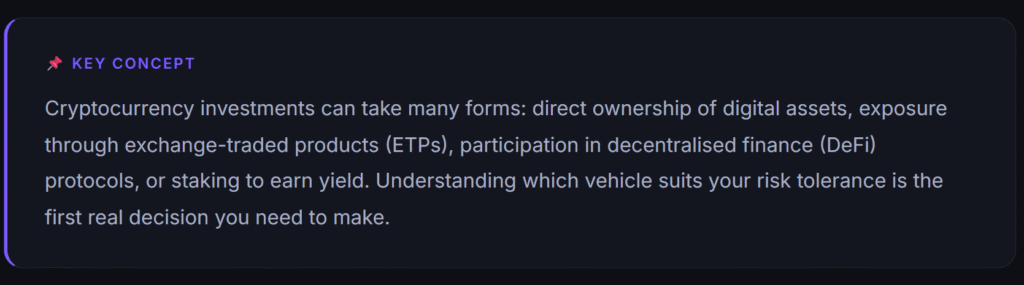
Cryptocurrency investments involve acquiring digital assets that exist on a blockchain- a decentralised, cryptographically secured ledger maintained by a global network of computers rather than any single institution.
Related Reads: What Are Cryptocurrency Earnings, KYC Challenges in Crypto.
Unlike stocks that represent ownership in a company, or bonds that represent a loan to a borrower, most digital assets represent something newer and sometimes harder to categorise: access to a decentralised network, computational resources, governance rights, or, in Bitcoin’s case, a mathematically scarce store of value.
When you purchase Bitcoin, Ethereum, Solana, or any other digital asset through an exchange or 🔗 crypto wallet, you receive a private key that proves ownership on the blockchain.
That key is what you are truly securing when you invest.
No bank, broker, or institution can freeze it, reverse it, or inflate it away which is precisely why the asset class has attracted so much attention from those seeking an alternative to traditional financial rails.
Which Cryptocurrencies Are Worth Investing In?
The most honest answer is that no one can tell you with certainty which assets will outperform.
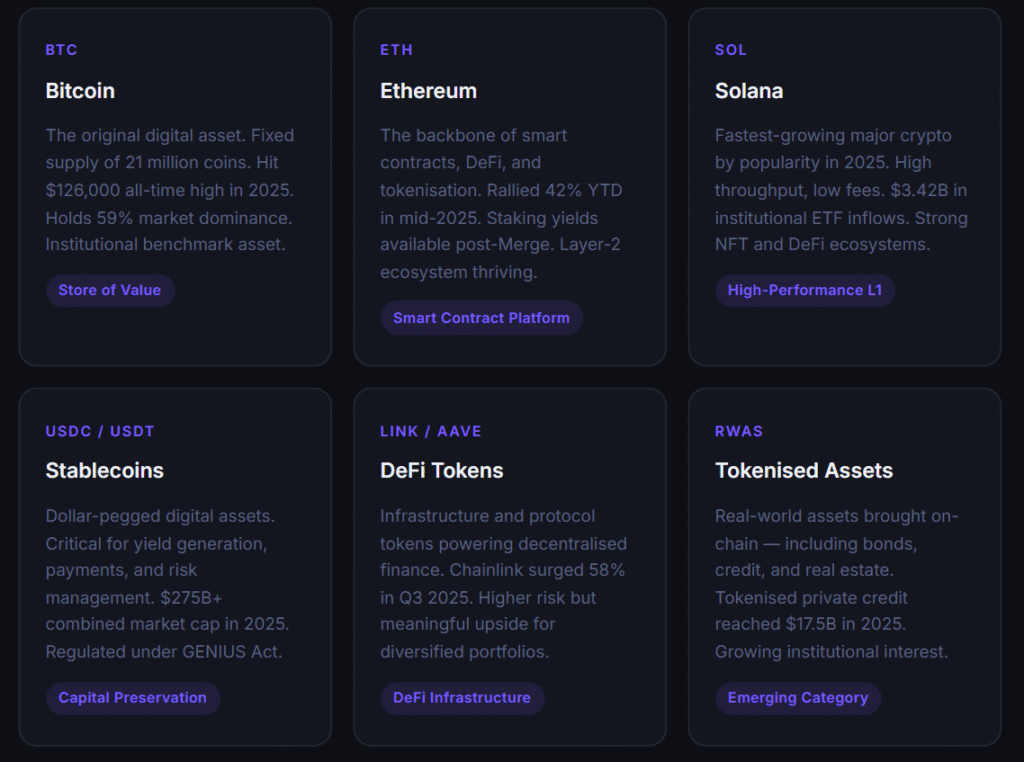
What the data can tell you is which assets have the deepest liquidity, the strongest developer ecosystems, the clearest regulatory status, and the most institutional backing all factors that historically reduce downside risk even if they do not guarantee upside.
Should You Invest in Altcoins or Stick to Bitcoin and Ethereum?
Altcoins, any cryptocurrency beyond Bitcoin, carry meaningfully higher volatility and project-specific risk.
In bull markets, they can outperform spectacularly. In Q3 2025, Ethereum rose 65%, Chainlink gained 58%, and Solana climbed 32%, while Bitcoin rose just 6%, illustrating how rotation into altcoins can generate outsized returns during specific market phases.
For full data/information, read also: Bitcoin or Altcoins
A widely used institutional framework positions 60 to 70% of a crypto portfolio in Bitcoin and Ethereum, 20 to 30% in large-cap altcoins and DeFi tokens, and 5 to 10% in stablecoins for liquidity management.
What Are the Real Risks of Cryptocurrency Investments?
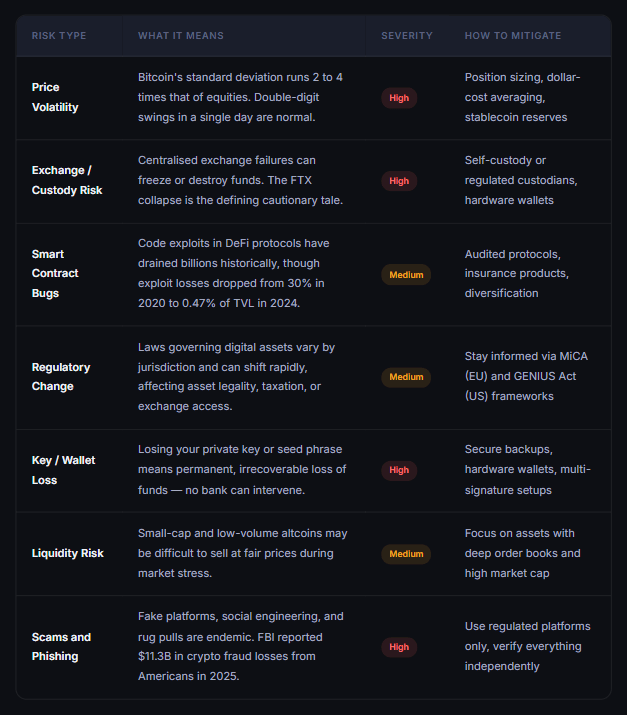
Investing in digital assets without understanding the risk profile is one of the most common and costly mistakes new participants make.
The risks are real, specific, and different in character from those of traditional asset classes.
How Is the Regulatory Environment Shaping Cryptocurrency Investments?
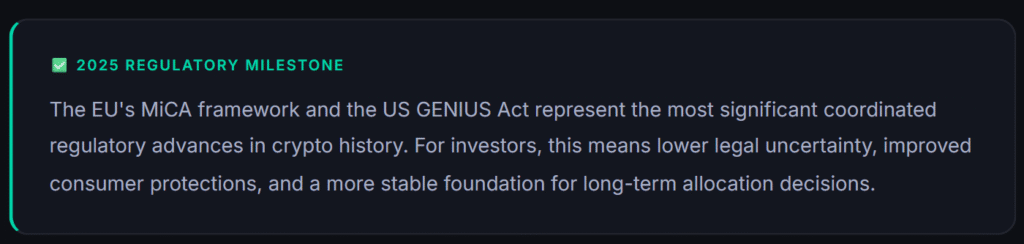
One of the most significant changes in the 2025 investment has been the arrival of genuine regulatory clarity in major markets, and this matters for investment risk.
Unclear regulation has historically been one of the primary barriers preventing institutional capital from entering the asset class at scale.
In the United States, the GENIUS Act was passed in July 2025, creating a comprehensive framework specifically for payment stablecoins.
This legislation opened the door for traditional banks, including Bank of America, to develop their own stablecoin products and gave institutional investors the regulatory certainty they had been waiting for.
In Europe, MiCA (Markets in Crypto-Assets Regulation) continues to set standardised rules across all EU member states, covering licensing, consumer protection, and market integrity.
Hong Kong and the UAE have simultaneously advanced their own stablecoin licensing regimes, creating a genuinely global regulatory architecture for the first time.
Exchange-traded products now hold over $175 billion in on-chain crypto holdings globally, up 169% from $65 billion a year ago, a direct result of regulatory progress making institutional participation viable.
BlackRock, Fidelity, JPMorgan, and Visa are no longer observers they are active participants building infrastructure on blockchain rails.
How Can Businesses Use Cryptocurrency as Part of Their Financial Strategy?
1. Set Up a Business Crypto Wallet
Your first step is a secure, business-grade wallet. Platforms like UPay provide managed wallet infrastructure, so you do not need to handle private keys or custody yourself.
2. Choose a Crypto Payment Gateway
A crypto payment gateway handles receiving, verifying, and settling payments. Look for one that supports automatic fiat conversion if you want to hold pounds or dollars instead of volatile crypto.
3. Decide Which Digital Assets to Accept
Starting with Bitcoin and a major stablecoin like USDC covers the largest share of crypto-paying customers while minimising complexity. You can expand to Ethereum and Solana as familiarity grows.
4. Integrate Into Your Existing Checkout
API-based gateways connect to your website, POS system, or invoicing platform with minimal development work. Most major e-commerce platforms now support stablecoin payment plugins natively.
5. Set a Treasury Policy
Decide how much crypto revenue, if any, you will hold versus converting to fiat.
Some businesses choose to hold a small percentage as a speculative position; others convert 100% immediately. Both are valid strategies depending on your risk tolerance.
What Happens When Investors Chase Trending Tokens Without Research?
Meme coins and politically themed tokens generate enormous short-term attention but rarely sustain value.
Despite heavy media coverage in 2025, politically themed tokens like those inspired by public figures were held by approximately 1% of crypto owners.
Chasing momentum without understanding the underlying technology, team, and use case is one of the fastest routes to significant losses.
Frequently Asked Questions
What is the difference between a Bitcoin ETF and buying Bitcoin directly?
A Bitcoin ETF (technically an ETP in the UK and US) holds Bitcoin on your behalf through a regulated financial product, allowing you to gain price exposure through a brokerage account without managing wallets or private keys.
The trade-off is that you do not own the underlying asset directly, you cannot use it for payments, and ongoing management fees apply.
Read also: Top Cryptocurrency Regulations Every Investor Should Know
Conclusion
As the saying goes, don’t wait to buy real estate, buy real estate and wait. The same logic applies to a smart cryptocurrency investment today
The path is clear, the infrastructure is ready, and this is your window of opportunity for a smart cryptocurrency investment.