

What if a company had no CEO, no headquarters, and no single owner, yet still managed billions of dollars, made decisions transparently, and operated 24/7 across the globe?
This isn’t a future idea or a sci-fi concept. It already exists, and it’s called a Decentralized Autonomous Organization (DAO).
DAOs are among the most exciting innovations to emerge from cryptocurrency and blockchain technology. They challenge traditional organizational models by replacing centralized control with community ownership, open participation, and rules enforced by code rather than people.
In an era where trust in institutions is often questioned, DAOs offer a new way to coordinate money, ideas, and people, without relying on intermediaries.
With DAO, anyone can propose an idea, such as improving the platform, funding a new feature, or rewarding contributors. The community votes, and once a proposal is approved, the system automatically executes the decision. No waiting for approvals. No closed-door meetings. Everything is visible, verifiable, and community-driven.
Key Takeaway
- DAOs replace traditional leadership with collective decision-making, allowing members to vote on proposals and shape the direction of the project together.
- Rules, voting, and fund management are handled by smart contracts, making DAO operations transparent, automated, and hard to manipulate.
- Transparency, global participation, and efficiency are key advantages, while smart contract bugs, governance challenges, and legal uncertainty remain important risks.
- As tools improve and regulations attain stability, DAOs are becoming a core model for how decentralized projects and digital communities operate.
What Does DAO Stand For?
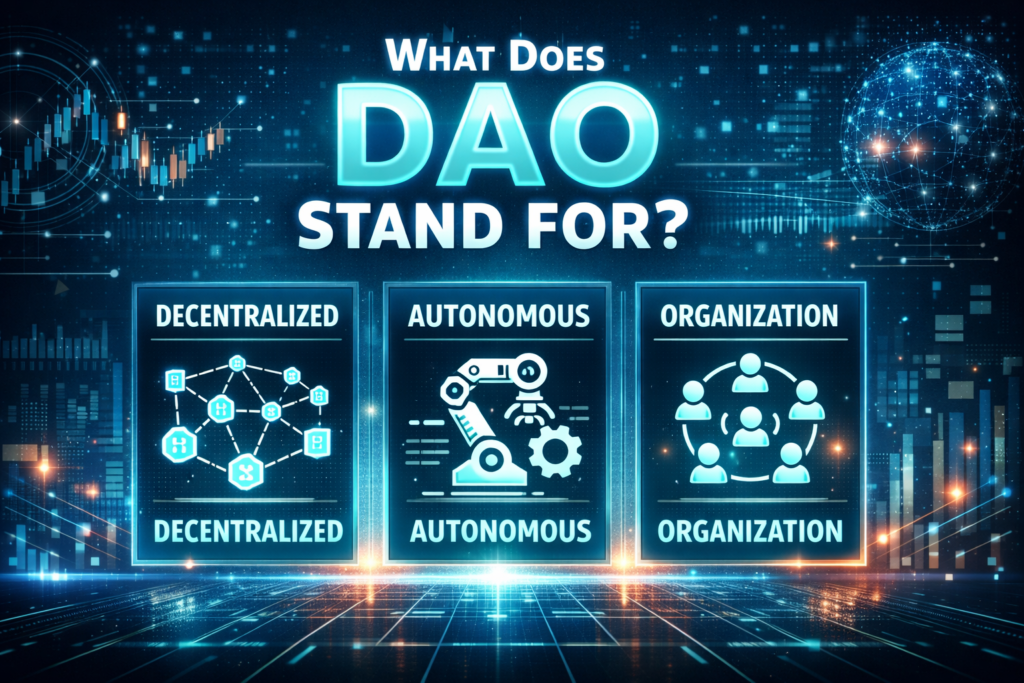
A DAO is short for Decentralized Autonomous Organization. It’s a new kind of internet-based organization that runs on blockchain technology.
Instead of being controlled by one person, founder, or company, a DAO is managed by the people who are part of it, usually through tokens and voting.
Think of it like an online community or company where the rules are built into computer code, and every major decision is made by the members together.
This makes DAOs open, transparent, and less dependent on traditional leaders or institutions.
- Decentralized: Control is distributed across token holders or members, rather than concentrated in a single authority.
- Autonomous: Rules and processes are encoded into blockchain-based smart contracts that automatically execute actions when conditions are met.
- Organization: Members work collectively toward shared goals, whether managing a protocol, investing capital, supporting creators, or building online communities.
In simple terms, a DAO is a digitally native organization governed by its community rather than a CEO or corporate hierarchy.
Decisions such as funding proposals, upgrades, partnerships, or strategic direction are made through on-chain (or sometimes hybrid) voting, where voting power is typically tied to governance tokens or membership mechanisms.
This model enables open participation; anyone who meets the DAO’s requirements, usually by holding tokens or being approved as a contributor, can take part in shaping its future.
Origins and Evolution of DAOs
The concept of decentralized governance predates cryptocurrency, but blockchain technology made it practical and enforceable without trust.
The term “DAO” gained mainstream recognition in 2016 with the launch of The DAO, one of the earliest high-profile decentralized investment funds built on Ethereum. It raised over $150 million worth of ether, an unprecedented amount at the time.
However, the DAO suffered a critical smart contract exploit that resulted in major losses and ultimately led to Ethereum’s hard fork. While the event exposed risks in decentralized systems, it also sparked intense innovation and learning across the blockchain industry.
From 2018 onward, DAOs grew rapidly alongside decentralized finance (DeFi). Protocols like MakerDAO demonstrated that DAOs could securely govern multibillion-dollar ecosystems, while networks such as Uniswap and Aave introduced community-driven token governance models.
By the early-to-mid 2020s, DAOs expanded beyond finance into:
- creator collectives
- social clubs
- community-owned media
- philanthropy and grants
- gaming guilds
- decentralized infrastructure
- venture capital funds
Legal frameworks also began emerging in regions such as the U.S. state of Wyoming, Dubai, Switzerland, and others, demonstrating growing mainstream recognition.
Today, DAOs continue to grow toward more secure, scalable, and inclusive governance structures while becoming a core component of Web3.
With smart contracts, DAOs make decisions automatically, transparently, and without intermediaries.
How DAOs Work
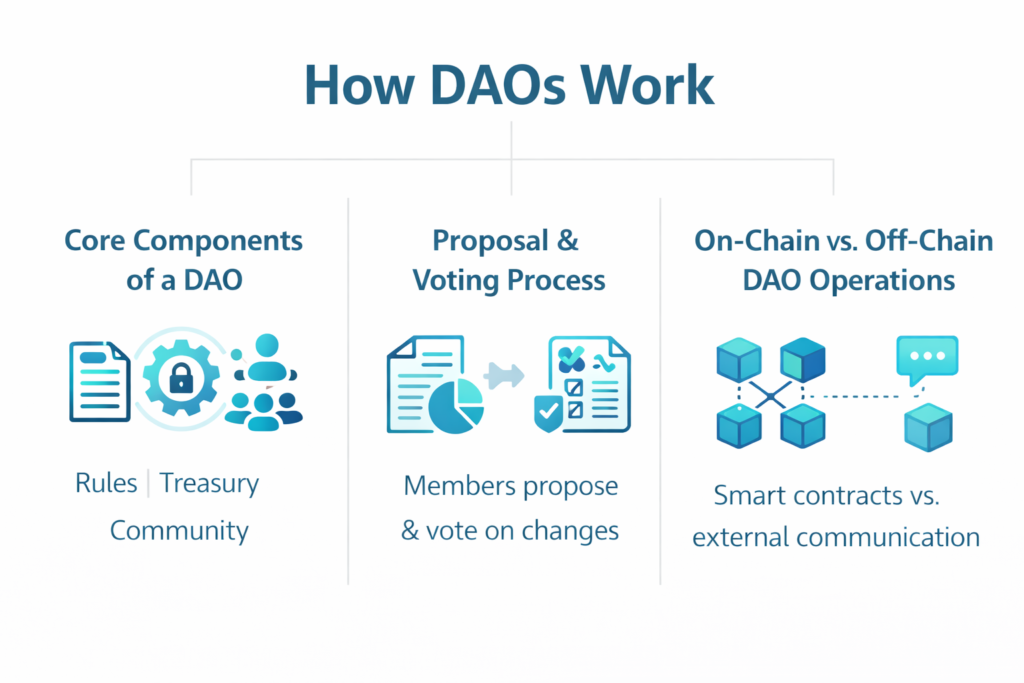
DAOs may sound complicated, but the idea is simple: a DAO is an online organization that runs on blockchain technology and is controlled by its members.
Everything operates according to rules written in code, and major decisions are made through voting instead of traditional management.
Core Components of a DAO
Every DAO is built using a few key building blocks. These tools help the DAO operate, manage money, and organize its community.
Smart Contracts
Smart contracts act as the “brain” of the DAO. They are programs stored on the blockchain that automatically carry out actions when certain conditions are met.
For example, if members vote to approve funding for a project, the smart contract can automatically release the money once the vote is completed. This removes the need for manual approval and reduces the chance of human error or manipulation.
Once the rules are written into the contract, they run exactly as programmed.
Governance Tokens
Most DAOs use governance tokens to give members a voice in decision-making. People who hold these tokens are able to vote on proposals, influence direction, and take part in important choices.
In many DAOs, the more tokens you hold, the greater your voting power, although some projects design systems to balance this out. Tokens may be earned through contributions, early support, or community participation.
Treasury and Funds
DAOs usually manage a shared pool of money called a treasury. This treasury often holds crypto assets that are used to fund projects, reward contributors, run operations, or support the ecosystem.
Because everything is recorded on the blockchain, anyone can see how much money the DAO has and how it is being spent. This creates a very high level of transparency compared to traditional organizations.
Communication & Collaboration Tools
Even though the blockchain handles voting and finance, members still need places to talk, share ideas, and organize work. DAOs usually communicate through platforms like Discord, Telegram, forums, and shared online documents.
This is where ideas are discussed and refined before becoming formal proposals. These tools also help build community culture and teamwork.
Proposal and Voting Process
DAOs operate through proposals and voting. This is how members make collective decisions about the future of the project.
Making Proposals
A proposal is simply a suggestion for the DAO to consider. It may request funding, suggest a new idea, update rules, or create a new initiative.
Proposals normally include an explanation of what is being done, why it matters, how much it will cost, and who will be responsible. Before voting begins, the community often discusses and improves the idea.
Voting Mechanisms
Once a proposal is ready, members vote on it. Different DAOs use different voting systems, but the goal is always the same: to let the community decide. Votes are recorded on the blockchain so the process is open and verifiable.
Execution of Decisions
When a proposal passes, the result is carried out. In many DAOs, smart contracts automatically execute the decision, for example, transferring funds or updating a rule. If a proposal does not receive enough support, nothing changes. This structure prevents back-room decisions and keeps everything transparent.
On-Chain vs Off-Chain DAO Operations
Not all DAOs run in exactly the same way. Some operate fully on the blockchain, while others combine on-chain systems with off-chain coordination.
On-Chain Governance
In on-chain governance, proposals, voting, and execution all happen directly on the blockchain. This offers strong security and transparency because everything is recorded publicly. However, it can sometimes be slower or more technical.
Hybrid Models & Sub-DAOs
Many DAOs today use a hybrid approach. Discussions and brainstorming may happen off-chain, while voting and final execution still occur on-chain.
Large DAOs sometimes create smaller groups called Sub-DAOs to focus on specific areas such as grants, marketing, or development. This helps the organization stay flexible while still remaining decentralized.
“While DAOs offer transparency and efficiency, they also remind us that innovation comes with real risks and challenges.”
Types and Use Cases of DAOs
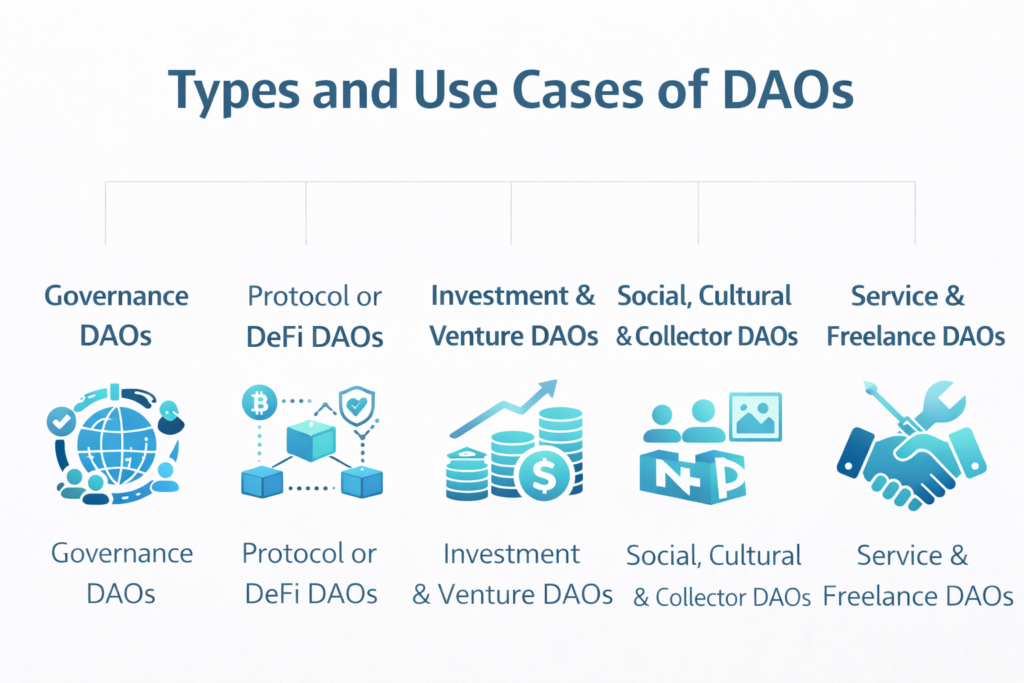
DAOs are used for many different purposes across the crypto industry and beyond. While every DAO is unique, most of them fall into a few main categories based on what they do and how they operate.
Understanding these types makes it easier to see how flexible and powerful DAOs can be.
Governance DAOs
Governance DAOs exist to help communities make decisions together. Instead of a company board or CEO making the rules, members vote on everything, from major strategy changes to small updates. These DAOs usually control important parts of a project, such as its direction, rules, or budget.
Members often hold governance tokens, which allow them to vote on proposals. This turns users into decision-makers. Governance DAOs are common in Web3 because they give real ownership and control back to the community instead of keeping it in the hands of a few founders.
Protocol or DeFi DAOs
Protocol or DeFi DAOs manage decentralized finance platforms such as lending protocols, exchanges, and staking platforms. These DAOs help operate the core crypto systems people use every day.
Because billions of dollars can flow through DeFi platforms, these DAOs are extremely important. They allow users to govern the financial systems they rely on rather than leaving control to traditional banks or private companies.
Investment & Venture DAOs
Investment and venture DAOs bring people together to pool money and invest as a group. Instead of one investor making decisions, members discuss opportunities and vote on where to place funds.
This model allows everyday people to take part in venture-style investing that was once limited to wealthy firms and private investors.
Social, Cultural & Collector DAOs
Not all DAOs are about finance. Social, cultural, and collector DAOs are built around shared interests, communities, or creative projects.
Members often join because they share a passion for art, gaming, music, culture, or social causes. These DAOs help turn online communities into real-world impact and collaboration.
Service & Freelance DAOs
Service DAOs operate like decentralized agencies. Instead of a company hiring employees, freelancers from around the world come together in a DAO to offer services such as:
- marketing
- design
- development
- consulting
- writing
Members work on projects, get paid from the DAO treasury, and help make decisions about how the organization runs. This model creates flexible, global teams without traditional corporate structures.
Real and Cross-Industry DAO Models
DAOs aren’t used only for crypto finance and social clubs, some are already trying to apply decentralized decision-making to real industries and assets.
Below is a breakdown of how DAOs are being used in areas like real estate, renewable energy, supply chains, charity, and more.
Real Estate
DAOs are beginning to coordinate community ownership of physical property. Instead of one investor or company owning a piece of land or building, a DAO lets people pool funds and then vote together on how the asset is managed or used.
For example, some blockchain communities have experimented with using DAO structures to govern community real estate projects, where every participant can transparently see financial decisions and vote on things like budget allocations or management plans.
In another case, a DAO successfully raised millions to buy a minor-league sports team, showing that DAO-based capital can be used toward real-world asset acquisition and governance.
Renewable Energy and Sustainability
Though not yet widespread, DAOs are being used as tools to support renewable energy coordination and community energy projects.
The idea is that local communities or groups can pool resources to fund renewable installations (like solar or wind) and manage decision-making collectively through transparent voting. This aligns with the broader cooperative principles seen in renewable energy cooperatives, where members participate directly in governance.
While most renewable energy projects today operate as cooperatives rather than blockchain DAOs, similar democratic participation and shared goals are key to both models and blockchain could make them more transparent and global over time.
Supply Chains
Although specific mainstream supply-chain DAOs are still emerging, the concept is gaining attention. Blockchain technology, the same technology that makes DAOs possible, is being used to track goods and responsibilities across complex supply chains, such as recycling, logistics, and transparency for sustainable materials.
In these systems, participants can verify actions, automate agreements, and share governance over the process. In practice, DAOs could enable a group of stakeholders (producers, recyclers, distributors) to vote on policy decisions and share revenue or responsibilities based on transparent rules encoded in smart contracts.
Charity and Social Impact
Some of the clearest real case DAO applications are in philanthropy and humanitarian support. For example, UkraineDAO rapidly raised millions to support relief efforts by auctioning a digital asset and directing proceeds to trusted aid organizations.
Another example is Gitcoin DAO, which uses community governance to distribute funds for open-source software and public goods, applying a democratic funding model called quadratic funding to amplify community contributions.
These DAOs show how decentralized communities around the world can quickly mobilize and allocate resources with full transparency and community oversight.
Decentralized Science (DeSci) and Research
DAOs are also beginning to fund scientific research and innovation. For example, projects in the decentralized science (DeSci) movement let members vote on which research areas receive funding, giving scientists and community members a direct voice in deciding research priorities and allocating resources.
This form of DAO democratizes access to research funding and opens new pathways for innovation outside traditional grant systems.
“The real power of DAOs is in shared ownership: communities collectively control funds, rules, and projects.”
Benefits of DAOs in Cryptocurrency
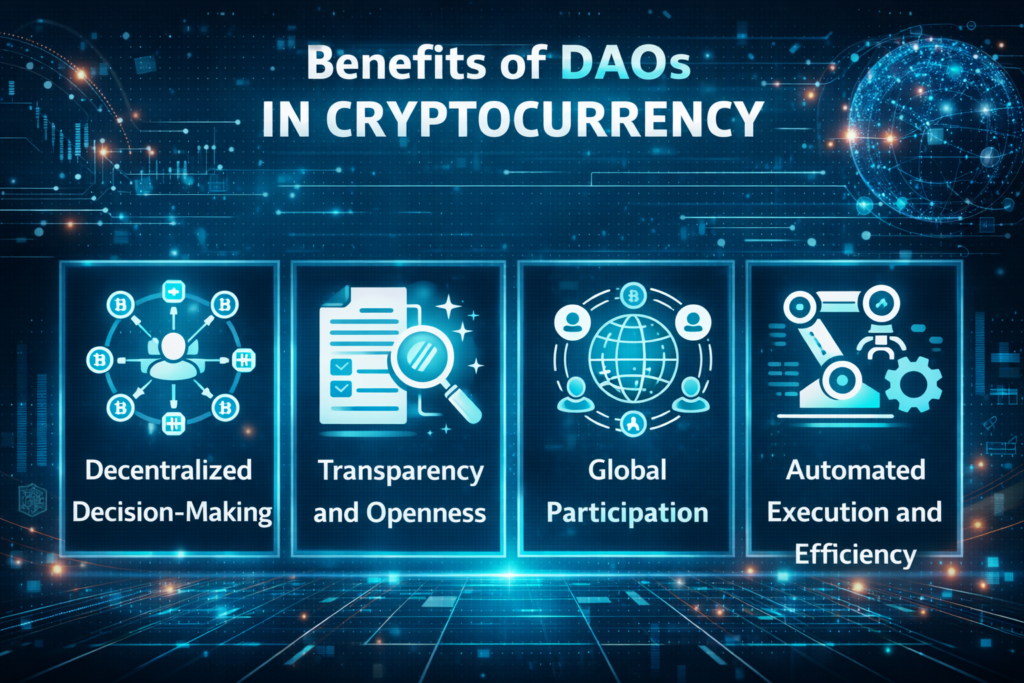
Decentralized Autonomous Organizations (DAOs) offer a new way to build and manage communities, projects, and businesses on the internet. By using blockchain technology and smart contracts, DAOs remove many limitations found in traditional organizations.
Below are the key benefits that make DAOs attractive in the crypto and Web3 ecosystem.
Decentralized Decision-Making
One of the biggest benefits of DAOs is decentralized decision-making. Instead of relying on a small group of executives or a single authority, decisions are made collectively by the community. Members can submit proposals, discuss ideas, and vote on important matters such as funding, partnerships, and protocol upgrades.
This structure reduces the risk of abuse of power and ensures that decisions reflect the interests of the wider community rather than a few individuals. It also creates a sense of shared ownership, because everyone with governance rights has a voice in shaping the future of the organization.
Transparency and Openness
DAOs operate with a high level of transparency. Most DAO activities, such as proposals, votes, treasury balances, and transactions, are recorded on the blockchain and can be viewed by anyone. This openness builds trust among members because decisions and fund movements are visible and verifiable.
Unlike traditional organizations, where financial records and decisions are often private, DAOs allow community members to see exactly how resources are managed. This makes it easier to hold participants accountable and reduces the chances of corruption or misuse of funds.
Global Participation
DAOs are open to people from anywhere in the world. There are no geographical barriers, office locations, or complex paperwork required to join. As long as someone has an internet connection and meets the DAO’s participation requirements, they can contribute.
This global access allows DAOs to attract diverse talent, ideas, and perspectives. Developers, designers, writers, and contributors from different countries can work together, bringing a wider range of skills and experiences than traditional organizations often can.
Automated Execution and Efficiency
DAOs rely on smart contracts to automate many processes. Once members vote and approve a proposal, the smart contract can automatically carry out the decision, such as releasing funds or updating rules, without needing manual intervention.
This automation improves efficiency by reducing delays, paperwork, and administrative costs. It also minimizes human error and ensures that rules are applied consistently.
As a result, DAOs can move faster, operate more smoothly, and scale more easily than many traditional organizations.
Popular DAO Examples in Cryptocurrency
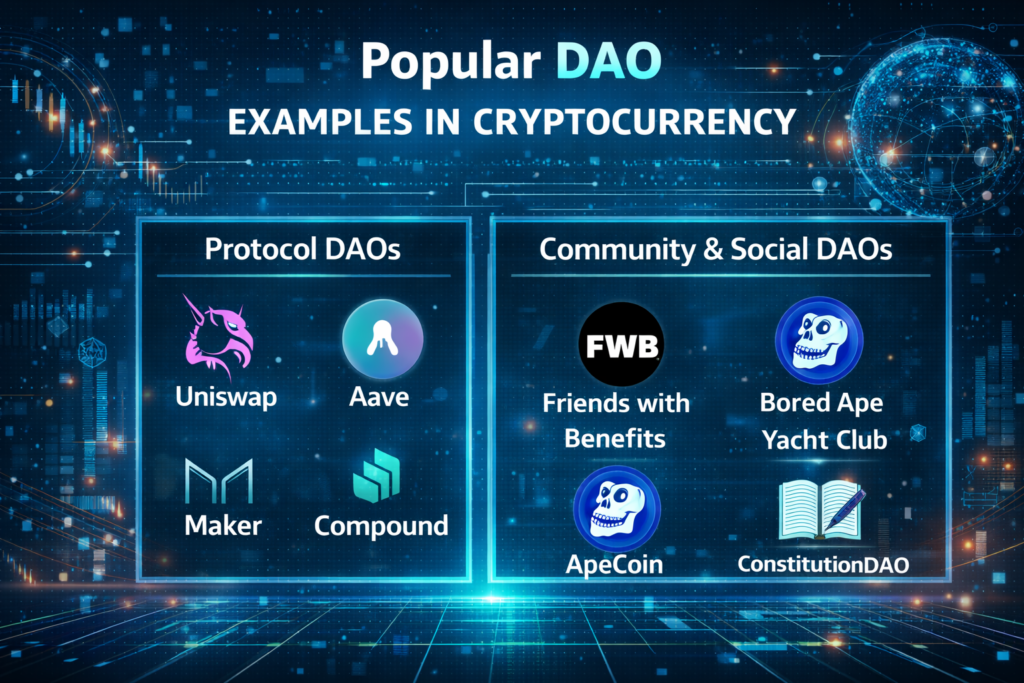
DAOs are no longer theoretical ideas; many are actively running major crypto protocols, managing billions of dollars, funding communities, and even coordinating real work.
Below are well-known DAO examples grouped by their purpose, along with short explanations and reference sites for deeper learning.
Protocol DAOs (e.g., MakerDAO, Uniswap)
Protocol DAOs govern the core infrastructure of decentralized finance (DeFi). These DAOs control how major blockchain protocols operate and manage risk.
MakerDAO
MakerDAO is one of the earliest and most influential DAOs in crypto. It governs the Maker Protocol, which issues the DAI stablecoin. MakerDAO members vote on critical decisions such as collateral types, stability fees, risk parameters, and treasury management.
This community governance model allows DAI to function without a central bank or company.
Uniswap DAO
Uniswap DAO governs the Uniswap decentralized exchange, one of the largest DeFi platforms in the world. Token holders vote on proposals related to protocol upgrades, fee switches, grants, and ecosystem development.
Uniswap DAO also manages a large treasury used to support long-term growth.
Community & Social DAOs
Community and social DAOs focus on bringing people together around shared interests, values, or goals rather than purely financial products.
Friends With Benefits (FWB)
Friends With Benefits (FWB) DAO is a social DAO centered around culture, music, and Web3 creativity. Members join by holding tokens and gain access to events, online communities, and collaborative projects.
Bankless DAO started as a community around the Bankless media brand and grew into a large decentralized organization producing content, education, and research about crypto. Contributors are paid through the DAO treasury, and decisions are made through governance votes.
Real-World and Specialized DAOs
Some DAOs focus on real-world impact, niche industries, or specialized goals beyond typical DeFi use cases.
- UkraineDAO is a well-known example of a real-world impact DAO. It raised millions of dollars in crypto to support humanitarian aid during the Ukraine crisis, using transparent on-chain fundraising and community governance.
- VitaDAO operates in the decentralized science (DeSci) space. It funds longevity and biomedical research, allowing token holders to vote on which scientific projects receive funding. This challenges traditional research grant systems by making funding more open and community-driven.
These DAOs show how blockchain governance can extend into charity, science, and social good.
Risks, Challenges & Criticisms
While DAOs offer many advantages, they are not without risks. Like any emerging technology, DAOs face technical, governance, and legal challenges.
Understanding these risks is important for anyone participating in or building a DAO, as they highlight where caution, better design, and regulation are still needed.
Technical Risks
DAOs rely heavily on software and blockchain infrastructure. When technical issues arise, they can be costly and difficult to reverse.
Smart Contract Vulnerabilities & Hacks
Smart contracts control how DAOs operate and how funds are managed. If there is a flaw in the code, attackers may exploit it to steal funds or disrupt the system. Because DAOs often manage large treasuries, they are attractive targets for hackers.
Code Immutability Issues
One key feature of blockchain is immutability, meaning code cannot easily be changed after deployment. While this provides trust and transparency, it also creates challenges. If a DAO launches with poorly written or outdated smart contracts, fixing them can be complicated and may require community votes, upgrades, or even migration to new contracts.
Governance Challenges
DAOs aim to be community-driven, but real-world governance can be difficult to manage at scale.
Voter Apathy & Low Participation
Many DAO members do not actively vote on proposals. This problem, known as voter apathy, means that important decisions are sometimes made by a small percentage of token holders. Low participation can weaken decentralization and reduce the quality of governance outcomes.
Power Concentration & Whales
Although DAOs are designed to be decentralized, voting power is often linked to token ownership. This can lead to power concentration, where a few large holders, often called “whales,” have significant influence over decisions.
Sybil Attacks
A Sybil attack occurs when one individual or group creates multiple identities to gain unfair influence over a DAO. In DAOs where voting is based on membership rather than token ownership, this can be especially problematic.
Legal and Regulatory Uncertainty
The legal status of DAOs remains unclear in many countries. This uncertainty creates risks for participants, developers, and investors.
Legal Status & Entity Recognition
In many jurisdictions, DAOs are not clearly recognized as legal entities. This makes it difficult for DAOs to open bank accounts, sign contracts, or interact with traditional businesses. Some regions have started offering legal frameworks for DAOs, but global clarity is still lacking
Liability and Partnership Risks
If a DAO is not legally recognized, participants may face personal liability. In some cases, authorities may treat DAO members as partners in an unregistered organization, meaning they could be held responsible for debts, legal violations, or damages.
Securities Classification of Tokens
Many DAOs issue governance tokens, but regulators may classify some of these tokens as securities. If this happens, the DAO may be required to follow strict financial regulations, including registration, reporting, and compliance requirements.
Read Also: What Exactly Are Non-Fungible Tokens (NFTs)?
Conclusion
Decentralized Autonomous Organizations (DAOs) represent a major shift in how people can organize, collaborate, and make decisions online. By using blockchain technology, DAOs remove the need for traditional leaders or centralized control and instead allow communities to govern themselves through transparent rules and collective voting.
However, they face real challenges, including technical risks, governance issues, and legal uncertainty. These limitations show that DAOs are still growing and learning from both successes and failures.
DAOs offer powerful new possibilities for ownership and coordination, but they require careful design, active communities, strong security, and clear rules to function well. As technology improves and regulations become clearer, DAOs are likely to become more stable, inclusive, and widely adopted.
FAQs
What is a DAO in cryptocurrency?
A DAO (Decentralized Autonomous Organization) is a blockchain-based organization that is run by its community instead of a central authority. Decisions are made through voting, and rules are enforced using smart contracts.
How do DAOs make decisions?
DAOs make decisions through proposals and voting. Members submit proposals, discuss them, and vote using governance tokens or other voting systems. If a proposal passes, it is executed automatically or implemented by the DAO.
Do I need coding skills to join a DAO?
No. While developers are important in DAOs, many roles do not require technical skills. People can contribute through writing, design, marketing, research, community management, or by simply participating in discussions and voting.
Are DAOs legal?
The legal status of DAOs varies by country. Some regions have begun to recognize DAOs as legal entities, while others have no clear regulations yet. Because of this, legal risks still exist for DAO participants.
What are the main risks of participating in a DAO?
The main risks include smart contract bugs, low participation in governance, power concentration among large token holders, and regulatory uncertainty. Understanding these risks helps participants make informed decisions.
Can DAOs operate in the real world, not just crypto?
Yes. Some DAOs are already involved in real-world activities such as funding research, supporting charities, managing communities, and investing in real-world assets. As adoption grows, more cross-industry use cases are expected.