


You might have felt that sting when you cash out Bitcoin or USDC for pounds, only to see a smaller number than you expected hit your account?
It’s a classic reality check: the market price you see on a screen and the actual cash you get in hand are rarely the same thing.
In this space, we have a saying: Volume is vanity, but liquidity is reality. That really strikes a chord when you start digging into the different factors affecting crypto-to-fiat conversion rates.
We would break down forces, factors affecting crypto conversion, so you can make smarter moves, pick better platforms, and so on.
What Are the Key Factors Affecting Crypto-to-Fiat Conversion Rates?

1. Market Supply and Demand
The most fundamental driver. When demand for a cryptocurrency rises, and available supply is constrained, its fiat price rises and vice versa.
Bitcoin’s fixed supply cap of 21 million coins makes this dynamic particularly pronounced during periods of high institutional buying.
2. Exchange Liquidity
Liquidity refers to how much buy and sell volume is available at any given price.
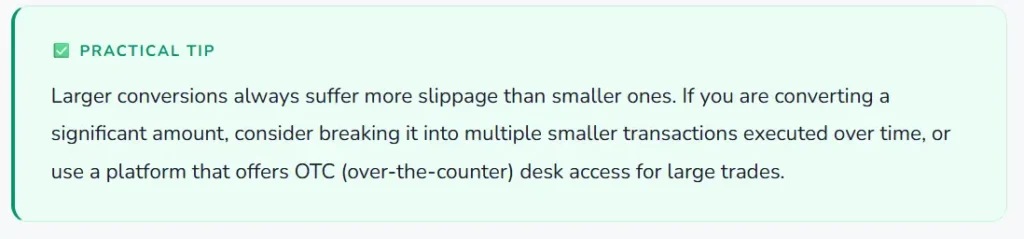
High-liquidity platforms execute your conversion closer to the market rate. Low-liquidity environments cause slippage, meaning larger trades execute at progressively worse prices.
3. Platform Fees and Spread
Every conversion platform charges directly or indirectly. Trading fees range from 0.04% on competitive centralised exchanges to 3% or more on convenience platforms.
The spread, the gap between buy and sell price, is a hidden fee that is often larger than the stated commission.
Read Also: What Is Cryptocurrency Liquidity, Crypto Wallet Card.
4. Price Volatility
Cryptocurrency prices can shift by several percentage points within minutes.
Conversions take time to execute, confirm on the blockchain, and settle.
Any price movement during that window directly affects your final fiat amount, especially during high-volatility periods.
5. Regulatory Environment
Regulatory announcements and legal changes trigger immediate market reactions.
The US GENIUS Act and EU MiCA framework, both active in 2025, reshaped institutional participation and liquidity depth across major trading pairs, with measurable effects on conversion rates.
6. Macroeconomic Conditions
Central bank decisions, interest rate changes, inflation data, and currency policy affect the value of the fiat currencies you are converting into.
A weakening pound or dollar raises the BTC/GBP or BTC/USD rate independent of any change in Bitcoin’s underlying demand.
7. Network Fees (Gas)
Before a crypto asset reaches a conversion platform, it travels on a blockchain.
Network fees called gas on Ethereum can vary from pennies to tens of dollars, depending on congestion. These costs reduce the effective value of what you are converting.
8. Investor Sentiment and Social Signals
Research consistently identifies social media activity, news cycles, and search interest as measurable drivers of short-term crypto price movements.
Positive or negative sentiment can move exchange rates significantly, particularly for mid and small-cap digital assets.
How Does Liquidity Actually Affect the Rate You Receive?
Of all the platform-level variables, liquidity has the most direct and predictable impact on your conversion rate. Here is how it works in practice.
When you place a market order to convert crypto to fiat, your order fills by working through an exchange’s order book buying or selling against whatever counterparties are available at successive price levels.
On a high-liquidity platform like Binance or Kraken, there is enough depth in the order book that even a reasonably large conversion fills near the quoted price.
For individual users converting meaningful sums, the difference between a high-liquidity and a low-liquidity platform can easily amount to 0.5% to 2% of the total transaction value.
What Role Do Regulation and Macroeconomics Play in Conversion Rates?
1. Regulation Drives the Tape:
News travels fast. Positive laws (like the GENIUS Act or MiCA) bring in big institutional money, which stabilizes rates.
On the flip side, a sudden crackdown can tank your conversion value in minutes.
2. The Fiat Side Matters
Remember, it’s a pair. If the Bank of England raises interest rates, your crypto might feel weaker compared to the pound.
If inflation is high, your crypto rate looks better simply because the fiat currency is losing value.
3. Timing is Strategy:
Remember, it’s a pair. If the Bank of England raises interest rates, your crypto might feel weaker compared to the pound.
If inflation is high, your crypto rate looks better simply because the fiat currency is losing value.
Conclusion
Look, if you actually enjoy watching slippage and hidden fees slowly bleed your bank account dry, then feel free to ignore everything we’ve discussed.
Related reads: Crypto cards limit explained, are people still buying crypto?
But if for some bizarre reason you’d rather keep your hard-earned cash and master the factors affecting crypto-to-fiat conversion rates, then I suppose you could start paying attention to liquidity and exchange spreads.
But hey, it’s your money, if you want to keep treating the market like a donation bin, who am I to stop you?