
The first cryptocurrency breakout happened when Bitcoin launched in 2009, introducing a revolutionary way to think about money and value transfer. Looking back, cryptocurrency was misunderstood and mainly dismissed by many as a passing trend.
Remember that story of the man in 2010 who used 10,000 Bitcoins to pay for two pizzas? That marked the first real-world crypto transaction. Now, look at what that much Bitcoin is worth today—over $1 billion at a trading price of $105,201 per Bitcoin. It’s a reminder of how far crypto has come and how much potential still lies ahead.
Currently, crypto is reshaping finance, tech, and how we think about value. Governments are drafting regulations, institutions are investing heavily, and Web3 is becoming a real use case.
So, what does crypto have in store for us in 2035? Let’s show you the future of crypto in the next 10 years, with insight, clarity, and precision.
Key Takeaways
- Bitcoin and Ethereum are expected to retain dominant roles while facing growing competition from scalable and innovative blockchains.
- Institutional investment and integration into traditional finance are accelerating cryptocurrency’s long-term relevance.
- Regulatory clarity, including recent wins like XRP’s case and U.S. policy shifts, will shape global crypto adoption.
- Technological advances like Layer 2 solutions, AI integration, and quantum-resistant encryption are essential for future growth.
- Real-world use cases such as, DeFi, NFTs, tokenized assets, and Web3 applications, will drive broader utility and adoption by 2035.
The Current State of Cryptocurrency (2025 Snapshot)

Source: CoinMarketCap
In 2025, cryptocurrency has cemented its position as a mainstream financial and technological asset class. With the total global crypto market capitalization hovering around $3.27 trillion, up from just over $1 trillion in late 2023, the growth reflects increased retail and institutional participation.
Significant assets, such as Bitcoin and Ethereum, still dominate, but utility tokens, stablecoins, and emerging blockchain platforms have gained notable traction.
Adoption rates have also surged. According to Security reports, 28% of American adults, or about 65 million people, use or hold cryptocurrency in some form, driven by better user education, mobile wallet accessibility, and real-world utility.
Countries in Latin America, Africa, and Southeast Asia are leading the way in grassroots adoption, while developed economies are moving forward with regulatory clarity.
Regulatory landscape as of 2025
On the regulatory front, 2025 has brought more structure to the crypto space. The U.S. has introduced more explicit rules through its Digital Asset Market Framework, classifying most tokens as commodities or securities based on usage.
In a significant development, Ripple’s XRP scored a decisive legal victory against the U.S. Securities and Exchange Commission (SEC). The court ruled that XRP does not qualify as a security in secondary markets, setting a precedent that brought clarity to how digital assets are classified in the U.S.
This has reignited interest in XRP and boosted investor confidence across the broader crypto space.
Additionally, President Donald Trump signed a crypto-focused executive order outlining strategic initiatives for blockchain innovation and national security. The order called for the development of U.S. strategic crypto reserves—a move aimed at positioning the country competitively in the global shift toward digital assets.
This executive action has led to increased federal support for blockchain research, mining infrastructure, and public-private partnerships.
Globally, the European Union’s MiCA regulation is now fully in effect, establishing unified compliance standards for crypto platforms.
Meanwhile, emerging markets such as Nigeria, India, and Brazil are adopting licensing frameworks that foster growth while mitigating fraud and financial risk. The shift toward proactive regulation is helping legitimize crypto as a long-term asset class and enabling broader institutional involvement.
Popular Use Cases
As for use cases, crypto is more than just a speculative investment. Decentralized Finance (DeFi) platforms continue to disrupt traditional banking, offering services such as lending, staking, and yield farming.
While NFT hype has cooled, NFTs now serve practical purposes in gaming, intellectual property, and real estate tokenization. Remittances powered by stablecoins have significantly reduced costs and transaction times, especially across Africa and South Asia.
Meanwhile, Bitcoin remains a store of value and digital hedge, often compared to gold in portfolios.
What the Future of Crypto in the Next 10 Years Looks Like

As we look ahead to 2035, cryptocurrency is poised to become a central part of the global financial and digital ecosystem. The groundwork laid today, through regulation, innovation, and adoption, is paving the way for a decentralized future that transforms not just how we invest, but how we live, work, and connect.
Here’s a look at what’s expected in the next 10 years:
Institutional and Mainstream Adoption
Growth in Institutional Investment
Over the next decade, institutional investment in cryptocurrency is expected to surge. Pension funds, hedge funds, family offices, and publicly traded companies are increasingly treating crypto assets as part of diversified portfolios.
The introduction of Bitcoin and Ethereum spot ETFs has already made it easier for institutions to gain exposure to digital assets without direct custody. As compliance standards mature, expect major financial institutions to offer crypto investment products by default.
Crypto Integration in Traditional Finance
Traditional finance is embracing crypto, not just as an asset class, but as a technology layer. Payment processors like Visa, Mastercard, and PayPal are already integrating blockchain rails for faster settlements.
By 2035, banks may offer crypto wallets alongside savings accounts, and asset managers could use tokenized securities to improve liquidity and transparency. Decentralized finance (DeFi) and centralized finance (CeFi) will increasingly intersect, creating hybrid financial ecosystems.
Role of Central Bank Digital Currencies (CBDCs)
CBDCs are likely to play a defining role in the future of cryptocurrency. Over 100 countries are currently exploring or piloting digital versions of their national currencies. By 2035, major economies, including the U.S., the EU, and China, are expected to have launched full-scale central bank digital currencies (CBDCs).
These will coexist with decentralized cryptocurrencies, offering state-backed digital cash for retail and wholesale transactions, which may enhance financial inclusion and government efficiency.
Introduction of New Economic Models
Play-to-Earn, Stake-to-Vote, and Other Crypto-Native Systems
In the next decade, crypto-native economic models, such as play-to-earn (P2E) and stake-to-vote, will be foundational to digital ecosystems.
In P2E, users earn real value through engagement in virtual economies, especially in gaming, as seen in some projects from last year, such as Hamster Kombat and Tapswap, among others.
Stake-to-vote mechanisms will become standard in DAOs (Decentralized Autonomous Organizations), enabling users to influence project governance based on their token holdings. These models align incentives among developers, users, and investors in ways traditional systems do not.
Rise of Decentralized Economies and Metaverse Integrations
By 2035, decentralized economies will power virtual cities, marketplaces, and even governments. Blockchain-based metaverses will allow individuals to earn, own, and transact value across interoperable digital worlds.
Crypto wallets will act as digital identities, enabling users to work, trade, and socialize in decentralized environments. As VR and AR technologies mature, expect immersive experiences tied directly to crypto-powered ownership models.
Technological Advancements
Layer 2 Solutions and Scalability Improvements
Scalability will no longer be a bottleneck by 2035, thanks to the growth of Layer 2 solutions like Optimistic Rollups, Coinbase Layer-2, Arbitrum, and zk-Rollups.
These technologies enhance blockchain speed and reduce fees by processing transactions off-chain while maintaining security guarantees. Ethereum’s ecosystem, for example, will rely heavily on Layer 2s for mass adoption and high-throughput applications.
Integration of AI and Blockchain
The convergence of AI and blockchain will unlock powerful new applications. Smart contracts powered by AI could autonomously manage portfolios, enforce digital rights, or operate decentralized insurance. AI will also help detect fraud, optimize DeFi strategies, and generate predictive analytics in crypto trading.
Quantum Computing and Crypto Security
By the 2030s, quantum computing may pose a threat to existing cryptographic algorithms. In response, developers are already working on quantum-resistant blockchains. This shift will be crucial for securing long-term value on public ledgers. Expect widespread adoption of post-quantum cryptographic standards by the end of the decade.
Interoperability Between Blockchains
The future of crypto is multi-chain. Interoperability protocols, such as Polkadot, Cosmos, and Chainlink CCIP, are enabling seamless communication between different blockchains.
This will enable assets, data, and smart contracts to flow seamlessly across networks without relying on centralized bridges, thereby enhancing both security and user experience.
The Future of Crypto Regulation
Expected Trends in Government Oversight
Governments are moving from reactive to proactive regulation. In the next 10 years, we’ll likely see standardized definitions for crypto assets, licensing for exchanges, and guidelines for stablecoins and token offerings. Regulatory clarity will open the door to mainstream adoption while deterring fraud and illicit activity.
Possible Global Regulatory Frameworks
Global regulatory bodies, such as the Financial Stability Board (FSB) and the International Monetary Fund (IMF), may lead coordinated efforts to develop universal cryptocurrency compliance standards.
These could cover anti-money laundering (AML), consumer protection, and cross-border payments. Such frameworks will help reduce regulatory arbitrage and foster a safer global crypto economy.
Impact of Regulation on Innovation and Adoption
While regulation may slow down certain speculative activities, it will accelerate adoption by legitimizing crypto in the eyes of institutions and the public. Clear rules will create a stable environment for developers, investors, and users, enabling innovation within boundaries that protect consumers and the economy.
Crypto Use Cases in 2035
Everyday Payments and Merchant Adoption
By 2035, crypto payments will be routine for online and in-person purchases. Retailers will accept stablecoins and even Bitcoin through integrated POS systems.
Thanks to Layer 2 scalability and low transaction fees, paying with crypto will be as seamless as using a debit card, especially in regions with high inflation or limited banking access.
Decentralized Finance (DeFi) 2.0
DeFi 2.0 will bring smarter, more user-friendly platforms with built-in insurance, compliance modules, and AI-driven tools. Collateralized lending, real-time trading, and yield-generating strategies will become safer and more accessible, particularly for institutions and small to medium-sized enterprises (SMEs).
Blockchain in Supply Chain, Healthcare, and Governance
Blockchain’s utility will extend well beyond finance. Supply chains will use blockchain for traceability, authenticity, and real-time tracking.
Healthcare systems will adopt secure, interoperable health records on-chain. Governments will deploy blockchain for identity management, voting systems, and transparent budgeting.
Tokenization of Real-World Assets
Real estate, stocks, art, and even carbon credits will be tokenized, enabling fractional ownership and increased liquidity. By 2035, tokenized asset markets could rival traditional securities exchanges, opening global investment access to a broader population.
The Role of Bitcoin and Ethereum in the Next 10 Years
Bitcoin as Digital Gold or a Payment System?
Bitcoin will continue to serve as digital gold, valued for its scarcity, security, and neutrality. While its use in day-to-day transactions may remain limited due to volatility and scalability constraints, it will be a trusted reserve asset for both individuals and nations. Layer 2 solutions like the Lightning Network may also expand their utility for fast, low-fee payments.
Ethereum’s Evolution and Competition
Ethereum’s roadmap includes full sharding, enhanced scalability, and stronger governance through decentralized autonomous organizations (DAOs).
However, it faces competition from newer blockchains optimized for speed and cost. Yet, Ethereum’s developer community, first-mover advantage, and widespread dApp ecosystem give it a strong position heading into 2035.
Potential New Dominant Blockchains
Blockchains like Solana, Avalanche, and Near, as well as modular chains like Celestia, are gaining ground with innovative architectures. Some may specialize in specific sectors, such as gaming, data storage, or DeFi, potentially becoming leaders in their respective niches and challenging Ethereum’s dominance.
The Rise of Web3 and the Decentralized Internet
How Web3 Will Redefine User Data Ownership
Web3 will mark a fundamental shift in how users control and monetize their data. Unlike traditional platforms where user data is centralized and monetized by corporations, Web3 platforms will allow users to own their identities, control access, and earn rewards through participation.
Crypto’s Role in Powering dApps and DAOs
Decentralized applications (dApps) and DAOs will be the engines of Web3. These autonomous systems will run services across finance, media, social networking, and more, without central oversight. Crypto will power everything from content creation platforms to collaborative workspaces, redefining digital labor and value exchange.
Forces Shaping the Future of Crypto
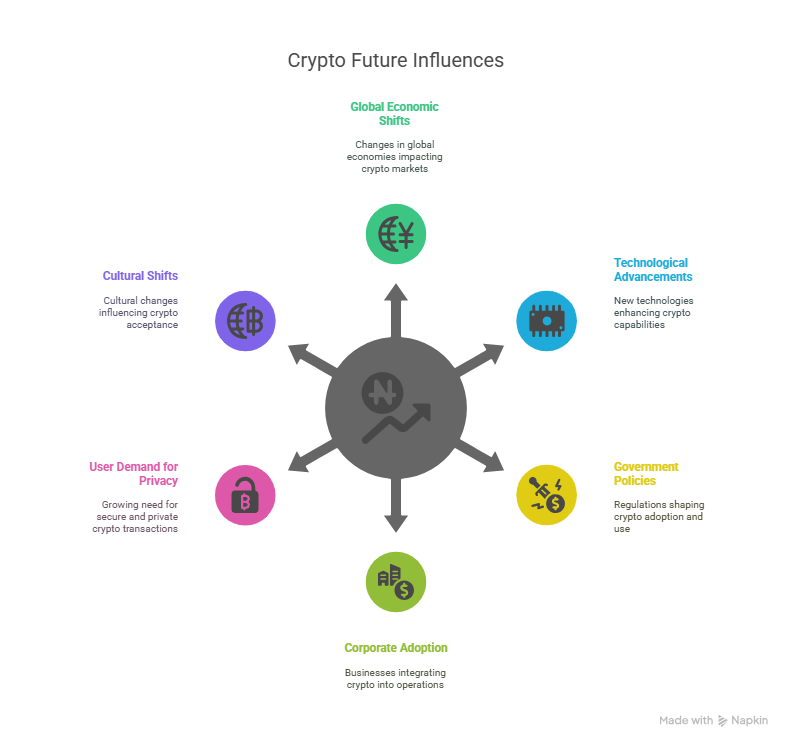
The future of cryptocurrency will not unfold in a vacuum. Several powerful forces, including economic, technological, political, and cultural, are actively shaping the next phase of the cryptocurrency revolution.
Understanding these forces is crucial to understanding where crypto is headed and how it will evolve over the next 10 years.
Global Economic Shifts
Economic instability, inflation, and currency devaluation continue to prompt individuals and institutions to seek alternative stores of value.
In countries like Argentina, Nigeria, and Turkey, cryptocurrency adoption is driven by the need to protect savings against local currency volatility.
As inflationary pressures persist globally, particularly in the wake of post-pandemic stimulus spending and geopolitical tensions, cryptocurrency is increasingly viewed as a hedge against fiat currency instability.
Additionally, the growing distrust in traditional financial institutions and central banks is fostering demand for decentralized financial systems. Cryptocurrencies offer borderless, permissionless access to capital, making them especially attractive in regions with weak banking infrastructure or capital controls.
Technological Advancements
Innovation is at the heart of crypto’s future. Breakthroughs in blockchain scalability, Layer 2 protocols, and modular architectures are addressing long-standing issues such as congestion and high fees.
Technologies like zero-knowledge proofs (zk-proofs) are enabling private and secure transactions without sacrificing transparency.
Artificial intelligence (AI) is also playing a growing role, optimizing smart contracts, automating compliance, and enhancing predictive analytics in cryptocurrency trading. Meanwhile, quantum computing is both a threat and a motivator, prompting developers to build quantum-resistant cryptographic standards to future-proof blockchain networks.
Government Policies and Regulation
Regulation remains one of the most significant forces shaping the crypto industry. Some countries, like the U.S., are focusing on compliance frameworks around taxation, stablecoins, and consumer protection. Others, like El Salvador and the United Arab Emirates, are embracing crypto innovation with open arms.
The legal clarity around assets like XRP, combined with executive-level policies like President Trump’s crypto order in 2025, signals a trend toward more structured regulatory environments. Over the next decade, harmonized global regulatory standards may emerge to reduce cross-border inconsistencies and build trust in crypto markets.
Corporate and Institutional Adoption
Major corporations are investing in crypto infrastructure and applications. Financial giants like BlackRock, Fidelity, and Goldman Sachs are launching crypto investment products. Tech companies are integrating crypto payments, NFTs, and blockchain-based identity solutions into their ecosystems.
Institutional adoption isn’t just about investment—it’s about using blockchain as an infrastructure layer. Tokenized equities, decentralized data storage, and blockchain-based audit systems are examples of how crypto technology is being embedded into the corporate world.
User Demand for Privacy and Control
As concerns over data privacy grow, more users are demanding control over their digital lives. Web3 and decentralized identity solutions are gaining momentum as users reject the surveillance-driven models of Web2 platforms. In this context, crypto offers a foundation for secure, self-sovereign interactions online.
The shift toward data ownership, censorship resistance, and peer-to-peer transactions reflects a broader cultural movement—one where individuals reclaim control from centralized institutions.
Cultural and Generational Shifts
Younger generations, especially Gen Z, are growing up in a world where digital ownership, virtual assets, and crypto wallets are the norm. They are more likely to invest in crypto, use NFTs as identity markers, and participate in DAOs or online communities driven by token-based incentives.
This cultural adoption, combined with education and digital literacy, will help normalize cryptocurrency use across everyday life, from social media to workspaces and financial services.
Challenges Facing Crypto’s Future

While cryptocurrency is poised for significant growth, its path forward is not without obstacles. From scalability issues to regulatory uncertainty, the crypto space faces a series of challenges that must be addressed to ensure sustainable adoption and innovation.
Here are the significant challenges confronting the future of crypto:
Regulatory Uncertainty and Fragmentation
One of the most pressing challenges is the lack of global regulatory clarity. While some nations, such as Switzerland and the UAE, have adopted crypto-friendly regulations, others, like the U.S., have offered inconsistent or reactive frameworks. This patchwork of laws creates confusion for developers, investors, and institutions.
The legal battles between XRP and the SEC, which XRP eventually won, highlight how unclear rules can stifle innovation and discourage participation. Until governments establish standardized, transparent, and crypto-specific regulations, many mainstream investors will remain hesitant.
Scalability and Network Congestion
Despite significant progress, scalability remains a key technical hurdle. Bitcoin and Ethereum still face limitations in processing large volumes of transactions efficiently. During periods of high demand, network congestion leads to slow processing times and high gas fees.
While Layer 2 solutions and upcoming upgrades (like Ethereum’s future sharding implementation) aim to address these issues, achieving mass adoption will require consistent, scalable performance across blockchain networks, without sacrificing security or decentralization.
Security Threats and Hacks
The decentralized nature of crypto makes it attractive, but it also introduces significant security risks. Exploits, protocol bugs, smart contract vulnerabilities, and phishing scams have led to billions in lost or stolen assets. High-profile hacks, such as the Poly Network breach or DeFi exploits, continue to undermine trust.
Furthermore, quantum computing poses a long-term threat to current cryptographic standards. Developers must work proactively to implement quantum-resistant security protocols to safeguard blockchains for the foreseeable future.
Environmental Concerns
Proof-of-work (PoW) mining, particularly Bitcoin mining, has faced criticism for its high energy consumption. Although Ethereum has shifted to the more sustainable proof-of-stake (PoS) model, Bitcoin remains reliant on energy-intensive operations.
As global awareness around climate change grows, crypto projects will need to demonstrate clear efforts toward sustainability. Green mining initiatives, carbon offset programs, and PoS consensus models will become increasingly important for public perception and regulatory compliance.
User Experience and Complexity
Despite years of development, crypto remains complex and intimidating for the average user. Wallet management, private key storage, gas fees, and understanding dApps or DeFi platforms can be overwhelming. Without more intuitive interfaces and seamless onboarding, mass adoption will continue to lag.
To bridge this gap, developers must prioritize user-friendly design, educational tools, and custodial solutions that balance security with accessibility, especially for less tech-savvy users.
Fraud, Scams, and Market Manipulation
The crypto space is still plagued by rug pulls, pump-and-dump schemes, and fraudulent ICOs. Lack of regulation in many areas makes it easy for bad actors to exploit retail investors. Even some major projects have collapsed due to poor risk management or dishonest practices, such as the infamous FTX collapse in 2022.
Protecting investors and ensuring ethical growth will require industry self-regulation, more transparent audits, and the development of investor protection mechanisms built into protocols and platforms.
Volatility and Price Instability
Price volatility remains a core challenge. Sudden price swings in Bitcoin, Ethereum, or altcoins can create fear, uncertainty, and doubt (FUD)—deterring long-term adoption and making crypto less viable for payments or savings.
Stablecoins like USDC and USDT have attempted to address this, but their own transparency and reserve management have come under scrutiny. For crypto to be used widely in commerce, systems that ensure price stability and trust in stable assets are essential.
Expert Predictions and Industry Opinions
As we look toward 2035, here are the insights of industry experts, analysts, and thought leaders, offering a glimpse into the potential trajectory of digital assets over the next decade.
Bitcoin’s Potential Trajectory
Bitcoin (BTC) remains a focal point for long-term investment strategies. Network economist, Timothy Peterson, predicts that Bitcoin could reach $1.5 million by 2035, citing network growth as a critical factor in its valuation.
Other industry figures have offered varying forecasts:
- Chamath Palihapitiya, CEO of Social Capital, envisions Bitcoin hitting $1 million by 2040, driven by its scarcity and adoption.
- Volodymyr Nosov, CEO of WhiteBIT, suggests a more ambitious target of $3 million, emphasizing the limited supply of Bitcoin.
- Jurrien Timmer, Director of Global Macro at Fidelity Investments, proposes a bold forecast of $1 billion per Bitcoin by 2040, highlighting its potential as a dominant global asset.
These projections underscore the diverse perspectives on Bitcoin’s future value, reflecting both optimism and caution within the industry.
Institutional Adoption and Integration
The integration of cryptocurrencies into traditional financial systems is accelerating. Financial institutions, such as JPMorgan and Goldman Sachs, are offering crypto custody services and structured products, while hedge funds are diversifying their portfolios with Bitcoin and Ethereum derivatives.
Cassie Craddock, Managing Director at Ripple, said:
“Large financial institutions will double down on crypto offerings.”
This trend signifies a shift toward a hybrid financial system that incorporates both traditional and digital assets.
Regulatory Developments
Regulatory clarity is pivotal for the sustainable growth of the crypto industry. Matthias Bauer-Langgartner, Head of Policy Europe at Chainalysis, emphasizes:
“One of the key themes for the crypto industry as we enter into 2025 will be the dynamic regulatory landscape.”
In the United States, the Department of Labor has rescinded its 2022 guidance, allowing for the inclusion of cryptocurrencies in 401(k) retirement plans.
This policy shift aligns with the broader deregulatory approach of the Trump administration, signaling increased institutional acceptance.
Web3 and Decentralized Internet
The evolution of the internet toward a decentralized model, known as Web3, is gaining momentum. Ran Hammer, VP of Business Development at Orbs, asserts:
“Ethereum, DeFi, and NFTs will play an immense role in the future of the internet.”
This perspective highlights the potential of blockchain technology to redefine digital ownership, data privacy, and online interactions.
Final Thoughts
All questions have been answered regarding what the future of crypto could look like over the next 10 years.
From increasing institutional adoption to emerging economic models and advancing blockchain technologies, the next decade is shaping up to redefine finance and digital interaction. Regulation, innovation, and utility will be the driving forces behind this development.
Cryptocurrency is transitioning from speculation to practical use, with increasing relevance across payments, governance, and data ownership. The next chapter of cryptocurrency promises purpose, scale, and global impact.
Frequently Asked Questions
What Is the Future of Cryptocurrency in 2030?
By 2030, cryptocurrency is expected to be widely adopted across finance, commerce, and technology, with greater regulatory clarity, institutional involvement, scalable networks, and expanded real-world use cases like payments, tokenized assets, and decentralized applications.
Does Cryptocurrency Have a Future?
Yes, cryptocurrency has a future, driven by growing institutional adoption, technological innovation, regulatory progress, and expanding real-world use cases across finance, governance, and digital ownership.
What Is the Future of Bitcoin in the Next 10 Years?
Bitcoin is expected to solidify its role as digital gold, with growing institutional adoption, potential use in national reserves, and integration into payment systems, possibly reaching valuations between $500,000 and $1 million by 2035.
Can Crypto Make You a Millionaire?
Yes, crypto can make you a millionaire, but it involves significant risk, market knowledge, timing, and strategic investment, not just luck.
Which Crypto Has the Best Future?
Ethereum is widely seen as having the best future due to its strong developer ecosystem, smart contract capabilities, and ongoing upgrades like Ethereum 2.0 that improve scalability and efficiency.