Anyone who has spent time in the crypto space has likely run into phrases like Bitcoin Cash hard fork or Taproot soft fork thrown around.
But unless you have a background in distributed systems, those words can feel like a foreign language.
The reality is that distinguishing between hard forks vs soft forks is not just an academic exercise.
These protocol-level events reshape the value of your holdings, affect which wallets and payment gateways remain compatible, and sometimes create entirely new cryptocurrencies overnight.
We’ve stripped away the complexity to show you how this stuff actually works, from the basic building blocks to the practical impact it has on you
What Exactly Is a Blockchain Fork?
Picture a blockchain as an open-source software project that runs on thousands of computers simultaneously.
Because no single company owns or controls it, any change to the rules has to be negotiated among all the participants: miners or validators, developers, node operators, and the broader community of holders.
A fork happens when those rules change. Sometimes the change is smooth, and the whole network upgrades together.
Other times, the community disagrees, and the blockchain literally splits into two separate chains, each following its own ruleset from that point forward.
That split point is the fork. Everything before it is shared history. Everything after it diverges.

What Is a Hard Fork and How Does It Work?
A hard fork is a permanent, backwards-incompatible change to a blockchain’s protocol. Backwards-incompatible is the key phrase here.
It means that nodes running the old software will no longer recognize blocks created under the new rules as valid.
See it as a city with a rulebook that says all cars must drive on the right side of the road. One day, half the city decides to switch to the left.
There is no way to accommodate both groups on the same roads anymore. The two factions effectively start using completely separate road networks from that moment, even though they share the same history of roads already built.
In blockchain terms, a hard fork forces every participant to make a choice: upgrade to the new software and follow the new rules, or stay on the old chain.
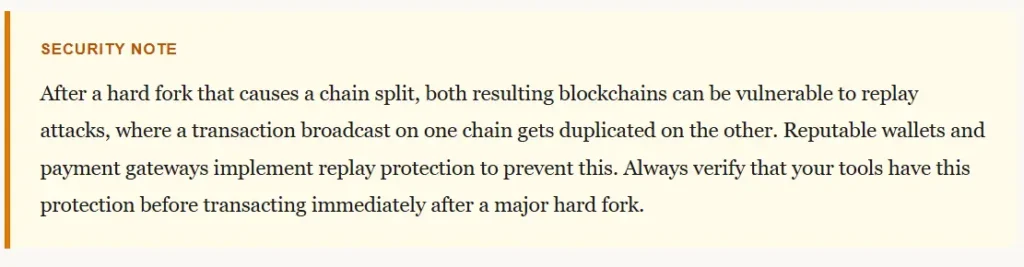
If enough participants refuse to upgrade, the original chain keeps running as its own network, and a new cryptocurrency is born
What are the key characteristics of a hard fork?
Hard forks are not backwards-compatible, meaning old nodes reject new blocks outright. They require a network-wide consensus to avoid a permanent split.
If miners and users are divided, two separate blockchains emerge with a shared transaction history up to the moment of the split.
The new chain may airdrop coins to holders of the original currency, since both chains share the same ledger history before the fork.
What Is a Soft Fork and Why Is It Less Disruptive?
A soft fork is a backwards-compatible upgrade to a blockchain’s protocol.
Old nodes can still validate blocks and transactions created under the new rules, because the new rules are more restrictive, not less.
See it as adding a new traffic law that says certain roads are now one-way. Cars following the old rules can still use the road network without causing a crash.
They just cannot drive the wrong way down the new one-way streets.
Soft forks are the standard, lower-drama mechanism for introducing new features, improving transaction efficiency, or patching security vulnerabilities without fracturing the network.
What are the defining features of a soft fork?
Soft forks are backwards-compatible, so unupgraded nodes keep functioning and validating blocks. They tighten or add constraints rather than loosening existing rules.
They do not result in a chain split when properly implemented and accepted by the mining majority. They typically see faster adoption because they pose less risk to the broader network.
Technical Differences Between Hard Forks vs Soft Forks
| Dimension | Hard Fork | Soft Fork |
| Backwards-compatible | No | Yes |
| Can split the blockchain | Yes, if community disagrees | No, under normal conditions |
| Creates new cryptocurrency | Often, when a split occurs | No |
| All nodes must upgrade | Yes, to stay on new chain | No, optional but encouraged |
| Replay attack risk | Yes, if split occurs | Minimal |
| Rule changes | Expands or restructures rules | Tightens or adds rules |
| Famous examples | Bitcoin Cash, Ethereum Classic | SegWit, Taproot |
| Community consensus needed | High: must be near-universal | Moderate: miner majority often sufficient |
| Impact on holders | May receive new coins via airdrop | No new coins; minor UX changes |
What Are the Most Important Real-World Fork Examples?
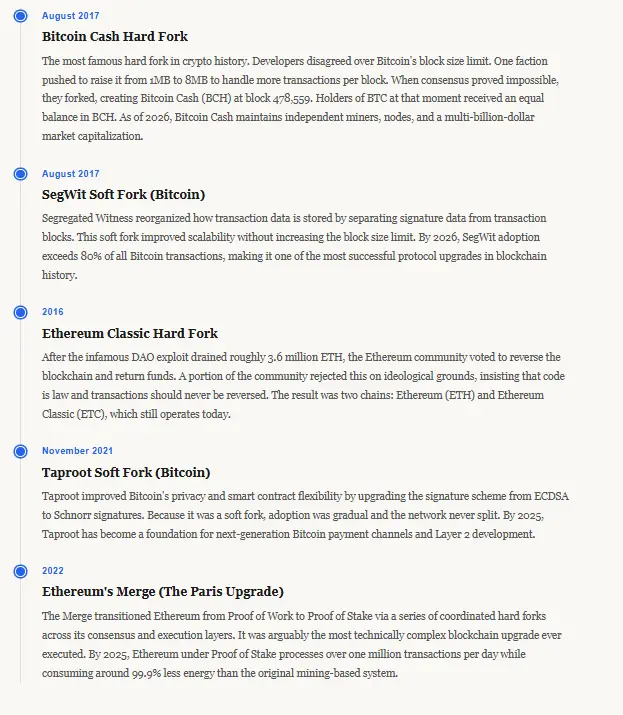
Examples: Bitcoin Cash (hard fork), SegWit (soft fork)
Frequently Asked Questions
Is a hard fork the same as a blockchain hack or exploit?
No. A hard fork is a deliberate protocol change, even if it is contentious. A hack is an unauthorized theft of funds.
Can a soft fork turn into a hard fork
In theory, yes. If a soft fork is not adopted by enough of the network’s miners, the incompatibility can escalate into a de facto split.
Do I automatically get new coins when a hard fork happens?
Only if you hold your coins in a wallet where you control the private keys at the time of the fork.
If your crypto is on an exchange or payment platform, that platform decides whether to credit you. Always check your exchange’s official fork policy before a major event.
Final Thoughts
There’s a common saying in this space: Don’t trust, verify. Distinguishing the difference between hard and soft forks is exactly how you put that into practice.
It’s the difference between a clean break and a subtle upgrade,
If you want to keep that momentum going, our blog is full of practical resources on topics like tokenomics, altcoins and many others.