How does someone move from hearing about crypto for the first time to making their first transaction with confidence? The answer lies in effective crypto onboarding, a process that turns curiosity into participation.
This article examines the key elements of onboarding, from compliance and payment options to wallet security, education, and global strategies.
It also looks ahead at how emerging technologies, regulations, and Web3 trends are shaping the future of crypto onboarding.
Key Takeaways
- Crypto onboarding is the process that takes a new user from sign-up to their first successful transaction.
- A smooth onboarding flow builds trust and confidence in both the platform and the wider crypto space.
- Regulatory compliance, like KYC and AML, is central to how onboarding is designed.
- Clear design choices reduce friction and keep users engaged through their first actions.
- Safe habits around wallets, keys, and security should be taught immediately.
Introduction to Crypto Onboarding
Crypto onboarding is the path a new user takes from first interest to their first successful transaction. It covers picking a safe place to start, creating an account, verifying identity, funding the account, and making a first buy. Some people start with a custodial exchange account.
Others start with a non-custodial wallet where they hold their own keys. A common flow is this. You open an exchange account, upload a valid ID, add a card or bank transfer, and buy a starter asset like USDT or BTC.
You then learn how network fees work and try a small transfer to your own wallet to see it land on the chain. A new user might sign up with a licensed exchange, fund with a bank transfer through a local payment partner, buy USDT, and send a small amount to a self-custody wallet to build confidence.
Good onboarding also teaches safety and helps you avoid errors. You learn the difference between custodial and non-custodial setups, how to store a seed phrase offline, and how to turn on two-factor authentication.
You learn to spot fake links and giveaway scams. You practice core tasks like receiving and sending tokens, swapping a small amount, and viewing a transaction on a block explorer.
You see that gas fees vary by network, so a first DeFi action might happen on Polygon or Base instead of the Ethereum mainnet. When you connect a wallet to a dapp with WalletConnect, you check the site name and the permissions before you click approve. With these basics in place, the jump from first buy to daily use feels natural and low-stress.
Why Onboarding is important
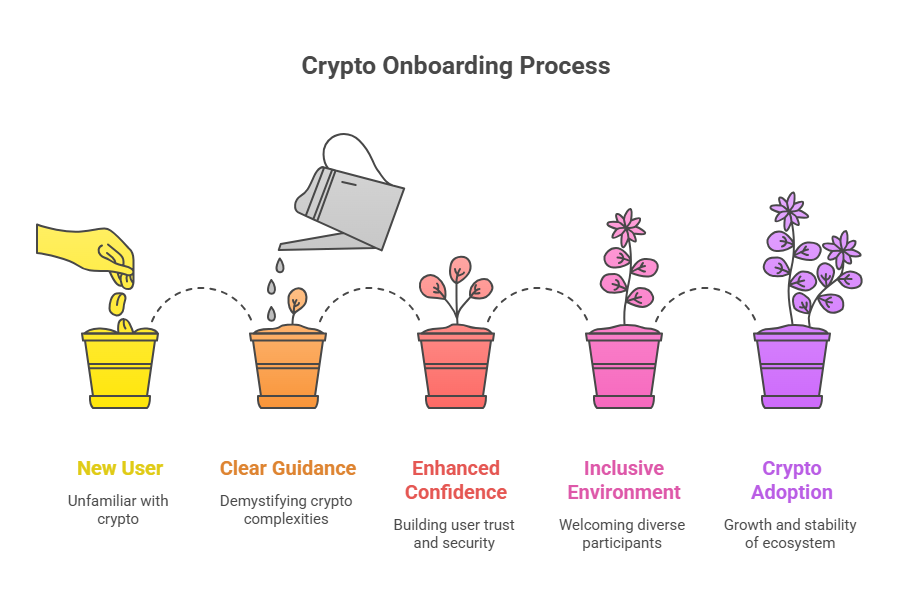
Onboarding in crypto matters because it shapes how someone starts, learns, trusts, and sticks with the platform.
1. Building Trust from the Start
Onboarding is important because it sets the foundation of trust. For many people, crypto still feels unfamiliar and risky, so the very first interaction matters. If the process is clear and the steps make sense, users gain the confidence to continue.
A well-designed onboarding flow explains why personal information is needed, how funds are protected, and what security measures are in place. This helps users feel safe in an environment where they may not fully understand the technology.
A good example is when exchanges show transparent security practices during sign-up. Some platforms now explain how they store assets in cold wallets and how withdrawals are monitored for safety.
When a new user sees this upfront, they understand that the platform is serious about protecting funds. That level of trust often determines whether someone stays and becomes an active user or drops out early.
2. Reducing Errors and Financial Loss
Onboarding also protects users from mistakes that could cost them money. Sending funds to the wrong address or misunderstanding how network fees work are common issues for beginners.
A well-thought-out onboarding process teaches the basics before any money is at risk. This can be through guided tutorials, simulations, or simple in-app tips that explain what to do next.
For instance, some wallets allow new users to test a transaction using tokens with no real-world value. By practicing, people learn how to copy and paste wallet addresses correctly and understand how a blockchain transaction is confirmed. This small step prevents costly errors later and builds user confidence in handling digital assets.
3. Making Crypto Accessible for Everyone
Another reason onboarding matters is accessibility. People from different parts of the world have different financial habits, languages, and levels of access to technology.
If crypto onboarding only works well for advanced users, most of the global population is left out. Local payment options, simple designs, and clear instructions can make all the difference.
Take the case of mobile money in Africa. Platforms that integrate with services like M-Pesa in Kenya allow people to buy and use crypto through familiar tools.
This lowers the barrier for entry and shows that crypto is not just for tech-savvy users but for anyone who needs easier ways to store or move money. When onboarding speaks to local realities, adoption grows naturally.
4. Encouraging Long-Term Engagement
Onboarding is not just about the first transaction. It also shapes how long someone will stay engaged with crypto. If the first experience is confusing, users are unlikely to return. But if they feel supported and educated, they are more open to exploring new features such as staking, lending, or NFTs.
For example, a beginner who starts by buying stablecoins through a simple app may later move to decentralized finance if the onboarding process prepares them with the right knowledge.
Clear first steps encourage users to build on what they already know instead of abandoning the journey. This gradual growth benefits both the user and the platforms that serve them.
5. Driving Growth and Adoption at Scale
Effective onboarding also supports the growth of platforms and the wider crypto ecosystem. Every exchange, wallet, or dapp relies on its ability to attract and keep users.
Strong onboarding means people are more likely to recommend a service to friends and family, creating organic growth. Word of mouth becomes one of the most powerful drivers of adoption, especially in places where formal crypto education is still limited.
An example can be seen in communities where one person learns how to safely buy and transfer stablecoins. That person often shares the knowledge with others, creating a ripple effect.
Onboarding not only helps individuals but also spreads crypto adoption across entire groups and regions. This is how onboarding becomes a key factor in scaling crypto from niche use to global participation.
India has emerged as the global leader in cryptocurrency adoption for the second consecutive year
Regulatory Foundations and Compliance
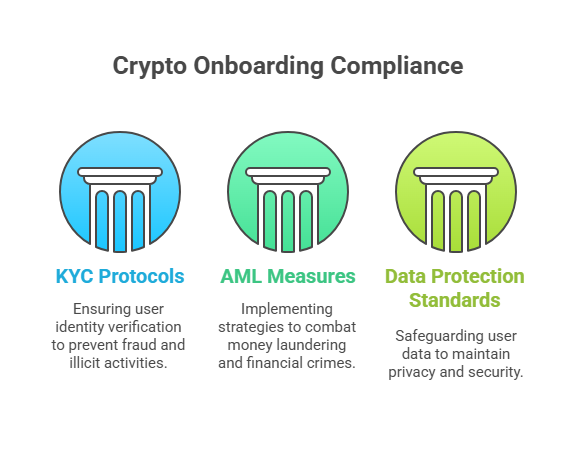
Regulations guide how data is handled, funds are monitored, and licenses are issued during onboarding.
1. Know Your Customer and Anti Money Laundering
KYC and AML set the baseline for who can use a platform and how funds move. Most regulators expect identity checks, screening against watchlists, and monitoring of activity. In practice, that means collecting government ID, verifying a selfie match, and confirming a real name before the first buy.
Platforms also watch for red flags like fast in and out movement or mixing services. Global standards from the Financial Action Task Force bring virtual assets and service providers under AML rules, so teams should design flows that meet those tests from day one.
The details matter when you go live in a region. In the United States, exchanges that move customer funds are treated as money services businesses and must register with FinCEN and build a Bank Secrecy Act program.
That includes KYC, recordkeeping, and suspicious activity reports. Clear KYC during onboarding lowers risk and speeds approvals later.
2. Data Protection and Privacy Regulations
Onboarding collects sensitive data, so teams must follow data protection laws. In the EU and UK, GDPR requires a lawful basis, purpose limits, data minimization, accuracy, storage limits, integrity, and confidentiality.
This means you only collect what you need to verify the user, you explain how you use it in plain terms, and you secure it during capture and storage. Building to these principles from the start reduces rework and lowers breach risk.
Clear privacy controls also improve user trust. Offer choices where possible, set retention schedules, and document how data flows between KYC vendors and your systems.
If you market in the UK, your promotions must also meet FCA rules for fair, clear, and not misleading communications, which ties into how you present consent and risks to new users.
3. Licensing and Registration Requirements
Most countries now expect crypto businesses to register or license before serving users. In the EU, MiCA sets a single rulebook for crypto asset service providers and introduces a path for authorization.
There is a transitional period for firms that were active under national rules, but full licensing is becoming the norm across the bloc. Plan your onboarding, custody, and conflict controls with MiCA in mind so the move from national approval to a MiCA license is smooth.
Other markets keep their own regimes. In the UK, the FCA assesses firms for AML registration and also polices how you market to retail users.
Approval takes time and requires proof that your onboarding, financial crime controls, and customer communications meet the standard. Teams that document their flow, vendor due diligence, and control testing have a faster path through review.
4. Travel Rule and Inter VASP Information Sharing
When users send funds between service providers, the Travel Rule requires the sending and receiving firms to share basic originator and beneficiary details. This rule comes from FATF Recommendation 16 and now applies to virtual assets and VASPs.
For onboarding, this means you must collect and validate the data needed to populate Travel Rule messages and align your wallet design with supported standards. It also shapes how you handle withdrawals to other exchanges.
Teams usually integrate Travel Rule tools that route identity fields with the transaction. A good design warns the user when a destination cannot accept compliant transfers and offers options such as smaller amounts or additional checks.
Getting this right avoids failed transfers and compliance breaches, and it keeps cross-platform activity open as more jurisdictions enforce the rule.
5. Tax Reporting and the Crypto Asset Reporting Framework
Tax rules are moving toward automatic exchange of information for crypto. The OECD Crypto Asset Reporting Framework sets a global standard for platforms to report user transactions to tax authorities.
Several jurisdictions have committed to adopting CARF over the next few years, and technical specs continue to be updated.
Onboarding should capture tax residency, local identifiers, and consent language that maps to CARF fields so you do not need a second data lift later.
Regions will phase in reporting on different timelines, so product and compliance teams should track local guidance. Public updates and FAQs help define the scope for DeFi and NFTs and clarify who reports what. Clear disclosures in onboarding about possible tax reporting build trust and reduce support tickets when statements go out.
User Experience and Interface Design
The way a platform looks and feels during onboarding often decides if a new user stays or leaves.
1. Frictionless UX: Conversion to Engagement
The first moments on a crypto platform decide if someone becomes an active user or leaves. A frictionless flow means the user moves smoothly from sign-up to first action with as few hurdles as possible.
This could be as simple as letting people register with an email or phone, auto-filling ID details with a quick scan, and showing progress so they know what step comes next. When the flow feels clear, users finish onboarding and move naturally into trading, staking, or exploring.
Practical design choices keep people engaged. A wallet app that lets a new user buy a stablecoin with a card in two clicks and then guides them through sending a small transfer helps build confidence.
Exchanges that add progress bars or clear messaging like “You are verified and ready to buy” keep motivation high. Each step becomes a milestone, and the momentum carries users into real activity instead of dropping off midway.
2. Accessibility and Inclusivity
Not every user comes with the same language, device, or level of financial literacy. An inclusive platform meets people where they are. This means offering multiple languages, mobile-friendly layouts, support for low-bandwidth connections, and designs that are readable for users with visual or cognitive challenges.
A beginner may not know what a private key is, so showing tooltips and step-by-step explanations makes the platform usable for more people.
In emerging markets, accessibility often means integration with local realities. Someone in Kenya might rely on M-Pesa, while a user in the Philippines may depend on GCash.
A good onboarding flow supports these local rails, explains fees in local currency, and works on affordable smartphones. A platform brings in users who would otherwise be excluded and makes crypto relevant in their daily lives by tailoring to regional needs.
3. Trust Signals and Social Proof
People are more likely to use a platform when they see proof that it is safe and trusted. Trust signals can be small but powerful. Verified security badges, visible licenses, clear disclosures, and well-known partners all reassure new users that the platform is legitimate.
Social proof comes from seeing that others use it, whether through testimonials, community reviews, or transparent metrics like the number of users or assets under custody.
For example, if an exchange shows that it is registered with a recognized regulator and publishes proof of reserves, that builds credibility. A DeFi app that highlights community governance votes or integrates user feedback on updates shows that real people are engaged.
When onboarding reflects these trust elements, users feel safer linking their bank account, making a first deposit, or connecting their wallet. This trust is often the deciding factor between trying once and becoming a long-term user.
Payment Gateways and Fiat On-Ramp Options
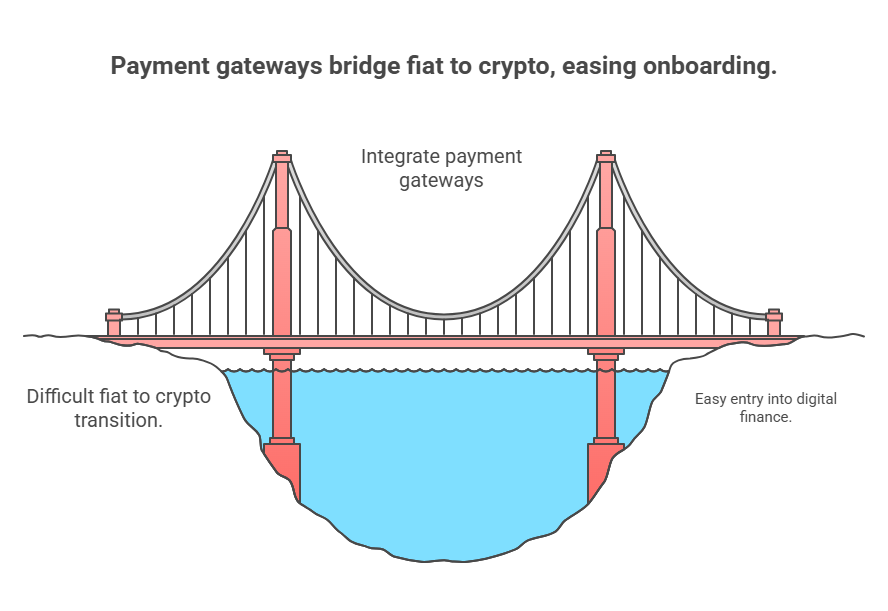
Onboarding is only complete when users have a clear way to fund their accounts through banking or alternative rails.
1. Traditional Banking Connections
Banking connections remain the most direct way for users to move money into crypto. Transfers through ACH in the United States or SEPA in Europe give users a familiar process and help them trust that funds will arrive. Debit and credit card options add speed, since they allow instant buys without waiting for settlement.
Many exchanges combine both, so users can choose between faster access and lower fees. These methods anchor onboarding because they feel close to what people already know from e-commerce or online banking.
The challenge is balancing convenience with risk. Card issuers charge higher fees and may block transactions if they suspect fraud. Bank transfers are safer but slower, sometimes taking several days.
A new user buying their first $50 of Bitcoin will likely choose a card, while a trader moving larger sums may prefer wire transfers. Platforms that explain these trade-offs in simple terms keep expectations realistic and avoid early frustration.
2. Alternative On-Ramp Solutions
In many regions, traditional banking rails do not reach everyone. Alternative on-ramps fill this gap by letting users fund crypto accounts with mobile money, peer-to-peer platforms, or even cash agents. For example, in Kenya, users often load wallets through M-Pesa.
In Nigeria, services like Paystack and Flutterwave connect local banks to exchanges. These methods allow people without credit cards or full bank accounts to still join the ecosystem.
Peer-to-peer marketplaces also play a major role. They match buyers and sellers directly, often with escrow services for safety.
This model has grown in markets where banks restrict direct transfers to exchanges. By offering these alternatives, platforms make crypto more inclusive and help onboarding reach communities that would otherwise be excluded.
3. Fee Transparency and Pricing Structures
Clear and upfront fees are critical for building trust. Every transaction has costs, whether it is network fees, platform charges, or currency conversion spreads. If users see unexpected deductions after a deposit or a buy, they lose confidence.
A good onboarding flow shows the full breakdown of costs before confirmation, so the user knows what they are paying and why. This prevents confusion and reduces support issues later.
Different pricing models suit different user groups. Some exchanges use fixed fees per transaction, while others use dynamic fees that vary with network traffic or order size. Volume discounts are common for traders who move larger sums.
For beginners, the key is simplicity. Showing “You will pay $2 in fees, and receive $98 worth of USDT” is clearer than showing percentages. Transparent pricing turns a first experience into a positive one and sets the tone for ongoing engagement.
Wallet Integration and Security
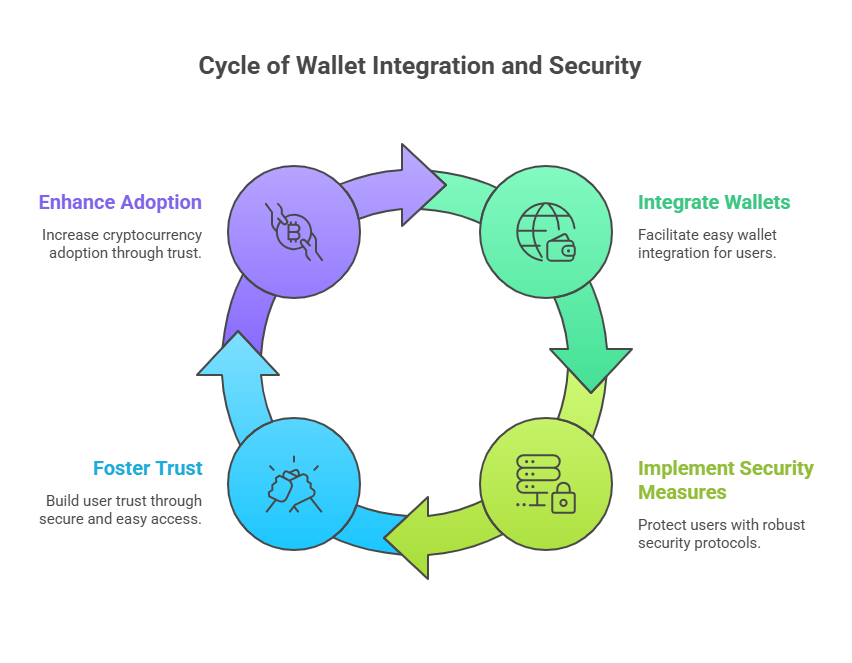
Wallet integration and security form the backbone of how users access, protect, and grow their digital assets.
1. Custodial vs Non-Custodial Wallets
When a new user starts with crypto, one of the first choices is whether to use a custodial or non-custodial wallet. A custodial wallet is managed by a service provider, usually an exchange, where the platform holds the private keys on behalf of the user.
This makes it simple because logging in with a password is enough to access funds. It feels familiar to people used to online banking, which is why many beginners start here.
The trade-off is that the user relies on the platform to keep funds safe, and if the provider is hacked or shut down, assets may be at risk.
A non-custodial wallet shifts full control to the user. Here, only the person holding the private keys can access the funds. Apps like MetaMask or hardware wallets like Ledger are common examples. This option provides independence and direct control, but it also adds responsibility.
If a user loses their recovery phrase, no company can restore access. This choice shapes onboarding because platforms must help users understand both options and guide them toward the one that matches their experience level and comfort with risk.
2. Secure Key Management
Keys are the backbone of digital ownership in crypto, so how they are managed is central to security. A private key controls access to funds, and losing it means losing assets. During onboarding, it is important to explain this clearly and provide safe ways to back it up.
Most non-custodial wallets use a seed phrase, usually 12 or 24 words, that can be written down and stored offline. Some newer systems introduce social recovery or encrypted cloud backups to make the process easier for beginners.
Key management education should start from the first login. A good design shows why a seed phrase matters, warns against sharing it, and walks the user through a short practice of confirming it.
Platforms that do this reduce mistakes like storing keys in plain text or taking screenshots. Strong habits formed early build long-term confidence and make people less vulnerable to phishing or loss.
3. Leveraging Hardware and Multi-Factor Security
Hardware wallets add another layer of safety by storing keys in a physical device that never exposes them to the internet. This makes them resistant to online attacks and a strong choice for holding larger amounts of crypto.
Users connect the device only when signing transactions, and many hardware wallets now integrate with mobile or desktop apps for smoother use. Including support for hardware wallets in onboarding signals to users that the platform takes long-term security seriously.
Multi-factor security builds on this by requiring more than one step to confirm an action. This could mean combining a password with an authenticator app, a text message, or a biometric scan.
For example, an exchange may require two-factor authentication before a withdrawal, or a wallet may ask for fingerprint verification before sending.
These extra checks can feel like small hurdles, but they prevent most unauthorized access. Teaching users how to enable them during onboarding helps keep accounts safe and strengthens trust in the platform.
Educational Pathways and Community Engagement

Onboarding is most effective when users are educated and supported by a strong community.
1. Guided Walkthroughs and Tooltips
When someone joins a crypto platform for the first time, clear guidance can make the difference between confusion and confidence. Guided walkthroughs help users complete core actions step by step, such as making their first deposit or sending tokens.
Tooltips can explain terms like gas fees or seed phrases right when the user encounters them, instead of expecting them to look elsewhere. This approach makes complex concepts feel approachable without overwhelming the user.
For example, a wallet app might guide a new user through creating a backup, with prompts that explain why writing down the recovery phrase is important.
An exchange might use interactive tutorials that walk through placing a first trade with a small amount. By giving support at the exact moment it is needed, these features help people learn by doing, which makes the lessons stick and builds trust in the platform.
2. Resource Hubs and Customer Support
A strong resource hub gives users a place to find answers in their own time. This might include FAQs, step-by-step guides, video explainers, and glossaries of common terms.
When built into the platform, it reduces the number of support requests and empowers users to solve problems themselves. The more accessible and well-organized the hub is, the faster users can move past roadblocks.
Customer support complements this by offering direct help when issues cannot be solved alone. Live chat, email support, and multilingual staff show users that assistance is available when they need it.
For instance, if a deposit does not appear or a verification fails, quick support can prevent a frustrated user from giving up. Together, resources and responsive support create a safety net that keeps people engaged through the early stages of adoption.
3. Peer Learning and Social Learning Channels
Community-driven spaces give users a chance to learn from each other. Platforms often host groups on Telegram, Discord, or forums where people share tips, ask questions, and celebrate milestones.
This peer-to-peer learning makes onboarding feel less isolating and builds trust because advice comes from real people using the product. It also creates a sense of belonging, which can encourage users to stick around longer.
Social learning also scales education without requiring the platform to answer every single question. For example, a new trader may ask about staking rewards in a community group, and an experienced member can respond with screenshots or explanations.
Some platforms amplify this by hosting community calls, AMA sessions, or ambassador programs. These channels make onboarding more interactive and dynamic, showing users that they are joining a living ecosystem rather than just signing up for a service.
Advanced Onboarding for DeFi and Web3 Services
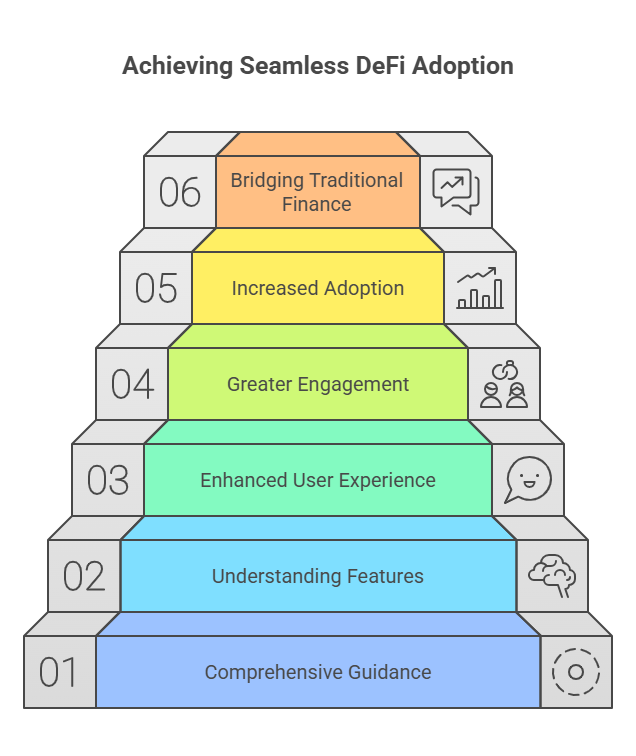
Advanced onboarding helps users move from simple transactions to exploring DeFi protocols, NFTs, and Web3 applications.
1. Layer-Specific On-Ramp Strategies
DeFi lives across different blockchains and layers, and each has its own costs and speeds. Onboarding should reflect this by guiding users toward networks that fit their needs. For example, the Ethereum mainnet is secure but has higher fees, while networks like Polygon, Arbitrum, or Base offer faster and cheaper transactions.
A clear onboarding flow can help new users choose a network that suits smaller first transactions without making them worry about the technical side.
A good example is when an exchange lets users buy stablecoins directly on a layer two instead of forcing them through Ethereum. This saves money on gas and lowers the barrier for entry.
Another case is when a DeFi wallet offers a default network setting that is optimized for low fees, so users can start swapping tokens right away. These strategies keep onboarding smooth and remove early cost shocks that might discourage adoption.
2. Abstracting Technical Complexity
DeFi involves many concepts that are unfamiliar to beginners, such as gas fees, slippage, and liquidity pools. Abstracting this complexity means hiding the hardest parts while still giving users safe control.
Some wallets already cover gas fees for the first few transactions or allow users to pay gas in the token they already hold. This makes the first experience more natural and avoids forcing users to manage multiple assets just to complete one action.
For example, a wallet could bundle transactions so a user does not have to manually approve each smart contract interaction.
Another approach is offering a simple toggle between “basic” and “advanced” modes, where beginners see only the core actions like buy or swap, and advanced users can adjust gas or slippage settings.
Abstracting complexity this way helps newcomers build confidence while still leaving room to grow into deeper DeFi use.
3. Composability and Cross-Platform User Flow
One of the strongest features of Web3 is that services can connect to each other, but this can overwhelm new users. Composability lets a wallet, exchange, or lending protocol interact seamlessly, yet if onboarding does not guide the flow, people may get lost switching between apps.
A good approach is to unify sign-ins with wallet connections and make it clear when a user is leaving one service to interact with another.
For instance, WalletConnect allows a user to connect the same wallet to multiple apps without creating new accounts everywhere. Some dashboards also aggregate DeFi positions across protocols, showing lending, borrowing, and liquidity pool data in one place.
These flows reassure users that their assets remain under their control, even when spread across platforms. By making cross-platform use simple, onboarding turns what could feel fragmented into a clear journey that encourages ongoing participation.
Crypto Onboarding Analytics and Optimization
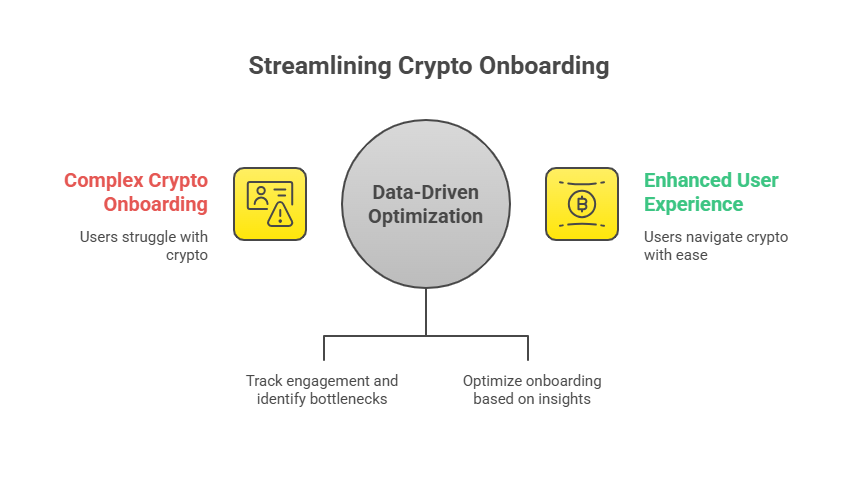
1. Funnel Tracking and Key Metrics
Tracking the onboarding funnel shows where users succeed and where they drop off. A typical funnel starts with sign-up, moves through identity verification, continues to funding, and ends with the first trade or transfer. Measuring completion rates at each stage highlights the friction points.
For example, if many users stop during KYC, it may signal that the process is too slow or not well-explained. By following these metrics, teams can make targeted fixes rather than guessing where problems lie.
Key performance indicators often include the percentage of users who finish KYC, average time to first deposit, cost per acquired user, and retention after the first week or month. An exchange might learn that users who complete a first trade within 24 hours are much more likely to stay active.
With this insight, they can build prompts or incentives to encourage that action early. Clear tracking of these steps ensures the onboarding journey is not just functional but also efficient.
2. A/B Testing and Iterative Improvements
A/B testing allows teams to compare different onboarding designs and see which version performs better. For instance, one group of users may see a detailed explanation of seed phrases, while another group sees a short animation.
The results show which approach leads to higher completion and fewer support tickets. This evidence-based method helps refine onboarding without relying on assumptions.
Improvements should be rolled out gradually and measured against clear goals. A platform might test whether adding a progress bar improves completion rates or whether simplifying ID upload increases KYC success.
Iterative adjustments keep the process responsive to user behavior and changing regulations. Over time, small refinements add up to a smoother and more reliable onboarding flow.
3. Security Audit and User Behavior Insights
Security plays a key role in onboarding, and regular audits ensure the process is safe without being too heavy. Audits can check that data is encrypted, that verification vendors meet compliance standards, and that withdrawal protections are in place.
They can also uncover points where users may be tricked by phishing or fake apps, which is especially important for mobile-first platforms. A well-audited flow prevents problems before they reach users.
Behavior insights add another layer by showing how users interact with security features. For example, if most users skip two-factor authentication, the platform may need to explain its benefits better or make it part of the default setup.
If analytics reveal repeated failed logins or abandoned withdrawals, these can signal attempted fraud or confusion. By combining audits with real user data, platforms can strengthen trust while keeping the onboarding journey clear and usable.
Scaling Global and Local Strategies
To scale effectively, platforms must connect global vision with local partnerships and compliance.
Localization and Regional Payment Optimization
For crypto onboarding to scale, platforms must adapt to local languages, currencies, and payment systems. A user in Europe may prefer SEPA transfers in euros, while someone in the Philippines might rely on GCash or GrabPay.
Providing these familiar options makes onboarding smoother and removes the barrier of needing foreign accounts or credit cards. Localization also extends to language support and cultural nuances in design, such as using local date formats and clear fee displays in native currency.
Practical examples show how this works. In Kenya, many platforms integrate directly with M-Pesa so that users can top up wallets with mobile money. In Latin America, supporting peso deposits through local bank partners speeds adoption.
When users can see their balances in their home currency and pay with local rails, the transition into crypto feels natural, and adoption spreads beyond early adopters to everyday people.
Partnerships and Ecosystem Collaboration
No single platform can cover all regions and services alone, so partnerships are key. By working with local banks, payment processors, and wallet providers, global exchanges can reach more users.
These collaborations also bring credibility since users trust institutions they already know. For instance, when a regional bank integrates with a global exchange, customers can move funds without worrying about blocked transfers or unclear fees.
Ecosystem collaboration goes beyond payments. Exchanges often integrate with NFT marketplaces, lending platforms, or yield protocols so that once a user is onboarded, they can access more services without leaving the platform.
This reduces friction and keeps value within the ecosystem. Strong partnerships turn onboarding into more than just account creation; they make it a gateway into a wider Web3 economy.
Regulatory Scalability Strategies
Regulations differ across countries, and scaling requires flexibility. A platform that operates in both the United States and Europe must meet FinCEN rules in one market and MiCA rules in the other.
Rather than building one rigid system, teams often design modular compliance layers that can be switched on or off depending on jurisdiction. This approach allows the same onboarding flow to adapt without starting from scratch each time.
An example is geofencing. Users from one country may see additional KYC steps or be restricted from certain assets, while others may get faster access with lighter checks.
Platforms can grow sustainably without risking shutdowns by combining local compliance with global standards.
Planning for scalability in regulation ensures that onboarding works today but can also adjust quickly as laws change.
Future of Crypto Onboarding
The future of crypto onboarding points toward safer, faster, and more connected user journeys.
Identity and On-Chain Reputation
Identity in crypto is moving beyond traditional KYC into systems that give users more control. Decentralized identifiers and verifiable credentials allow people to prove who they are without sharing excess data.
Instead of uploading the same ID to multiple platforms, a user could carry a reusable credential that proves their age, residency, or accreditation. This creates a smoother onboarding experience while still meeting compliance needs.
On-chain reputation adds another layer by recording activity that demonstrates trustworthiness. A user’s history of successful transactions, governance participation, or loan repayments can serve as proof of reliability.
This can open access to advanced services without repeating heavy verification steps. For example, a DeFi lending platform might use on-chain credit scores instead of requiring collateral for every loan. These innovations make onboarding both faster and more personal.
Web3 and Metaverse Onboarding Trends
As Web3 expands, onboarding is no longer just about opening a wallet or exchange account. In metaverse platforms, users may start by creating an avatar or claiming a digital space.
Wallet integration happens in the background, with assets like NFTs serving as identity markers or access passes. This approach makes entry more playful and interactive while still teaching the basics of digital ownership.
Metaverse experiences also blend social learning with onboarding. A new user can walk through a virtual space, attend a live event, and receive a token reward for completing steps like setting up two-factor authentication.
These trends move onboarding away from static forms into immersive experiences. They make the first interaction memorable, which encourages users to keep exploring the ecosystem.
Regulatory Evolution and Technical Innovations
The future of onboarding will also be shaped by regulation. Frameworks like MiCA in Europe and the OECD’s tax reporting standards point toward stricter but more unified global rules.
This could mean standardized data collection, shared identity systems, and clearer expectations for platforms. For users, it may reduce the frustration of having to repeat verification in every new service.
On the technical side, innovations like gasless transactions, smart contract wallets, and AI-driven fraud detection will keep reshaping onboarding flows.
Users may soon sign up with a wallet that automatically handles key recovery or pays gas in the token they already own. Combined with evolving regulation, these changes point toward onboarding that is safer, simpler, and more connected across platforms.
Conclusion
Crypto onboarding is more than just a sign up process, it is the first step that shapes how people see and use digital assets. When platforms combine clear compliance, smooth design, strong security, and simple education, they give users the confidence to explore further. A good start makes crypto feel less like a risky unknown and more like a practical tool that anyone can use in daily life.
From building trust with KYC and data protection, to guiding users through their first transfer, to making platforms accessible across languages and regions, each step matters. The better we make this journey, the more people will feel included, safe, and ready to take part in the growing world of crypto.
Frequently Asked Questions (FAQs)
Is KYC required during crypto onboarding?
Yes. Most regulated platforms require Know Your Customer checks to verify identity and prevent fraud or money laundering.
How long does crypto onboarding usually take?
Crypto onboarding usually takes a few minutes to a few days, depending on the platform, identity verification process, and local regulations.
What is the difference between custodial and non-custodial wallets in onboarding?
The difference is that custodial wallets are managed by a provider, while non-custodial wallets give users full control of their private keys.
Can users buy crypto without going through onboarding?
No. To use regulated platforms, users must complete onboarding steps like registration, KYC, and funding their accounts.
What are the common challenges in crypto onboarding?
Common challenges in crypto onboarding include complex identity checks, high fees, limited payment options, and a lack of clear guidance.
How does user experience affect crypto onboarding?
User experience affects crypto onboarding by making the process easier, faster, and more engaging, which increases completion rates