


Knowing how to buy cryptocurrency with a debit card is genuinely one of the simplest entry points into the digital asset space
This guide walks you through every stage of the process, highlights what can go wrong, and makes sure you know how to keep your purchases secure.
We will use UPay as our primary example because the steps are clean and beginner-friendly, but the same core process applies across all major platforms.
Why Is Buying Cryptocurrency with a Debit Card the Most Popular Method?
Over $1 billion in cryptocurrency is purchased using debit and credit cards every year, and that figure continues to grow.
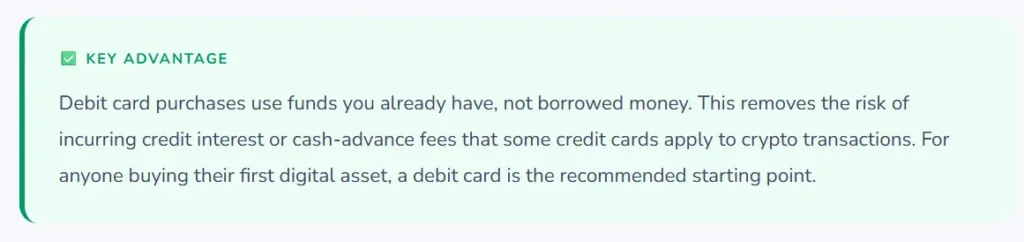
The reason is straightforward: debit cards are universal, instant, and familiar.
Every major crypto platform, from Coinbase and Binance to UPay, supports Visa and Mastercard debit payments precisely because most new buyers already have one in their wallet.
Compared to bank transfers, debit card purchases are near-instant.
Your crypto typically arrives in your wallet within one to three minutes of the transaction confirming, rather than the one to five business days a bank wire might take.
Compared to peer-to-peer platforms, debit card purchases on regulated exchanges are straightforward and protected by platform-level KYC and security monitoring.
Related Reads: The role of cryptocurrency in lifestyle and travel, all you need to know about altcoins.
What Coins Can You Buy with a Debit Card in 2025?
Almost any major digital asset is available for purchase by debit card on established platforms.
Bitcoin remains the most traded, commanding around 42% of all crypto transactions.
Ethereum is close behind, prized for its smart contract capabilities and staking yield potential.
Solana has risen sharply in popularity through 2025, celebrated for low fees and high transaction speed.
Stablecoins like USDC and Tether (USDT) are an increasingly popular buy for those who want to avoid price volatility while still holding funds on-chain.
Most platforms support between 50 and 750 different digital assets accessible via card purchase.
How Do You Buy Cryptocurrency with a Debit Card Step by Step?
The process is consistent across virtually all reputable platforms.
Here is how it works from start to finish, using UPay as the example, though the same steps apply whether you are on Coinbase, Binance, or any other regulated exchange.
1. Choose a Reputable Platform and Create Your Account
Visit the platform’s website or download its app. You will need to provide your email address and create a strong, unique password. On UPay, this takes about two minutes.
Choose a platform that is clearly regulated, displays transparent fee information, and has strong user reviews.
Avoid any service that does not require at least some identity verification, this is a regulatory requirement on all legitimate platforms, and its absence is a warning sign.
2. Complete Identity Verification (KYC)
Know Your Customer (KYC) verification is a legal requirement under global anti-money laundering regulations, including the EU’s MiCA framework and UK Financial Conduct Authority rules.
You will typically need to provide a government-issued ID (passport or driving licence) and complete a quick facial scan.
On most platforms, this takes three to five minutes and unlocks your full purchase limits. On UPay, this process is streamlined and can often be completed within minutes on a mobile device.
3. Link Your Debit Card
Navigate to the payment methods or buy crypto section and select the option to add a debit card. Enter your full card number, expiry date, and CVV code.
Visa and Mastercard are accepted universally; some platforms are beginning to expand support to additional card networks.
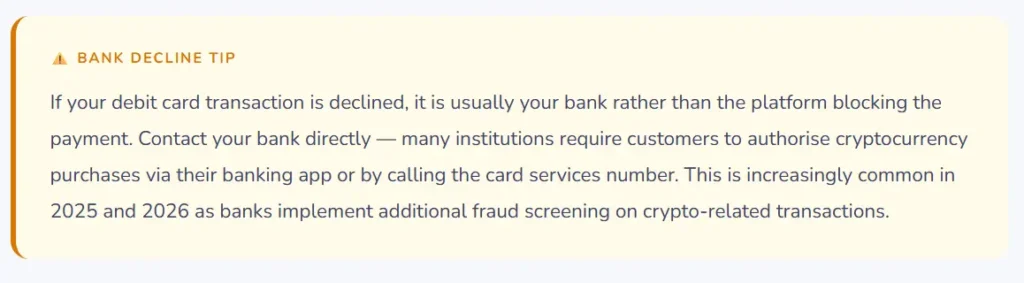
Most prepaid cards are declined by exchanges, as card issuers often restrict crypto-related transactions on these products.
4. Select the Cryptocurrency You Want to Buy
On UPay and similar platforms, you will see a simple interface where you choose your digital asset and enter either the fiat amount you want to spend (for example, £100) or the crypto quantity you want to receive.
The platform will display the current exchange rate, the exact amount of crypto you will receive, and the total fee breakdown before you confirm.
Always review this information before proceeding.
5. Confirm the Transaction and Authorise with Your Bank
Once you review the order summary, click to confirm the purchase. Your bank may send a one-time password (OTP) via SMS or require 3D Secure authentication for security.
Complete this step promptly, most authentication windows expire within a few minutes.
6. Receive Your Crypto and Secure Your Wallet
Your digital assets typically arrive in your platform wallet within one to three minutes of successful payment authorisation. On UPay, you can view your holdings immediately in the wallet dashboard.
From here, you can hold on the platform, transfer to a personal crypto wallet for self-custody, or use your crypto for payments.
For significant holdings, transferring to a hardware wallet that stores your private keys offline is the most secure option.
Which Platforms Let You Buy Crypto with a Debit Card
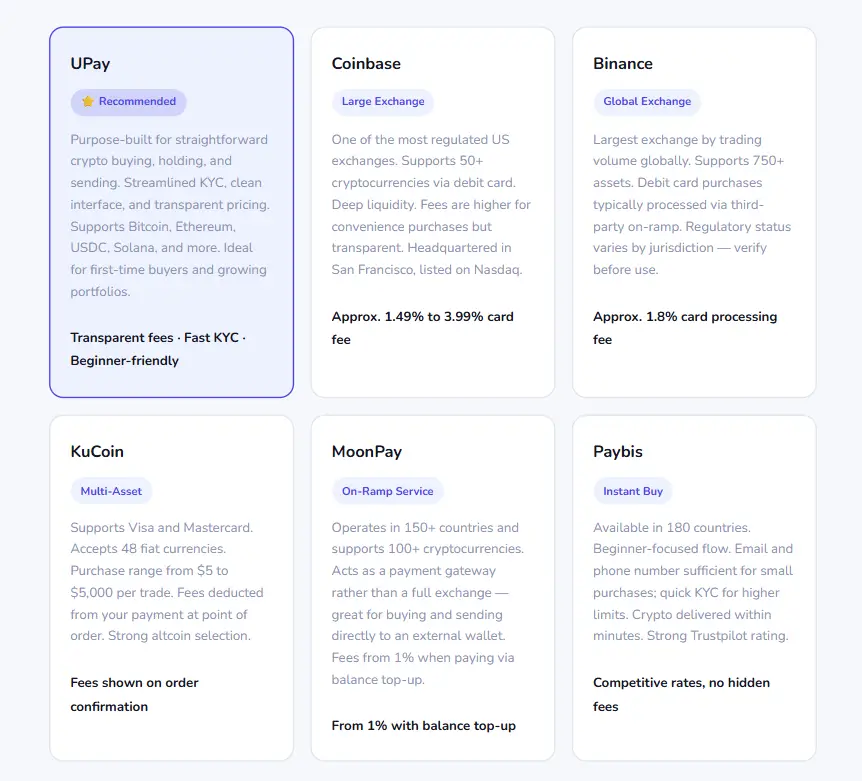
The good news is that most major platforms now support debit card purchases.
The differences come down to fees, supported coins, purchase limits, and the smoothness of the verification process.
Here is how the leading options compare, with UPay highlighted as the most beginner-focused solution.
What Are the Biggest Mistakes to Avoid When Buying Crypto with a Debit Card?
Using an Unregulated or Unknown Platform
If a platform does not require KYC, displays no regulatory information, and offers rates that seem too good to be true, it is likely a scam.
Stick to platforms with documented regulatory compliance — in the UK, FCA registration; in the EU, MiCA-authorised platforms; in the US, FinCEN registration and state money transmitter licences.
Ignoring the Full Fee Breakdown
Many buyers look only at the exchange rate headline and miss the spread embedded in that rate. A platform advertising “1% fee” may apply a 1.5% spread on top, making your true cost 2.5%.
Always check the exact amount of crypto you will receive versus what the spot market price shows before confirming.
Leaving Large Holdings on the Exchange
Keeping significant crypto on a centralised exchange means the platform controls your private keys — not you.
The principle “not your keys, not your coins” exists because exchange failures and hacks have cost users billions.
For holdings above a few hundred pounds, transferring to a personal wallet is strongly recommended.
Sending Crypto to the Wrong Wallet Address
Blockchain transactions are irreversible. Sending Bitcoin to an Ethereum address, or entering a single incorrect character in a wallet address, typically results in permanent loss of funds.
Always copy-paste wallet addresses and verify the first and last several characters before confirming any transfer.
Investing More Than You Can Afford to Lose
Crypto prices can fall dramatically and rapidly. Bitcoin, Ethereum, and most altcoins have experienced drawdowns of 50% to 80% from their peaks in previous market cycles.
Only use funds that you genuinely do not need for living expenses, and treat any crypto position as a long-term commitment rather than a short-term trade unless you have significant market experience.
Using a Prepaid or Virtual Card Without Checking First
Most prepaid debit cards are blocked by crypto exchanges because the card issuer restricts cryptocurrency-related transactions.
Before attempting to buy, confirm that your card is a standard Visa or Mastercard debit card linked directly to a bank account.
Virtual cards linked to accounts like Revolut or Monzo often work, but verify your specific card type with the platform before adding it.
Related read: I Just Bought Some Crypto, What Happens Next?
Conclusion
Look, learning how to buy cryptocurrency shouldn’t feel like you’re trying to crack a secret code.
By starting with a simple debit card, whether you’re using UPay, you’ve already cleared the biggest hurdle
But remember, the real win isn’t just hitting buy for the first time; it’s about sticking to the security habits and common-sense rules we’ve covered here.