


If you’ve come across decentralized finance (DeFi) or thought about adding your tokens to a liquidity pool, you’ve probably come across the term impermanent loss. At first, it can sound confusing or even intimidating, but it’s actually a core concept that every crypto user providing liquidity should understand.
In simple terms, impermanent loss is what happens when the price of the tokens you put into a liquidity pool changes compared to when you added them. This price movement can leave you with fewer gains (or even a loss) compared to just holding the tokens in your wallet.
But why is it called “impermanent”? Because the loss isn’t locked in unless you remove your tokens while prices are still far apart; if prices return to their original levels, the loss can shrink or completely disappear.
Key Takeaway
- Impermanent loss is a temporary decrease in the value of assets a person holds in a liquidity pool
- To really understand impermanent loss, you need to know how decentralized exchanges work behind the scenes
- Impermanent loss doesn’t affect every liquidity pool equally
- One of the simplest strategies is to choose pairs of tokens that move similarly or stablecoins.
- If your fees and rewards are higher than the impermanent loss, you still end up with a profit overall.
What is Impermanent Loss in Crypto?

Impermanent loss is a temporary decrease in the value of assets a person holds in a liquidity pool compared to simply holding those assets in their wallet.
It happens because automated market makers (AMMs) like Uniswap, SushiSwap, and PancakeSwap adjust the ratio of tokens in the pool as prices change. This rebalancing creates situations where the combined value of your tokens inside the pool can become lower than if you had just kept them untouched.
The term originated from early discussions among DeFi developers and communities around 2018–2019, when AMMs became popular.
They noticed liquidity providers sometimes “lost” value when asset prices moved but these losses weren’t always permanent if prices later returned to their starting point.
Why it’s called “impermanent”
The word impermanent is used because the loss only becomes permanent when the liquidity provider withdraws their tokens while prices are still unfavorable.
If the prices of the tokens in the pool return to the same relative prices as when the liquidity was first added, the impermanent loss disappears. So, the loss is “impermanent” in the sense that it can be reversed, depending on how prices move before you remove your funds.
For example, imagine you put ETH and USDT into a liquidity pool. ETH price rises quickly compared to USDT. Arbitrage traders buy the cheaper ETH from your pool, and you end up holding more USDT and less ETH.
If ETH later drops back to its original price before you withdraw, the balance of assets readjusts closer to your starting point—and your loss can disappear.
Difference between realized and unrealized loss across price movements
- Unrealized (impermanent) loss:
This is the loss on paper that you see while your funds remain inside the liquidity pool. Prices have moved, and your assets are worth less compared to simply holding them, but you haven’t actually “lost” anything yet because you haven’t withdrawn.
- Realized (permanent) loss:
Once you remove your funds from the pool while prices are still unfavorable, the loss becomes real. This means you now permanently have fewer assets in dollar terms compared to if you had just held them outside the pool.
Why Impermanent Loss Occurs

To really understand impermanent loss, you need to know how decentralized exchanges work behind the scenes, especially the systems called Automated Market Makers (AMMs) and liquidity pools. Let’s break this down step by step.
Role of AMMs (Automated Market Makers) & liquidity pools
Unlike traditional exchanges that match buyers and sellers directly, AMMs use smart contracts to automatically set prices for trading pairs based on how much of each token is in the liquidity pool.
Liquidity pools are simply shared pots of tokens (e.g., ETH and USDT) that anyone can add to. When you provide liquidity, you deposit equal values of two tokens, and in return, you earn trading fees from people swapping those tokens.
This system keeps markets running 24/7, even without active traders setting prices. But it also introduces impermanent loss because of how AMMs calculate and adjust prices.
Constant product formula (xy = k): Most popular AMMs (like Uniswap V2) use something called the constant product formula: > x × y = k. Here:
- x = amount of Token A in the pool (e.g., ETH)
- y = amount of Token B in the pool (e.g., USDT)
- k = constant value that doesn’t change
This formula keeps the product of the two token balances (x and y) always equal to the same number (k).
When someone trades ETH for USDT,the amount of ETH (x) in the pool increases, and the amount of USDT (y) in the pool decreases. The price changes automatically so the product (x × y) still equals k. This automatic rebalancing is what makes AMMs work—but it also opens the door to impermanent loss.
Rebalancing via arbitrage
As the prices of ETH and USDT on other exchanges (like Binance or Coinbase) change, the price inside the AMM might not instantly keep up.
Arbitrage traders notice these price differences. They quickly buy or sell tokens in the AMM pool until the price in the pool matches the market price outside.
This process benefits the whole market by keeping prices aligned but for liquidity providers, it changes the balance of tokens they hold. Often, they end up with more of the token that lost value and less of the token that gained value. This difference is what causes impermanent loss.
Price divergence between paired assets
The size of impermanent loss depends mostly on how much the prices of the two tokens in your liquidity pool move away from each other.
If the prices stay close together (for example, USDC and USDT, both stablecoins), the loss is very small.
And if one token rises or falls sharply compared to the other, the loss can grow significantly.
- Impact of price divergence on asset ratios: As prices diverge, the AMM changes the ratio of your tokens to keep the product xy = k constant:
If ETH price goes up a lot, arbitrage traders buy cheap ETH from the pool. The pool ends up with less ETH and more USDT. Your share of the pool now includes fewer valuable ETH and more USDT.
In dollar terms, your total pool share might end up being worth less than if you’d simply kept your original ETH and USDT.
Calculating Impermanent Loss in Simple Steps
Understanding how to calculate impermanent loss helps liquidity providers know what to expect and make smarter choices. You don’t need to be a math expert to get the basics, but it’s useful to see where the numbers come from and how to check them easily.
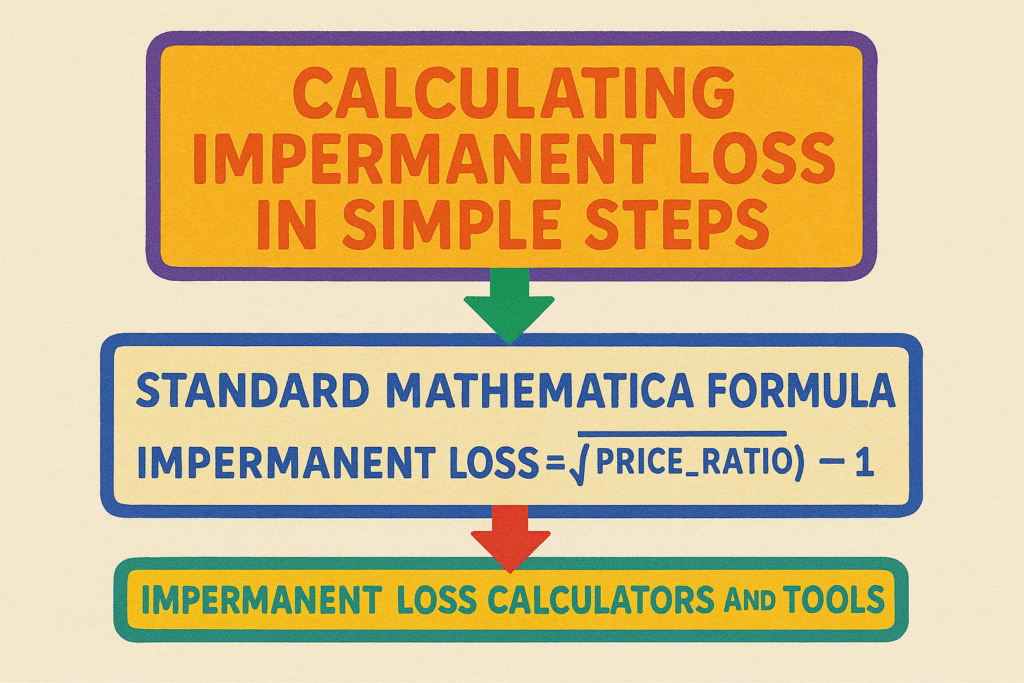
Standard mathematical formula
The standard way to estimate impermanent loss is based on how much the price of one token changes compared to the other.
The most common formula looks like this:
> Impermanent loss = 2 × √(price_ratio) / (1 + price_ratio) – 1
Let’s break it down simply:
Price ratio is how much the price of Token A has changed compared to Token B. For example, if ETH doubles in price against USDC, the price ratio is 2.
The formula calculates what percentage of your potential value you’ve “lost” compared to just holding the tokens.
Impermanent loss calculators and tools
You don’t have to do the math by hand. Today, many DeFi platforms and crypto websites offer free impermanent loss calculators where you simply enter your token pair, starting prices, ending prices and sometimes your pool share or fees earned. Some popular tools as of 2025:
- CoinGecko: Easy online calculator and guides
- Uniswap:Built-in dashboard shows potential impermanent loss
- DeFi Saver: More advanced tools for simulation
- Balancer: Especially useful for pools with uneven ratios (e.g., 80/20 pools)
- Yieldwatch: Tracks your live LP positions and shows real-time impermanent loss
These tools are helpful because they also show the effect of trading fees, which can offset some or all of the loss.
Factors That Influence Impermanent Loss in Crypto

Impermanent loss doesn’t affect every liquidity pool equally. Several factors decide how big or how small it can be. Let’s look at the most important ones, explained simply.
Asset volatility & correlation
One of the biggest drivers of impermanent loss is how much the prices of the two tokens in a pool move compared to each other, this is called volatility and correlation.
- Volatility: If both tokens in your pool are very volatile (their prices swing a lot), the chance of large impermanent loss goes up.
- Correlation: If the tokens usually move together (high correlation), impermanent loss tends to be much smaller.
Pool composition (ratio and weighted AMM)
Not all liquidity pools use a 50/50 split between two tokens. Some platforms like Balancer and Bancor offer weighted pools with different ratios.
- 50/50 pools (most common): You provide equal value of both tokens (e.g., $500 of ETH and $500 of USDC). These pools are easy to understand but have higher impermanent loss when prices diverge.
- 80/20 or other weighted pools: Example: a Balancer pool where 80% is ETH and 20% is a smaller token.These pools reduce impermanent loss because most of your exposure is in one asset.
- Single‑asset pools (e.g., Bancor’s IL protection or Thorchain): You deposit only one token, and the protocol pairs it internally. These pools can help protect against impermanent loss, but the mechanisms vary and sometimes include time‑based protection.
Time horizon and price recovery dynamics
How long you keep your funds in a liquidity pool matters too. If token prices move apart temporarily but later return to similar levels before you withdraw, the impermanent loss can disappear.
If you withdraw while prices are still highly divergent, the impermanent loss becomes realized (permanent). Compare the short and the long term liquidity provider below:
- Short-term liquidity providers might get caught by sudden price moves and higher impermanent loss.
- Long-term providers may benefit if prices stabilize or revert, plus they have more time to earn fees that help offset the loss.
Timing and patience can reduce the final impact of impermanent loss, but no strategy guarantees a profit, especially in highly volatile markets.
Strategies to Mitigate Impermanent Loss in Crypto
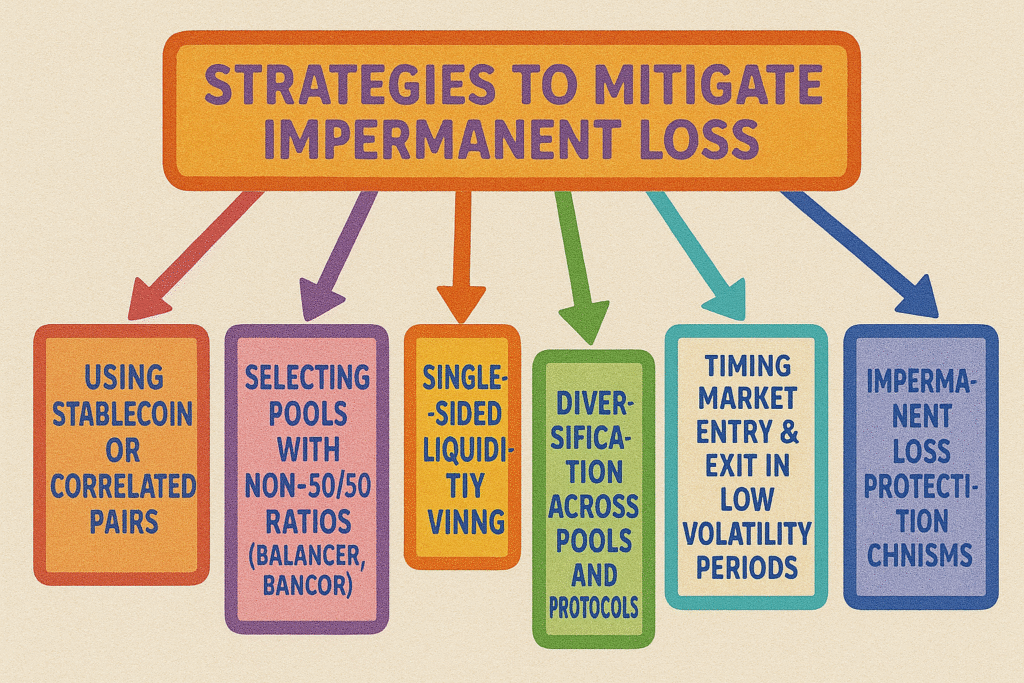
Impermanent loss can’t be completely avoided when you’re providing liquidity to most AMMs, but there are smart ways to reduce its impact. Let’s look at the most practical strategies anyone can use, explained simply.
Using stablecoin or correlated pairs
One of the simplest strategies is to choose pairs of tokens that move similarly (highly correlated) or stablecoins.
- Stablecoin pools (like USDC/USDT or DAI/USDC): Prices stay close to $1, so impermanent loss is minimal. These pools mainly generate steady income from trading fees.
- Correlated assets (like ETH/wstETH or BTC/renBTC): These tokens often track each other’s price, reducing price divergence. Impermanent loss can still happen, but it’s typically lower.
Selecting pools with non‑50/50 ratios (Balancer, Bancor)
Most pools use a 50/50 split between two tokens, but some platforms (like Balancer) let you choose custom ratios like 80/20.
- 80/20 pools: With this, you keep 80% exposure to one token (e.g., ETH) and 20% to another. This setup reduces impermanent loss because most of your position stays in the dominant asset.
- Trade‑off: These pools can see bigger price swings for trades (higher slippage), which might reduce trading activity and fees.
Single‑sided liquidity provisioning
Some protocols (e.g., Bancor, Thorchain) allow you to provide liquidity with just one token instead of a balanced pair. You deposit, say, only ETH. The protocol pairs your ETH internally or uses pooled insurance to cover potential losses.
Diversification across pools and protocols
Just like investing, don’t put all your funds into one pool. Spread liquidity across different pools (stablecoin pools, volatile pools, weighted pools) and different protocols (Uniswap, Balancer, Curve, Thorchain, etc.)
Diversification helps balance risk. Some pools may experience high impermanent loss, while others stay stable. By diversifying, you avoid being overly exposed to one pair’s volatility or a single platform’s risks.
Timing market entry & exit in low volatility periods
Impermanent loss gets worse when prices move sharply right after you deposit. A better approach is to enter pools during quiet market periods when prices are stable and avoid adding liquidity right before big news, events, or high volatility.
If prices start to converge again after a big move, withdrawing then can reduce realized impermanent loss. Timing isn’t always predictable, but being mindful of market trends can help.
Impermanent loss protection mechanisms
Some DeFi projects have introduced ways to protect against impermanent loss or reduce its impact. ILP protocols like Bancor and THORChain
Bancor offers full impermanent loss protection if you stay in the pool long enough (usually ~100 days). THORChain uses its own reserve to cover some impermanent loss after a set time.
These solutions don’t make impermanent loss disappear instantly, but they share the risk between the protocol and liquidity providers, lowering your exposure over time.
When Impermanent Loss Becomes Permanent
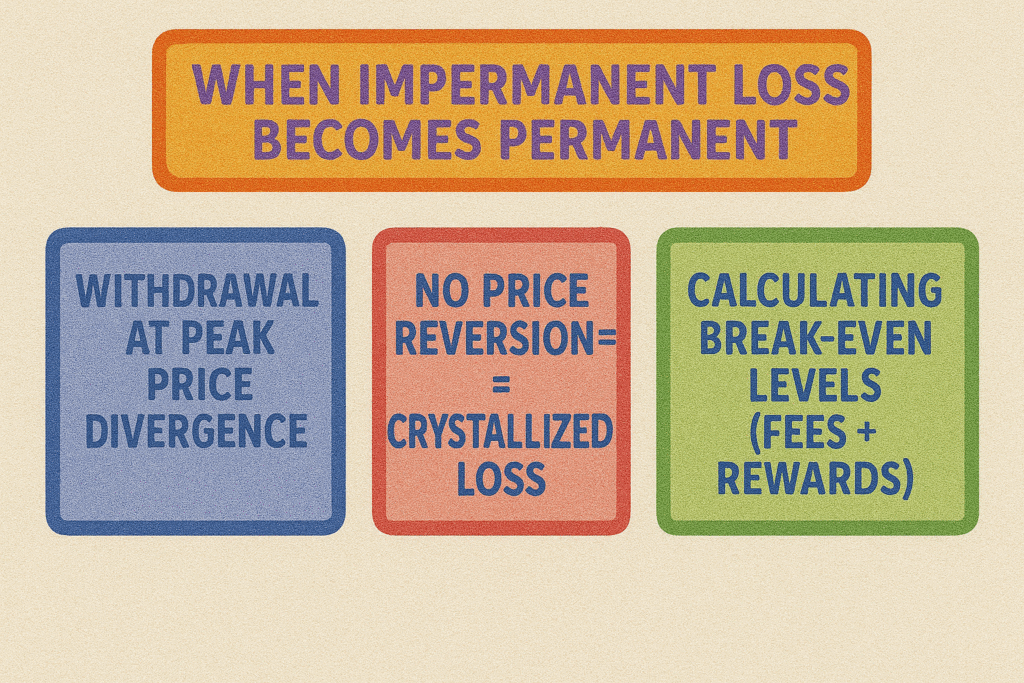
By itself, impermanent loss is only temporary because prices can still move back to where they started. But at some point, it can become permanent turning into an actual, realized loss. Let’s see when and why this happens.
Withdrawal at peak price divergence
Impermanent loss stays on paper as long as your assets stay in the liquidity pool.
But if you withdraw your tokens while prices are still far apart (meaning one asset has gone up or down a lot compared to the other), the loss becomes permanent. For example:
You add ETH and USDC to a pool. ETH price rises sharply and the pool rebalances, giving you less ETH and more USDC.
If you withdraw at this moment, you lock in the difference, you get fewer ETH back than you originally deposited, and your total dollar value ends up lower than if you had just held the tokens.
This is why timing your exit matters: withdrawing during extreme price divergence usually means bigger realized losses.
No price reversion = crystallized loss
Impermanent loss can disappear if the price of the tokens returns to the level they were at when you entered the pool.
But if prices never come back or keep moving further apart the loss stops being “impermanent.”
At that point, once you withdraw, the value gap compared to just holding becomes a crystallized (realized) loss.
Calculating break‑even levels (fees + rewards)
The good news is that impermanent loss isn’t the whole story, liquidity providers also earn from trading fees paid by people swapping tokens in the pool and incentives like liquidity mining or yield farming rewards.
To see if you really lost money, you compare total earnings from fees and rewards vs. the amount of impermanent loss you suffered
If your fees and rewards are higher than the impermanent loss, you still end up with a profit overall. This balance point where your extra income fully covers the loss is called the break‑even level.
Conclusion
Impermanent loss is the potential drop in value you face when you add tokens to a liquidity pool, caused by price changes between those tokens. It’s called “impermanent” because the loss only becomes real if you withdraw while prices are still far apart; if prices return to their original levels, the loss can shrink or disappear.
While you can’t remove the risk completely, you can reduce it by using stablecoin pools, choosing weighted pools, diversifying, or earning extra rewards and fees that help balance out the loss. With a bit of planning and awareness, impermanent loss becomes a manageable part of participating in DeFi.
FAQs
Is impermanent loss the same as losing money?
Not always. Impermanent loss is the difference between what you’d have if you just held your tokens vs. what your share in the pool is worth after prices change. If prices later return to where they started or if you earn enough fees, you might still end up with a profit overall.
Can I avoid impermanent loss completely?
It’s hard to avoid completely, but you can reduce it. For example: choose stablecoin pools, use single‑sided liquidity pools, pick weighted pools (like 80/20), or provide liquidity during calm market periods.
Does impermanent loss only happen when prices fall?
No. Impermanent loss can happen any time prices move apart, whether one token rises, falls, or both move in opposite directions. It’s about price divergence, not just falling prices.
How do trading fees help?
Every trade in the pool pays a fee, which goes to liquidity providers. Over time, these fees can help cover or even fully offset the impact of impermanent loss, especially in pools with high trading volume.
What happens if I leave my tokens in the pool long enough?
If prices return to their original level, impermanent loss can shrink or disappear. Also, some protocols offer impermanent loss protection if you stay in long enough (like Bancor).