What makes millions of people around the world put their money into digital coins that only exist on a computer screen? The answer is simple: cryptocurrencies give people new ways to store value, move money across borders, and invest in technology that is changing finance from the ground up.
The global cryptocurrency market reached $2.96 trillion in 2025 and is projected to grow to $7.98 trillion by 2030, a trajectory that has moved digital assets from niche technology to mainstream financial infrastructure. Over 560 million people worldwide now own cryptocurrency, roughly 6.8% of the global population, and that number keeps growing.
This guide on investing in cryptocurrency for dummies breaks it all down in plain language so you can understand how it works, why it matters, and how to begin safely. You will learn about blockchain, wallets, exchanges, investment strategies, security best practices, and the risks and rewards that come with this fast-moving market. By the end, you will have the tools to decide whether crypto has a place in your financial journey.
Key Takeaways
- Cryptocurrency is digital money that works on computer networks instead of banks or governments.
- Bitcoin was the first widely used cryptocurrency and remains the largest by market cap today.
- Every transaction is recorded on a blockchain, a public digital ledger that anyone can verify.
- Blockchains make it possible to send money directly without a middleman.
- Some cryptocurrencies like Ethereum also support apps and smart contracts.
- Stablecoins are designed to keep a steady value by linking to assets like the US dollar.
- People invest in crypto for growth, to store value, to earn yield, and to move money across borders.
- Security starts with understanding wallets, private keys, and choosing regulated platforms.
What Is Cryptocurrency?
Cryptocurrency is a decentralized form of digital currency that relies on blockchain technology to record transactions and manage the issuance of new units. Unlike traditional fiat currencies, cryptocurrencies are not controlled by any central authority, making them independent of government interference or manipulation.
The first widely used cryptocurrency was Bitcoin, which launched after a whitepaper was published in 2008 by an anonymous person or group known as Satoshi Nakamoto. It introduced the concept of peer-to-peer electronic cash and proved that trustless, borderless money was possible without a bank in the middle.
You can send cryptocurrency to someone else without a middleman, and every transfer is recorded on a shared ledger. Some blockchains, like Ethereum, also let you run small programs called smart contracts, which let people build apps for lending, trading, and digital ownership. There are coins meant for stability called stablecoins that try to hold a steady value by linking to dollars or other assets, and others that aim to be a store of value or power decentralized applications.
As of mid-2025, global cryptocurrency ownership had grown to 708 million people, a figure that surpasses the active user bases of PayPal and American Express combined.
How Does Blockchain Work?
A blockchain is a digital record that keeps information in blocks, which are connected in a chain and shared across many computers. Each block contains details of transactions, the time they happened, and a link to the block before it. Once a block is added, it cannot be changed without the whole network agreeing.
This setup removes the need for a bank or other middleman to check and approve transactions. For example, when someone sends Bitcoin, the transfer is grouped with others into a block, added to the chain, and then copied across the network. Because of this, no single person can alter it later.
Think of it like a shared notebook that everyone can see, but no one can erase or rewrite once something is added. Each new page connects to the one before it, forming a long, secure chain, hence the name “blockchain.”
Mobile devices now account for 87% of all crypto transactions globally, making smartphones the primary gateway through which most new users interact with the blockchain for the first time. Global cryptocurrency wallet adoption reached 820 million unique active wallets in 2025.
Key terms to know:
- Blockchain: A decentralized and immutable ledger that records all transactions made with a particular cryptocurrency.
- Wallet: A digital tool used to store, send, and receive cryptocurrencies. Wallets can be hardware, software, or paper-based.
- Mining: The process of validating and adding new transactions to the blockchain through complex mathematical computations.
- Public and Private Keys: Cryptographic keys that secure cryptocurrency transactions. The public key is used to receive funds, while the private key is used to access and spend them.
- Smart Contract: A self-executing program stored on a blockchain that runs automatically when predefined conditions are met.
Popular Cryptocurrencies Explained
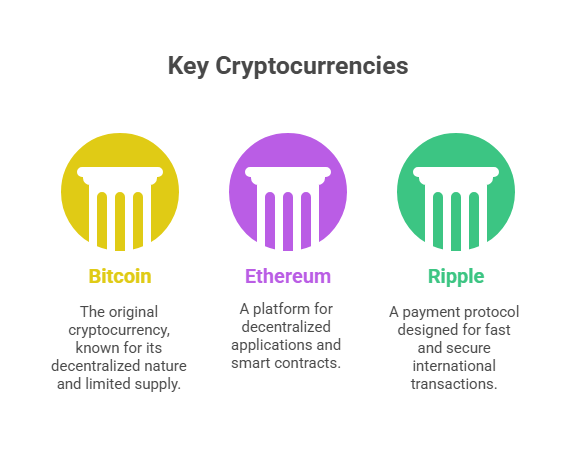
Before you start investing, it helps to know the most recognized cryptocurrencies that shape the market today.
Bitcoin (BTC)
Bitcoin is digital money that people use to send value without a bank. It launched after the 2008 whitepaper and runs on a network that records every transfer on a public blockchain. There will only ever be 21 million bitcoins, which is built into the software and shapes how people treat it as a scarce asset.
Bitcoin remains the most widely held cryptocurrency globally, owned by 71% of all crypto users in 2025, with a market dominance of over 51% of total crypto market capitalization. People use it as a way to store value, to move money across borders, and as an investment for portfolios seeking exposure to digital assets. Institutional products like spot ETFs have changed how many investors access Bitcoin.
Ethereum (ETH)
Ethereum is a blockchain that runs smart contracts, which are small programs that execute when conditions are met. It launched in 2015 and uses Ether as the token to pay for transactions and to reward validators. Smart contracts let developers build lending apps, marketplaces for tokens, and other services that run without a single company controlling them.
Ethereum holds the second-largest market cap position at roughly 20% of total crypto market capitalization and is particularly popular among users involved in decentralized finance and staking. The platform switched its core validation method to proof of stake, so validators secure the network by staking Ether instead of running energy-intensive mining hardware.
Stablecoins (USDT, USDC, DAI)
Stablecoins are tokens designed to maintain a steady value, usually by linking to fiat currency like the US dollar. Tether (USDT) and Circle (USDC) try to maintain one dollar of value per token by holding reserves. DAI is a decentralized option that uses other crypto as collateral and code-based rules to keep its peg.
People use stablecoins to move funds quickly between platforms, to trade without going back to bank accounts, and to pay for services that need a predictable unit of account on blockchains. Stablecoins face risks tied to how reserves are managed and to evolving regulation, so users should check reserve reports and issuer policies before large use.
Other Major Altcoins
Altcoins are any cryptocurrencies other than Bitcoin. They may offer different features, functionalities, and use cases, such as smart contract capabilities, cross-border payments, or privacy features.
- BNB started as a coin used on the Binance exchange to pay lower trading fees and now powers the Binance Smart Chain, where developers build apps and users trade tokens.
- Solana is known for being fast and handling many transactions at once, making it useful for games and apps that need quick results.
- Cardano focuses on building its network carefully and securely, with updates that go through rigorous testing before release.
- XRP is mainly used for fast and low-cost international payments, helping banks and businesses move money across countries.
Understanding the differences between altcoins is essential for diversifying investment portfolios and exploring alternative blockchain projects.
Memecoins and Speculative Assets
Memecoins are tokens that emerge from online culture and community rather than a technical roadmap. Dogecoin and Shiba Inu began as lighthearted projects and grew because people traded them and talked about them on social media.
Speculative assets can spike in price and then fall quickly, so they carry high risk. Some memecoin projects add features like staking, NFTs, or integrations with decentralized finance to build more utility, but buyers should treat them as high-risk and do thorough research on token supply, developer transparency, and on-chain activity before putting money in.
How Cryptocurrency Markets Work
To understand crypto as an investment, you first need to know how its markets operate and what makes them different from traditional finance.
Centralized vs. Decentralized Exchanges
Centralized exchanges like Coinbase, Binance, and Kraken are platforms owned by companies. You create an account, deposit your crypto, and they manage trades and security on your behalf. They often make it easy to buy crypto with fiat, follow regulations, and offer customer support if something goes wrong. That makes them a good starting point for most users.
Decentralized exchanges such as Uniswap or PancakeSwap let you trade directly from your own wallet. You do not hand over your keys or trust a company with your assets. Trades happen through smart contracts, with prices set by algorithms and liquidity from other users. That offers more control but can be harder to use, especially for beginners.
For a step-by-step walkthrough, see our guide on how to use crypto exchanges.
Market Capitalization and Liquidity
Market capitalization is the easiest way to see how big a cryptocurrency is. You multiply the current price by how many coins are in circulation. It helps you compare coins even when their prices differ.
Liquidity reflects how easily you can buy or sell a crypto without moving its price much. High trading volume and tight bid-ask spreads mean good liquidity. Major coins have that on big exchanges, so you can trade quickly with predictable pricing.
Volatility and Price Movements
Cryptocurrency markets never sleep. Unlike stock markets, crypto trades 24 hours a day, 7 days a week, and that around-the-clock action can cause sharp price swings. The global cryptocurrency market cap today stands at over $4 trillion, reflecting both the scale and the momentum of this asset class.
Trading Pairs and Fiat On-ramps
Trading pairs let you swap one asset for another. In BTC/ETH, you trade Bitcoin for Ether, and the pair’s price tells you how much ETH equals one BTC.
On-ramps are services that let you use regular money, like from your bank or credit card, to buy cryptocurrency. Platforms like Coinbase and Binance offer these options so you can easily move from cash to crypto. Off-ramps do the opposite, allowing you to convert your crypto back into regular money.
Ways to Invest in Cryptocurrency
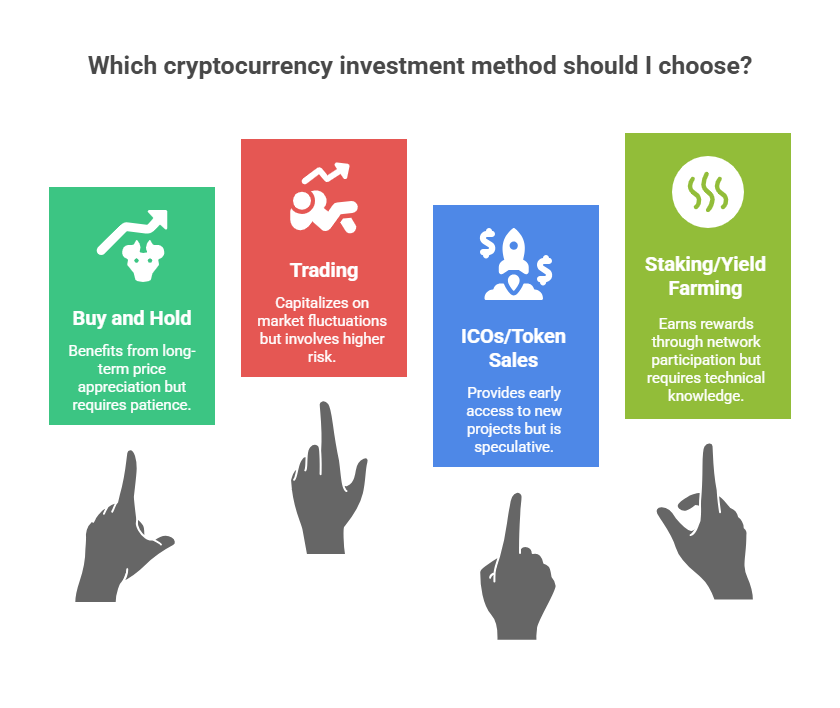
The way you choose to invest in cryptocurrency can shape your returns, your risks, and how much time you spend managing your assets.
Buying and Holding (HODL)
Buying and holding means you buy coins and keep them for a long time because you believe the asset will be worth more in the future. Many people treat Bitcoin and large altcoins this way. They move coins off an exchange into a private wallet and wait through market cycles.
This strategy reduces the need to time short-term price moves. You may use dollar-cost averaging to buy on a regular schedule, spreading out your purchase price over time. You still need a plan for security and taxes, and you should only use money you can afford to lose. Investopedia explains HODL as one of the most widely practiced long-term strategies in crypto.
Trading (Day Trading, Swing Trading)
Day trading means you open and close positions inside a single day and try to profit from small price moves. Swing trading means you hold positions for several days or weeks to capture a larger move. Both styles use charts, technical indicators, and trade management to make decisions.
Trading can return profits, but it also increases fees and risk. You need a clear entry and exit plan, tight risk controls, and practice with small amounts before scaling up. Many traders use spot markets first and study derivatives only after they understand margin and leverage.
Staking and Yield Farming
Staking involves locking tokens on a proof-of-stake network to help secure the chain and earn rewards paid in the token. You stake on the network directly or through a service that does it for you. The return is often steady, but the token price can move against you while funds are locked.
Yield farming means you move assets through decentralized finance protocols to earn higher yields. You may provide liquidity to a pool or move assets between protocols to chase better returns. The potential rewards can be larger, but you take on smart contract risk and impermanent loss when prices change.
Mining and Proof of Work
Mining on proof-of-work networks means you run hardware that solves cryptographic puzzles to add blocks and earn new coins and transaction fees. Mining requires specialized machines, electricity, and maintenance. You can join a mining pool to share work and rewards if running your own hardware is not practical.
Network events like Bitcoin halving change miner revenue, and you should factor that into any mining plan. Halving cuts the block reward in half approximately every four years, reducing the supply of new Bitcoin entering circulation.
Earning Through DeFi
DeFi lending lets you deposit crypto into a protocol where others borrow it and you earn interest. Protocols like Aave and Compound set interest rates based on supply and demand. You keep control of your funds and earn yield while the protocol matches lenders and borrowers automatically.
Liquidity pools let you supply pairs of tokens to enable trading on decentralized exchanges. You earn a share of trading fees and sometimes additional token rewards. Understand impermanent loss and smart contract risk before committing capital.
NFTs and Digital Assets
Non-fungible tokens are unique tokens that prove ownership of a digital item on a blockchain. They can represent art, collectibles, event passes, or real-world items. NFTs can also bring utility beyond ownership through royalties, access rights, and composable features inside apps.
The market for NFTs is speculative, and prices vary by demand, creator reputation, and rarity. If you collect for investment, check provenance, supply, and marketplace activity before you buy.
Setting Up to Invest: A Step-by-Step Approach
Before buying your first coin, understand the basic tools and choices every beginner needs to make.
Step 1: Choose a Cryptocurrency Exchange
Research and compare different cryptocurrency exchanges based on reputation, security features, supported cryptocurrencies, fees, and user interface. Look for exchanges licensed in recognized regions, such as the US, Europe, and other regulated markets. Being cautious with platforms that operate without clear oversight can help protect your assets over time. Read our guide on choosing the best crypto exchange for a detailed breakdown of what to look for.
Step 2: Create a Wallet
A hot wallet is software connected to the internet, like a phone or computer app. It stores your keys online so you can send or receive crypto quickly. It is simple and convenient for daily use, but because it is connected, it can be vulnerable to hacking or phishing.
A cold wallet keeps your private keys offline, usually on a hardware device that looks like a USB drive. That makes it much safer from online threats, though it takes extra steps to use when sending funds.
A common strategy is to use a hot wallet for small daily amounts and a cold wallet for long-term storage of larger holdings. Reputable options include Ledger and Trezor for hardware wallets and Trust Wallet or Exodus for software wallets.
Step 3: Complete KYC Verification
Crypto platforms follow Know Your Customer rules, or KYC, to verify your identity. They may ask for information like your name, birthdate, and a government-issued ID. This helps exchanges prevent fraud and money laundering and comply with laws around financial transactions. Stronger verification processes matter if you trade large volumes or want advanced features.
Step 4: Buy Your First Cryptocurrency
Fund your exchange account using fiat currency or other cryptocurrencies. Navigate the exchange platform to buy your desired cryptocurrencies by placing buy orders at the current market price or setting limit orders at specific price levels. You can start with as little as $10 to $20 on most platforms.
Step 5: Secure Your Investment
Implement robust security measures from day one. Enable two-factor authentication (2FA) on your exchange account and wallet. Create strong, unique passwords and keep your private keys offline.
Your private key or seed phrase controls access to your wallet. Keep them offline, not in cloud storage or screenshots. If someone gets access to them, they can take your funds. Losing them may mean losing access forever. Store them securely on paper or a metal backup and treat them as you would a bank PIN or password.
Security Best Practices Every Beginner Needs
Ensuring the security of your cryptocurrency holdings is paramount. Here are the most important practices to follow:
Use secure wallets. Choose reputable wallets with strong security features. Hardware wallets like Ledger Nano S and Trezor are considered best for large holdings. Software wallets like Exodus and Trust Wallet are good for everyday use.
Secure your private keys. Safeguard your private keys by storing them offline in a hardware wallet or encrypted digital storage. Never share your private keys with anyone, under any circumstances.
Enable two-factor authentication. Add 2FA to your exchange accounts and wallets. Use authenticator apps or hardware tokens rather than SMS-based methods, which can be intercepted.
Use strong passwords. Create strong and unique passwords using a combination of uppercase and lowercase letters, numbers, and special characters.
Keep software updated. Regularly update your wallets, exchange platforms, and devices with the latest security patches to protect against malware and other threats.
Beware of phishing. Exercise caution when clicking links or downloading files related to cryptocurrency. Phishing attempts are common and often look legitimate.
Diversify across wallets. Spread your holdings across multiple wallets and exchanges to minimize the impact of a security breach on your overall portfolio.
For more on this topic, read our dedicated guide on security concerns in cryptocurrency and whether crypto payments are safe.
Tools and Resources for Crypto Investors
To make smart decisions in crypto, you need the right tools and trusted resources to guide you.
Crypto News Sources
Reliable news helps you stay informed. CoinDesk offers news, analysis, and live price updates across the crypto world. Cointelegraph covers fintech, blockchain trends, and future money topics in a readable format. Decrypt is more beginner-friendly and delivers easy-to-follow explainers. Together, they keep you current without drowning you in industry jargon.
Other useful aggregators include CryptoPanic and CryptoSlate, which pull news articles from various sources into one place.
Portfolio Trackers
Portfolio trackers let you watch your crypto across wallets and exchanges in one spot. CoinStats supports over 300 wallets, exchanges, and 1,000 DeFi protocols. CoinMarketCap offers a free and simple tracker to view balances and profits. For DeFi holdings, DeBank, Zerion, and Nansen are frequently recommended by experienced users.
Technical Analysis Tools
TradingView is the go-to platform for chart analysis, offering many chart types, 100-plus built-in indicators, and drawing tools. Standard indicators like moving averages, RSI, Bollinger Bands, and OBV help you spot momentum, trend, and volume shifts. You can also explore our Risk Reward Calculator andSimple Crypto Calculator for quick decision-making.
On-Chain Data Analytics
On-chain analytics help you go deeper into blockchain trends. Glassnode offers dashboards and customizable charts to visualize metrics like transaction count, wallet balance, and network activity. Nansen adds value by labeling wallets so you can track what large holders do in real time. CryptoQuant provides market-level data, while Santiment layers in social metrics and on-chain insights.
Learning Resources for Beginners
Building your knowledge is just as important as picking the right tools:
- Online courses: Platforms like Coursera, Udemy, and Khan Academy offer courses covering cryptocurrency basics, blockchain technology, and specific projects.
- YouTube: A wide range of video tutorials covers wallet setup, trading, and blockchain fundamentals.
- Books: “Mastering Bitcoin” by Andreas M. Antonopoulos and “The Internet of Money” by the same author provide deep insights into Bitcoin and blockchain.
- Communities: Subreddits like r/Bitcoin, r/Cryptocurrency, and r/Ethereum are vibrant spaces where beginners can engage with experienced users and ask questions.
- Our own resources: Explore the UPay Crypto Education Hub and Crypto Terms glossary for straightforward definitions and explanations.
Risks Every Beginner Must Understand
Investing in cryptocurrency carries real risks that every beginner must understand before putting money in.
Price volatility. Crypto prices can swing dramatically in short periods. A coin worth $1,000 today could be worth $200 next month. Only invest money you can afford to lose entirely.
Project failure. Many cryptocurrency projects fail. Teams abandon development, funding runs out, or better alternatives emerge. Thorough research into the team, roadmap, and community is essential.
Scams and fraud. The crypto space attracts bad actors. Common scams include phishing attacks, fake exchanges, rug pulls (where developers abandon a project after collecting funds), and impersonation scams. Use only licensed exchanges and never share your private keys.
Regulatory risk. Governments around the world are still figuring out how to regulate crypto. Regulatory changes can affect prices, restrict access, or change how exchanges operate in your country.
Tax obligations. In most countries, cryptocurrency gains are taxable. Selling, trading, or even spending crypto can trigger a taxable event. Use our Crypto Tax Estimator to get a rough idea of your obligations, and consult a tax professional for your specific situation.
Smart contract risk. DeFi protocols and NFT platforms run on code. Bugs or exploits in smart contracts can lead to loss of funds. Only use protocols that have been audited by reputable security firms.
The Future of Cryptocurrency
Looking ahead, the future of cryptocurrency will depend on mass adoption, regulation, and how well the technology continues to solve real problems.
Mass Adoption Through Everyday Payments
When more people and businesses use crypto every day, it becomes part of the mainstream. That is happening now through payment tools that let you settle bills or shop with digital coins. Some retailers and payment networks are building ways to let you pay with crypto just like you would with a debit card. Stablecoins backed by trusted fiat currencies offer a steady bridge between crypto and the real world.
UPay is one example of how crypto is being built into everyday payment infrastructure, allowing users to spend crypto with a card anywhere in the world without cross-border fees.
Integration with Traditional Finance
Traditional financial institutions are moving closer to digital assets. Banks are building blockchain tools for trading and settlements. This blending softens the line between traditional finance and crypto and makes the whole system more efficient. It is not about replacing banks but about modernizing what they do behind the scenes.
Central Bank Digital Currencies (CBDCs)
Many central banks are experimenting with their own digital versions of fiat money. The European Central Bank is fast-tracking plans for a digital euro, and China is expanding pilots of its e-CNY across new use cases. CBDCs can improve payment speed, lower costs, and expand access to money. They can also let governments deliver aid directly or automate tax collection through programmable transactions.
Emerging Trends in DeFi, NFTs, and Web3
Decentralized finance keeps building. It uses programmable contracts to power lending, insurance, and trading without middlemen. NFTs are expanding beyond digital art into tokenized real-world assets, entertainment perks, and digital identity. Tools that connect AI and Web3 are also emerging, with decentralized platforms letting people access AI tools by staking tokens or trading data, opening a new ecosystem of shared services.
Conclusion
Investing in cryptocurrency for dummies is about starting with the basics, understanding the risks, and building confidence step by step. Digital assets like Bitcoin, Ethereum, and stablecoins are shaping how money is stored and moved, while tools such as wallets, exchanges, and DeFi platforms give you different ways to take part.
The key is to stay informed, keep your funds secure, and never invest more than you can afford to lose. With patience, clear goals, and the right strategy, cryptocurrency can become a valuable addition to your financial journey rather than a confusing gamble.
Ready to take your first step? Join UPay and experience seamless crypto payments and management from one platform, with no cross-border fees.
Frequently Asked Questions
What is the best way to start investing in cryptocurrency for dummies?
The best way to start is to open an account with a reliable, regulated exchange, create a secure wallet, and begin with small amounts you can afford to lose. Research your first coin thoroughly before buying, and never invest money you cannot afford to lose entirely.
Is cryptocurrency a safe investment for beginners?
No, cryptocurrency is not considered completely safe because prices are volatile and markets are still developing. Beginners should research carefully, diversify thoughtfully, and invest only what they can risk losing.
How much money do I need to start investing in cryptocurrency for dummies?
You can start with as little as $10 to $20, depending on the exchange, since most platforms allow fractional purchases of major coins like Bitcoin and Ethereum.
Can I lose all my money investing in cryptocurrency?
Yes, it is possible to lose all your money. Cryptocurrencies can drop in value sharply, and some projects may fail completely. Use only money you can afford to lose and take security seriously.
Do I need a crypto wallet to start?
You will need a wallet to store cryptocurrency safely. Beginners often start with the wallet provided by their exchange before moving to a private wallet for more control and security.
How do I avoid scams when investing in cryptocurrency?
Use only licensed and regulated exchanges, enable strong two-factor authentication, never share your private keys or seed phrases, and be skeptical of any promise of guaranteed returns or pressure to act quickly.