


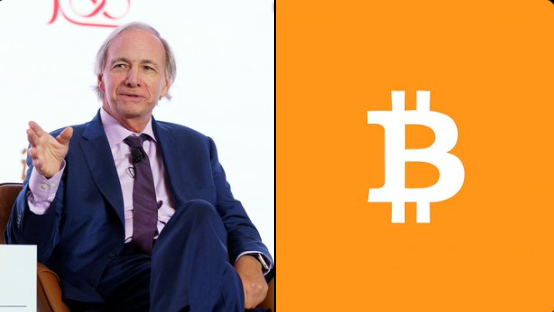
Billionaire hedge fund founder Ray Dalio has reaffirmed his long-standing cautious stance on Bitcoin, confirming that only about 1% of his portfolio is allocated to the cryptocurrency.
Despite being one of the most respected macro investors of the past five decades, Dalio remains skeptical about Bitcoin’s ability to grow into a global reserve asset—even as he continues to hold a small, steady position.
Key Takeaways
- Bitcoin makes up only about 1% of Ray Dalio’s portfolio, a position he has kept for years.
- Dalio argues that Bitcoin’s transparency prevents it from becoming a global reserve asset.
- Long-term security threats, including potential advances in quantum computing, remain central to Dalio’s concerns.
- Despite earlier skepticism, Dalio acknowledges Bitcoin’s durability but still warns of regulatory and technical risks.
- Bridgewater Associates continues to prioritize traditional equities, with Bitcoin representing a minor part of Dalio’s broader strategy.
Dalio Confirms 1% Bitcoin Allocation
Speaking on CNBC’s Squawk Box, Dalio said his Bitcoin exposure has barely changed over the years and continues to serve as a small, passive piece of his broader strategy.
“I have a small percentage of Bitcoin… I’ve had it forever, like 1% of my portfolios,” Dalio said.
His remarks come during a period of heightened market sensitivity. Bitcoin recently traded below $90,000 following uncertainty triggered by delayed U.S. jobs data, a move that rippled through tech stocks and broader risk assets. Yet despite market volatility, Dalio made it clear he has no intention of expanding his Bitcoin position.
Why Dalio Believes Bitcoin Won’t Become a Reserve Asset
Dalio has repeatedly argued that Bitcoin cannot serve as a reserve currency for major economies. His reasoning centers on transparency, technical constraints, and the political realities of global monetary systems.
“It’s not going to be a reserve currency for major countries because it can be tracked,” he said.
The public nature of Bitcoin’s ledger, he argues, makes it unsuitable for large governments that rely on opaque, flexible monetary controls. According to Dalio, no leading nation would build its financial foundation on a system where transactions are permanently recorded in public view.
Quantum Computing and Long-Term Security Concerns
Dalio also expressed concern about the future of cryptographic security. While Bitcoin has never been hacked, he believes emerging technologies—especially quantum computing—pose potential long-term threats.
“It could be conceivably, with quantum computing, controlled, hacked, and so on and so forth,” he warned.
These comments reflect a broader debate taking place within the crypto community. Chainalysis recently suggested that quantum computing could begin challenging Bitcoin’s underlying cryptography within the next decade, and Solana cofounder Anatoly Yakovenko argued the network might need a quantum-resistant upgrade by around 2030. Such a change would require a controversial hard fork.
Others—such as Blockstream CEO Adam Back—downplay the threat, noting that quantum computing remains far from being powerful enough to break Bitcoin’s cryptographic defenses. Still, Dalio’s stance highlights a core vulnerability that he believes makes Bitcoin an unlikely candidate for global monetary leadership.
Dalio’s History With Bitcoin: From Skepticism to Measured Acceptance
Dalio’s views on Bitcoin have evolved over time. When he first entered the crypto market in 2021, he cautioned heavily against its regulatory risks, famously stating:
“If it becomes really successful, they will kill it. And they have ways of killing it.”
By late 2021 and into 2022, however, Dalio acknowledged Bitcoin’s durability, noting it had “proven itself” by resisting attacks and remaining operational despite global scrutiny.
More recently, Dalio even suggested investors could place up to 15% of their portfolio in assets such as Bitcoin or gold. Still, his skepticism remains intact—especially regarding Bitcoin’s future security and regulatory uncertainty.
Influence From Crypto Leaders
In a lighthearted remark, Binance founder Changpeng “CZ” Zhao hinted that he may have played a small role in Dalio’s decision to keep Bitcoin in his portfolio.
“I might have contributed a tiny bit in influencing him. I learned more from him in exchange of course.,” CZ said.
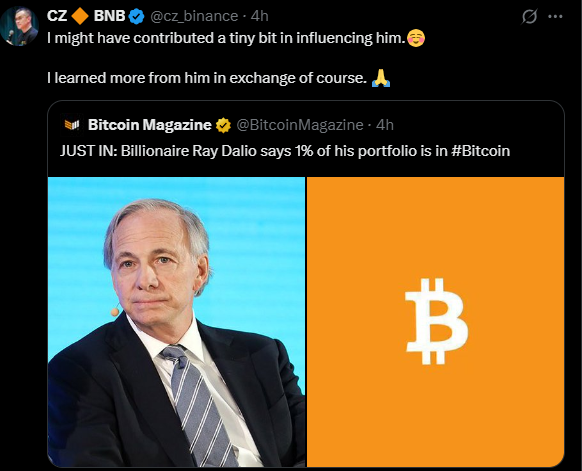
While Dalio downplayed any external pressure, the acknowledgment reflects Bitcoin’s growing influence among traditional and crypto-native financial leaders alike.
Bridgewater’s Massive Traditional Portfolio
Dalio’s Bitcoin commentary comes alongside fresh disclosures from Bridgewater Associates. The hedge fund’s latest 13F filing revealed a $25.53 billion U.S. equities portfolio spanning more than 1,000 positions, with heavy exposure to mega-cap tech and index ETFs.
The filing reinforces what Dalio has made clear for years: his Bitcoin allocation, though notable, remains a footnote in a deeply diversified investment empire.