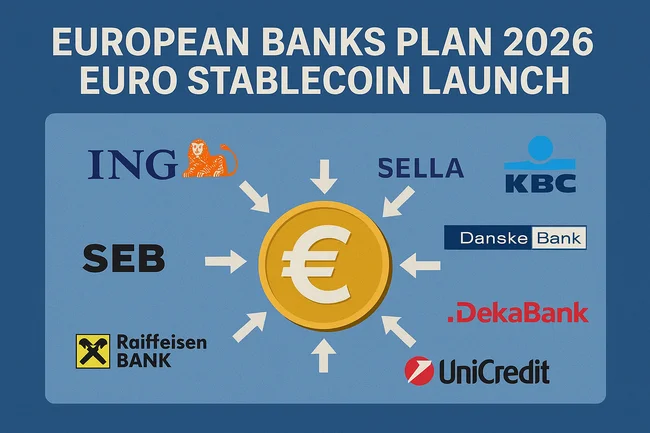
Nine European banks have announced plans to launch a euro-denominated stablecoin designed to meet upcoming European Union regulations. The digital currency, expected in the second half of 2026, aims to provide a regulated alternative to U.S.-based stablecoins.
European Banks Alliance and Regulation
ING, Banca Sella, KBC, Danske Bank, DekaBank, UniCredit, SEB, CaixaBank and Raiffeisen Bank International are the founding members of the alliance behind the project. The group has established a company in the Netherlands, which will seek licensing and supervision from the Dutch Central Bank as an electronic money institution.
The initiative will operate under the EU’s Markets in Crypto-Assets Regulation (MiCAR), a framework set to take effect in 2026. The banks said the stablecoin will be structured to comply with these requirements from the outset. A chief executive is expected to be appointed once regulatory approvals are in place, and the group remains open to additional banks joining.
Digital Payments and Use Cases
The stablecoin is being developed as a blockchain-based payment instrument intended for use across Europe. It is designed to allow near-instant and low-cost transactions, operating around the clock. The system could support cross-border payments, programmable transfers, and settlement of both securities and cryptocurrencies.
According to the consortium, the technology could also be applied in areas such as supply chain management and digital asset settlement. Individual banks would be able to provide related services, including digital wallets and custody.
Strategic Positioning
By creating a euro-denominated stablecoin, the banks aim to strengthen Europe’s position in the digital payments sector, which is currently dominated by dollar-backed tokens. The consortium has described the project as part of broader efforts to ensure Europe’s autonomy in financial infrastructure.
“Digital payments are key for new euro-denominated payments and financial market infrastructure,” Floris Lugt, digital assets lead at ING and public representative of the group, said in a statement. He added that the industry should adopt shared standards to ensure efficiency and transparency in cross-border settlement.
The project marks one of the first large-scale, bank-led attempts in Europe to develop a stablecoin aligned with MiCAR rules. If approved, it would offer an EU-regulated option for businesses and financial institutions seeking blockchain-based payment solutions.
No related posts.