



Veteran trader Peter Brandt has poured cold water on hopes for a fast rebound in Bitcoin, warning that the world’s largest cryptocurrency may not reach the long-anticipated $200,000 mark until the third quarter of 2029.
His remarks arrive at a tense moment for the market, with Bitcoin sliding from its October all-time high and fears of deeper downside spreading among traders.
A Longer Road to $200K Than Many Expected
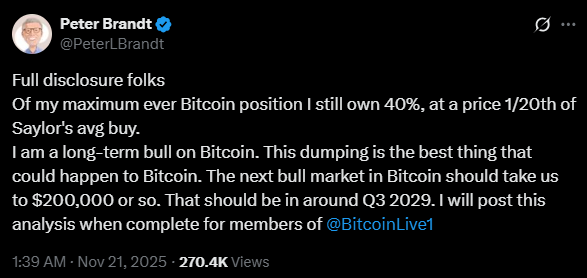
Brandt, known for his decades of chart-based trading and accurate macro calls, said in an X post that Bitcoin’s next major bull market is underway — but will unfold more slowly than many industry leaders predict.
“The next bull market in Bitcoin should take us to $200,000 or so. That should be in around Q3 2029,” he wrote, adding that he remains a long-term believer in Bitcoin’s upside.
His projected timeline sharply contrasts with the forecasts of high-profile Bitcoin advocates such as Arthur Hayes and Tom Lee, both of whom reiterated as recently as October that Bitcoin could still reach $200,000 by year-end.
Coinbase CEO Brian Armstrong and ARK Invest’s Cathie Wood have gone even further, predicting that Bitcoin could hit $1 million by 2030 — just a quarter after Brandt’s $200K timeline.
Brandt’s conservative outlook stands out, especially at a time when several crypto executives have doubled down on ultra-bullish long-term scenarios.
A “Healthy Reset” After a Sharp Market Pullback
Bitcoin surged to a new all-time high of $125,100 on October 5, but the rally quickly reversed. The asset has since fallen to the mid $80,000 range, briefly touching $86,870 and, at one point this week, dipping as low as $88,000. Panic selling pushed 24-hour volume up more than 38%, while the broader crypto market lost its footing above the $3 trillion mark.
Despite the turmoil, Brandt sees the correction as not only normal — but necessary.
“This dumping is the best thing that could happen to Bitcoin,” he said, describing the decline as a market “reset” that clears speculative excess and sets the stage for healthier long-term growth.
His view aligns with analysts who point out that Bitcoin’s strongest long-term rallies often follow periods of steep, emotionally driven pullbacks.
Warning of a Potential Drop to $58K Before the Next Surge
Brandt has also issued a short-term warning: a deeper crash may still be ahead before Bitcoin begins its march toward $200,000.
According to him, Bitcoin is tracking its typical four-year cycle pattern, including a confirmed death cross — a technical signal where the short-term moving average falls below the long-term average, hinting at weakening momentum.
Brandt identifies two major support levels:
- $81,000
- $58,000
He believes the latter could be tested if selling pressure accelerates, especially as whales and long-term holders continue taking profits from the October peak. Most traders, he warns, will be too fearful to buy when those levels arrive.
Supporting this outlook, data from 10x Research and CryptoQuant suggests Bitcoin has entered a broader bear phase. The historically crucial 200-week moving average currently sits near $56,000, closely aligning with Brandt’s lower target.
Still Bullish in the Long Run
Despite sounding the alarm on short-term downside, Brandt remains firmly bullish on Bitcoin’s long-term potential. He disclosed that he continues to hold 40% of his largest-ever Bitcoin position — purchased at a price roughly “1/20th of Michael Saylor’s average buy.”
His confidence stems from Bitcoin’s history of cyclical crashes followed by exponential rallies. Brandt previously compared the current chart structure to the soybean market of the 1970s, which experienced a similar parabolic rise and a 50% crash before resuming its long-term trend.
Other analysts, such as Charles Edwards of Capriole Investments, have also flagged unprecedented levels of institutional selling relative to Coinbase’s total volume — a sign that large entities are dominating current market flows.
Why Patience Matters for Investors
Brandt’s latest forecast may disappoint traders hoping for a quick rebound to six-figure territory. But to him, Bitcoin’s path is defined by long, grinding corrections followed by explosive growth — not rapid moonshots driven by short-term hype.
His message is simple: long-term investors have always fared best when they ignore panic cycles and focus on major trend shifts.
As the market grapples with macro uncertainty—including concerns about U.S. Federal Reserve rate cuts, sticky inflation, and unusually high equity valuations—Bitcoin’s volatility may persist. Yet Brandt argues that these painful stretches often precede some of Bitcoin’s strongest rallies.
For now, the veteran trader believes Bitcoin’s next major milestone is coming—just not as soon as many expect.