Polymarket has quietly introduced taker fees on its 15-minute crypto prediction markets, ending the platform’s long-standing zero-fee trading model for this specific product and marking a notable shift in its market structure.
The change applies exclusively to Polymarket’s fast-paced 15-minute markets, where traders speculate on near-term price movements of major cryptocurrencies such as Bitcoin (BTC), Ethereum (ETH), Solana (SOL), and XRP.
According to the platform, the new fees are not designed as a revenue grab, but rather as a mechanism to fund a newly launched Maker Rebates Program aimed at strengthening liquidity and improving trade execution during periods of rapid price movement.
Polymarket said the collected fees will be redistributed daily to liquidity providers in USDC, creating a closed-loop system in which takers fund incentives for makers who actively support the market.
Key Takeaways
- Polymarket introduced taker fees exclusively on its 15-minute crypto markets to fund a new Maker Rebates Program rather than generate direct platform revenue.
- All taker fees collected are redistributed daily in USDC to liquidity providers, incentivizing tighter spreads and more reliable trade execution during volatility.
- The variable fee model peaks when market prices are near 50% probability and declines toward zero at extreme odds, meaning some small or edge-case trades may still incur no fees.
- The change is widely viewed as a market-structure upgrade that discourages exploitative high-frequency trading while strengthening liquidity and market stability.
A Targeted Fee, Not a Platform-Wide Change
Unlike traditional exchange fee rollouts that affect all users and markets, Polymarket’s move is narrowly scoped. Taker fees apply only to traders who remove liquidity from 15-minute crypto markets by filling existing orders. All other Polymarket markets, including longer-duration prediction contracts, remain zero-fee.
The platform framed the decision as a response to the unique dynamics of ultra-short-term markets, where prices can swing sharply within minutes and liquidity often disappears when volatility spikes. In such environments, thin order books can lead to wider spreads, slippage, and unreliable fills.
By contrast, deeper liquidity tends to produce tighter spreads, lower price impact, and more consistent execution. Polymarket says the new structure is designed to reward participants who help maintain that liquidity when it matters most.
How the Maker Rebates Program works
Under the Maker Rebates Program, market participants who provide liquidity and have their orders filled earn daily rebates paid in USDC. The rebates are performance-based, meaning payouts depend on how much of a maker’s posted liquidity is actually taken by other traders.
Rebates are calculated and distributed every day, offering market makers predictable compensation for maintaining competitive quotes. Polymarket said this approach encourages consistent participation rather than sporadic order placement, which can destabilize short-term markets.
Crucially, the program is funded entirely by taker fees collected in the same 15-minute markets. Polymarket does not take a separate cut for itself from these fees, instead redistributing them to liquidity providers.
Inside the taker fee formula
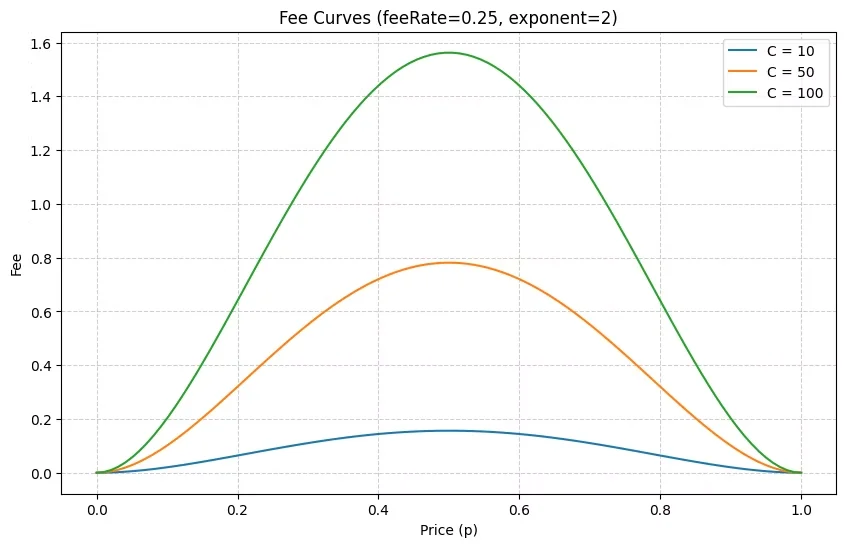
Polymarket introduced a variable fee model rather than a flat percentage. Each taker trade incurs a fee calculated using the following formula:
- fee = C × feeRate × (p × (1 − p))²
In this equation:
- C represents the number of shares traded
- p is the price of the shares (expressed as a probability)
- feeRate is set at 0.25
- exponent equals 2
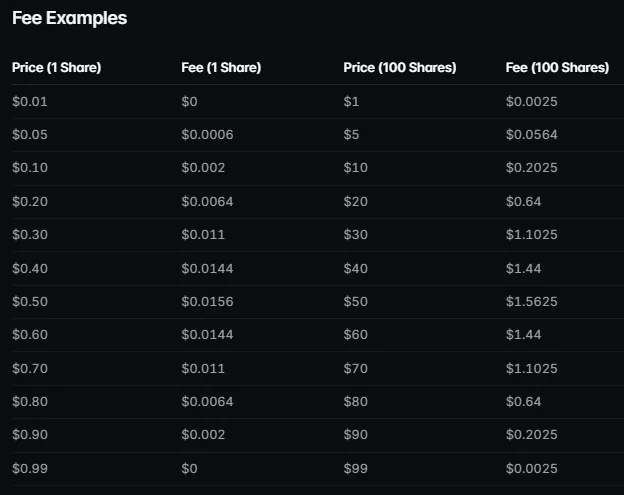
The structure means fees are highest when market prices sit near 50%, where uncertainty is greatest and liquidity is most valuable. As probabilities move closer to 0% or 100%, fees decline toward zero.
Polymarket provided examples to illustrate the impact. A taker trade of 100 shares priced at $0.50 would incur a fee of roughly $1.56, just over 3% of the trade’s notional value at the peak of the curve. Smaller trades or trades near probability extremes may incur much lower fees, or none at all.
Precision Limits and Minimum Charges
Fees are calculated with support for up to six decimal places but are rounded to four decimals. The smallest non-zero fee Polymarket can charge is 0.0001 USDC. Any calculated fee below that threshold is rounded down to zero.
As a result, very small trades or trades placed at extreme odds may still execute without any fee, even under the new system. Polymarket emphasized that this precision limit is a technical constraint rather than a policy choice.
Social Media Reaction: “Scary, but Not as Bad as It Sounds”
The rollout sparked immediate discussion across crypto and prediction-market circles on social media, particularly on X.
On January 6, Tawer95.eth, CEO of the PolyScanner3000 bot and an active Polymarket user, published a detailed breakdown of the change, describing the headline as:
“Scary, but not as bad as it sounds.”
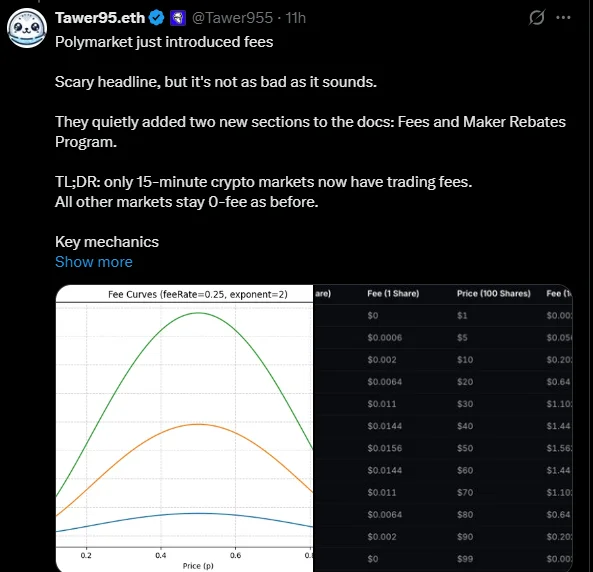
In his analysis, he argued that the new structure creates a sustainable flow of rewards for market makers while reducing incentives for bots that previously exploited free liquidity in 15-minute markets.
Other traders echoed similar views. One participant described the fees as effectively targeting high-frequency bots that thrive in zero-fee environments, suggesting that maker rebates could lead to tighter spreads and more stable liquidity overall.
Another trader focused on market integrity, arguing that the introduction of fees offers additional protection against wash trading. In that framing, Polymarket is not “charging users” in the traditional sense, since the fees are recycled back into the market via rebates.
Why Polymarket Made the Move Now
The timing of the change comes as Polymarket continues to expand its product offerings and visibility. The platform recently launched a real-estate prediction market in partnership with housing data firm Parcl, underscoring its ambition to move beyond crypto price speculation alone.
At the same time, 15-minute crypto markets have become one of Polymarket’s most actively traded products. Their speed and simplicity attract a wide range of participants, but those same qualities make them vulnerable to thin liquidity and sudden dislocations.
By introducing a maker-taker model specifically for these markets, Polymarket appears to be borrowing from traditional financial market design, where similar structures are widely used to encourage depth and orderly trading.
Broader Implications for Prediction Markets
Polymarket’s decision highlights a broader shift in how decentralized prediction markets think about incentives and sustainability. While zero-fee trading has been a powerful growth tool, it can also distort behavior, especially in high-frequency environments.
If the Maker Rebates Program succeeds in deepening liquidity and narrowing spreads, it could improve price discovery and execution quality for all participants, including retail traders. It may also attract more professional market makers, further stabilizing short-term markets during volatile periods.
At the same time, the change sets a precedent. Other prediction platforms may watch closely to see whether Polymarket’s approach strikes the right balance between accessibility and market quality.
For now, Polymarket has made its position clear: taker fees in 15-minute crypto markets are not a tax, but a redistribution mechanism designed to reward the participants who keep those markets liquid when seconds matter.