


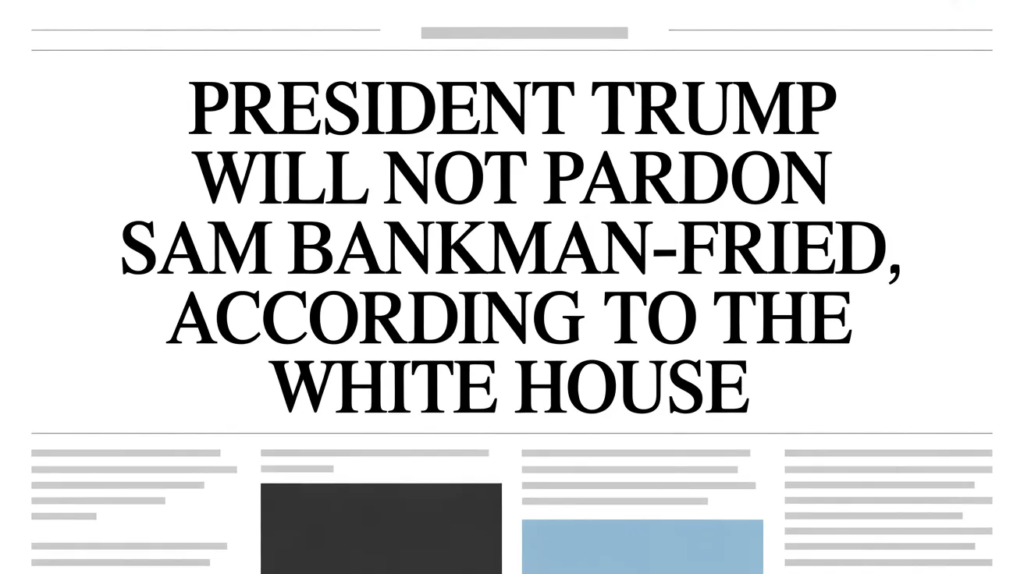
The White House has made its position clear: President Donald Trump has no intention of granting clemency to Sam Bankman-Fried, the disgraced founder of FTX who is currently serving a 25-year federal prison sentence.
The statement follows days of renewed speculation across crypto circles and political media that Bankman-Fried—widely known as SBF—was angling for a presidential pardon. Those rumors intensified after a series of posts on X in which the former billionaire appeared to pivot politically, praising Trump while criticizing the judge who presided over his criminal case.
A spokesperson confirmed that the president alone decides matters of clemency and that he is “absolutely not” considering a pardon for Bankman-Fried. The message leaves little room for interpretation.
Key Takeaways
- The White House has confirmed that President Donald Trump will not grant a pardon to Sam Bankman-Fried.
- Bankman-Fried recently adopted a pro-Trump tone on X, criticizing Judge Lewis Kaplan while praising Trump’s policies.
- Trump previously told The New York Times that he was not considering clemency for the former FTX CEO.
- Bankman-Fried is serving a 25-year sentence at the Metropolitan Detention Center, Brooklyn after being convicted on fraud and conspiracy charges tied to FTX’s collapse.
- An appeal before the U.S. Court of Appeals for the Second Circuit now represents Bankman-Fried’s primary legal avenue for relief.
Social Media Campaign Fails to Gain Traction
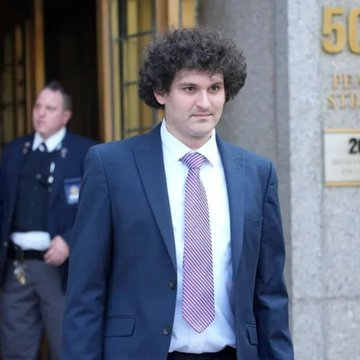
In recent weeks, Bankman-Fried’s X account has featured commentary that many observers see as a calculated attempt to align himself with Trump’s political base. He accused Judge Lewis Kaplan—who oversaw his trial—of political bias and praised several Trump policies, including positions on crypto regulation and foreign affairs.
The tone marked a sharp contrast to Bankman-Fried’s previous political posture. Before FTX’s collapse, he was one of the largest political donors in the United States, giving tens of millions of dollars during the 2022 election cycle, largely to Democratic candidates and causes.
That history has made his recent pro-Trump messaging all the more conspicuous. Some analysts interpret the shift as an attempt to reshape his public image and make a case for clemency similar to the relief granted to certain financial figures in the past. However, the White House’s response suggests that the effort has not moved the needle.
In a January interview with The New York Times, Trump reportedly dismissed the idea that he was considering a pardon for Bankman-Fried. The latest confirmation reinforces that position.
The 25-Year Sentence and $8 Billion Fallout
Bankman-Fried was sentenced in March 2024 to 25 years in prison after being convicted on seven counts, including wire fraud, securities fraud, and money laundering conspiracy. Prosecutors argued that he orchestrated a years-long scheme that diverted billions in customer funds from FTX to prop up its sister trading firm, Alameda Research.
Federal authorities estimated that roughly $8 billion in customer funds were misappropriated. While bankruptcy proceedings have since recovered and redistributed a significant portion of assets to creditors, the court found that the fraud itself warranted a substantial prison term.
Bankman-Fried is currently incarcerated at the Metropolitan Detention Center, Brooklyn.
In public statements following his sentencing, he maintained that FTX’s downfall was mishandled and argued that external actors—including legal advisors and restructuring officials—exacerbated the exchange’s collapse.
He has also claimed that the bankruptcy estate’s repayment of approximately $7.1 billion to customers demonstrates that the situation was more complex than portrayed at trial. The court, however, rejected that framing.
No Political Lifeline in Sight
Despite his recent rhetoric, Trump appears unwilling to intervene. According to the White House spokesperson, the president considers the scale of the fraud and the losses tied to FTX’s implosion disqualifying factors.
The refusal to consider clemency for Bankman-Fried may also signal a broader reluctance to extend pardons to other high-profile figures facing corruption or financial crime convictions, including former Senator Robert Menendez or even foreign political actors such as Nicolás Maduro, whose legal and political controversies have drawn international attention.
For Bankman-Fried, the path forward is now largely confined to the appellate courts. His legal team is pursuing an appeal before the U.S. Court of Appeals for the Second Circuit, challenging aspects of the trial and sentencing. Appeals in complex financial crime cases can take years to resolve, and reversals are far from guaranteed.
Within the crypto industry, reaction to the White House’s stance has been mixed. Some argue that Bankman-Fried’s sentence was severe compared to other executives in the digital asset space who faced legal scrutiny. Others maintain that the scale of the FTX collapse—one of the largest financial frauds in U.S. history—justifies the outcome.
For now, the political route appears closed. The White House has drawn a firm line, leaving Bankman-Fried to fight his legal battles in court rather than count on executive clemency.