


Tether, the issuer of the world’s largest stablecoin USDT, is rapidly transforming its financial firepower into a sprawling global investment portfolio, stretching from South American agriculture to European football, while quietly scaling its workforce and technology ambitions.
According to reporting by the Financial Times, the stablecoin giant has built a portfolio of roughly 140 investments, funded not from USDT reserves but from the massive profits generated by managing the assets backing its $185 billion stablecoin supply.
The strategy signals a shift from being a narrow crypto infrastructure provider to something far broader — and far more influential.
“The company generates tens of billions of dollars in annual profit from returns on assets backing USDT, which it retains rather than distributing to token holders.”
Key Takeaways
- Tether is reinvesting the massive profits from USDT reserves into a broad portfolio of 140 investments spanning agriculture, technology, media, and sports.
- Retaining yield from reserve assets has allowed Tether to build a multibillion-dollar proprietary investment arm without touching stablecoin backing funds.
- USDT’s explosive growth has turned Tether into one of the largest non-government holders of U.S. Treasuries, increasing its relevance to traditional financial markets.
- Expanding headcount, political ties, and ambitious technology plans are intensifying regulatory scrutiny around transparency and governance.
Profits Power a Diverse Investment Web
Tether’s business model allows it to keep the yield earned on reserve assets such as U.S. Treasuries, gold, and bitcoin. Those returns have surged alongside USDT’s growth, which has ballooned from roughly $5 billion in market value in 2020 to $185 billion today, serving an estimated 500 million users globally.
Those profits are now being recycled into a wide mix of sectors. The company holds stakes in agricultural firms in South America, technology ventures, and even sports, including a notable investment in Italian football club Juventus.
One of its most high-profile bets is a $775 million stake in Rumble, the video platform that positions itself as an alternative to YouTube and provides cloud services for Truth Social.
Tether says these proprietary investments sit outside the stablecoin’s reserve pool and are funded strictly by excess capital. As of late 2025, that separate portfolio was valued at more than $20 billion.
Building a “Freedom Tech Stack”
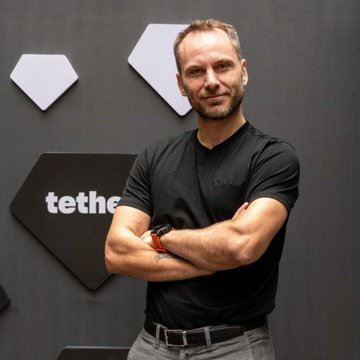
Chief executive Paolo Ardoino has framed the company’s expansion around a broader ideological and technological vision. Speaking at a recent conference in San Salvador, Ardoino described plans to build what he called a “freedom tech stack,” spanning finance, communications, artificial intelligence, and energy.
Conference exhibits showcased tools such as a bitcoin mining operating system, an AI-agent platform known as QVAC, and wallets designed to allow autonomous AI systems to transact using Tether.
“CEO Paolo Ardoino presented Tether’s vision for peer-to-peer tools across finance, intelligence, communications and energy.”
While supporters see this as an ambitious attempt to reduce reliance on centralized intermediaries, critics argue the messaging lacks focus and raises questions about execution across so many domains.
Headcount Expansion and Global Hiring
Behind the scenes, Tether is also growing its human capital. The company has expanded to around 300 employees and plans to add roughly 150 more over the next 18 months, bringing total headcount to about 450. Most of the new roles are engineering-focused, but hiring spans far beyond software development.
LinkedIn listings show openings for AI filmmakers in Italy, venture investment associates in the UAE, and regulatory affairs leads in countries including Ghana and Brazil. A newly formed London-based team now oversees finance and operations under chief financial officer Simon McWilliams.
Despite its global footprint, Tether reportedly operates through a relatively tight executive circle. Employees often have limited insight into work happening outside their immediate teams, with in-person interaction largely confined to occasional gatherings in places such as El Salvador or Lugano, Switzerland.
A Growing Force in Traditional Markets
Tether’s scale now places it firmly on the radar of regulators and traditional finance watchers. As of December 2025, its reserve assets stood near $193 billion against liabilities of about $186 billion tied to issued tokens. The bulk of those reserves are held in highly liquid instruments.
U.S. Treasuries alone account for approximately $122 billion, rising above $141 billion when including overnight reverse repurchase agreements. That makes Tether one of the largest non-government holders of U.S. government debt globally. The company also holds an estimated $17.4 billion in gold and $8.4 billion in bitcoin.
“Direct Treasury holdings of $122 billion place Tether among the biggest holders of U.S. government debt outside sovereign states.”
This growing footprint comes with trade-offs. Regulators have long warned that stablecoins can pull funds away from bank deposits, potentially reducing credit available to the real economy. At the same time, Tether’s profits and political ties — including close relations with El Salvador’s pro-crypto president Nayib Bukele — continue to draw scrutiny over transparency and oversight.
Why It Matters
Tether’s expansion highlights how stablecoin issuers are no longer just plumbing for crypto markets. With USDT acting as a primary bridge between digital assets and the dollar, the company’s investment choices, reserve management, and political relationships now carry implications well beyond crypto trading desks.
As Tether pushes further into technology, media, and even sports, regulators and market participants alike are watching closely to see whether its growing influence will bring greater clarity — or deeper questions — about the role of private stablecoins in the global financial system.