Interest-earning opportunities through lending have become one of the most efficient ways to generate passive income in 2026.
As digital finance continues to attract both retail and institutional participation, lending platforms are offering increasingly competitive yields, especially on stablecoins and major tokens like Bitcoin and Ethereum.
Choosing the right platform isn’t just about high returns—it’s about reliability, security, and understanding how crypto lending rates actually work.
From DeFi protocols like Aave and Compound to CeFi options like Nexo and Binance, the gap between platforms can significantly impact your annual earnings. Knowing where to earn the best rates is essential for building a sustainable crypto income stream.
In this guide, we’ll break down the top crypto lending rates in 2026.
Key Takeaways
- Crypto lending rates are influenced by supply-demand dynamics, token volatility, platform risk models, and rate structures like APR or APY.
- CeFi platforms such as Nexo offer higher fixed returns and user-friendly features, while DeFi protocols like Aave and Compound provide more flexible, algorithm-driven yields.
- Stablecoin lending generally offers more consistent returns with lower risk, while altcoin lending comes with higher volatility and potential upside.
- Fixed rates deliver predictable income with lock-up periods, while variable rates offer more flexibility but require close monitoring.
- Lending crypto carries risks, including platform failure, smart contract bugs, market crashes, and shifting regulatory conditions that can impact returns or access to funds.
What is Crypto Lending?

Crypto lending is a financial service that allows cryptocurrency holders to lend their assets to borrowers in exchange for interest. It’s similar to traditional lending, but instead of fiat currency, the process involves digital assets like Bitcoin (BTC), Ethereum (ETH), and stablecoins such as USDT or USDC.
There are two main types of crypto lending platforms which are, centralized Finance (CeFi) and decentralized Finance (DeFi).
In CeFi platforms like Nexo or Binance, the company manages the lending process and typically handles custody, risk assessment, and repayment. In contrast, DeFi protocols like Aave or Compound use smart contracts to automate the process without intermediaries.
Lenders earn interest, often paid daily or weekly, while borrowers use crypto collateral to access quick liquidity without selling their holdings.
How Crypto Loan Interest Rates Are Determined
Crypto loan interest rates, often expressed as APR (Annual Percentage Rate) or APY (Annual Percentage Yield), are dynamic and influenced by several technical and market-driven factors.
These rates determine how much lenders earn and how much borrowers pay when participating in crypto lending platforms.
Factors Influencing Lending APRs and APYs
The interest rates offered on crypto lending platforms are not fixed. They fluctuate based on a mix of economic factors, protocol mechanics, and user behavior. Key factors include:
- Platform Liquidity: Platforms with high liquidity may offer lower rates because assets are readily available. Conversely, when liquidity is low, platforms raise interest rates to attract more deposits from lenders.
- Loan Duration: Short-term loans usually come with lower rates compared to long-term commitments, which may offer higher APYs due to the added risk of time exposure.
- Collateral Type: The type of collateral (e.g., BTC, ETH, or altcoins) also impacts rates. High-cap, stable tokens tend to result in lower rates compared to more volatile or less liquid tokens.
- Utilization Rate: This metric refers to the ratio of borrowed funds to available supply on a platform. A higher utilization rate indicates strong borrowing demand and typically results in higher interest rates for both lenders and borrowers.
Market Demand and Supply
Just like traditional finance, crypto lending interest rates are directly affected by the forces of demand and supply.
- High Borrowing Demand: When more users want to borrow a specific asset (especially stablecoins during market dips), lending rates increase. Platforms adjust these rates to incentivize more lenders to supply the needed asset.
- Surplus Supply: If many users deposit the same token for lending and there’s not enough borrowing activity, rates tend to decrease. This protects the platform from holding too much idle liquidity, which could otherwise go unutilized.
- Token-Specific Trends: Popular tokens like USDC or USDT often see consistent demand, which keeps rates relatively stable. On the other hand, demand spikes for tokens involved in trending DeFi activities can lead to short-term interest rate surges.
Token Volatility and Risk
Volatility and risk are two of the most significant factors that influence how lending rates are set.
- Price Volatility: Highly volatile tokens pose more risk to lenders and platforms. If the collateral value suddenly drops, there’s a higher chance of loan defaults. To compensate, platforms may increase the interest rate on loans secured by such tokens.
- Smart Contract Risk (DeFi): DeFi platforms face unique risks, such as bugs or exploits in smart contracts. To offset potential losses or attract more liquidity despite these risks, protocols may offer higher APYs.
- Counterparty Risk (CeFi): Centralized platforms are exposed to the risk of borrowers defaulting or the company mishandling funds. To remain competitive and mitigate the perception of risk, CeFi lenders often adjust interest rates based on their risk models and reserve ratios.
Comparison of the Top Crypto Lending Rates Across Popular Platforms
| Platform | Type | Supported Assets | Avg APY (Stablecoins / Altcoins) | Unique Features | Risk Level |
| Nexo | CeFi | 100+ (BTC, ETH, USDT, etc.) | 8–12% / 4–7% | Daily interest, NEXO loyalty tiers | Low–Moderate |
| Ledn | CeFi | BTC, USDC | 12.4%/ 6% | Bitcoin mortgages, proof-of-reserves | Low |
| YouHodler | CeFi | 50+ | Up to 12% / 4–7% | Turbo Loans, dual asset investing | Moderate–High |
| Aave | DeFi | 30+ across 14+ chains | 4–7% / 2–6% | GHO stablecoin, Safety Module staking | Moderate |
| Compound | DeFi | 10+ (mainly Ethereum) | 3–6% / 1–3% | Algorithmic rate adjustment, COMP governance | Moderate |
| Venus Protocol | DeFi | 20+ (BNB, BTCB, stablecoins) | 5–9% / 3–7% | High LTV, XVS governance | High |
| Sky Protocol | DeFi | ETH, L2s (DAI-backed) | 3–7% (via DSR) | DAI Savings Rate, real-world asset integration | Low–Moderate |
| Morpho Blue | DeFi | Ethereum-native assets | 6–10% / 3–8% | Peer-to-peer matching, optimized yield | Moderate |
Crypto lending platforms, both centralized (CeFi) and decentralized (DeFi), offer varying interest rates based on token type, liquidity, and protocol mechanics.
Here is a detailed comparison of the leading platforms and their current crypto lending rates in 2026.
Top CeFi Platforms
Nexo

Nexo is one of the most established centralized crypto lending platforms, offering a seamless experience for both lenders and borrowers.
Users can earn up to 12% APY on stablecoins like USDT and USDC, and around 4–7% on BTC and ETH, depending on their loyalty tier and whether they opt to earn in NEXO tokens.
Nexo also provides crypto-backed loans with instant access and zero credit checks. Users who stake NEXO tokens benefit from higher yields, discounted borrowing rates, and cashback rewards on transactions. In 2025, its reputation remains strong due to consistent payouts and regulatory transparency.
- Number of Supported Assets: 100+
- Fees: No deposit or withdrawal fees for most assets; early withdrawal penalty on fixed terms
- Unique Features: Daily interest payouts, higher APY with NEXO loyalty tiers, $375M insurance
- Fee Allocation: Part of revenue goes to NEXO token buybacks and treasury reserves
Ledn
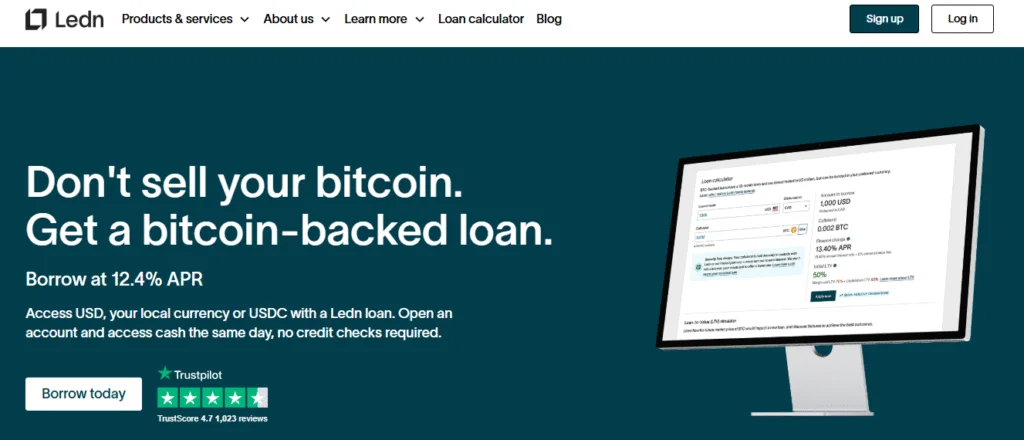
Ledn is a Canada-based CeFi platform known for its transparent and conservative approach to crypto lending. It mainly supports BTC and USDC and offers both lending and Bitcoin-backed mortgage products.
Unlike more complex platforms, Ledn avoids token-based rewards and focuses on sustainable yield generation. Their proof-of-reserves attestation, done every six months, adds a layer of transparency.
APYs on BTC can reach up to 12.4%, while USDC lending yields up to 6% on longer terms. It appeals to risk-averse users who prefer simplicity and credibility.
- Number of Supported Assets: BTC, USDC
- Fees: No deposit fees; withdrawal fees apply
- Unique Features: Bitcoin mortgages, proof-of-reserves audits
- Fee Allocation: Primarily funds operations and the institutional lending desk
YouHodler

YouHodler combines the flexibility of a wallet app with lending, dual asset investing, and yield farming features. It supports a broad range of crypto assets and offers up to 8% APY on stablecoins, depending on lock-in periods.
YouHodler allows users to take multi-asset crypto loans and even use their assets for structured products like Turbo Loans. Despite its aggressive yield strategy, it maintains reserves and risk limits to protect users. Borrowers enjoy up to 90% LTV on some assets—rare in the CeFi sector.
- Number of Supported Assets: 50+ cryptocurrencies
- Fees: Loan origination fees apply; withdrawal fees depend on asset
- Unique Features: Turbo Loans, Multi-HODL investing tool
- Fee Allocation: Funds lending operations and risk buffers
Top DeFi Protocols
Aave
Aave remains one of the most prominent decentralized lending protocols, operating across more than 14 blockchain networks with strong support for Ethereum and its Layer-2 ecosystems.
It allows users to supply or borrow a broad selection of crypto assets, with interest rates that shift dynamically in response to real-time supply and borrowing activity.
In 2023, Aave introduced its own overcollateralized stablecoin, GHO, backed by assets deposited within the Aave V3 framework.
The protocol is governed by the AAVE token, which enables community voting, staking in the platform’s Safety Module, and access to protocol incentives. Stakers can earn 5–7% APY, and borrowers using AAVE enjoy fee reductions.
A portion of interest paid by borrowers, typically between 10% and 20%, is funneled into Aave’s decentralized treasury, helping sustain future development and governance initiatives.
- Chains Supported: Ethereum, Polygon, Optimism, Arbitrum, Avalanche, and others
- Fees: Reserve fees (10–20%) + interest spread
- Unique Features: Flash loans, Safety Module staking, GHO stablecoin
- Fee Allocation: DAO staking and protocol reserves
Compound

Compound is an algorithmic DeFi lending protocol that pioneered automated interest rate markets on Ethereum. Lenders supply assets into liquidity pools and earn variable interest based on utilization rates. Interest rates are updated every 15 seconds, making them highly responsive to market changes.
Compound’s governance is driven by COMP token holders who vote on protocol upgrades and risk parameters. While its interface is simple, Compound supports deep integrations with DeFi apps and aggregators, giving users programmatic control over their lending and borrowing activity.
- Chains Supported: 10+ (Ethereum, Base, DAI, wrapped Bitcoin and others)
- Interest: 10%
- Fees: No direct user fees; the protocol takes part of the interest spread
- Unique Features: Algorithmic rate adjustment, COMP governance token
- Fee Allocation: Sent to the Compound Treasury and community fund
Venus Protocol
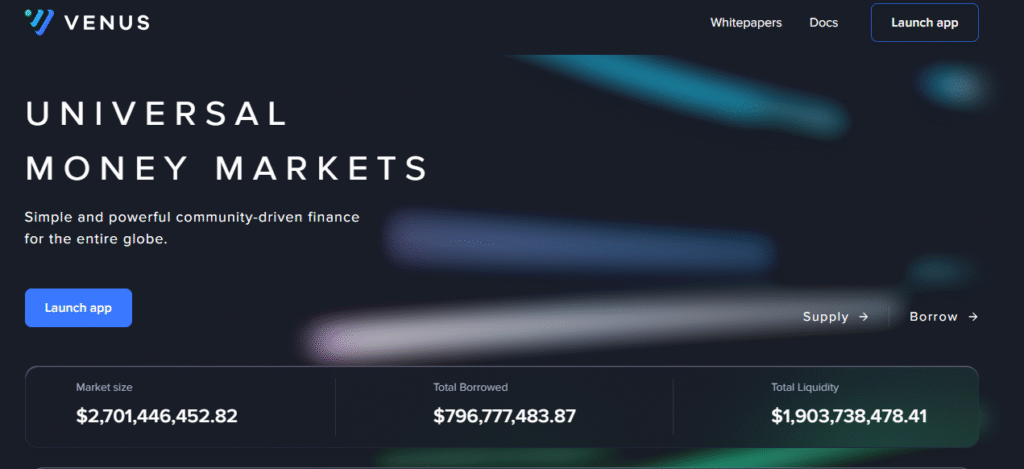
Venus is a DeFi money market built on the BNB Chain, offering high-yield lending and borrowing for a range of assets, including BNB, ETH, BTCB, and stablecoins.
It uses over-collateralized loans to minimize risk and has one of the most active DeFi communities on BNB Chain. Venus is also known for its high borrowing limits and competitive interest rates, which can range from 7.53% APY for USDT, 1.76% APY for ETH, 1.1% APY for BTCB, and 1.9% APY for BNB.
The native token XVS governs the protocol, including liquidation settings and interest rate models. Liquidity providers on Venus often enjoy higher returns than Ethereum-based protocols due to network efficiencies.
Chains Supported: BNB Chain
Fees: 10% of borrower interest goes to protocol reserves
Unique Features: High LTV loans, XVS governance, stablecoin minting
Fee Allocation: Reserves and protocol insurance
Sky Protocol (formerly MakerDAO)

Sky Protocol is the rebranded version of MakerDAO, now supporting multi-chain deployment and next-generation DAO governance. It continues to offer DAI, a decentralized stablecoin backed by crypto collateral locked in smart contracts.
Borrowers generate DAI by depositing assets, while lenders earn by participating in DSR (DAI Savings Rate).
Sky Protocol introduces better rate control, real-world asset integrations, and improved collateral flexibility. Interest rates on DAI vary but remain competitive due to strong demand and over-collateralization guarantees.
- Chains Supported: Ethereum, Optimism, Arbitrum
- Fees: Stability fees vary per collateral type
- Unique Features: DAI Savings Rate (DSR), RWA (real-world assets) integration
- Fee Allocation: Vault liquidations, governance reserves
Morpho
Morpho is a modular lending primitive that optimizes yield and capital efficiency by sitting between peer-to-pool and peer-to-peer models.
It improves the capital efficiency of protocols like Compound and Aave by matching lenders and borrowers directly. Unlike traditional lending pools, Morpho reduces the spread between supplied and borrowed rates, allowing both parties to get better deals.
Interest rates are based on supply/demand dynamics and adjusted automatically. The protocol is also non-custodial, with fully decentralized governance via the MORPHO token.
- Chains Supported: Ethereum
- Fees: Minimal protocol fees; relies on rate spread
- Unique Features: Peer-to-peer matching, minimal slippage, high APY
- Fee Allocation: DAO-controlled reserves and incentives
Stablecoin vs. Altcoin Lending Returns (2025)
In 2025, stablecoins like USDT, USDC, and DAI remain the most popular assets for crypto lending. Their low volatility and high liquidity make them safer for both lenders and borrowers.
Average APYs for stablecoin lending on DeFi platforms range from 3% to 8%, while CeFi platforms offer 5% to 12%, depending on lockup terms and loyalty programs.
By contrast, altcoin lending (e.g., ETH, MATIC, DOT, LINK) offers higher but more variable yields.
On average:
- ETH lending yields: 1.5%–4.5% APY
- DOT/MATIC: 4%–7% APY
- Smaller altcoins: Up to 10% APY, often with higher risk exposure
Altcoin lending also carries price volatility and liquidity risk. If the asset drops in value during lending, users may suffer impermanent loss or insufficient yield to offset losses. Stablecoins offer consistency, while altcoins offer upside potential for risk-tolerant users.
Fixed vs. Variable Crypto Lending Rates

When participating in crypto lending, one of the key decisions you’ll face is choosing between fixed and variable interest rates.
Each model has distinct benefits and risks that can significantly affect your returns and overall investment strategy.
Fixed Lending Rates
Fixed interest rates are predetermined and remain constant throughout the duration of the lending term.
They are commonly offered by CeFi platforms such as Nexo and YouHodler. These platforms may lock your funds for a set period—typically 1 to 3 months—in exchange for higher and guaranteed returns.
Pros
- Predictable income over the lock-in period
- Protection from market rate volatility
- Often come with higher APYs than flexible options
Cons
- Funds are illiquid until the end of the term
- Opportunity loss if market rates increase significantly
- May have penalties for early withdrawal
Variable Lending Rates
Variable interest rates, also called floating rates, fluctuate based on real-time supply and demand dynamics. They are the standard model for most DeFi protocols, such as Aave, Compound, and Morpho Blue.
These platforms adjust borrowing and lending rates algorithmically, often updating rates by the second.
Pros
- Flexibility to deposit or withdraw funds at any time
- Potential to benefit from rate spikes during high borrowing demand
- Ideal for short-term or active strategies
Cons
- Uncertainty in returns; rates may drop without warning
- Requires regular monitoring to optimize gains
- Exposes lenders to protocol congestion and changing incentives
When to Choose Fixed vs. Variable Returns
| Situation | Better Option |
| Want guaranteed passive income? | Fixed Rates |
| Expect market borrowing demand to rise | Variable Rates |
| Need liquidity or plan to withdraw anytime | Variable Rates |
| Willing to lock up funds for higher yield | Fixed Rates |
| Unsure of future market trends | Variable (short-term) |
Risks Involved with High-Yield Crypto Lending
While high-yield crypto lending can offer attractive returns, it also exposes users to several key risks. These risks may not be immediately obvious, especially when interest rates seem too good to ignore.
Before locking in your assets, it’s essential to understand what could go wrong and how each risk affects your capital.
Platform Insolvency or Hacks
One of the biggest risks in crypto lending, especially with CeFi platforms is platform insolvency. When centralized lenders like BlockFi or Celsius collapsed, many users lost access to their funds.
These platforms often lend your assets to third parties or institutional borrowers without full transparency. If one borrower defaults or if the platform overextends itself, your funds may be at risk. Additionally, centralized exchanges and wallets are prime targets for hackers, and despite insurance claims, recovery is never guaranteed.
How to mitigate: Choose platforms with transparent audits, insurance policies, and strong reputations. Don’t keep all your funds in one place.
Smart Contract Vulnerabilities
In DeFi lending, smart contracts replace traditional intermediaries. While this eliminates custodial risk, it introduces code-based risk. Poorly written or unaudited contracts can be exploited by attackers to drain funds from liquidity pools.
Even established platforms like Compound and Curve have faced vulnerabilities despite community reviews and bug bounties. Once a contract is exploited, funds are often lost permanently, with little to no recourse.
How to mitigate: Stick to platforms with multi-layered audits, strong developer teams, and community trust. Use DeFi insurance if available.
Market Crashes Affecting Collateral
Most crypto lending is over-collateralized, meaning borrowers must deposit more value than they borrow. But when markets crash, collateral value can fall quickly, triggering liquidations.
This affects both borrowers—who may lose their collateral—and lenders, who may experience delayed repayments or devaluation of assets. Stablecoin lending is more protected, but when lending altcoins, price drops can erode your effective returns.
How to mitigate: Lend primarily in stablecoins for consistent returns. Monitor market volatility and avoid platforms with low collateral ratios.
Regulatory Uncertainties
Crypto lending exists in a regulatory grey area in many countries. Authorities are increasingly scrutinizing high-yield lending products, labeling some as unregistered securities. Platforms may be forced to halt services, delist assets, or impose withdrawal limits under legal pressure. These sudden changes can freeze your funds or alter yield expectations overnight.
How to mitigate: Diversify across jurisdictions. Choose platforms with clear regulatory standing or licenses. Avoid unregistered platforms promising unrealistic returns.
Tips to Maximize Returns While Minimizing Risk
Final Thoughts
To make smarter lending decisions in 2026, focus on the platforms offering consistent yields, transparent operations, and real-time risk controls. Compare both CeFi and DeFi options not just by APY, but by their security track record, collateral models, and rate structures.
High returns can be appealing—but aligning them with platform integrity and market timing is what actually protects your capital. Stay updated, review rate changes regularly, and use stablecoins when targeting more predictable, passive income through crypto lending.
Frequently Asked Questions
What Is the Interest Rate on a Crypto Loan?
The interest rate on a crypto loan typically ranges from 3% to 12% annually, depending on the platform, asset type, loan terms, and collateral used.
What Is Crypto Lending?
Crypto lending is the process of loaning your cryptocurrency to borrowers through a platform in exchange for interest payments, either via centralized (CeFi) or decentralized (DeFi) services.
How To Make Money With Crypto Lending?
You can make money with crypto lending by depositing your crypto assets on trusted CeFi or DeFi platforms, where they are lent to borrowers in exchange for interest—paid daily, weekly, or monthly—based on the platform’s rates and terms.
How Are Crypto Loans Paid Back?
Crypto loans are repaid by returning the borrowed amount plus interest, usually in the same asset, either in full or through scheduled payments, before or at the end of the loan term.