


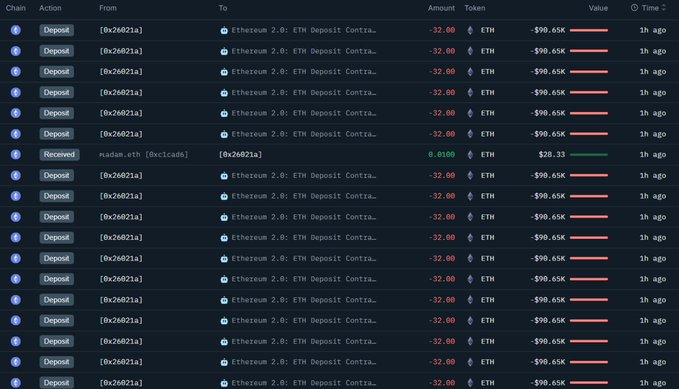
A major Ethereum wallet that has remained untouched for more than a decade has suddenly come back to life—only not to sell, but to stake. The long-dormant whale transferred 40,000 ETH, valued at roughly $120 million, into staking, signaling strong long-term conviction in Ethereum’s future.
The move is drawing attention across the crypto community, especially amid fears that reactivated early holders might trigger sell-offs. Instead, this wallet did the opposite.
A Whale From the ICO Era Resurfaces
Blockchain analytics firm Lookonchain confirmed that the owner of this wallet was an early Ethereum participant, having obtained the ETH during the 2015 initial coin offering for approximately $12,000 total—a number that feels almost unreal today.
Rather than sending the ETH to a centralized exchange—commonly understood as preparing to liquidate—the entire balance was deployed directly into a staking address. As one user remarked:
“Imagine surviving every ETH narrative for a decade, and your first move is to add duration instead of derisk. Different breed.”
That sentiment captures the market reaction perfectly: this is not panic, this is conviction.
Contrasting Whale Behavior: Sell-Offs vs. Staking

This staking decision arrives at a time when whale activity is split between accumulation and distribution.
One ICO-era whale who originally held 254,908 ETH began selling on November 26, unloading 20,000 ETH and gradually reducing the position to just $9.3 million worth of ETH by December 1.
Another large holder, who accumulated 154,076 ETH starting in 2017, sent 18,000 ETH to the exchange Bitstamp—typically interpreted as intended selling.
Meanwhile, there have been bullish moves the other direction. Earlier this year, a Bitcoin whale who held 4,000 BTC sold it and converted the entire value into 96,859 ETH in just 12 hours.
The diverging behavior has created a unique tension in the market: some whales are exiting, others are doubling down.
A Confidence Play in Ethereum’s Future
Ethereum staking requires participants to lock up ETH to support network consensus and security. In return, stakers earn yield denominated in ETH. Because staked funds cannot be sold immediately, staking is widely considered a long-term strategy.
This whale’s choice to stake rather than sell suggests a belief that Ethereum’s value and ecosystem growth will continue over the coming years—not merely weeks or months.
The timing is particularly interesting given the ongoing uncertainty surrounding price direction. According to CCN analyst Valdrin Tahiri:
“If $2,800 breaks, the charts point clearly to a drop toward $1,500, completing the long-term range rotation.”
At the time of the reported activity, Ethereum was trading around $2,818, hovering right near that critical level.
Why This Matters
A wallet idle since Ethereum’s infancy suddenly choosing to commit $120M of capital to staking is more than a private financial maneuver—it’s a market signal.
- It softens fears that dormant whales waking up means sudden dumping.
- It reinforces the narrative that early believers still see Ethereum’s upside potential.
- It adds staking security to the network.
- It reflects confidence in ETH as a long-duration holding.
Even though a single wallet cannot move the market alone, it can influence sentiment—and market psychology matters.
The Road Ahead
As more early wallets become active, two behaviors are emerging:
- Some are distributing and securing profits.
- Some are staking and strengthening their commitment.
Which trend prevails may influence how Ethereum behaves in the months ahead—especially if the price makes any decisive move from the current levels.
For now, one thing is clear: surviving a decade of market volatility—and then staking $120M instead of cashing out—is a rare kind of conviction. This whale didn’t just return—it made a statement.