


Tether CEO Paolo Ardoino Says an AI-Driven Market Bubble Could Be Bitcoin’s Biggest Risk in 2026
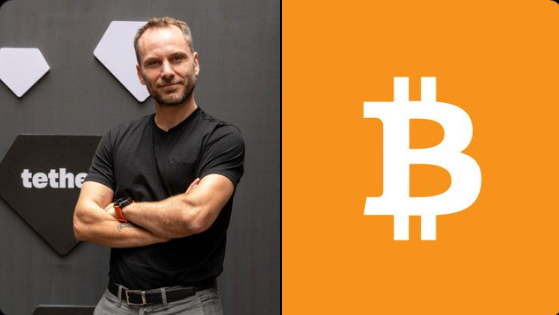
Tether CEO Paolo Ardoino has warned that an artificial intelligence–driven market bubble could pose the most significant risk to Bitcoin’s price performance in 2026, even as he remains confident about the cryptocurrency’s long-term adoption and the growth of tokenized assets. Speaking on the Bitcoin Capital podcast, co-hosted by Bitfinex Securities and Blockstream, Ardoino shared a nuanced outlook on Bitcoin and the wider digital asset market. While he sees strong structural support forming around Bitcoin, he cautioned that the asset is still closely tied to traditional capital markets—a linkage that could expose it to turbulence if enthusiasm around artificial intelligence reverses sharply. AI Euphoria and Bitcoin’s Market Correlation According to Ardoino, the biggest concern lies not within crypto itself but in the broader financial system. He argued that Bitcoin remains “still too much correlated” with capital markets, making it vulnerable to any large-scale correction driven by overinvestment in AI infrastructure. “That is the so-called AI bubble, this concern about the fact that AI companies are spending too much money in AI infrastructure and data centers and trying to build a gazillion gigawatts of power and installing GPUs,” Ardoino said during the discussion. He suggested that if investor sentiment around AI shifts in 2026—particularly in the United States—it could trigger stock market stress that spills over into Bitcoin. In such a scenario, crypto would not be insulated, despite its growing reputation as an alternative asset. Still, Ardoino made it clear that this risk is conditional. Outside of a potential AI-led market downturn, he does not see major threats to Bitcoin’s trajectory in the coming year. The End of Deep Bitcoin Crashes? One of Ardoino’s more optimistic assessments centered on market maturity. He argued that the era of extreme Bitcoin drawdowns may be fading as institutional participation deepens. “So I would imagine that sharp corrections of 80%, like we saw in 2022 or early 2018, might not be the case anymore,” he said. This view is rooted in the increasing involvement of pension funds, governments, and large financial entities, which tend to bring longer-term capital and more disciplined risk management. While volatility will likely remain part of Bitcoin’s identity, Ardoino believes the scale of past collapses is becoming less probable. Tokenization Boom, With Limits Beyond Bitcoin’s price outlook, Ardoino expressed strong confidence in the growth of real-world asset tokenization. He described tokenized securities and commodities as an area poised for massive expansion, reflecting broader interest in bringing traditional assets onto blockchain infrastructure. At the same time, he offered a note of caution about excessive institutional dominance. “The only downside I see is like. Bitcoin is for Bitcoin, right? You don’t want 99% of Bitcoin being institutionalized,” Ardoino remarked. His comment highlights a tension within the crypto community: balancing mainstream adoption with the original ethos of decentralization. While institutions can add liquidity and legitimacy, too much concentration could undermine Bitcoin’s foundational principles. Europe, Regulation, and a Bleak Outlook Ardoino reserved his sharpest criticism for Europe’s approach to crypto regulation. He was openly bearish on the region’s innovation prospects, arguing that regulatory efforts continue to outpace genuine understanding of the technology. “Europe will always remain the last wheel of the cart whenever we talk about innovation. Europe is trying to regulate something that it doesn’t understand yet. That is very sad,” he said. His comments come amid ongoing debate over the European Union’s Markets in Crypto-Assets Regulation (MiCA). Tether has notably refused to comply with MiCA requirements, a stance that has led several European crypto service providers to delist USDT. Ardoino’s remarks underline growing friction between global crypto firms and European regulators. Skepticism Around Treasury-Only Crypto Firms The Tether CEO also addressed the rise of digital asset treasury (DAT) companies, expressing skepticism toward firms that focus solely on holding crypto without a strong operational backbone. “I’m not very bullish on crypto treasury companies that are just treasury companies,” Ardoino said, stressing that long-term success requires a real, productive business model. He contrasted this with Tether’s involvement in Twenty One, a Bitcoin-focused company backed by the stablecoin issuer. Ardoino explained that the goal is not simply accumulation, but building a company that delivers meaningful Bitcoin-related services alongside maintaining a substantial treasury. “The aim for Twenty One is for Twenty One to be an amazing Bitcoin company that provides Bitcoin services and also has a Bitcoin treasury,” he said. A Measured Warning, Not a Bearish Call Taken as a whole, Ardoino’s message was not one of pessimism, but caution. He sees Bitcoin entering a more mature phase, supported by institutional adoption and expanding use cases like tokenization. Yet, he warned that macroeconomic excess—particularly in AI—could still ripple through crypto markets. For investors, the takeaway is clear: Bitcoin’s biggest risks may no longer come from within the crypto ecosystem itself, but from the same forces shaping global financial markets.
A Whale Lost $27.3m After a Multisig Private Key Compromise, With Funds Laundered via Tornado Cash

A major Ethereum whale has suffered a catastrophic loss after a private key compromise rendered a multisignature wallet effectively useless, allowing an attacker to drain roughly $27.3 million in crypto assets and begin laundering the proceeds through Tornado Cash. The incident, first flagged by blockchain security firm PeckShield, has sent fresh shockwaves through the DeFi community and renewed concerns around wallet setup practices, key management, and the hidden risks tied to active on-chain positions. “A whale’s Multisig was drained of ~$27.3M due to a private key compromise,” PeckShield wrote in an alert on X. “The drainer has laundered $12.6M (4,100 ETH) via Tornado Cash and retains ~$2M in liquid assets.” Key Takeaways How a Multisig Became a Single Point of Failure Multisignature wallets are widely viewed as a safer alternative to single-key wallets, especially for large holders. They are designed to require multiple approvals before funds can be moved. In this case, however, that protection failed entirely. On-chain investigators later revealed that the wallet was configured as a 1-of-1 multisig. That setup meant only one signature was required to authorize transactions, eliminating the redundancy that gives multisigs their security edge. Once the private key was compromised, the attacker gained full control. According to on-chain investigator Specter, the multisig wallet was created on April 11, 2025, at 07:48:11 UTC. Just 35 minutes later, at 08:23:23, a massive outflow occurred from the main signing address. The speed of the drain suggests the key may have been exposed during wallet setup, possibly through an insecure tool, a poisoned download, or third-party assistance that turned out to be malicious. Systematic Draining and On-Chain Laundering Blockchain data shows that the attacker did not rush to exit in a single transaction. Instead, the funds were moved in a structured pattern that points to deliberate laundering rather than panic selling. Roughly 4,100 ETH, valued at about $12.6 million at the time, was sent through Tornado Cash in batches of 100 ETH. In total, the attacker executed 41 separate transfers, a method commonly used to reduce traceability and avoid drawing immediate attention from automated monitoring systems. Etherscan-linked traces show the address, partially identified as 0x1fCf…367d23Ac, repeatedly interacting with Tornado Cash while retaining control of additional assets. Beyond ETH, the wallet still holds tokens including Wrapped Ether, OKB, Trust Wallet Token, Bitfinex LEO, Fetch, and Nexo. PeckShield estimates that around $2 million in liquid assets remain under the attacker’s control. The Aave Position That Raised the Stakes What makes this breach more dangerous than a standard wallet drain is what the attacker gained access to after the initial theft. PeckShield confirmed that the compromised multisig still controls a large live position on Aave. “The drainer also controls the victim’s multisig, which maintains a leveraged long,” PeckShield noted. The wallet reportedly holds about $25 million worth of ETH supplied as collateral, against approximately $12.3 million in DAI borrowed. Control over this position turns the incident from a simple theft into an ongoing risk event. With signing authority over the multisig, the attacker can withdraw collateral, adjust borrow parameters, or intentionally push the position toward liquidation. Any sudden move could have ripple effects, not just for the victim, but also for the DeFi protocols involved if liquidations occur under stressed market conditions. This highlights a key issue for advanced DeFi users: wallets are no longer just storage tools. They are control centers for complex financial positions. When access is lost, the damage can extend well beyond the assets already stolen. Signs of a Broader Compromise On-chain analysts also observed the attacker interacting with contracts related to ownership and control, suggesting the breach went deeper than a single unauthorized transfer. This reinforces concerns that the private key was fully exposed rather than temporarily misused. Security firms point out that even when users distribute signing keys across devices or locations, they remain vulnerable to phishing attacks, malware, SIM swaps, compromised backups, and malicious transaction approvals. In multisig environments, a single weak link can undermine the entire setup. A Whale Already Under Pressure Additional context from Onchainlens shows that the whale had already been struggling before the attack. In May, the same wallet reportedly suffered losses after withdrawing more than 2,500 ETH from OKX and transferring the funds to Kiln Finance. By July, the whale had staked a total of 9,918 ETH, valued at roughly $22.5 million at the time, earning only 105.5 ETH in staking rewards. Even before the hack, the address was estimated to be down about $4.26 million overall. The breach effectively wiped out any chance of recovery, turning an already difficult position into one of the largest individual losses of the year. Not an Isolated Case This incident fits a broader pattern of high-value crypto thefts that rely less on protocol bugs and more on user-side failures. In a separate case earlier this year, an unknown investor lost more than $3 million after unknowingly approving a malicious contract. Those funds were also converted to ETH and routed through Tornado Cash. These attacks underline a hard truth in crypto security: most losses do not come from broken blockchains, but from compromised keys, poor wallet configurations, and deceptive approvals. Lessons From a $27 Million Mistake The takeaway from this breach is not that multisig wallets are unsafe, but that they are only as strong as their configuration and key hygiene. A 2-of-3 or 3-of-5 multisig dramatically reduces the risk of total loss from a single compromised key. A 1-of-1 multisig does not. For large holders and DeFi power users, the incident is a reminder to treat wallet setup with the same care as institutional custody. That includes using trusted tools, verifying software sources, isolating signing devices, and understanding exactly what each approval allows. As PeckShield’s findings make clear, once an attacker can sign transactions, speed becomes the enemy of recovery. And when that access includes live DeFi positions, the fallout can escalate far beyond the initial theft. The $27.3 million loss is now effectively locked behind Tornado Cash, with little chance
Intuit Has Partnered With Circle To Integrate USDC Into Its Financial Platforms, Enabling Faster and Lower-Cost Payments

Intuit has taken a major step into blockchain-powered finance by signing a multi-year strategic partnership with Circle Internet Group to integrate USDC stablecoin payments across its widely used financial platforms. The move places one of the world’s largest consumer and small-business FinTech companies firmly within the growing stablecoin economy, as mainstream financial services increasingly look beyond traditional payment rails. Under the agreement, Intuit will gain access to Circle’s stablecoin infrastructure and USDC, with plans to embed stablecoin-based money movement across products including TurboTax, QuickBooks, Credit Karma, and Mailchimp. The goal is to enable faster settlement, lower transaction costs, and programmable payments that operate around the clock, features that conventional banking systems often struggle to deliver. This partnership signals a clear shift in how large financial platforms view stablecoins. Once considered niche tools tied mainly to crypto trading, stablecoins are now being positioned as practical payment infrastructure for everyday financial activity. Key Takeaways A Strategic Push Beyond Legacy Payment Rails For Intuit, the partnership addresses long-standing limitations in traditional payment systems. Bank-based transfers often depend on business hours, involve multiple intermediaries, and carry fees that can be burdensome for small businesses and consumers. Stablecoins, by contrast, settle nearly instantly and operate 24/7, making them attractive for refunds, payroll, invoicing, and cross-border transactions. Intuit serves millions of users globally and sits at the center of critical financial workflows, from tax filing and refunds to invoicing, payroll, and credit management. Integrating USDC introduces a new money rail that can be embedded directly into these workflows, rather than layered on top of them. “Intuit is at the forefront of financial innovation to deliver faster, lower-cost, and programmable money movement to millions of consumers and businesses to fuel their success,” said Sasan Goodarzi, CEO of Intuit. “Our partnership with Circle will expand our capabilities to layer stablecoins onto Intuit’s trusted platform as we put money at the center of everything we do, so money works harder and smarter for everyone.” While Intuit has not yet disclosed specific launch timelines or product-level implementations, the framework allows the company to roll out stablecoin features incrementally across its ecosystem. Why USDC Fits Intuit’s Business Model USDC is one of the most widely used dollar-backed stablecoins, issued by Circle and designed to maintain a one-to-one peg with the U.S. dollar. It is commonly used for payments, settlements, and on-chain financial applications, with a focus on transparency and regulatory alignment. For a company like Intuit, which operates at massive scale and handles sensitive financial data, stability and trust are non-negotiable. USDC’s structure makes it suitable for enterprise use cases such as instant refunds, automated payouts, and global remittances without exposing users to crypto price volatility. Jeremy Allaire, Co-Founder, Chairman, and CEO of Circle, emphasized the significance of Intuit’s scale in pushing stablecoins into everyday finance. “Intuit’s massive scale and industry leadership make it an ideal platform to extend the speed, power and efficiency of USDC for everyday financial transactions,” Allaire said. “Together, we bring a shared commitment to build a more efficient financial system that unlocks powerful new capabilities for people globally.” The partnership is formally signed with a subsidiary of Circle Internet Group, ensuring operational alignment while maintaining Circle’s broader corporate structure. Real-World Use Cases Across Intuit’s Platforms The practical implications of this partnership could be wide-ranging. TurboTax, for example, plays a major role in tax refunds, which often represent one of the largest annual cash inflows for many households. Stablecoin-based payouts could reduce waiting times and provide faster access to funds. Intuit operates in a market with more than $100 billion in annual tax refunds. Faster settlement through stablecoins could meaningfully change how and when users receive their money, particularly during peak tax seasons. For QuickBooks users, many of whom are small and medium-sized businesses, USDC integration could simplify invoicing, contractor payments, and cross-border transactions. Instant settlement improves cash flow visibility and reduces reliance on short-term credit to bridge payment delays. Credit Karma and Mailchimp also stand to benefit, particularly as embedded payments and global customer engagement become more central to their offerings. Stablecoins Gain Ground With Regulators and Institutions The announcement comes amid renewed attention on stablecoins from both regulators and traditional financial institutions. As discussions around payment efficiency and financial inclusion continue, stablecoins are increasingly viewed as a bridge between blockchain technology and regulated financial systems. Unlike volatile cryptocurrencies, stablecoins aim to maintain price stability while offering the technical advantages of blockchain settlement. This has made them attractive to FinTech platforms seeking speed and efficiency without exposing users to market risk. Intuit’s move reflects a broader industry trend: large platforms are no longer experimenting quietly with blockchain infrastructure but are making public, long-term commitments to it. Trust, Security, and Governance Still Central Despite the shift toward stablecoin-based payments, Intuit has emphasized that its existing standards around privacy, security, and governance remain unchanged. The company says all platform innovations will continue to be built with strong data protection and responsible oversight. Intuit has spent decades building trust with consumers, businesses, and accountants by handling highly sensitive tax, credit, and payroll data. Any integration of stablecoin infrastructure will need to meet those same expectations, particularly as regulators keep a close eye on digital payment systems. A Signal Moment for Mainstream Crypto Adoption While crypto-native firms have long promoted stablecoins as a better payment solution, adoption by a company of Intuit’s size marks a turning point. This is not a pilot program or a limited experiment; it is a multi-year strategic partnership designed to reshape how money moves across a major financial ecosystem. By embedding USDC directly into products used daily by millions, Intuit is helping normalize stablecoins as financial infrastructure rather than speculative tools. If successful, the partnership could encourage other large FinTech and enterprise platforms to follow a similar path. As stablecoins continue to move from the margins to the center of global payments, Intuit’s collaboration with Circle stands out as one of the clearest signs yet that blockchain-based money is becoming part of everyday finance.