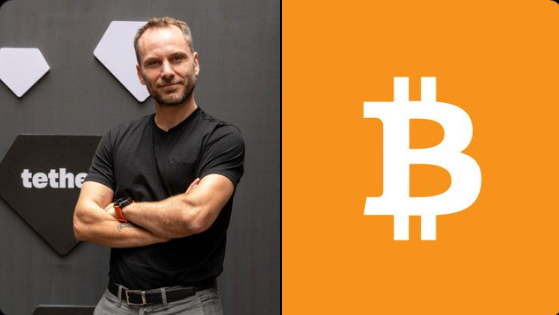
Tether CEO Paolo Ardoino has warned that an artificial intelligence–driven market bubble could pose the most significant risk to Bitcoin’s price performance in 2026, even as he remains confident about the cryptocurrency’s long-term adoption and the growth of tokenized assets.
Speaking on the Bitcoin Capital podcast, co-hosted by Bitfinex Securities and Blockstream, Ardoino shared a nuanced outlook on Bitcoin and the wider digital asset market. While he sees strong structural support forming around Bitcoin, he cautioned that the asset is still closely tied to traditional capital markets—a linkage that could expose it to turbulence if enthusiasm around artificial intelligence reverses sharply.
AI Euphoria and Bitcoin’s Market Correlation
According to Ardoino, the biggest concern lies not within crypto itself but in the broader financial system. He argued that Bitcoin remains “still too much correlated” with capital markets, making it vulnerable to any large-scale correction driven by overinvestment in AI infrastructure.
“That is the so-called AI bubble, this concern about the fact that AI companies are spending too much money in AI infrastructure and data centers and trying to build a gazillion gigawatts of power and installing GPUs,” Ardoino said during the discussion.
He suggested that if investor sentiment around AI shifts in 2026—particularly in the United States—it could trigger stock market stress that spills over into Bitcoin. In such a scenario, crypto would not be insulated, despite its growing reputation as an alternative asset.
Still, Ardoino made it clear that this risk is conditional. Outside of a potential AI-led market downturn, he does not see major threats to Bitcoin’s trajectory in the coming year.
The End of Deep Bitcoin Crashes?
One of Ardoino’s more optimistic assessments centered on market maturity. He argued that the era of extreme Bitcoin drawdowns may be fading as institutional participation deepens.
“So I would imagine that sharp corrections of 80%, like we saw in 2022 or early 2018, might not be the case anymore,” he said.
This view is rooted in the increasing involvement of pension funds, governments, and large financial entities, which tend to bring longer-term capital and more disciplined risk management. While volatility will likely remain part of Bitcoin’s identity, Ardoino believes the scale of past collapses is becoming less probable.
Tokenization Boom, With Limits
Beyond Bitcoin’s price outlook, Ardoino expressed strong confidence in the growth of real-world asset tokenization. He described tokenized securities and commodities as an area poised for massive expansion, reflecting broader interest in bringing traditional assets onto blockchain infrastructure.
At the same time, he offered a note of caution about excessive institutional dominance.
“The only downside I see is like. Bitcoin is for Bitcoin, right? You don’t want 99% of Bitcoin being institutionalized,” Ardoino remarked.
His comment highlights a tension within the crypto community: balancing mainstream adoption with the original ethos of decentralization. While institutions can add liquidity and legitimacy, too much concentration could undermine Bitcoin’s foundational principles.
Europe, Regulation, and a Bleak Outlook
Ardoino reserved his sharpest criticism for Europe’s approach to crypto regulation. He was openly bearish on the region’s innovation prospects, arguing that regulatory efforts continue to outpace genuine understanding of the technology.
“Europe will always remain the last wheel of the cart whenever we talk about innovation. Europe is trying to regulate something that it doesn’t understand yet. That is very sad,” he said.
His comments come amid ongoing debate over the European Union’s Markets in Crypto-Assets Regulation (MiCA). Tether has notably refused to comply with MiCA requirements, a stance that has led several European crypto service providers to delist USDT. Ardoino’s remarks underline growing friction between global crypto firms and European regulators.
Skepticism Around Treasury-Only Crypto Firms
The Tether CEO also addressed the rise of digital asset treasury (DAT) companies, expressing skepticism toward firms that focus solely on holding crypto without a strong operational backbone.
“I’m not very bullish on crypto treasury companies that are just treasury companies,” Ardoino said, stressing that long-term success requires a real, productive business model.
He contrasted this with Tether’s involvement in Twenty One, a Bitcoin-focused company backed by the stablecoin issuer. Ardoino explained that the goal is not simply accumulation, but building a company that delivers meaningful Bitcoin-related services alongside maintaining a substantial treasury.
“The aim for Twenty One is for Twenty One to be an amazing Bitcoin company that provides Bitcoin services and also has a Bitcoin treasury,” he said.
A Measured Warning, Not a Bearish Call
Taken as a whole, Ardoino’s message was not one of pessimism, but caution. He sees Bitcoin entering a more mature phase, supported by institutional adoption and expanding use cases like tokenization. Yet, he warned that macroeconomic excess—particularly in AI—could still ripple through crypto markets.
For investors, the takeaway is clear: Bitcoin’s biggest risks may no longer come from within the crypto ecosystem itself, but from the same forces shaping global financial markets.
No related posts.