



Economic Landscape in Guatemala

Guatemala stands as the largest economy in Central America. In 2024, the nation’s GDP reached $113.2 billion, with growth in early 2025 expanding at a rate of 3.9%. This trajectory is supported by disciplined fiscal management and an inflation-targeting regime that has maintained relative macroeconomic stability.
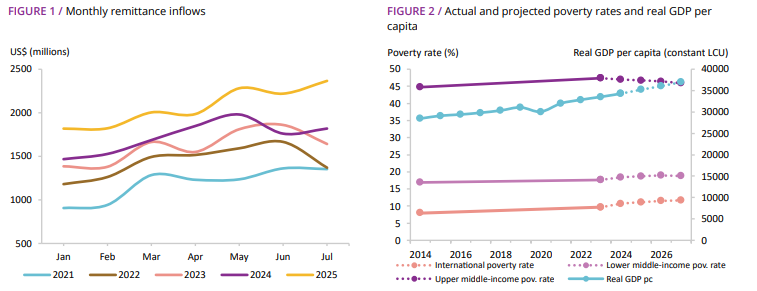
A defining feature of the economy is its reliance on remittances from the United States, which now represent approximately one-fifth of the national GDP. These inflows support consumption for nearly 46% of households. Despite these gains, poverty remains a persistent issue, with 47.3% of the population—roughly 8.6 million people—living on less than $8.30 a day as of 2023.
The informal sector continues to employ 71.1% of the workforce, leaving many without traditional financial security or benefits. Again, the lack of access to essential services like healthcare and education, particularly in rural and indigenous areas, further adds to the country’s social inequality.
On top of these challenges, Guatemala faces the added burden of climate change. Natural disasters, such as hurricanes and droughts, frequently disrupt the country’s infrastructure and agricultural productivity, making it harder for people to escape poverty.
For example, the devastating impact of hurricanes Eta and Iota in 2020 led to infrastructure losses that amounted to 0.56% of the country’s GDP, along with agricultural losses of around 0.20%. Furthermore, Guatemala’s low Human Capital Index shows how much more needs to be done in terms of improving education, healthcare, and overall quality of life for its citizens.
In spite of these challenges, Guatemala has significant untapped potential. The country is incredibly rich in natural resources and is one of the world’s most biodiverse nations, which creates opportunities for growth in sectors like tourism, agriculture, and renewable energy.
Plus, Guatemala’s proximity to the United States opens doors for nearshoring and trade, which could give the country an economic boost.
However, since President Bernardo Arévalo, took office in January 2024, he has been focused on social and economic reforms, anti-corruption efforts, and improving the business climate to attract both local and foreign investments.
These reforms aim to fill gaps in infrastructure, human development, and economic inclusion—helping the country grow in a more equitable and sustainable way.
Current State of Crypto Adoption in Guatemala
Cryptocurrency adoption has moved beyond a niche interest to become a practical tool for many Guatemalans.
The country has established itself as a global leader in infrastructure, ranking third worldwide for the number of cryptocurrency ATMs with over 2,700 machines. These unidirectional ATMs, provided through a partnership between Coincaex and 5B, allow users to convert assets like Bitcoin directly into Quetzales cash.
This impressive growth stems from a partnership between Coincaex, a local cryptocurrency exchange, and ATM provider 5B, making it easier for Guatemalans to convert digital currencies like Bitcoin into their local currency, Quetzales. These ATMs are unidirectional, meaning they allow users to withdraw cash but don’t support deposits or cryptocurrency purchases.
In addition to the infrastructure improvements, community-driven projects have played a key role in spreading cryptocurrency adoption in Guatemala.
Another notable example is Bitcoin Lake, a Bitcoin Beach-inspired project near Lake Atitlán, which has encouraged local businesses to accept Bitcoin as payment. This initiative has helped spark interest in digital currencies, not only among the locals but also among Bitcoin tourists. Another innovative way to further promote Bitcoin adoption has been through free Bitcoin-themed tattoos.
For example, Osmo Wallet, a Guatemalan-based Bitcoin company, partnered with Soul’s Anchor Tattoo Shop in Guatemala City to offer free tattoos to customers who participated in a Bitcoin merchant adoption competition.
Although cryptocurrency adoption is on the rise, Guatemala is still in the early stages. Many business owners are still wary about accepting digital currencies, primarily due to concerns over volatility.
However, solutions like instant Bitcoin-to-fiat conversion at payment terminals are helping alleviate these concerns, enabling merchants to bypass the risks associated with fluctuating Bitcoin prices. This approach has been growing in popularity, making it easier for businesses to integrate Bitcoin into their payment systems without being exposed to unnecessary risk.
Crypto Law and Regulation

While the central bank, Banco de Guatemala, previously focused on warning citizens about the speculative risks of digital assets, the regulatory approach changed significantly in 2025. On May 12, 2025, Bill No. 6538, titled the “Cryptocurrency Law in Guatemala,” was introduced to the Congress of the Republic.
This bill represents the first comprehensive effort to regulate the use, exchange, and storage of digital assets.
Key provisions of the proposed law include:
- Mandatory Registration: All platforms, wallets, and service providers must register with the Superintendency of Banks (SIB).
- Compliance Standards: Entities must adhere to strict cybersecurity, transparency, and user protection regulations.
- Identity Verification: Implementation of mandatory Know-Your-Customer (KYC) measures is required for all users.
- Transaction Monitoring: Providers must report suspicious activities to the Special Verification Authority (IVE) to prevent financial crimes.
Factors Driving Crypto Adoption in Guatemala

High Remittance Dependency
Given the country’s heavy reliance on cross-border remittances, cryptocurrencies present a more cost-effective and quicker solution for money transfers, offering advantages over traditional remittance channels. Crypto offers a faster, cheaper alternative to traditional wire services for the 20% of GDP derived from US-based workers.
Financial Exclusion
With a large portion of the population unbanked, cryptocurrencies are gaining traction as an alternative means of accessing financial services, bypassing the need for conventional banking systems. With over 71% of the workforce in the informal sector, decentralized wallets provide banking services to the unbanked population.
Technological Growth
The growing penetration of smartphones and internet access is empowering more people to use digital wallets and engage in cryptocurrency transactions, fostering greater financial inclusion. Also, the presence of over 2,700 ATMs makes converting digital assets to physical cash widely accessible
Inflation and Currency Instability
Cryptocurrencies offer a safeguard against inflation and currency depreciation, making them a compelling choice for saving and transferring money in an uncertain economic climate.
Benefits of Crypto Adoption

Access to Financial Services
Cryptocurrencies provide unbanked populations with opportunities to engage in the financial ecosystem. For example, in Guatemala, individuals in rural areas can use mobile-based crypto wallets to save and transfer money without relying on traditional banks.
Lower Transaction Costs
For cross-border remittances, cryptocurrencies drastically reduce transaction fees. Platforms like Bitso, popular in Latin America, enable families to receive funds faster and at lower costs compared to traditional services like Western Union.
Economic Empowerment
Projects like Bitcoin Lake in Guatemala illustrate how digital currencies can stimulate local economies, enabling small businesses to transact with global customers and bypass costly financial intermediaries.
Greater Financial Autonomy
Cryptocurrencies empower individuals by giving them full control over their assets. In regions with unstable currencies, such as Guatemala, crypto adoption allows residents to store value without fear of devaluation.
Diversified Investment Options
Digital currencies present new investment opportunities for Guatemalans, offering an alternative to conventional savings methods. For instance, some individuals use stablecoins to hedge against inflation while exploring the broader crypto market for potential gains.
Challenges to Crypto Adoption in Guatemala

Regulatory Ambiguity
While Bill No. 6538 provides a framework, the transition from an unregulated market to a supervised one may create high compliance costs for startups.
Insufficient Digital Literacy
A significant portion of the population in Guatemala lacks the digital knowledge required to use cryptocurrencies effectively. This gap in understanding limits the ability to take advantage of crypto’s benefits and inhibits wider adoption.
Infrastructure Deficiencies
In rural regions, limited internet connectivity and access to smartphones prevent many from participating in the crypto space. These infrastructural challenges hinder the ability of citizens to fully engage with digital currencies.
Security Concerns
The absence of robust security measures leaves cryptocurrency users vulnerable to cyberattacks, fraud, and scams. Without comprehensive regulations or adequate protection, individuals may be reluctant to trust crypto platforms.
Volatility of Cryptocurrencies
The inherent price fluctuations of cryptocurrencies present a challenge for users in Guatemala who may struggle to maintain stable value in their digital assets. This volatility undermines confidence and deters potential adopters from using cryptocurrencies for everyday transactions or saving
The Future of Cryptocurrency in Guatemala

Cryptocurrency adoption in Guatemala could change the country’s financial system and open up new opportunities for growth. For example, the idea of Central Bank Digital Currencies (CBDCs) could help modernize the financial sector, just as it has in places like the Bahamas and Jamaica.
Additionally, blockchain technology has the potential to improve public services, like land registries and voting systems, by making them more secure and transparent. Projects like Bitcoin Lake already show how cryptocurrencies can help local economies grow.
However, for wider adoption to happen, Guatemala needs clear regulations to reduce risks and encourage investment. At the same time, focusing on digital literacy and improving internet access, especially in rural areas, will be key to making sure everyone can benefit from crypto.
With the right support and investment in infrastructure and education, cryptocurrency adoption in Guatemala has the potential to drive substantial financial growth and innovation, positioning the country to thrive in the digital economy
Conclusion
Guatemala is at a pivotal crossroads in its digital evolution. The introduction of the 2025 “Cryptocurrency Law” signals a shift from cautious observation to active regulation.
By balancing the need for consumer protection with the economic benefits of cost-effective remittances and financial inclusion, the country has the potential to harness digital assets as a tool for sustainable growth and poverty reduction.
The potential for cryptocurrency adoption in Guatemala is promising, with its ability to drive financial inclusion and economic empowerment.


