


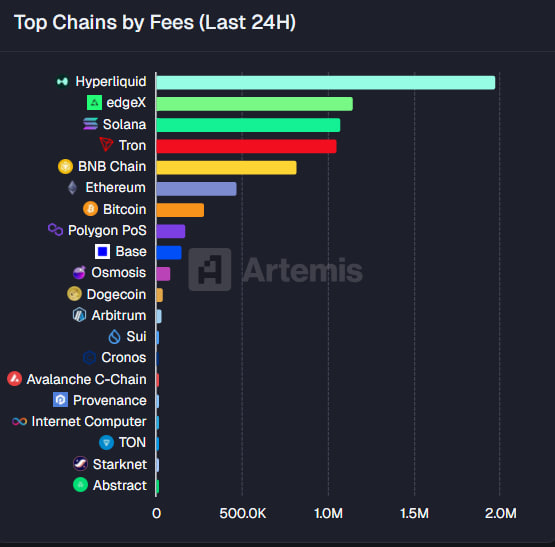
Blockchain revenue dynamics shifted sharply over the past 24 hours as Hyperliquid emerged as the highest-fee-generating network, outpacing both established and emerging chains amid heightened trading activity.
Fresh data tracking fees collected across major blockchains shows Hyperliquid firmly in the lead, generating roughly $2 million in fees over the last 24 hours.
The figure places the derivatives-focused chain ahead of Edgex and Solana, which followed closely behind, underscoring a notable change in where user activity and transaction demand are currently concentrated.
Key Takeaways
- Hyperliquid generated the highest 24-hour fee revenue, reflecting intense on-chain derivatives trading activity.
- Edgex’s second-place ranking highlights rising adoption and concentrated usage within its ecosystem.
- Solana’s strong showing demonstrates how high transaction volume can offset low per-transaction fees.
- Daily fee rankings reveal shifting user demand toward networks that capture real economic activity during volatile market conditions.
Hyperliquid’s Fee Surge Reflects Trading Intensity
Hyperliquid’s top position is closely tied to its growing dominance in on-chain perpetual futures trading. The protocol has attracted traders seeking deep liquidity, low latency execution, and transparent order books, driving a surge in transaction volume and, in turn, fee generation.
Unlike general-purpose smart contract networks, Hyperliquid’s revenue is largely derived from trading-related activity rather than decentralized application usage. This makes its leading position particularly notable, as it surpassed multi-ecosystem chains that support NFTs, DeFi, and payments simultaneously.
Market observers note that elevated volatility across crypto markets tends to benefit derivatives platforms, where frequent position adjustments and liquidations translate directly into higher fee income.
Edgex and Solana Maintain Strong Positions
Following Hyperliquid, Edgex secured second place in 24-hour fee generation. While still relatively new compared to legacy networks, Edgex’s performance suggests growing traction, likely driven by concentrated application usage and rising user engagement within its ecosystem.
Solana, long recognized for its high throughput and low transaction costs, ranked third. Despite its reputation for inexpensive fees, Solana’s placement highlights the scale of its activity, with large volumes compensating for lower per-transaction costs.
The network continues to benefit from strong adoption across DeFi, NFTs, and consumer-facing applications.
How Major Chains Compare
Beyond the top three, Tron and BNB Chain also recorded substantial fee totals, reflecting steady usage in payments, stablecoin transfers, and decentralized finance. Ethereum, while no longer leading daily fee charts, maintained a solid mid-tier position, supported by Layer 2 activity and ongoing demand for blockspace.
Bitcoin appeared lower on the list, consistent with its role as a settlement-focused network rather than a high-frequency transaction platform.
Several Layer 2 and alternative chains, including Polygon PoS, Base, Arbitrum, and Sui, generated smaller but consistent fee volumes, pointing to fragmented yet persistent user activity across the broader ecosystem.
What the Data Signals
Daily fee rankings offer a real-time snapshot of where users are most active and willing to pay for blockspace. Hyperliquid’s rise to the top suggests a growing preference for specialized trading platforms during periods of heightened market engagement.
At the same time, the strong showing from Solana and other high-throughput networks indicates that general-purpose chains continue to play a critical role, even as niche platforms capture outsized revenue during specific market conditions.
As market momentum shifts, fee data will remain a key indicator of underlying demand, competitive positioning, and the real economic activity driving blockchain networks forward.
No related posts.