


Crypto isn’t just about buying and holding coins anymore. DeFi staking has opened up a whole new way to earn while you HODL. By staking your digital assets on decentralized platforms, you can generate passive income, support blockchain networks, and participate in the growing DeFi ecosystem.
With options ranging from beginner-friendly liquid staking protocols to advanced restaking and yield optimization strategies, there’s a solution for every investor’s goal and risk appetite.
In 2026, the DeFi staking space has exploded with innovative platforms like Lido Finance, Rocket Pool, Aave, EigenLayer, and Pendle, each offering unique features, token support, and reward opportunities.
Whether you want instant liquidity, high yields, or advanced multi-chain strategies, understanding the differences between these platforms is key to making smart, profitable choices. In this guide, we break down the types of staking, top platforms, risks, and strategies, so you can confidently select the best DeFi staking platform for your crypto journey.
Key Takeaway
- DeFi staking lets you earn passive income by locking or delegating crypto assets while supporting blockchain networks.
- Different staking types, liquid staking, traditional on-chain staking, and restaking offer varying levels of liquidity, risk, and yield potential.
- Top platforms vary by goals and risk tolerance, from beginner-friendly options like Lido Finance and Aave to advanced yield strategies with EigenLayer, Pendle, or Ether.fi.
- Security and risk management are crucial, including auditing history, smart contract safety, diversification, and understanding lock-up periods.
What Is DeFi Staking?
DeFi staking is the process of locking your cryptocurrency in a decentralized finance (DeFi) platform to help run and secure a blockchain network. In return, you earn rewards, usually paid in the same token or another crypto asset.
Instead of relying on banks or centralized companies, DeFi staking uses smart contracts, self-executing programs on the blockchain to manage deposits, rewards, and withdrawals automatically. This means users keep control of their funds while earning returns directly from the network.
Also Read: What Is A Phantom Wallet
How It Differs from Traditional Staking
Traditional staking is often done through centralized exchanges or custodial services, where the platform controls your assets on your behalf. While this may be easier for beginners, it comes with risks like platform freezes, withdrawal limits, or loss of custody. DeFi staking is different because:
- You remain in control of your crypto through your wallet
- There is no middleman handling your funds
- Staking rules and rewards are transparent and coded into smart contracts
- Many platforms offer liquid staking, allowing you to use your staked assets elsewhere in DeFi
Types of DeFi Staking
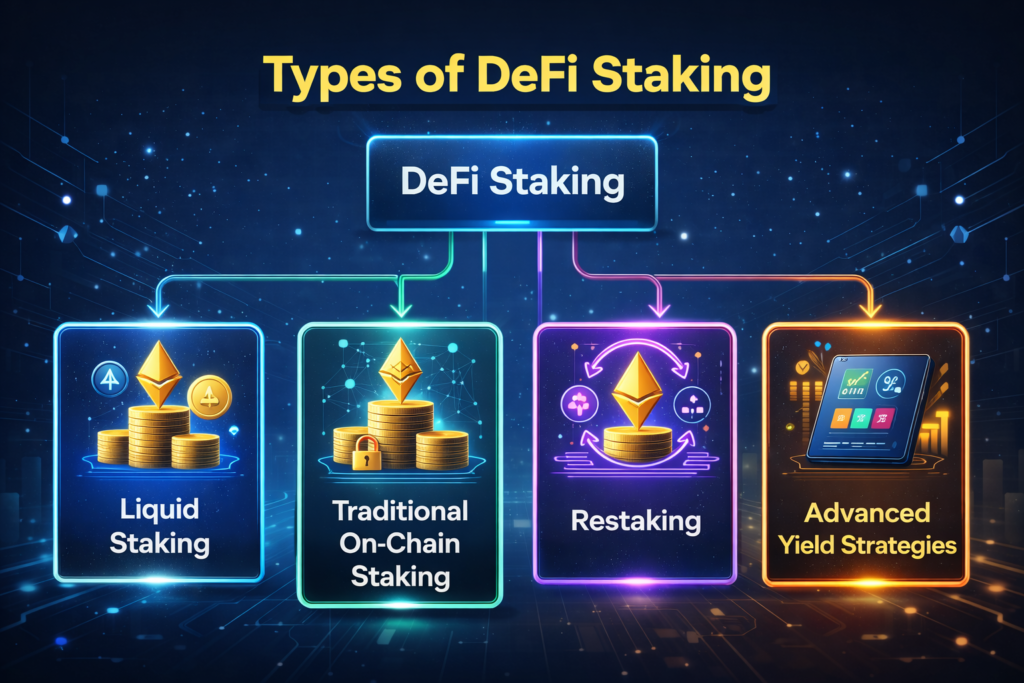
DeFi staking is not a one-size-fits-all activity. There are different staking models, each designed to meet specific goals such as flexibility, security, or higher yields.
Understanding these types helps you choose the best option based on your risk tolerance and investment strategy.
Liquid Staking
Liquid staking allows you to stake your crypto while still keeping it usable in the DeFi ecosystem. When you stake your tokens, you receive a liquid staking token that represents your staked assets and earned rewards.
For example, if you stake ETH through a liquid staking protocol, you receive a token that mirrors the value of your staked ETH. This token can be traded, lent, or used in other DeFi applications while your original ETH remains staked and earning rewards.
Key benefits include:
- Continued staking rewards while maintaining liquidity
- Ability to use liquid tokens in lending, farming, and trading
- Easier exit compared to locked staking
- Greater capital efficiency
Common use cases:
- Using liquid staking tokens as collateral in lending protocols
- Providing liquidity in decentralized exchanges
- Earning additional yield through yield farming strategies
Traditional On-Chain Staking
Traditional on-chain staking involves locking your tokens directly into a blockchain’s validator system. Your tokens are used to help validate transactions and secure the network.
Rewards are earned based on the amount staked and network participation rules. During the staking period, tokens are usually locked and cannot be used elsewhere.
Benefits:
- Direct participation in network security
- Often lower smart contract risk
- Stable and predictable staking rewards
Limitations:
- Funds are locked for a set period
- Unstaking may require a waiting time
- No ability to use staked assets in DeFi
- Slashing risks if validators misbehave
Restaking and Advanced Yield Strategies
Restaking allows users to reuse already staked assets to secure additional protocols and earn extra rewards. Instead of staking once, your staked tokens help secure multiple systems at the same time.
For example:
You stake ETH, that staked ETH is restaked to support other networks or services, you then earn rewards from both layers. This approach increases capital efficiency and opens new earning opportunities within DeFi.
Rewards
- Extra yield without adding new capital
- Participation in emerging protocols
- Better use of locked assets
Risks
- Increased exposure to smart contract failures
- Higher chance of slashing penalties
- More complex systems that are harder to evaluate
Top 10 DeFi Staking Platforms
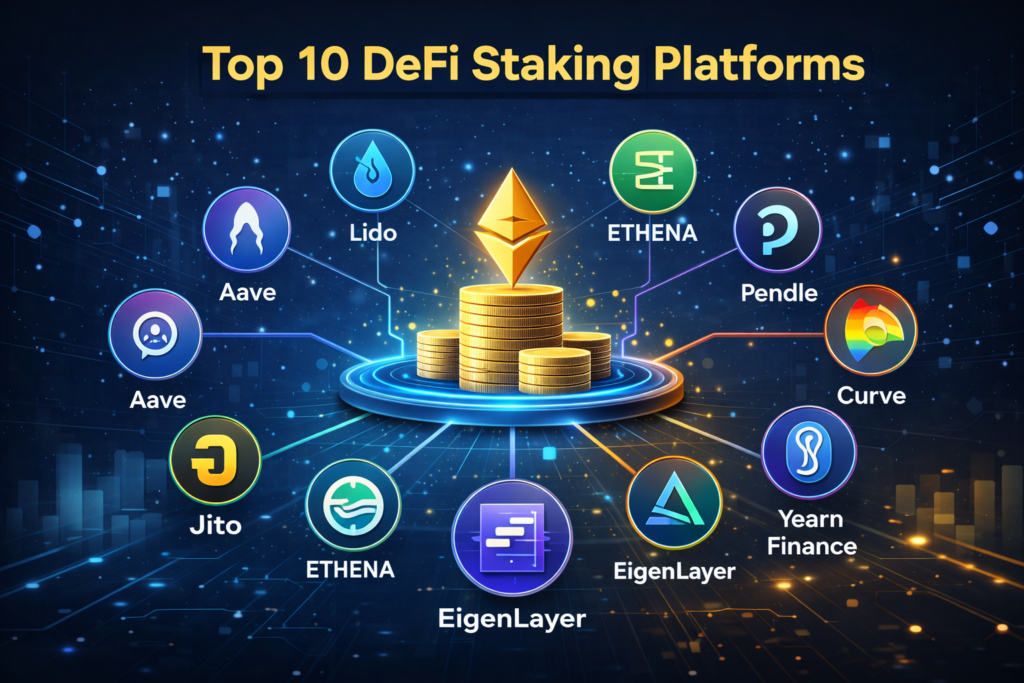
As DeFi continues to mature in 2026, staking platforms have become more secure, flexible, and user-friendly. Below are some of the most popular and trusted DeFi staking platforms, each offering different benefits depending on your goals.
Lido Finance
Best for: Users who want flexible staking
Lido Finance is the largest liquid staking protocol in DeFi, letting ETH holders stake without lock-ups while receiving stETH they can still use across 150+ DeFi apps.
As of November 2025 it holds about $34.8B–$38.3B TVL, offers ~2.5–3.0% APY, and runs mainly on Ethereum while expanding to Layer-2 networks like Arbitrum, Optimism, and Base.
Lido is DAO-governed (LDO token) and security-audited by major firms with a bug bounty program up to $2M, while withdrawals typically take 1–5 days depending on network demand. It uses 31+ professional node operators, has no minimum staking requirement, and provides instant liquidity through stETH.
The platform is generally considered low–medium risk due to size and centralization concerns, and is best suited for long-term ETH holders who want staking rewards without losing flexibility. Lido earns around $9.25M monthly in staking commissions and can be accessed directly at lido.fi.
Pros
- Offers liquid staking with no lock-up period
- No minimum staking amount
- Deep integration across DeFi protocols
- High liquidity and strong adoption
Cons
- Smart contract risk
- Governance power is somewhat concentrated
- Liquid token price may slightly deviate from underlying asset
Also Read: Top 10 Free Crypto Mining Apps In 2026
Rocket Pool
Best for: Users who value decentralization over convenience
Rocket Pool is a decentralized liquid staking protocol for Ethereum with about $4.6B TVL as of November 2025. It lets users stake ETH and receive rETH, a liquid token that grows in value as rewards accrue, typically earning around 2.5–2.7% APY.
Launched in November 2021, Rocket Pool is known for being the most decentralized ETH staking option, supporting over 1,500 independent node operators and allowing nodes to run with only 8 ETH (instead of 32), backed by RPL collateral. It is community-driven rather than controlled by a single DAO token and has undergone multiple audits by leading security firms.
Withdrawals usually take 1–7 days depending on network activity, and risk is considered low-to-medium due to decentralization but smaller scale compared to Lido. Rocket Pool is best for ETH stakers who value decentralization and for node operators wanting a permissionless setup, with staking available directly at rocketpool.net.
Pros
- Highly decentralized Ethereum staking
- Community-run node operators
- Strong alignment with Ethereum’s decentralization goals
- rETH token automatically accrues rewards
Cons
- Supports only Ethereum
- More complex setup than Lido
- Smaller liquidity compared to larger platforms
Aave
Best for: Long-term DeFi users
Aave is one of the largest DeFi lending platforms, with over $24 billion locked across 13 blockchains as of November 2025. Its main purpose is to let users lend and borrow crypto, while also offering staking through the Safety Module where AAVE holders can earn variable rewards (usually 3–8%) in exchange for helping secure the protocol.
Available on Ethereum, Polygon, Avalanche, Arbitrum, Optimism, Base, and more, Aave is known for features like flash loans, cross-chain liquidity, and over-collateralized lending. The platform is governed by AAVE token holders and has undergone multiple security audits, though risks still exist due to smart contracts and borrower liquidations.
Overall, Aave is best suited for experienced DeFi users who want to earn yield while actively using lending strategies, and staking is done directly through app.aave.com.
Pros
- Combines staking with lending and borrowing
- Strong security track record
- Supports multiple yield strategies
- Active governance participation
Cons
- Not a pure staking platform
- Yields are generally lower than aggressive DeFi strategies
- Requires understanding of DeFi lending mechanics
EigenLayer
Best for: Advanced DeFi users
EigenLayer is a restaking protocol on Ethereum that allows users to reuse already staked ETH to secure additional services called AVSs, earning extra rewards on top of base ETH staking yields. As of November 2025, it holds an estimated TVL of $12–15B, with APYs that vary depending on AVS rewards and market conditions.
Launched in June 2023, EigenLayer has become popular among advanced DeFi users who want to maximize ETH yield, including those using liquid restaking partners like Ether.fi. While the protocol is audited, restaking introduces extra slashing and smart contract risks because funds help secure multiple systems at once.
Unbonding typically takes around seven days, and governance is still evolving. Overall, EigenLayer suits experienced users willing to accept Medium–High risk in exchange for layered reward opportunities, and staking is available through app.eigenlayer.xyz.
Pros
- Introduces innovative restaking model
- Enables multiple layers of rewards
- Strong ecosystem growth in 2025
- Maximizes capital efficiency
Cons
- Higher smart contract and slashing risk
- Complex mechanics for beginners
- Rewards can be variable
Ether.fi
Best for: users who want restaking exposure
Ether.fi is a liquid restaking protocol built on Ethereum that lets users earn extra rewards by restaking ETH while still keeping liquidity through tokens like eETH and weETH. By late 2025 it holds an estimated $8–10B TVL, working closely with EigenLayer to combine liquid staking and restaking so users can delegate validator keys without giving up custody.
Rewards are variable because they come from both ETH staking and restaking incentives, and users can deploy their liquid tokens across 150+ DeFi apps including Uniswap, Curve, Morpho, and Aave V3.
The protocol is non-custodial and has been audited by Halborn and OpenZeppelin with an Immunefi bounty program, though risks remain such as AVS slashing and possible weETH de-pegging, giving it a medium-high risk profile.
Ether.fi is best suited for users who want higher-yield ETH exposure with flexibility and liquidity, and staking is available directly on the ether.fi platform.
Pros:
- Non-custodial: Users keep control of their keys
- Combines liquid staking with restaking for multiple yield streams
- Integration with 150+ DeFi apps, including Uniswap, Curve, Morpho, and Aave V3
- Audited by reputable security firms (Halborn, OpenZeppelin)
- Flexible staking with liquidity (via eETH/weETH)
Cons:
- Medium-High risk due to AVS slashing conditions
- Potential de-peg risk of liquid restaking tokens like weETH
- Novel protocol; less established than major staking platforms
- Complexity may be challenging for beginners
ETHENA
Best for: users looking for high-yield opportunities with stablecoins
ETHENA is a yield-bearing stablecoin protocol that lets users stake its synthetic dollar token, USDe, to earn variable APYs, currently ranging from 5% to 15% depending on funding.
Launched in 2024, it operates on Ethereum and is expanding to BNB, Solana, and TON, offering features like delta-neutral hedging, instant stake/unstake via sUSDe, and no traditional collateral requirements.
While it provides attractive yields for stablecoin investors, it carries high risk due to funding rate dependency and potential de-peg events. ETHENA is best suited for users seeking high-risk stablecoin yields and has been audited by Zellic and Trail of Bits, with an Immunefi bug bounty of up to $250K.
Pros:
- High yield potential (5–15% APY in 2025; previously 60%+ in 2024)
- Delta-neutral hedging reduces some market exposure
- Instant stake and unstake via sUSDe
- Expanding multi-chain support (Ethereum, BNB, Solana, TON)
- Audited by reputable firms (Zellic, Trail of Bits) with bug bounty coverage
Cons:
- High risk due to funding rate dependency and de-peg potential
- Less established and highly variable TVL
- Complexity may not suit beginners
- Yield can fluctuate significantly based on market conditions
JITO
Best for: Solana ecosystem participants who want to earn staking rewards with liquid SOL
JITO is a Solana-based liquid staking platform that allows users to stake SOL and receive JitoSOL tokens while earning 7–8% APY, including MEV rewards.
Launched in November 2022, it offers MEV-boosted yields and deep integration with the Solana DeFi ecosystem, enabling staked SOL to remain liquid for other uses.
The protocol has been audited by OtterSec, Neodyme, and Zellic, and carries a medium risk due to Solana network vulnerabilities and validator performance. JITO is best suited for users participating in the Solana ecosystem who want to earn staking rewards while retaining flexibility.
Pros:
- Attractive APY (7–8%) including MEV rewards
- Liquid staking via JitoSOL tokens allows flexibility
- Deep integration with Solana DeFi protocols
- Audited by reputable firms (OtterSec, Neodyme, Zellic)
- Simple entry for Solana users
Cons:
- Medium risk due to Solana network vulnerabilities and validator performance
- MEV rewards can fluctuate
- Limited to Solana, not multi-chain
- Newer platform, so less long-term track record
Avalanche (AVAX) Staking
Best for: Users seeking Layer-1 staking rewards with optional liquidity
Avalanche staking allows users to earn rewards by helping secure a fast, low-fee Layer-1 blockchain that supports a growing DeFi ecosystem. Native AVAX staking offers competitive yields, usually around 7–10% APY, but requires locking tokens for a set period.
For users who prefer flexibility, liquid staking platforms like Benqi (sAVAX) provide liquidity while still earning staking rewards. Avalanche staking is a strong option for users looking beyond Ethereum while staying within an active DeFi environment.
Pros:
- Competitive staking rewards compared to Ethereum
- Fast transactions and low network fees
- Liquid staking available via sAVAX
- Growing DeFi ecosystem
Cons:
- Native staking requires lock-up periods
- Smaller DeFi ecosystem than Ethereum
- Validator performance affects rewards
Polkadot (DOT)
Best For: Long-term stakers seeking higher protocol yields
Polkadot staking uses a Nominated Proof-of-Stake (NPoS) model, where DOT holders earn rewards by nominating reliable validators. Staking yields are relatively high, often in the 10–14% APY range, making DOT attractive for long-term holders.
However, unstaking involves a long unbonding period. Liquid staking solutions like Lido (stDOT) and Acala (LDOT) help reduce this friction by allowing stakers to keep their assets liquid while earning rewards.
Pros:
- Higher staking rewards than many Layer-1 networks
- Strong focus on interoperability and multi-chain design
- Liquid staking options available
- Well-established validator network
Cons:
- Long unbonding period (around 28 days)
- More complex staking process for beginners
- Liquid staking adds smart contract risk
Cardano(ADA)
Best For: Beginners prioritizing safety and easy staking
Cardano offers one of the simplest and safest staking models in crypto. ADA holders can stake directly from their wallets without locking funds or facing slashing risks.
Rewards are more modest, typically 3–5% APY, but users retain full control of their tokens at all times. While Cardano’s DeFi ecosystem is smaller compared to Ethereum or Solana, its staking system is ideal for users who value security, simplicity, and flexibility.
Pros:
- No lock-up or unbonding period
- No slashing risk for delegators
- Easy staking directly from wallets
- Beginner-friendly and low maintenance
Cons:
- Lower staking rewards compared to other networks
- Smaller DeFi ecosystem
- Fewer liquid staking and advanced yield options
Comparison of Best DeFi Staking Platforms
Choosing the right DeFi staking platform often comes down to which tokens you want to stake, how decentralized the platform is, and whether you want liquidity or fixed lock-ups. Below is an easy-to-read comparison to help you decide.
| Platform | Type | Primary Asset / Token | APY (Nov 2025) | Chain(s) | Risk Level | Best For | Pros | Cons |
| Lido Finance | Liquid staking | ETH (stETH) | 2.5–3.0% | Ethereum, L2s (Arbitrum, Optimism, Base) | Low–Medium | ETH holders wanting liquidity while staking | No minimum stake; instant liquidity via stETH; 150+ DeFi integrations; audited; DAO-governed | Centralization concerns; withdrawal queue 1–5 days; smart contract risk |
| Rocket Pool | Decentralized liquid staking | ETH (rETH) | 2.5–2.7% | Ethereum, L2 bridges | Low–Medium | Decentralization-focused ETH stakers | Highly decentralized; liquid rETH; 1,500+ node operators; audited | ETH-only; smaller platform than Lido; withdrawal queue 1–7 days |
| Aave | Lending + staking (Safety Module) | AAVE | 3–8% (variable) | Ethereum, Polygon, Avalanche, Arbitrum, Optimism, Base +7 | Medium | Users wanting to lend assets + earn yield | Cross-chain liquidity; safety module staking; flash loans; audited | Smart contract risk; borrower liquidation risk; complex for beginners |
| EigenLayer | Restaking | ETH | Variable | Ethereum | Medium–High | Advanced users seeking maximum ETH yields | Restake ETH for multiple networks; layered yield; liquid restaking via partners | Novel protocol; additional slashing risk; complex |
| Ether.fi | Liquid restaking | eETH/weETH | Variable | Ethereum, expanding to L2s | Medium–High | Users wanting restaking exposure with liquidity | Non-custodial; liquid + restaking; 150+ DeFi integrations; audited | AVS slashing risk; token de-peg risk; complex for beginners |
| ETHENA | Yield-bearing stablecoin | USDe | 5–15% (variable) | Ethereum, expanding to BNB, Solana, TON | High | Stablecoin yield seekers with high risk tolerance | High yield potential; delta-neutral hedging; instant stake/unstake; audited | High risk due to funding rate; de-peg risk; less established |
| JITO | Liquid staking with MEV | SOL (JitoSOL) | 7–8% | Solana | Medium | Solana ecosystem participants | MEV-boosted yields; deep Solana DeFi integration; audited | Solana network risk; validator performance; limited to Solana |
| Avalanche (AVAX) | Native and liquid staking | AVAX / sAVAX | 7-10% | Avalanche | Medium | Users seeking Layer-1 staking with optional liquidity | High APY; fast low-fee network; liquid staking via sAVAX; growing DeFi ecosystem | |
| Polkadot (DOT) | Nominated Proof-of-Stake and liquid staking | DOT / stDOT / LDOT | 10-14% | Polkadot | Medium | Long-term stakers seeking higher protocol yields | High staking rewards; strong interoperability design; liquid staking options; mature validator set | |
| Cardano (ADA) | Delegated Proof-of-Stake | ADA | 3-5% | Cardano | Low | Beginners prioritizing safety and flexibility | No lock-up; no slashing risk; easy wallet staking; beginner-friendly |
How to Choose the Best DeFi Staking Platform
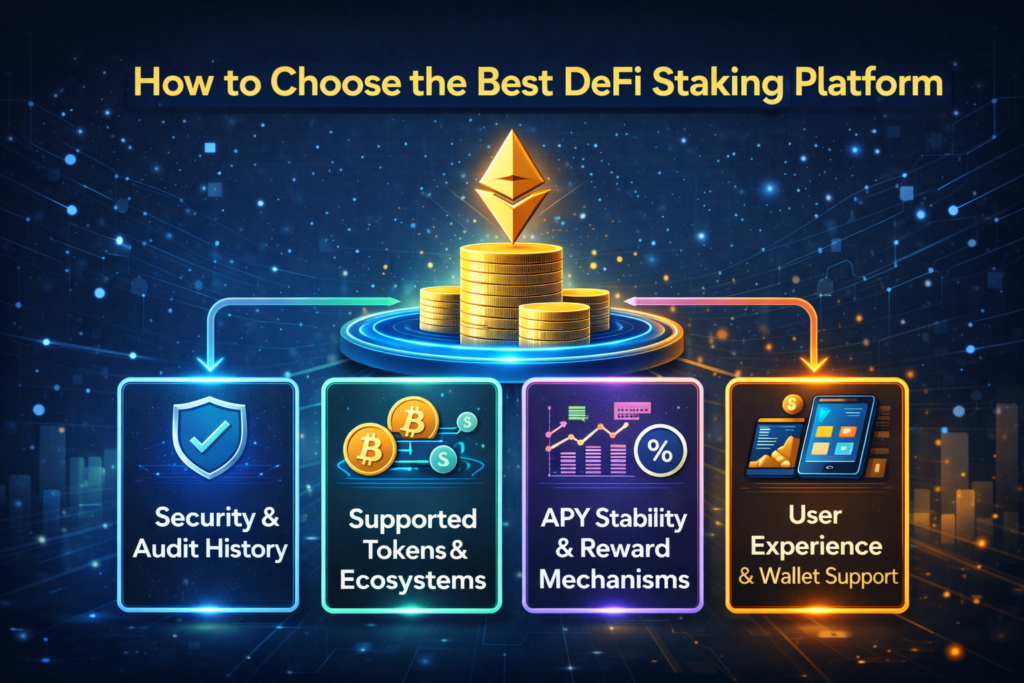
Choosing the right DeFi staking platform is an important step because it affects how much you earn, how safe your funds are, and how easy the whole process feels.
The best platform for you depends on your goals, risk level, and how actively you want to manage your crypto. Below are the main things you should look at before deciding.
Security and Audit History
Security should always come first. A good DeFi staking platform should have its smart contracts reviewed or audited by trusted security firms. This reduces the risk of bugs or hacking issues.
It also helps if the platform has been around for a while and has a strong track record with no major security failures. Platforms that are open about their audits and security measures are usually more trustworthy.
Supported Tokens and Ecosystems
Not every platform supports the same cryptocurrencies. Some focus on Ethereum only, while others support multiple blockchains like Solana, Polygon, or Polkadot. You should choose a platform that supports the tokens you already hold or plan to invest in.
It also helps to consider the ecosystem. For example, if you are active in Ethereum DeFi, using a platform built around ETH may feel more natural and convenient.
APY Stability and Reward Mechanisms
APY (Annual Percentage Yield) tells you how much you may earn over time. However, higher APYs do not always mean better options. In DeFi, yields can change frequently based on market demand, token supply, and activity on the network.
It is smart to look for platforms that offer consistent and transparent reward systems rather than chasing very high but unstable returns. Understanding how rewards are generated also helps you judge risk.
User Experience & Wallet Support
A platform should be easy to use, especially if you are new to DeFi. Clear dashboards, simple staking steps, and helpful documentation can make a big difference.
It also matters whether the platform supports popular wallets like MetaMask, Trust Wallet, or Coinbase Wallet. Smooth wallet connection and simple transactions reduce confusion and potential mistakes.
Risk Management Tips
Risk management is one of the most important parts of DeFi staking. It helps you protect your money while still earning rewards from the platforms you choose. By taking a few smart precautions, you can reduce risk and feel more confident about your staking decisions.
Diversification of Assets
It is usually safer not to stake all your funds in one platform or one token. Spreading your staking across different platforms or assets reduces the impact if something goes wrong with one protocol. Diversification helps balance risk and reward over time.
Understanding Lock-Up Durations
Some staking platforms require you to lock your tokens for a fixed period. During this time, you may not be able to withdraw your funds. Others allow flexible or liquid staking, where you can exit more easily.
Before staking, make sure you understand how long your funds will stay locked and whether early withdrawal is possible. This is especially important during market volatility.
Staying Updated with Protocol Changes
DeFi platforms evolve quickly. Reward rates, fees, rules, and features can change at any time. It helps to follow official announcements, community channels, or dashboards so you always know what’s happening. Staying informed allows you to react early if risks increase or better opportunities appear.
Beginner’s Guide to Getting Started with Defi Staking
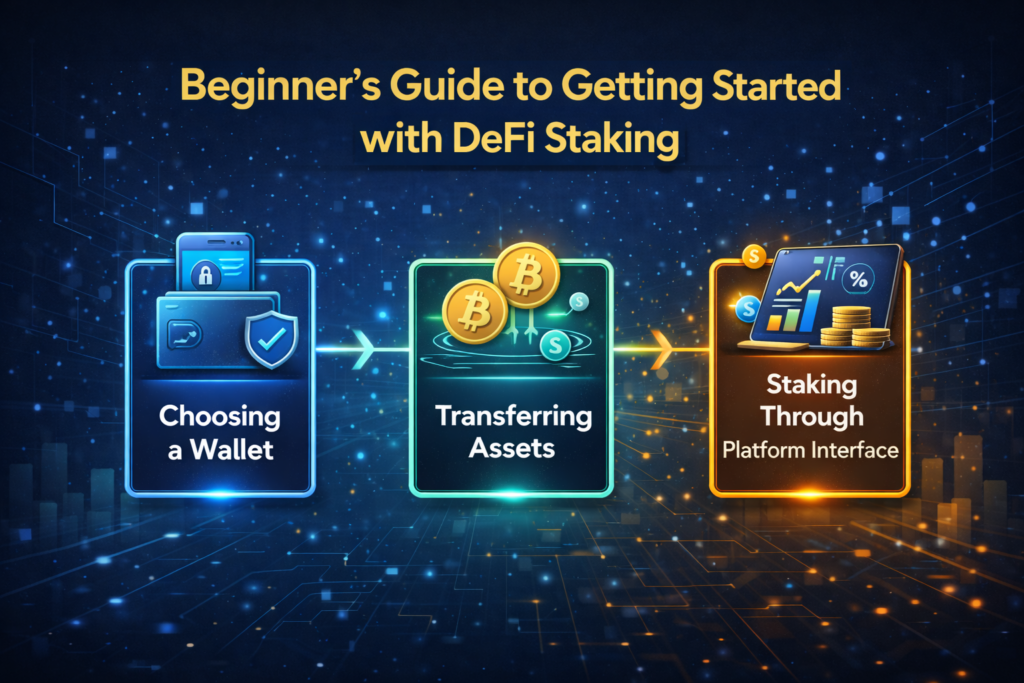
Getting started with DeFi staking is easier than it may seem. All you need is a crypto wallet, some tokens, and access to a staking platform. Follow the simple steps below to begin safely and confidently.
Choosing a Wallet
First, you need a crypto wallet that supports DeFi. Popular choices include MetaMask, Trust Wallet, and Coinbase Wallet. Your wallet is where you store your crypto and connect to staking platforms.
Always write down your recovery phrase and never share it with anyone. This phrase is the only way to regain access if you lose your device.
Transferring Assets
Next, deposit the tokens you want to stake into your wallet. This may involve buying crypto on an exchange and sending it to your wallet address. Double-check the network you are using to avoid mistakes, because sending tokens to the wrong network can result in permanent loss.
Staking Through the Platform Interface
Once your wallet has funds, visit the staking platform’s website and connect your wallet. Select the token you want to stake and choose the amount. The platform will show expected rewards and any lock-up period. Confirm the transaction in your wallet and your staking will begin automatically. You can usually monitor your rewards in real time.
Tools & Resources for Tracking Your Stakes
Dashboard Tools
Most staking platforms provide built-in dashboards that show your staked balance, rewards earned, and performance over time. These are helpful for monitoring progress without switching tools.
DeFi Analytics Platforms
External analytics platforms allow you to track multiple staking positions across different protocols in one place. They help you see total portfolio value, rewards growth, and historical performance so you can make informed decisions.
Alerts and Risk Monitoring
It’s also useful to set notifications for price changes, reward updates, or major platform announcements. Alerts help you react quickly if something changes, such as market volatility or protocol upgrades.
Also Read: Tokenomics in Crypto: What It Is and Why It Matters
Conclusion
DeFi staking offers an exciting way to earn passive income while supporting blockchain networks. From beginner-friendly options like Lido Finance and Coinbase Staking to advanced protocols like EigenLayer and Pendle, there is a platform to suit every investor’s goals, risk tolerance, and preferred level of involvement.
Choosing the right platform comes down to security, supported assets, APY potential, and user experience, while managing risks through diversification and staying informed about protocol updates is key
However, DeFi staking is not without risks. Smart contract vulnerabilities, network-specific risks, and token de-peg or slashing events can affect returns, making it essential to diversify your assets, understand lock-up periods, and monitor protocol updates. By carefully comparing platforms, evaluating APYs, and considering your comfort with risk, you can create a staking strategy that balances reward and safety.
FAQs
What is DeFi staking and how does it work?
DeFi staking allows you to lock up or delegate your crypto assets on decentralized platforms to earn rewards. Unlike traditional banking, your staked assets help secure blockchain networks and support operations while generating passive income.
What are the main types of DeFi staking?
The main types include liquid staking, where tokens remain tradable while staked; traditional on-chain staking, where assets are locked for a period; and restaking or advanced yield strategies, which allow assets to earn rewards multiple times or across multiple protocols.
Which DeFi staking platform is best for beginners?
Platforms like Lido Finance, Aave, and Coinbase Staking are beginner-friendly. They offer simple interfaces, audited security, and lower risk levels, making it easy to start earning without managing complex strategies.
How do I choose the right DeFi staking platform?
Consider security, supported tokens, APY stability, liquidity options, and user experience. It’s also important to assess risk tolerance, understand lock-up durations, and stay updated with platform changes.
Can I access my funds while staking?
It depends on the platform. Liquid staking allows you to trade or withdraw your tokens with minimal delay, while traditional staking may require waiting for unbonding periods ranging from a few days to several weeks.
What risks should I be aware of when staking?
Key risks include smart contract vulnerabilities, network failures, slashing penalties, and token de-pegs. Diversifying your assets and monitoring protocol updates can help mitigate potential losses.