


Bitcoin mining is one of the most important yet least understood parts of the Bitcoin network. It is the invisible engine that keeps the world’s most popular cryptocurrencies running, yet very few people really grasp what it involves or why it matters.
Imagine a massive, global ledger that records every Bitcoin transaction ever made. This public record, known as the blockchain, must be constantly updated and protected against tampering. Bitcoin mining accomplishes this by using powerful computers to solve complex mathematical problems that verify and bundle transactions into secure blocks.
When a miner successfully completes this work, their block is added to the blockchain, and they are rewarded with newly minted bitcoins plus the transaction fees included in that block
Bitcoin mining does far more than create new coins. It is the mechanism that makes Bitcoin secure, trustless, and decentralized.
Mining has improved tremendously since Bitcoin’s early days. What once could be done on a home computer now requires specialized, energy-efficient machines and low-cost power sources to remain competitive.
The industry continues to innovate, adapting to changes in price, technology, and global regulation.
Read Also: Assessing the Sustainability of Cryptocurrency Mining
Key Takeaway
- Miners verify transactions and add them to the blockchain, keeping Bitcoin decentralized and trustworthy.
- Mining consumes significant electricity, so power efficiency and low-cost energy are crucial for profitability.
- You can mine solo, join a pool for steady rewards, or use cloud mining for convenience, each with its own risks and benefits.
- Modern mining relies on ASIC machines for speed and energy efficiency; CPUs and GPUs are no longer practical.
What Is Bitcoin Mining?
Bitcoin mining is the process by which new Bitcoin transactions are verified and added to the public ledger known as the blockchain. At the same time, mining is how new bitcoins are created and introduced into circulation. At its core, mining serves two main purposes:
- Validating transactions to ensure no one is cheating the system.
- Securing the network by making it extremely difficult to alter past transaction records.
Miners use powerful computers to compete in solving complex mathematical problems. When a miner successfully solves one of these problems, they earn the right to add a new block of transactions to the blockchain and receive a block reward (newly minted bitcoins plus transaction fees).
The Role of Miners in Securing the Bitcoin Blockchain
Bitcoin operates without a central authority like a bank or government. Instead, it relies on thousands of independent miners around the world. These miners collectively:
- Verify that transactions are valid
- Prevent double spending (using the same bitcoin twice)
- Maintain a single, agreed-upon history of transactions
Because miners must spend real-world resources (electricity and hardware) to participate, attacking the network would be extremely expensive. Any attempt to alter past transactions would require controlling a massive portion of the network’s total computing power, making fraud economically impractical.
This decentralized structure is what makes Bitcoin trustless, participants do not need to trust each other or a central party; they only need to trust the system’s rules.
Proof-of-Work Explained
Proof-of-Work (PoW) is the mechanism that allows Bitcoin to function as a decentralized system without relying on trust, central authorities, or human oversight.
It is not simply a technical rule but the economic and security foundation of the Bitcoin network. Proof-of-Work forces participants to demonstrate that they have expended real-world resources before earning the right to update the blockchain, making dishonesty extremely costly and honest participation economically rational.
Transaction Collection and Validation
When a user sends a Bitcoin transaction, that transaction is broadcast to the network and temporarily stored in a waiting area known as the mempool. Miners constantly monitor the mempool and select valid, unconfirmed transactions to include in a new block.
Before inclusion, each transaction is independently verified by the miner. Digital signatures are checked, transaction inputs are confirmed to be unspent, and all consensus rules are enforced. Any transaction that fails these checks is rejected and never makes it into a block.
How Proof-of-Work Secures Bitcoin
Proof-of-Work ultimately secures Bitcoin by anchoring digital transactions to physical reality. Each block represents a measurable amount of energy spent, and every new block builds on all the work that came before it.
To change a past transaction, an attacker would need to redo the proof-of-work for that block and every block after it, while simultaneously outrunning the ongoing work of the rest of the network. This quickly becomes economically and practically impossible.
In essence, Proof-of-Work converts electricity into trust. It replaces reliance on institutions with mathematics, economics, and physics, enabling Bitcoin to function as a decentralized, censorship-resistant monetary system where no single party is in control.
Why Bitcoin Mining Matters
Bitcoin mining is not just a way to earn bitcoin, it is fundamental to Bitcoin’s survival and success as a decentralized financial system.
Mining helps ensure that no single entity controls Bitcoin. Because miners are spread across different countries, jurisdictions, and energy sources:
- Power is distributed, not concentrated
- No single miner can easily censor transactions
- The network remains resilient against shutdowns or political interference
Bitcoin has a fixed supply of 21 million coins, and mining is the only way new bitcoins are created. This issuance follows a predictable schedule written into Bitcoin’s code
How Bitcoin Mining Works
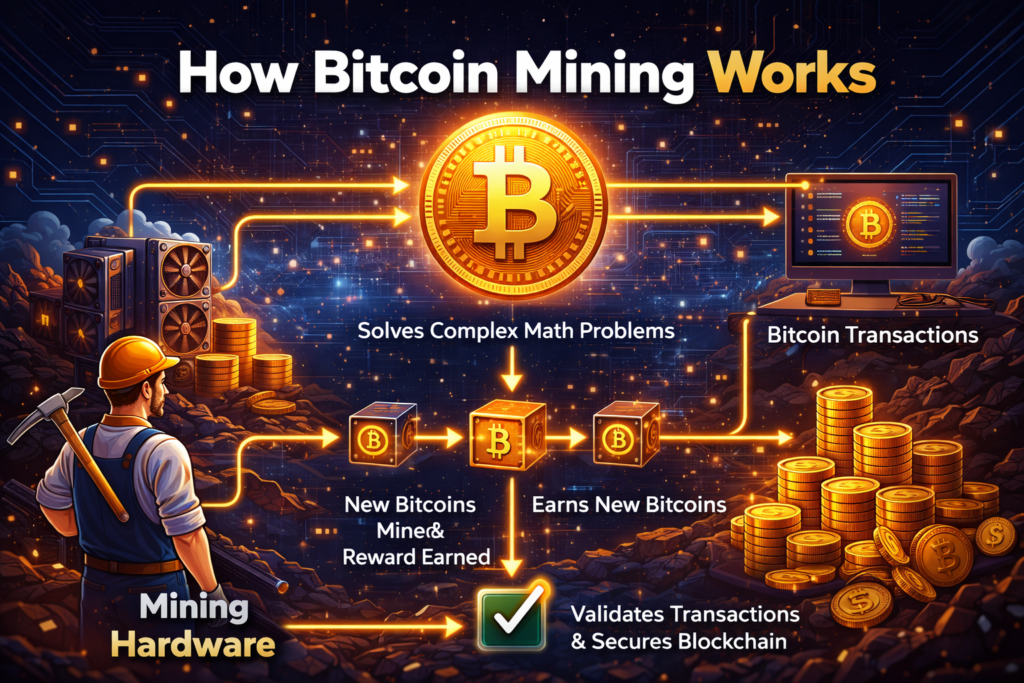
Bitcoin mining is the process that keeps the Bitcoin network operational, secure, and synchronized without relying on any central authority.
To understand how mining works in practice, it is important to look at the mining process itself, how miners are rewarded, and how those rewards are expected to evolve over time.
The Mining Process
At the heart of Bitcoin mining is a cryptographic mechanism built around the SHA-256 hashing algorithm. SHA-256 is a one-way function that converts data of any size into a fixed 256-bit output.
This output appears random, cannot be reversed, and changes completely if even a single character in the input is altered. Bitcoin relies on these properties to create a secure computational challenge that cannot be solved through logic or shortcuts, only through raw computation.
The actual mining process follows a clear sequence of steps:
- Miners collect unconfirmed transactions from the network’s mempool.
- Each transaction is independently verified to ensure digital signatures are valid, inputs have not already been spent, and all consensus rules are followed.
- Verified transactions are grouped together into a candidate block.
- A block header is created, containing the previous block’s hash, a Merkle root representing all transactions, a timestamp, the current difficulty target, and a nonce.
- The miner repeatedly hashes the block header using SHA-256.
- With each attempt, the nonce or other adjustable data is changed to produce a new hash.
- This process continues until a hash is found that is numerically lower than the network’s difficulty target.
Because SHA-256 outputs are unpredictable, miners must rely entirely on brute force, performing trillions of hash calculations per second. There is no way to estimate how close a miner is to finding a valid hash, and each attempt has the same probability of success as the last.
This randomness is what makes mining competitive and resource-intensive. Once a valid hash is discovered, the block is broadcast to the network. Other nodes quickly verify the proof-of-work and confirm that all included transactions follow Bitcoin’s rules.
If everything checks out, the block is accepted and added to the blockchain, extending the ledger by one block and marking the completion of a successful mining cycle.
Bitcoin Block Rewards and Halving
Each time a miner successfully adds a new block to the blockchain, they receive a reward made up of newly created bitcoins, known as the block subsidy, along with the transaction fees included in that block.
The block subsidy is how new bitcoins enter circulation, and it follows a strict and predictable schedule defined in Bitcoin’s code.
When Bitcoin launched in 2009, the block subsidy was 50 BTC per block. Approximately every four years, or every 210,000 blocks, this subsidy is cut in half in an event known as the Bitcoin halving.
Each halving reduces the rate at which new bitcoins are created. Over time, this has a direct impact on miner revenue, as the portion of income coming from newly minted coins steadily declines. While halving events reduce immediate rewards, they also reinforce Bitcoin’s scarcity by slowing the growth of its supply.
Historically, halvings have played a significant role in shaping mining economics, forcing miners to become more efficient and increasingly reliant on market conditions such as bitcoin price and transaction demand.
Transaction Fees vs Block Rewards
In addition to the block subsidy, miners earn transaction fees paid by users who want their transactions included in a block. When users submit transactions, they can attach a fee, and miners typically prioritize transactions with higher fees, especially during periods of network congestion.
As block subsidies decrease over time due to halvings, transaction fees become a more important component of miner income.
Eventually, when the maximum supply of 21 million bitcoins is reached and block subsidies drop to zero, transaction fees are expected to be the primary incentive for miners.
At that point, Bitcoin’s security will be funded entirely by users who value transaction finality and censorship resistance enough to pay for it. This transition is a deliberate part of Bitcoin’s long-term design, ensuring that the network remains secure and sustainable without relying on inflation.
Types of Bitcoin Mining
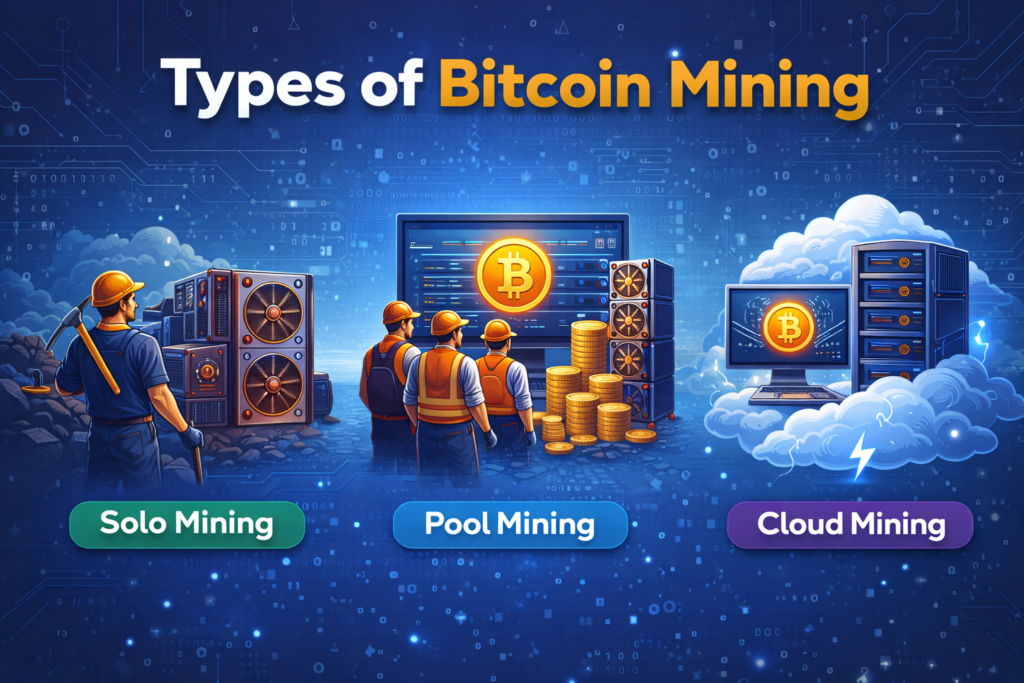
Bitcoin mining can be done in different ways depending on the miner’s resources, experience level, and risk tolerance. While the underlying mining process remains the same, how miners participate in the network varies widely.
The three main types of Bitcoin mining are solo mining, mining pools, and cloud mining. Each approach has its own advantages, disadvantages, and suitability for different users.
Solo Mining
Solo mining means mining Bitcoin independently without joining a mining pool. The miner runs their own hardware and software, connects directly to the Bitcoin network, and keeps the entire block reward if they successfully mine a block.
The main benefit of solo mining is full control and full rewards, with no pool fees or shared payouts. It also supports Bitcoin’s decentralization by allowing individuals to participate on their own.
However, due to today’s extremely high mining difficulty and network hash rate, the chances of a single miner finding a block are very low unless they operate at a very large scale. Most small or home miners may run equipment for long periods without earning any reward, making income highly unpredictable.
Pros
- Full control over the mining operation
- Keeps 100% of block rewards and transaction fees
- Supports network decentralization
Cons
- Extremely low chance of finding a block for small miners
- Highly unpredictable income
- Requires significant hardware and electricity investment
Mining Pools
Mining pools are groups of miners who combine their computing power to increase the chances of mining blocks regularly. Instead of mining alone, participants share their hash power and work together.
When a block is mined, the reward is split among members based on the amount of work they contributed. Although pools charge small fees and use different payout methods, they provide steady and predictable income.
For most individual and small-scale miners, mining pools are the most practical option because they reduce risk and eliminate the long wait times common with solo mining.
Pros
- More consistent and predictable earnings
- Lower risk compared to solo mining
- Suitable for small and medium-scale miners
Cons
- Rewards are shared among participants
- Pool fees reduce total earnings
- Some pools contribute to hash power centralization
Cloud Mining
Cloud mining lets users mine Bitcoin by renting hash power from companies that operate large mining facilities.
The provider handles the hardware, electricity, and maintenance, while the user receives a portion of the mining rewards.
Its main advantage is convenience, as users do not need to buy or manage mining equipment. However, cloud mining carries high risks.
Many services are unprofitable or unreliable, and fees or long-term contracts can eliminate potential earnings. Compared to owning mining hardware, cloud mining offers less control and transparency, making it a higher-risk option for most users.
Pros
- No need to buy or manage mining hardware
- No concerns about electricity, heat, or maintenance
- Easy entry for beginners
Cons
- High risk of scams or unprofitable contracts
- Limited control and transparency
- Often less profitable than owning hardware or buying Bitcoin directly
Bitcoin Mining Hardware
Bitcoin mining hardware refers to the specialized machines used to perform the calculations required to secure the Bitcoin network. Over time, mining hardware has evolved from simple home computers to highly specialized machines.
Understanding mining hardware helps miners choose the right equipment and avoid costly mistakes.
Overview of ASIC Miners
ASIC stands for Application-Specific Integrated Circuit. An ASIC miner is a machine designed exclusively to mine Bitcoin and other SHA-256–based cryptocurrencies.
Unlike general purpose computers, ASIC miners do one task extremely well: hashing as fast and as efficiently as possible.
In the early days of Bitcoin, mining could be done using CPUs and later GPUs. However, as more miners joined the network and difficulty increased, CPUs and GPUs became too slow and inefficient to compete.
ASIC miners replaced them because they deliver far higher hash rates while using less power per calculation. Today, mining Bitcoin with a CPU or GPU is effectively impossible to do profitably.
ASIC miners now dominate the Bitcoin network because they offer the best balance of speed, energy efficiency, and long-term reliability.
Top Bitcoin Mining Hardware in 2026
| Miner Model | Hash Rate (TH/s) | Power Efficiency (J/TH) | Launch Year |
| Bitmain Antminer S21 XP | 270 | 13.5 | 2024 |
| Bitmain Antminer S21 Pro | 234 | 15 | 2024 |
| Bitmain Antminer S21+ | 216 | 16.5 | 2025 |
| MicroBT WhatsMiner M66S++ | 298 | 18 | 2023 |
| Canaan Avalon Q | 90 | 18.6 | 2025 |
By 2026, Bitcoin mining hardware continues to focus on higher efficiency and lower energy usage, as electricity costs are one of the biggest factors affecting profitability.
- Bitmain Antminer Series
Bitmain’s Antminer lineup remains one of the most popular choices in the mining industry. These machines are known for high hash rates, competitive power efficiency, and widespread support. Antminers are commonly used by both large scale mining farms and serious individual miners.
- WhatsMiner Models
WhatsMiner devices, produced by MicroBT, are another leading option in Bitcoin mining. They are known for strong build quality, stable performance, and competitive efficiency. Many industrial mining operations prefer WhatsMiner models due to their durability and consistent output.
- Canaan Avalon Q
Avalon Q delivers stable performance and good power efficiency, making it a solid alternative for miners who value reliability and ease of use.
Hardware Specs to Consider
When choosing Bitcoin mining hardware, a few key specifications matter more than anything else.
- Hash rate: measures how many calculations a miner can perform per second. A higher hash rate increases the chances of earning rewards, but it usually comes with higher power usage.
- Power efficiency: often measured in watts per terahash (W/TH), shows how much electricity the miner uses to produce hashing power. Lower W/TH values mean better efficiency and lower operating costs.
- Cost and depreciation: are also critical. ASIC miners are expensive and lose value over time as newer, more efficient models are released. A miner must earn enough Bitcoin before the hardware becomes outdated to justify the investment.
Energy & Environmental Considerations of Bitcoin Mining
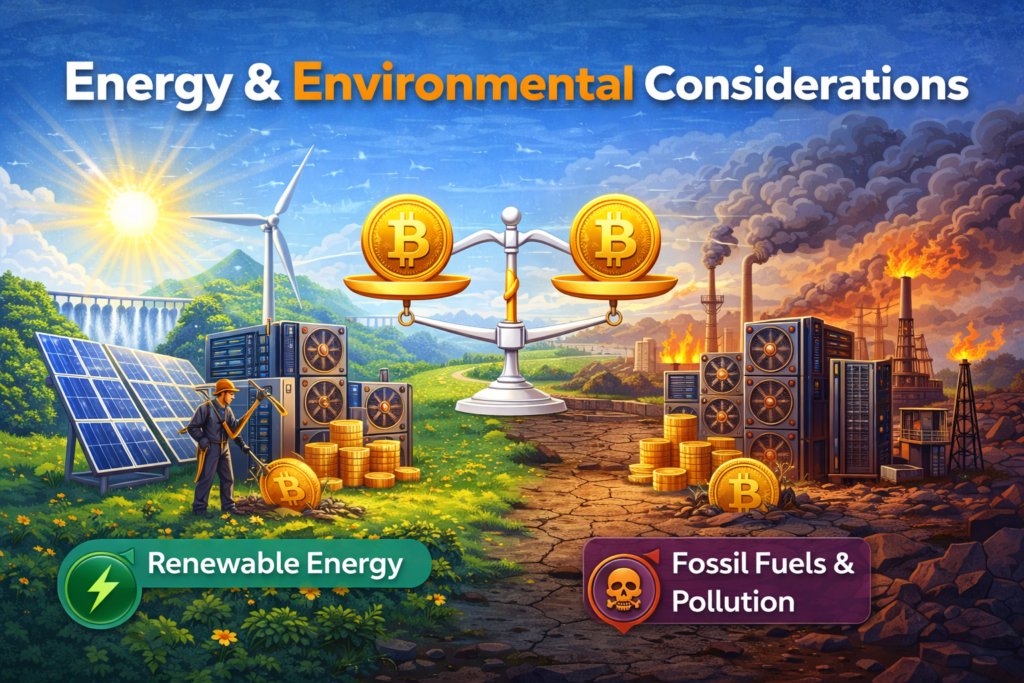
Energy use is one of the most discussed aspects of Bitcoin mining. Because mining relies on large amounts of computation, it naturally consumes electricity.
Energy Consumption of Bitcoin Mining
Bitcoin mining consumes significant power because it is built on the Proof-of-Work system, which requires miners to perform vast numbers of cryptographic calculations.
These calculations secure the network by making it expensive and difficult to attack or manipulate. The more computing power participating in mining, the more energy is required, but also the more secure the network becomes.
Mining machines run continuously, often 24 hours a day, to compete for block rewards. As mining difficulty increases, more energy is needed to maintain the same level of competitiveness.
This energy usage is not accidental or wasteful by design; it is the cost paid to maintain a decentralized, censorship-resistant financial system without relying on trusted intermediaries.
Renewable and Alternative Energy Strategies
To reduce costs and environmental impact, many miners actively seek low-cost and renewable energy sources. Hydroelectric power is widely used in regions with abundant water resources because it provides reliable and inexpensive electricity.
Wind and solar energy are also increasingly used, especially when paired with energy storage or flexible mining operations that can shut down during peak demand.
Some miners use alternative energy strategies such as flare gas, which captures and converts excess natural gas that would otherwise be burned off and wasted. By turning stranded or unused energy into productive work, mining can help improve overall energy efficiency.
These approaches allow miners to operate in remote locations and reduce both emissions and energy waste.
Sustainability Challenges
Despite these efforts, Bitcoin mining continues to face criticism over its carbon footprint. Concerns often focus on mining operations that rely on fossil fuels or operate in regions with carbon-intensive energy grids.
Public perception and regulatory scrutiny have increased as global attention on climate change has grown.
In response, the mining industry is investing in cleaner energy sources, more efficient hardware, and advanced cooling technologies that reduce overall power consumption.
New ASIC designs focus on higher efficiency, while innovations such as immersion cooling help reduce energy waste.
Potential Risks and Challenges of Bitcoin Mining
While Bitcoin mining can be profitable, it also comes with several risks and challenges that miners must understand before investing.
These risks come from regulations, market conditions, and the rapid pace of technological change in mining hardware. Being aware of them helps miners make better decisions and avoid unexpected losses.
Regulatory & Legal Risks
Bitcoin mining regulations vary widely from country to country and can change quickly.
- Country-Specific Mining Regulations
Bitcoin mining laws differ by country and can change with little notice. Some regions support mining, while others restrict or ban it due to energy, financial, or environmental concerns.
Sudden policy changes can force miners to shut down or relocate, creating major financial losses.
- Tax Implications and Compliance
In many jurisdictions, mined bitcoin is treated as taxable income. Miners may also owe capital gains tax when selling their bitcoin. Poor record-keeping or non-compliance can result in fines or legal issues, making tax awareness essential.
Market Volatility and Bitcoin Price Risk
Bitcoin’s price is highly volatile, and this directly affects mining profitability. When the price rises, mining rewards become more valuable, making operations more profitable.
When the price falls, miners may struggle to cover electricity and operating costs, especially those with high power expenses.
Because mining costs are relatively fixed in the short term, sudden price drops can quickly turn a profitable operation into a loss.
This risk is higher for small miners who lack access to cheap electricity or efficient hardware. Market volatility makes long-term planning difficult and adds uncertainty to mining returns.
Hardware Obsolescence and Lifecycle
Bitcoin mining hardware becomes outdated quickly. New ASIC miners are released regularly, offering better performance and lower power usage.
Older machines often become unprofitable as mining difficulty increases and energy costs rise, leading to rapid depreciation of equipment value.
Disposal becomes another challenge. Mining hardware contributes to electronic waste, and improper disposal can harm the environment. Responsible recycling and reuse of components are becoming more important as the industry grows.
Miners must plan for hardware replacement and end-of-life management as part of their overall strategy.
Conclusion
Bitcoin mining is the backbone of the Bitcoin network. It verifies transactions, secures the blockchain, and releases new bitcoins into circulation in a predictable, decentralized way.
Whether mined solo, through a pool, or via cloud services, mining requires careful planning, specialized hardware, and significant energy, making efficiency and cost management critical.
Miners also face challenges, including market volatility, hardware obsolescence, regulatory changes, and environmental concerns. Yet, ongoing innovation in hardware design and renewable energy solutions continues to make mining more sustainable and competitive.
Understanding Bitcoin mining gives you insight on how Bitcoin functions as a secure, trustless, and resilient digital currency. It’s not just about earning rewards, mining is what keeps the network alive, decentralized, and growing.
FAQs
What is Bitcoin mining?
Bitcoin mining is the process of verifying transactions and adding them to the blockchain. Miners solve complex mathematical problems, and in return, they earn new bitcoins and transaction fees.
Do I need expensive hardware to mine Bitcoin?
Yes. Modern Bitcoin mining requires specialized ASIC machines. CPUs and GPUs are no longer competitive for Bitcoin mining.
Can I mine Bitcoin at home?
You can, but home mining is usually unprofitable due to high electricity costs and network difficulty. Mining pools or small-scale setups are more practical for individual miners.
Do I need expensive hardware to mine Bitcoin?
Yes. Modern Bitcoin mining requires specialized ASIC machines. CPUs and GPUs are no longer competitive for Bitcoin mining.
How much electricity does mining consume?
Bitcoin mining uses a lot of power because miners run hardware continuously. Efficiency and energy costs are key factors in determining profitability.
What are mining pools and cloud mining?
Mining pools combine the computing power of multiple miners to earn rewards more consistently. Cloud mining lets you rent mining power from a provider without owning hardware, but it comes with higher risk and less control.
Is Bitcoin mining environmentally friendly?
Mining can impact the environment due to high energy consumption. However, many miners now use renewable energy like hydro, solar, wind, or flare gas to reduce carbon footprint.