It’s no surprise that everyone is searching for ways to handle crypto payments without the KYC headache.
Between wanting to keep your data private and just needing a faster, global way to move money, the demand for low-friction options is real.
This guide is about giving you the straight facts: what KYC actually is, where you can still find real privacy, and how the tech behind self-managed payments actually functions.
By the time you’re done reading, you’ll have a clear, pragmatic view of what’s actually possible (and legal) in today’s market.
Related Reads: KYC challenges in crypto, KYC compliance in the crypto sector.
What Is KYC and Why Does It Apply to Cryptocurrency?
KYC, short for Know Your Customer, is a regulatory requirement that obligates financial service providers to verify the identities of the people using their platforms.
Cryptocurrency entered KYC compliance territory formally in 2019 when the Financial Action Task Force (FATF) extended its Recommendations to cover Virtual Asset Service Providers (VASPs) through Interpretive Note 15.
Since then, the global compliance infrastructure has expanded dramatically.
By June 2025, FATF’s Travel Rule frameworks had been adopted or were in progress across 99 jurisdictions, according to FATF’s own update.
The Travel Rule specifically requires VASPs to collect and share originator and beneficiary information for transactions above defined thresholds.
The result is that any platform receiving, holding, exchanging, or transferring crypto on behalf of users is almost universally treated as a regulated entity that must verify customer identities.
Are Crypto Payments Without KYC Still Possible in 2026
Yes, but the answer requires precision. The phrase crypto payments without KYC covers several very different scenarios, and conflating them leads to poor decisions.
How Do Self-Custody Wallets Operate Without Identity Verification?
Self-custodial wallets: software or hardware wallets where you hold your own private keys have never required KYC and are not expected to under any current regulatory framework.
Self-custodial wallets: software or hardware wallets where you hold your own private keys have never required KYC and are not expected to under any current regulatory framework.
On-chain transactions between private wallets remain alias-based by design; your wallet address is public, but it is not directly linked to your name by any centralised party.
This is a legitimate, legal, and widely used approach. The caveat is that blockchain transactions are permanently recorded on a public ledger.
Blockchain analytics firms such as Chainalysis, Elliptic, and TRM Labs have become highly sophisticated at linking wallet addresses to real-world identities through transaction pattern analysis.
A 2025 report found that 68% of supposedly anonymous exchange users could be de-anonymised through on-chain analysis combined with publicly available data.
Privacy is not the same as anonymity.
What About Decentralised Exchanges and DeFi Protocols?
Decentralised exchanges (DEXs) like Uniswap execute trades through smart contracts without taking custody of user funds and, in most jurisdictions, currently operate without mandatory KYC on end users.
This is the technical reality. However, it is a rapidly narrowing window.
FATF’s 2025 report found that 48% of jurisdictions with advanced VASP regulation now require certain DeFi arrangements to be licensed or registered as VASPs, meaning KYC obligations are increasingly being extended even into decentralised infrastructure.
The US signed new legislation in 2025 that differentiates between DeFi protocols and brokers, providing some relief for pure DeFi protocols, but enforcement boundaries remain actively contested.
What Is a Non-Custodial Payment Gateway and How Does It Work Without KYC?
This is where the topic gets most relevant for merchants and businesses.
A non-custodial crypto payment gateway routes incoming payments directly to the merchant’s own wallet address, it never holds, touches, or controls the funds.
Because it takes no custody, it does not legally qualify as a VASP in most jurisdictions and therefore is not required to perform KYC on either the merchant or the customer.
The logic mirrors that of self-custody wallets: no custody means no regulatory trigger.
This is why non-custodial gateways can offer faster onboarding, sometimes within minutes, compared to custodial processors that require weeks of document verification before approving a merchant account.
The trade-off is that you receive crypto directly into your own wallet and are responsible for conversion to fiat through your own exchange relationship.

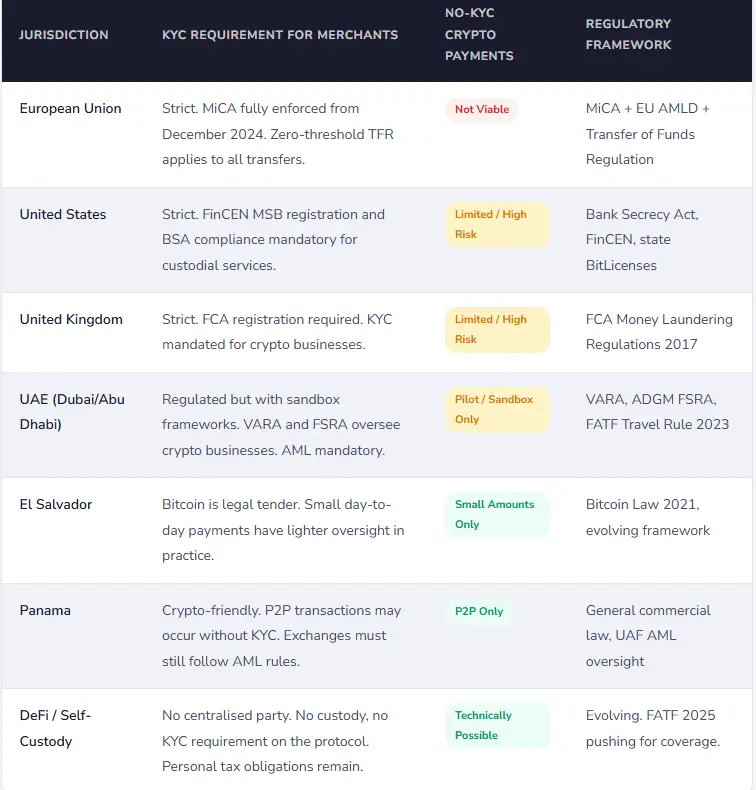
Where in the World Are Crypto Payments Permitted With Minimal KYC?
Why Anonymous Platforms Protect You Less Than You Think
The idea that you can stay completely hidden on a public blockchain is one of the biggest myths in crypto.
Every single move you make is etched into the blockchain forever.
Today, sophisticated analytics tools can trace your funds, link your different wallets together, and in many cases connect your digital activity right back to your real identity.
You don’t even need to be in a database for this to happen.
In fact, a 2025 Chainalysis report showed that most anonymous exchange moves can now be de-anonymized with the right tools.
What Happened to Major Platforms That Skipped KYC Compliance?
- OKX: Hit with a massive $504 million penalty by the DOJ for failing to implement basic AML and KYC controls, facilitating over $5 billion in suspicious moves.
- Paxful: Paid a $3.5 million fine to FinCEN for violations of the Bank Secrecy Act, including failing to report suspicious activity.
- Coinbase Europe: Fined €21.5 million by the Central Bank of Ireland for monitoring failures. This was a landmark move, the first major crypto enforcement action from Irish regulators.
- MiCA Crackdown: Over 50 crypto firms lost their licenses across the EU in 2025 alone, almost entirely because they couldn’t meet the new, stricter identity and money-laundering standards.
Drawbacks of KYC Requirements for Crypto Users
While KYC measures are designed to enhance security and regulatory compliance, they come with drawbacks.
Issues include the risk of identity theft, data breaches, and the overall compromise of personal information. Below are the privacy concerns in financial transactions:
- Identity Theft: Users are concerned about the risk of misusing their personal information for identity theft, leading to financial and reputational damage.
- Data Breaches: The potential for data breaches in centralized systems poses a significant threat, as hackers could gain access to a treasure trove of sensitive financial information.
- Surveillance and Tracking: Users value anonymity in financial dealings, and concerns arise when transactions are closely monitored, leading to a loss of individual freedom and autonomy.
- Targeted Advertising: Sharing financial data may result in targeted advertising, creating discomfort among users who prefer to keep their purchasing habits private.
- Government Surveillance: Fear of government surveillance and the potential misuse of financial information for surveillance purposes contributes to users’ desire for increased privacy.
- Third-Party Access: Users worry about how third-party service providers may access and use their financial data, raising questions about the security of such intermediaries.
- Financial Discrimination: KYC requirements may unintentionally contribute to financial discrimination, excluding individuals who lack conventional identification documents from participating in the financial system.
Potential Risks Associated with Crypto Payments Without KYC
- Legal and Regulatory Risks
- Security Risks
- Transaction Anonymity Challenges
- Fraud and Scams
Crypto Payment Without KYC: Tips To Stay Secure
- Stay Informed
- Use Reputable Services
- Diversify Privacy Measures
- Verify Counterparties in Peer-to-Peer Transactions
Conclusion
At the end of the day, the perfect setup for Crypto Payments Without KYC doesn’t exist, there is only the path that works best for your specific needs.
Be it through full compliance or non-custodial tools, the goal is to stay in the driver’s seat of your digital footprint, no matter how much the regulations shift
Don’t be a stranger, take a look at our other resources while you’re here. We’ve put together quite a bit on interesting topics such as how to donate crypto to charity, the role of cryptocurrency in lifestyle, and travel.