
If you have been sitting on appreciated Bitcoin or Ethereum and wondering whether your gains could do some good in the world, you are not alone.
Millions of crypto holders are asking exactly the same question: how to donate crypto to charity in a way that is straightforward, tax-efficient, and genuinely impactful.
This guide covers everything you need: how crypto charitable giving works, the tax advantages available in both the UK and the US, a step-by-step process for making your first donation, and the platforms and precautions that ensure your gift reaches the causes you care about.
Why Is Donating Crypto to Charity Such a Tax-Smart Decision?
This is the single most important piece of information most crypto holders are missing.
Donating digital assets directly to a registered charity is almost always more tax-efficient than selling your crypto and donating the cash proceeds.
Both the IRS in the United States and HMRC in the United Kingdom classify cryptocurrency as property rather than currency.
This classification has a critical implication: when you sell appreciated crypto, you owe capital gains tax on the profit.
But when you donate it directly to an eligible charity, that taxable disposal event is treated very differently.
Read Also: Technical Analysis in Crypto Trading and How Do You Actually Use It? 8 Factors Affecting Crypto-to-Fiat Conversion Rates
What Are the US Tax Benefits of Donating Cryptocurrency?
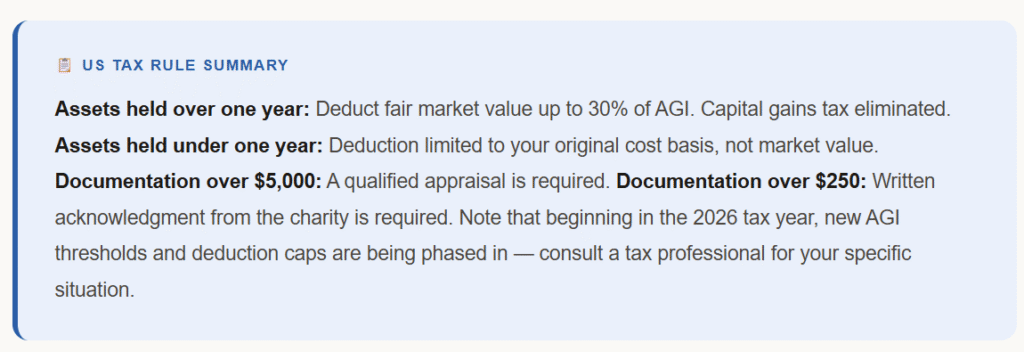
In the United States, donating long-term appreciated cryptocurrency directly to a qualified 501(c)(3) nonprofit can deliver two distinct tax advantages simultaneously.
First, you generally eliminate capital gains tax liability entirely on the donated asset.
Second, you can claim a charitable income tax deduction for the full fair market value of the crypto at the time of the gift, up to 30% of your adjusted gross income (AGI), with any excess carried forward for up to five years.
The combined capital gains and Medicare surtax saving can reach up to 23.8% of the asset’s appreciated value.
To put that in practical terms:
if you bought Bitcoin for £5,000 and it is now worth £33,000, donating it directly to charity means the charity receives the full £33,000, you claim a deduction for £33,000, and neither you nor the charity pays capital gains tax on the £28,000 appreciation.
Selling and then donating the cash would have cost you roughly £5,600 in tax first.
What Are the UK Tax Benefits of Donating Crypto to Charity?
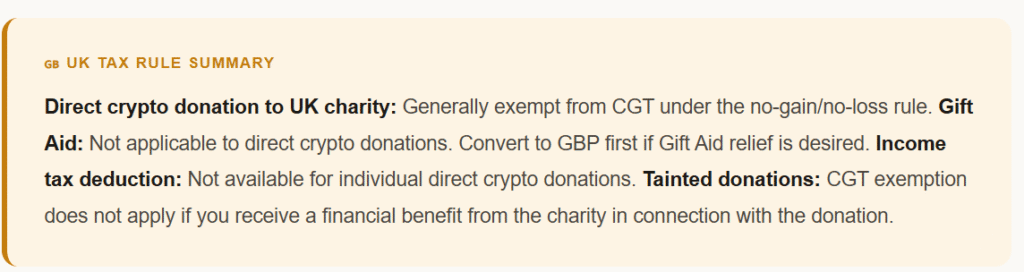
In the United Kingdom, donating cryptocurrency to a registered UK charity is generally exempt from Capital Gains Tax.
HMRC treats the disposal as a no-gain, no-loss transaction, meaning you do not pay CGT on the appreciation between your acquisition cost and the market value at the time of donation.
This is a significant benefit for any UK crypto holder sitting on substantial unrealised gains.
HMRC does not consider cryptoassets to be currency or money, which means crypto donations are not directly eligible for Gift Aid.
If you want your donation to qualify for Gift Aid which lets the charity reclaim 25p for every £1 donated, and lets higher-rate taxpayers claim additional relief, you will need to convert your crypto to sterling first, then donate the cash proceeds.
Bear in mind that converting crypto to cash is a taxable disposal event under UK tax law, so you would need to account for any CGT liability on the conversion before the donation.
How to Donate Crypto to Charity: A Step-by-Step Process
Once you understand the tax benefits, the mechanics of donating are surprisingly straightforward.
Here is a clear walkthrough from deciding to give, through to confirmation on the blockchain.
1. Verify the Charity Is Registered and Eligible
In the US, confirm the charity holds 501(c)(3) status using the IRS Tax Exempt Organisation Search. In the UK, check the Charity Commission register.
Donating to an unregistered entity does not qualify for tax benefits, and could expose you to scams.
2. Confirm the Charity Accepts Crypto Directly
Check the charity’s website for a crypto donation page.
Major organisations including the British Red Cross, Alzheimer’s Research UK, Save the Children, and Diabetes UK all accept crypto directly via platforms like The Giving Block.
If your chosen charity does not accept crypto, a donor-advised fund is your next best option (covered below).
3. Choose Which Cryptocurrency to Donate
In 2025, Bitcoin (BTC) remained the most donated cryptocurrency, followed by USDC and USDT stablecoins, Ripple USD (RLUSD), and Ethereum (ETH).
Donating an asset that has appreciated the most since you acquired it will typically generate the greatest tax benefit, since you avoid the largest potential capital gain.
4. Initiate the Transfer From Your Wallet
Open your crypto wallet, enter the charity’s wallet address exactly, specify the amount, and confirm the transaction.
Always double-check the recipient address before confirming blockchain transactions are irreversible once broadcast to the network.
Many charities use platforms like The Giving Block, which generates a unique wallet address for each donation.
5. Save Your Transaction Receipt
Once the transaction is confirmed on the blockchain, save the transaction hash (TXID), the fair market value of the crypto on the date of donation (check a reputable exchange for this figure), and the written acknowledgment from the charity.
For US donations over $250, the charity must provide a contemporaneous written acknowledgment. For gifts over $5,000, a qualified appraisal is required by the IRS.
6. Report the Donation on Your Tax Return
In the US, report the donation on Schedule A (if itemising) and attach Form 8283 for noncash contributions above £500.
In the UK, report any CGT-exempt disposal through your Self Assessment return. In both jurisdictions, a qualified tax professional familiar with digital assets is worth consulting before filing.
Examples of Well-Known Charities and Organizations Accepting Crypto Donations
Many well-known charities and organizations are now accepting crypto donations, recognizing the growing popularity of cryptocurrency and its potential to attract new donors and increase their fundraising capabilities. Here are some examples:
Save the Children: This international organization accepts donations in several cryptocurrencies, including Bitcoin, Ethereum, and Litecoin, to support its child-focused programs around the world.
UNICEF: The United Nations Children’s Fund accepts Bitcoin donations through its partnership with The Giving Block, a platform facilitating crypto donations for nonprofits.
World Food Programme: The WFP, part of the United Nations, accepts Bitcoin donations to provide food assistance to people in need worldwide.
American Cancer Society: The ACS accepts Bitcoin and other crypto donations to fund cancer research, education, and advocacy efforts.
St. Jude Children’s Research Hospital: This pediatric cancer research center accepts Bitcoin and other crypto donations to support its lifesaving work.
National Multiple Sclerosis Society: The NMSS accepts Bitcoin donations to fund research into multiple sclerosis, a chronic neurological disease.
The Nature Conservancy: This global conservation organization accepts Bitcoin donations to protect biodiversity and fight climate change.
ASPCA (American Society for the Prevention of Cruelty to Animals): The ASPCA accepts Bitcoin donations to help animals in need.
Which Platforms Make It Easy to Donate Crypto to Charity?
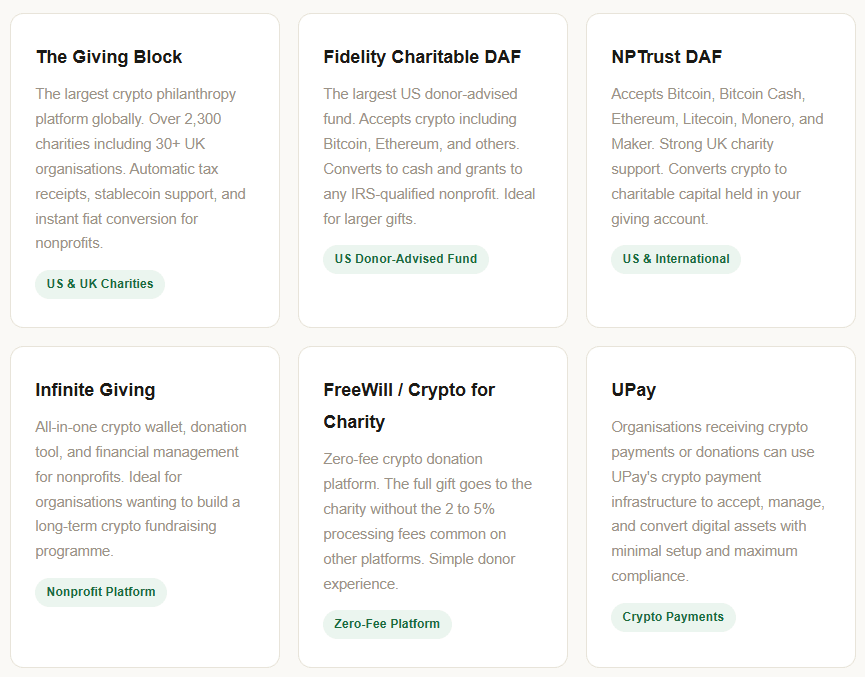
You do not need to arrange a crypto donation manually.
Several platforms have built dedicated infrastructure specifically for this purpose, handling wallet management, tax receipts, and currency conversion on behalf of both donors and charities.
Cryptocurrencies Commonly Accepted by Charities
While Bitcoin remains the most common, many charities accept other popular options like:
- Ethereum (ETH): Widely used, offering smart contracts for potential future charity applications.
- Litecoin (LTC): Faster transaction speeds compared to Bitcoin, attracting some charities.
- Stablecoins (USDC, DAI): Pegged to fiat currencies
Conclusion
Giving back doesn’t have to be a headache or a tax burden.
If you’ve been watching your portfolio grow, learning How to Donate Crypto to Charity is one of the most effective ways to maximize your impact while minimizing what you owe the taxman