



Over 560 million people worldwide now own Bitcoin as of 2025, yet most don’t know the 16+ proven methods to actually earn money with it beyond simple buying and holding.
In January 2025, Bitcoin surpassed $100,000 for the first time in history, reaching an all-time high of $126,198 in October. But the real story isn’t just about price appreciation.
The institutional revolution has transformed Bitcoin from a speculative asset into a legitimate wealth-building vehicle. BlackRock’s Bitcoin ETF manages over $50 billion, MicroStrategy holds 628,000+ BTC in corporate treasury, and 335 major institutions collectively own 3.75 million Bitcoin worth over $400 billion.
Most people believe making money with Bitcoin requires either being an early adopter (too late), technical expertise (too complex), or significant capital (too expensive). The truth? Bitcoin offers earning opportunities across every skill level, time commitment, and budget.
From passive methods requiring zero daily effort to active trading strategies for those willing to master chart analysis. Yet 93% of the global population still hasn’t touched cryptocurrency, and those who do often leave thousands in potential earnings on the table by only using one or two basic strategies.
What This Article Covers
This article provides 16 comprehensive methods to make money with Bitcoin, from passive HODLing to active trading, mining to affiliate marketing. You’ll get the 2026 market reality, including current profitability, institutional adoption impact, and regulatory changes. Every method includes real numbers showing actual returns, capital requirements, time investments, and tax implications.
I’ll give you a risk-adjusted analysis with honest assessments of difficulty, potential returns, and failure rates. The article includes interactive tools like Bitcoin profit calculators, mining ROI estimators, and tax impact calculators.
You’ll learn how BlackRock’s $50B ETF and corporate adoption creates new opportunities, master IRS guidance including Form 1099-DA requirements, and see 5+ real case studies with actual numbers, timelines, and lessons learned.
This is not a get-rich-quick scheme article. We’ll cover methods requiring $0 investment (faucets, affiliate marketing) to those requiring significant capital (mining operations, venture investing). Some strategies take 5 minutes to set up (credit card rewards), others require months to master (futures trading).
We’ll show you which methods match your risk tolerance, available capital, time commitment, and skill level, then provide actionable steps to get started today.
Bitcoin’s transformation in 2025 makes this the most opportune time in history to earn with BTC. Bitcoin ETF accessibility removes barriers for mainstream investors. Corporate adoption validates Bitcoin as an institutional-grade asset. Regulatory clarity through the GENIUS Act, CLARITY Act, and Strategic Bitcoin Reserve provides a legal framework.
Maturing infrastructure with custodians, tax software, and lending platforms makes earning easier and safer. Whether you’re a beginner with $100 or an experienced investor with $100,000+, there’s a Bitcoin earning strategy that fits your situation.
Why Bitcoin Has Value
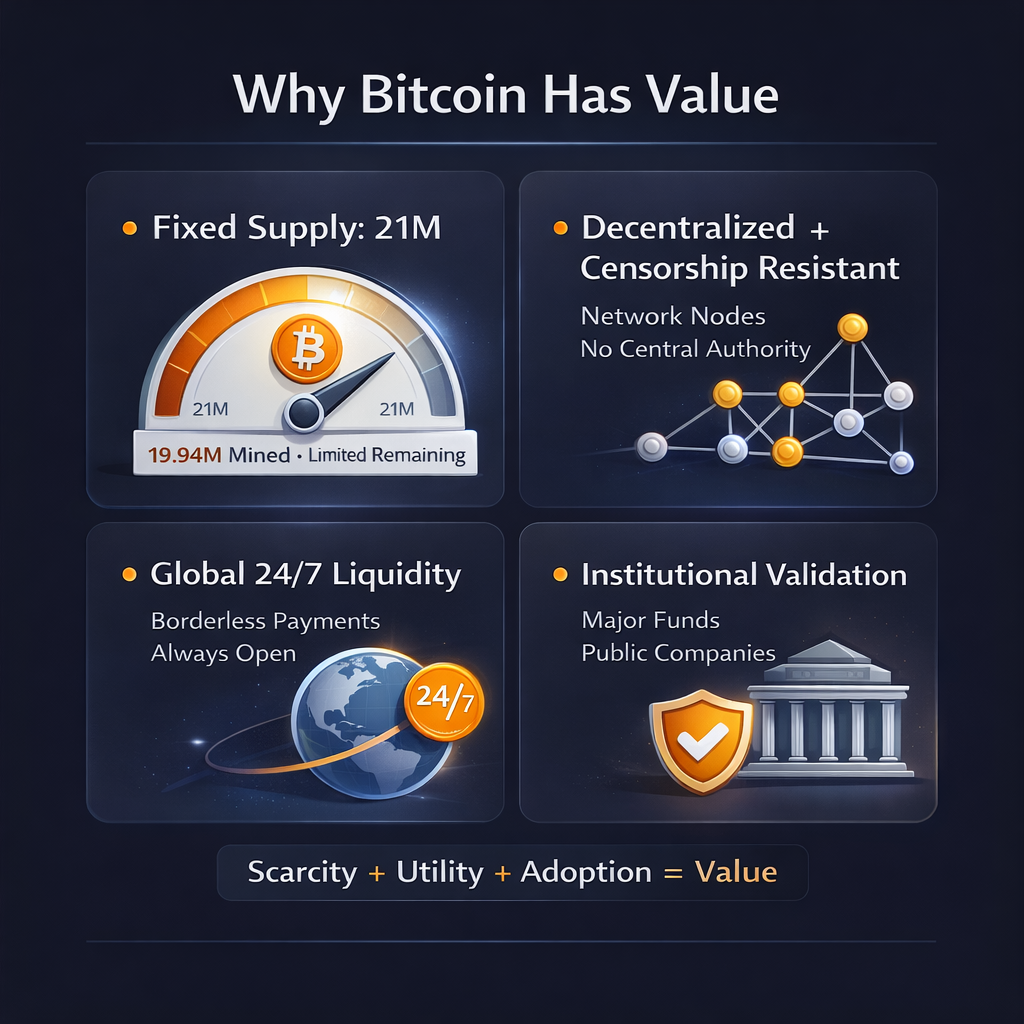
Understanding Bitcoin’s value proposition starts with fixed supply. Only 21 million Bitcoin will ever exist, and 19.94 million have already been mined. No government or entity controls Bitcoin, making it truly decentralized.
It’s the first truly scarce digital asset with global accessibility through 24/7 trading and borderless transfers. Institutional validation comes through $414 billion in institutional ownership and 66 ETFs globally. The “digital gold” comparison and inflation hedge properties support the store of value narrative.
The 2025 market shows genuine maturation. BlackRock, Fidelity, and 172 public companies now hold BTC. The Strategic Bitcoin Reserve, GENIUS Act, and CLARITY Act frameworks provide regulatory clarity.
Robust exchanges, custody solutions, tax software, and lending platforms demonstrate infrastructure maturity. Volatility is down 75% compared to earlier cycles, though still volatile versus stocks.
The $138B+ in spot Bitcoin ETFs makes institutional-grade investment easy, and MicroStrategy’s 628K BTC validates Bitcoin as a balance sheet asset.
Several factors drive Bitcoin’s price. The April 2024 halving reduced new supply to 3.125 BTC per block, creating a supply shock. ETF demand with $6.96B+ annual inflows removes BTC from circulation. Institutional accumulation sees 335 entities holding 3.75M BTC, roughly 19% of supply.
Macroeconomic factors like Fed rate cuts, dollar weakness, and inflation fears drive BTC demand. Bitcoin operates in roughly 4-year cycles tied to halving events. Technical factors show support at $108K and resistance at $115K-$118K as of November 2025.
The 2025 Market Landscape
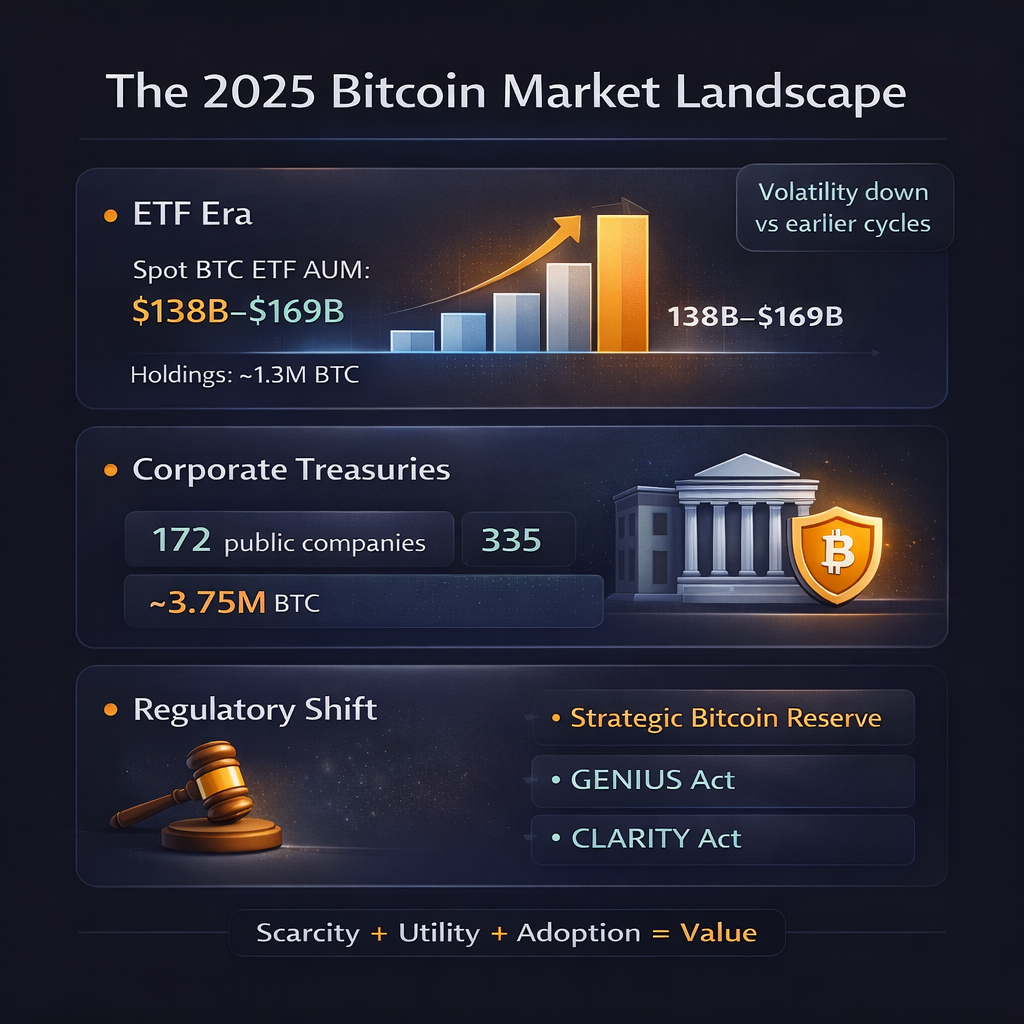
The institutional revolution in 2025 centers on Bitcoin ETFs. Total AUM across U.S. spot ETFs reaches $138-$169 billion, representing 6.79% of total Bitcoin market cap.
BlackRock iSHARES (IBIT) manages $50-$63 billion in AUM, becoming the largest commodity ETF and generating $244.5M profits in its first year.
2025 saw $6.96B+ in annual inflows, with Q3 2025 contributing $7.8B, an 85% increase from Q2’s $4.2B. A single-day inflow of $1.38B followed the Trump victory in November 2025. Total ETF Bitcoin holdings reach 1.296-1.358 million BTC, approximately 6.5% of the 19.94M circulating supply.
Corporate treasury adoption tells an equally striking story. 335 entities collectively hold 3.75 million BTC through institutional and corporate channels. MicroStrategy leads with 628,791-640,031 BTC, creating a $70B+ portfolio value.
Corporate holdings increased from 1.68M BTC in January 2025 to 1.98M BTC in May 2025, marking 18.67% year-to-date growth. 172 public companies now hold Bitcoin as a strategic treasury reserve, a 38% rise in Q3 2025.
Fortune 500 participation includes Oracle with 5% treasury allocation, Ford Motor Company launching blockchain currency, and rumors of Apple Bitcoin wallet integration.
Regulatory transformation accelerated in 2025. Trump’s executive order in March 2025 established the Strategic Bitcoin Reserve for federal BTC holdings. The GENIUS Act in July 2025 created the first federal stablecoin framework with 100% reserve requirements.
The CLARITY Act in 2025 defined SEC/CFTC oversight boundaries, ending jurisdictional disputes. SEC ETF streamlining in September 2025 cut approval time from 270 days to 75 days, a 72% efficiency gain. SEC Chairman Paul Atkins launched the “Project Crypto” initiative creating governance token frameworks. 58% of G20 members fully implemented crypto regulations, up from 22% in 2023.
Global adoption metrics show 1.732 billion crypto owners worldwide, representing 13% of 5.63 billion internet users. Bitcoin holders specifically number around 560 million people globally, less than 7% of the world population. 271% of institutional investors have invested in digital assets, with 341% holding spot cryptocurrencies.
The gender distribution shows 67% male and 33% female among U.S. cryptocurrency owners. The median age sits at 45 years old for U.S. cryptocurrency owners.
Top adoption countries include Vietnam at approximately 21.19%, followed by India, Pakistan, and the U.S. Wallet concentration remains extreme, with the top 1% of holders controlling 90%+ of Bitcoin supply.
Passive Income Methods: Earn Bitcoin with Minimal Effort
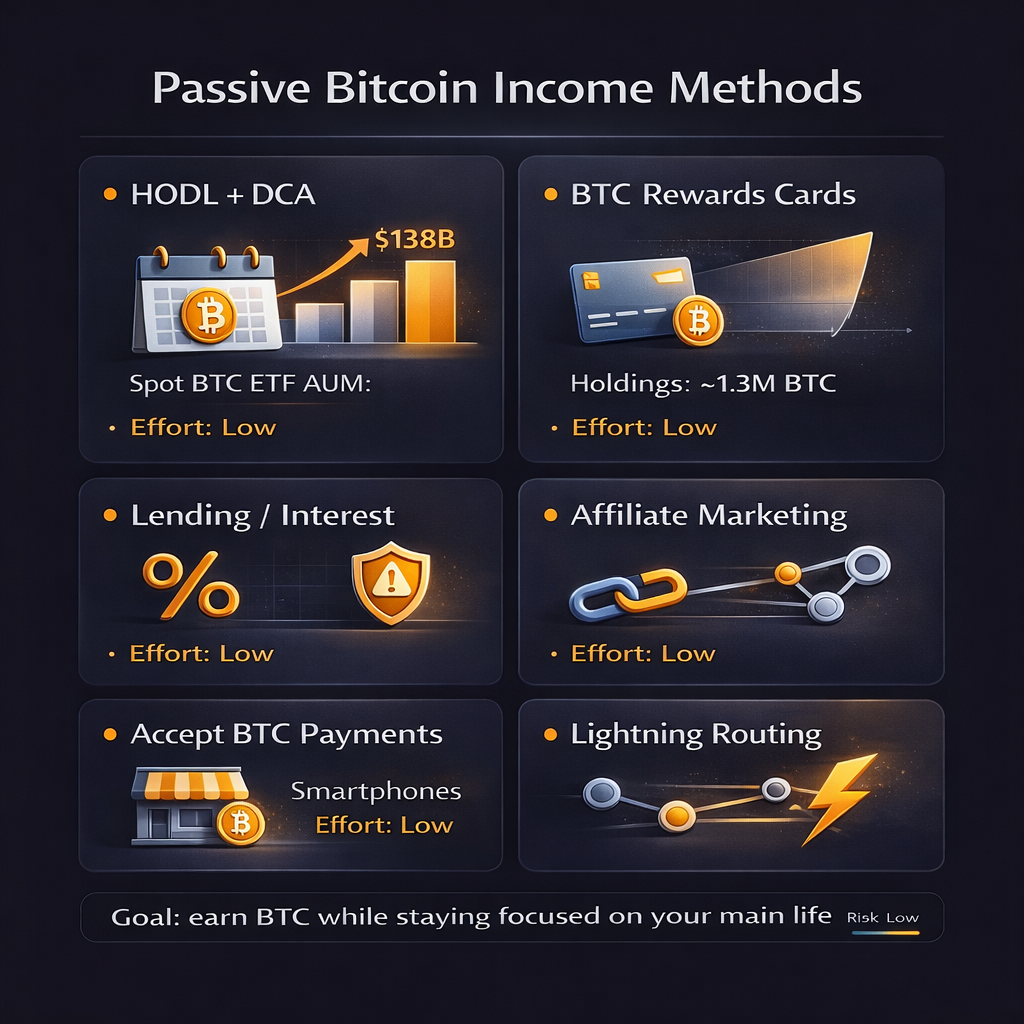
If your goal is to earn Bitcoin while staying focused on other priorities, these passive methods are worth a closer look.
1: Buy and HODL (Hold Long-Term)
HODLing means purchasing Bitcoin and holding it for extended periods, typically 1-10+ years, betting on long-term price appreciation. This strategy assumes Bitcoin’s scarcity with only 21 million maximum supply, institutional adoption, and global adoption will drive value higher over time.
This works in 2025 for several reasons. Historical performance shows Bitcoin went from $0.09 in 2010 to $100K+ in 2024, roughly 10,000,000% growth. Institutional validation through $138B+ in ETFs and 335 institutions holding provides a price floor.
The post-April 2024 halving means only 900 BTC mined daily versus 3,000 pre-halving, creating a supply shock.
The maturing asset shows 75% lower volatility than previous cycles, behaving more like a commodity. ETF accessibility lets mainstream investors access Bitcoin through retirement accounts.
Here’s how to implement this strategy. Choose a platform like Coinbase for beginner-friendly interface, Kraken for lower fees, or Binance for most features.
Determine your investment, starting with 2-5% of portfolio for conservative investors or 10%+ for aggressive. Dollar-cost average by investing a fixed amount weekly or monthly to smooth volatility.
Secure storage requires transferring BTC to a hardware wallet like Ledger or Trezor for holdings over $10K. Set a minimum 4-year holding period, one full halving cycle. Avoid emotional selling by ignoring short-term volatility and focusing on your long-term thesis.
Returns and expectations vary. Historical averages show roughly 200% per year from 2015-2020 and about 100% per year from 2020-2025. Conservative 2025-2030 projections suggest 15-25% annual returns matching institutional projections.
Optimistic scenarios predict $200K+ by 2026 and $400K+ by 2030 based on various analyst targets. The risk involves 20-40% drawdowns requiring emotional discipline.
Capital requirements start at $10 minimum, though $1,000-$10,000 is recommended for meaningful returns. Time investment needs 30 minutes initial setup and 1 hour monthly monitoring. Difficulty rates as beginner level (1/10). Risk level sits at medium due to Bitcoin volatility but no leverage or complexity risk.
Tax considerations matter. Hold 12+ months for long-term capital gains at 0%, 15%, or 20% versus 10-37% short-term rates. No taxable event occurs until you sell, trade, or use Bitcoin. Strategic selling in low-income years reduces tax burden.
Sarah’s case study shows the power of patient HODLing. She invested $10,000 in January 2020, purchasing at $5,000 per BTC for 2 BTC. She dollar-cost averaged an additional $200 monthly for 5 years, totaling $22,000 invested over 5 years.
By November 2025, her holdings reached approximately $250,000+ with a mix of $5K average purchase price compounding to $110K current price. The result was roughly 10x return. She learned patience beats trading and wishes she bought more.
2: Bitcoin Rewards Credit Cards
Bitcoin rewards credit cards offer cashback in Bitcoin instead of traditional points or miles. Every purchase earns 1-5% back in BTC, which appreciates if Bitcoin’s price rises.
Top platforms in 2025 include Fold Card offering 1-5% Bitcoin rewards, with higher tiers requiring Fold+ subscription.
BlockFi Card provides 1.5% BTC rewards, though BlockFi faces regulatory scrutiny so verify operational status.
Coinbase Card gives 1-4% crypto rewards where you can choose BTC. Crypto.com Visa offers up to 5% but requires CRO staking.
Real returns work like this. With $3,000 monthly spending and 2% BTC rewards, you earn $60 monthly or $720 yearly in BTC. If BTC appreciates 20% that year, $720 becomes $864 effective return. If BTC doubles, $720 becomes $1,440 effective return.
Capital requirements are $0 since there’s no cost if you pay your balance monthly. Time investment needs 5 minutes setup, then zero ongoing effort. Difficulty rates as beginner (1/10). Risk level is very low, the same as regular credit card use.
3: Bitcoin Lending & Interest Accounts
Bitcoin lending works by depositing Bitcoin into lending platforms that pay interest, typically 2-12% APY. Your BTC is lent to borrowers like margin traders or institutions who pay interest, which is passed to you.
Platform categories split into two types. Centralized lending includes platforms like Gemini Earn (recovering from 2022 freeze), Binance Earn, and Crypto.com Earn. Rates run 2-6% APY on Bitcoin.
The advantages are easy to use with higher rates for locked terms. The disadvantages include counterparty risk, regulatory uncertainty, and funds not FDIC insured.
DeFi lending uses platforms like Aave and Compound with wrapped Bitcoin like WBTC and renBTC. Rates run 0.5-4% APY, variable based on utilization.
The advantages are transparent smart contracts, no KYC, and permissionless access. The disadvantages include smart contract risk, requiring wrapping BTC which adds complexity, and gas fees.
A critical 2022-2024 warning: Multiple Bitcoin lending platforms collapsed in 2022-2023, including Celsius, BlockFi, and Voyager. Gemini Earn froze withdrawals in November 2022, only resolved in February 2024 with $1.1B customer recovery. Never invest more than you can afford to lose. Centralized lending carries significant counterparty risk.
Best practices for safe lending include diversifying platforms by never putting all BTC on one platform. Limit exposure to maximum 10-20% of Bitcoin holdings in lending.
Research solvency by checking platform reserves, audits, and insurance coverage. Prefer DeFi as smart contracts reduce but don’t eliminate counterparty risk. Consider opportunity cost by asking if 4% APY is worth risking principal.
Returns and expectations show centralized platforms at 2-6% APY with promotional rates potentially higher. DeFi runs 0.5-4% APY plus risk of impermanent loss if providing liquidity. Reality check means subtracting tax liability since interest is taxed as ordinary income.
Capital requirements start at $100 minimum on most platforms, with $1,000+ for meaningful returns. Time investment needs 30 minutes setup and 10 minutes monthly monitoring.
Difficulty rates as beginner-intermediate, 3/10 for centralized and 5/10 for DeFi. Risk level is high due to proven platform insolvencies and smart contract risk.
4: Bitcoin Affiliate Marketing
Affiliate marketing means promoting Bitcoin exchanges, wallets, or services using your unique referral link. You earn 20-50% commission on fees generated by referred users, paid in Bitcoin or fiat convertible to BTC.
Top affiliate programs in 2025 include Binance Affiliate offering up to 50% commission on trading fees, tiered based on referrals. Coinbase Affiliate pays $10-$15 per qualified referral who trades $100+.
Kraken Affiliate offers $10-$100 per referral with tiered rewards. Hardware wallets like Ledger give 10-15% of sale, with Trezor offering similar rates. Bitcoin mining platforms like NiceHash and Hashing24 run affiliate programs.
This works for content creators on YouTube, blogs, Twitter/X, or TikTok. Crypto educators teaching courses, tutorials, or newsletters benefit. Financial advisors or influencers with established audiences succeed. Being active in crypto communities on Reddit, Discord, or Telegram helps.
Income potential varies by audience size. Small creators with 1,000 followers earn $100-$500 monthly with 10-30 active referrals. Mid-size creators with 10K-50K followers make $1,000-$5,000 monthly.
Large creators with 100K+ followers earn $10,000-$50,000+ monthly. For example, if 100 referrals trade $10K monthly each at 0.1% fee, you earn 30% commission equaling $300 monthly passive income.
Capital requirements are $0, just needing a platform to promote from. Time investment runs 2-10 hours weekly creating content.
Difficulty rates as intermediate (4/10) since it requires audience building. Risk level is very low with no capital at risk.
5: Accept Bitcoin as Payment
If you run a business, freelance, or sell products or services, accepting Bitcoin as payment lets you hold the received BTC to benefit from price appreciation. You effectively get paid twice, once for the service and again from BTC gains.
Setup options include BTCPay Server for self-hosted with no fees and full control, though technical setup is required. Coinbase Commerce offers easy integration with 1% fee and instant conversion option.
BitPay is an established processor supporting multiple cryptocurrencies. Lightning Network provides instant, near-zero-fee Bitcoin payments, perfect for small transactions.
Real business examples show the potential. A freelance graphic designer charges $5,000 in BTC, holds for 6 months, and BTC appreciates 30% for $6,500 effective payment.
An e-commerce online store accepts BTC where 2% of customers pay in crypto, capturing a tech-savvy demographic. A consulting firm handling high-value services with $10K-$100K contracts in BTC avoids international wire fees.
Tax consideration matters. Receiving BTC as payment creates taxable income at fair market value on receipt date. Later sale triggers additional capital gains or losses.
Capital requirements are $0 since payment processing is free with BTCPay. Time investment needs 2-4 hours setup with minimal ongoing maintenance. Difficulty rates as beginner-intermediate (3/10). Risk level is medium since BTC price can drop after receipt
6: Lightning Network Routing
Lightning Network routing involves setting up a Lightning Network node to facilitate Bitcoin transactions and earn small fees for routing payments between other users.
The Lightning Network operates as a second layer on top of Bitcoin, enabling instant, low-cost transactions.
How it works: You run a Lightning Network node with Bitcoin locked in payment channels. When users need to send Bitcoin through the network, your node routes the payment and collects a small routing fee. The more well-connected your node and the more liquidity you provide, the more routing opportunities you receive.
Technical requirements include running Lightning Network software like LND (Lightning Network Daemon), c-lightning, or Eclair. You need a computer or server running 24/7 with reliable internet connection.
Initial Bitcoin investment to fund channels, typically $500-$5,000+ for meaningful routing. Understanding of Lightning Network topology and channel management.
Setup process starts with installing Lightning Network software on your system. Sync Bitcoin full node, which requires 500GB+ storage space. Fund your Lightning wallet with Bitcoin.
Open payment channels to other well-connected nodes. Monitor channel balance and rebalance when needed. Set competitive routing fees to attract payment flows.
Income potential remains modest for most operators. Typical earnings run $5-$50 monthly for small nodes with $1,000-$5,000 liquidity. Mid-size operations with $10,000-$50,000 liquidity earn $50-$200 monthly. Large routing nodes with $100,000+ liquidity can earn $500-$2,000+ monthly. Earnings depend heavily on network position and channel management skills.
Real example shows a node operator with $10,000 Bitcoin locked in 20 channels. Monthly routing volume handles $500,000 in payments. Average routing fee sits at 0.01% or 1 basis point.
Monthly revenue equals $500,000 × 0.01% = $50. Minus electricity and internet costs of roughly $10. Net monthly profit reaches $40.
Challenges include channel management requiring constant rebalancing to keep channels functional. Competition from large nodes with better liquidity and connectivity.
Technical complexity for setup and maintenance. Capital locked up in channels earning minimal returns. Risk of force closes creating on-chain transaction fees.
Best practices for success mean connecting to high-volume nodes like exchanges and payment processors. Setting competitive but profitable routing fees. Automating rebalancing using tools like Balance of Satoshis. Monitoring node performance and adjusting strategy. Keeping sufficient on-chain Bitcoin for opening new channels.
Capital requirements start at $500 minimum, though $2,000-$10,000 recommended for meaningful income. Time investment needs 10-20 hours initial setup, then 2-5 hours weekly for management.
Difficulty rates as advanced (7/10) due to technical knowledge required. Risk level is medium since Bitcoin is locked in channels but remains yours.
Tax considerations show routing fees taxed as ordinary income when received at fair market value. Later appreciation from routing fees to sale creates capital gains. Must track all routing income for tax reporting.
Verdict: Lightning Network routing offers true passive income once setup, but returns are modest relative to capital locked up. Best suited for those passionate about Lightning Network technology and wanting to support Bitcoin’s payment infrastructure while earning small income.
7: Bitcoin Staking Through Wrapped Assets
Bitcoin staking works indirectly since Bitcoin itself doesn’t have native staking like proof-of-stake cryptocurrencies. Instead, you stake Bitcoin-adjacent assets or wrapped Bitcoin on various platforms to earn yields.
How it works: Convert Bitcoin to wrapped versions or Bitcoin Layer 2 tokens that support staking mechanisms. Deposit these assets into staking protocols that lock your funds for a period and distribute rewards. Rewards typically come from network inflation, transaction fees, or protocol revenue.
Platform categories include Bitcoin Layer 2 networks. Stacks (STX) uses Proof of Transfer, allowing you to lock STX tokens and earn Bitcoin rewards. Staking yields run 8-12% APY paid in Bitcoin. Rootstock (RSK) offers staking opportunities on Bitcoin-secured smart contract platform. Liquid Network has staking for LBTC, Liquid’s Bitcoin.
Wrapped Bitcoin staking uses platforms like Ethereum DeFi protocols. Stake WBTC in protocols like Lido or similar platforms. Yields typically lower at 1-4% APY. Risk includes smart contract exposure and wrapped Bitcoin de-peg risk.
Centralized platform staking includes exchanges offering “Bitcoin staking” products. Binance Earn, Crypto.com, and others offer locked staking. Yields range 2-8% APY depending on lock period. These aren’t true staking but lending with fixed terms.
Step-by-step implementation for Stacks staking: Purchase Stacks (STX) tokens using Bitcoin or fiat. Download Stacks wallet like Leather or Xverse. Transfer STX to your wallet.
Choose staking pool, research pools for best performance and fees. Delegate STX to chosen pool through wallet interface. Start earning Bitcoin rewards paid in each Bitcoin block cycle, roughly every 2 weeks.
Real example shows staking 10,000 STX tokens worth roughly $10,000. Annual yield at 10% APY in Bitcoin rewards. Monthly earnings equal roughly 83 STX or about $83 worth of Bitcoin. Annual total reaches $1,000 in Bitcoin rewards. Must hold STX, which has price volatility independent of Bitcoin.
Returns and expectations vary significantly. Stacks staking delivers 8-12% APY in Bitcoin rewards, highest Bitcoin-earning rate.
Risk includes STX price volatility can offset Bitcoin rewards. Wrapped Bitcoin staking offers 1-4% APY with smart contract and de-peg risks. Centralized staking shows 2-8% APY with counterparty and platform risks.
Key risks include token price volatility where the staked asset like STX can drop in value relative to Bitcoin. Lock-up periods mean funds locked for days to months depending on platform.
Platform risk involves smart contract bugs or centralized platform failures. Reward variability means yields change based on network participation and conditions.
Best practices include diversifying across multiple staking platforms. Only stake 10-20% of Bitcoin holdings maximum. Research platform security audits and track record. Understand unbonding periods before staking. Calculate real returns accounting for token price changes, not just stated APY.
Capital requirements start at $500 minimum, with $2,000-$10,000 recommended for meaningful returns. Time investment needs 2-4 hours initial setup, then 30 minutes monthly monitoring.
Difficulty rates as intermediate (5/10) due to multiple steps and platform knowledge. Risk level is high due to token price volatility and platform risks.
Tax nightmare warning: Converting Bitcoin to STX or wrapped assets creates taxable event. Earning staking rewards creates ordinary income. Converting rewards back to Bitcoin creates another taxable event. Must track every transaction across multiple assets.
Verdict: Bitcoin “staking” through Layer 2 tokens or wrapped assets offers higher yields than traditional lending but introduces additional token price risk and complexity. Only suitable for those comfortable holding non-Bitcoin crypto assets and managing tax implications across multiple tokens.
8: Bitcoin Faucets and Micro-Earning
Bitcoin faucets are websites or apps that give away small amounts of Bitcoin, called satoshis, in exchange for completing simple tasks like watching ads, playing games, completing surveys, or solving captchas.
Originally created to introduce people to Bitcoin, faucets now serve as ultra-low-barrier entry to earning Bitcoin.
How it works: Visit faucet website or download faucet app. Create account and link Bitcoin wallet address. Complete required tasks like viewing ads for 30 seconds, solving captcha puzzles, playing simple games, completing surveys, or clicking links.
Receive small Bitcoin payment, typically 10-1,000 satoshis (0.00000010-0.00001000 BTC). Withdraw once you reach minimum threshold, usually 10,000-50,000 satoshis.
Top Bitcoin faucets in 2025 include FreeBitcoin, one of oldest and most established faucets. Earn up to 200 satoshis per hour. Also offers interest on deposited Bitcoin and lottery.
Cointiply provides multiple earning methods including faucet, surveys, offers, and tasks. Pays 10-500 satoshis per claim with bonuses. Fire Faucet aggregates multiple earning methods in one platform. Users report $2-$10 daily with consistent effort.
Realistic earnings expectations show casual use earning $0.10-$0.50 per hour for occasional faucet claims and simple tasks. Active use brings $1-$3 per hour with surveys, offers, and multiple faucets. Power users making $5-$10 per hour by maximizing referrals, bonuses, and all earning methods.
Monthly realistic income ranges $20-$100 for serious faucet users, nowhere near minimum wage in developed countries.
Real example shows spending 2 hours daily on faucets. Complete 10 faucet claims earning 100 satoshis each = 1,000 satoshis. Finish 3 surveys earning 10,000 satoshis each = 30,000 satoshis.
Watch 20 ads earning 50 satoshis each = 1,000 satoshis. Daily total equals 32,000 satoshis or roughly 0.00032 BTC. At $108,000 per BTC equals $34.56 daily. Monthly total reaches roughly $1,036, but this requires significant time investment.
Advantages of faucets include zero capital required to start. No technical knowledge needed. Can start earning immediately. Introduces Bitcoin concepts to beginners.
Some faucets offer compound interest on accumulated Bitcoin. Accessible globally, including regions with banking restrictions.
Disadvantages include very low earnings relative to time invested. Many faucets are scams or never pay out. Withdrawal minimums can take weeks to reach.
Privacy concerns from providing email and personal data. Risk of malware or phishing from sketchy faucet sites. Better to spend time on higher-earning activities in developed countries.
Referral programs multiply earnings significantly. Most faucets pay 10-50% of referral earnings. Building network of 100+ active referrals can create $50-$200 monthly passive income. Successful faucet users focus heavily on referral building through YouTube, blogs, or social media.
Best practices for faucet earning include using dedicated email address for faucet signups to avoid spam. Install ad blocker but whitelist legitimate faucets since ads fund payouts.
Focus on established faucets with proven payout history. Check Bitcoin faucet review sites before joining new platforms. Build referral network for passive income multiplier. Set realistic expectations that this is micro-income, not wealth building.
When faucets make sense: Living in developing countries where $50-$100 monthly meaningful income. Complete beginners wanting risk-free Bitcoin introduction. Students or those with excess free time. Building referral audience as content creator. Supplementing other earning methods.
Tax considerations show faucet earnings taxed as ordinary income at fair market value when received. Must track all earnings for tax reporting. In practice, many small faucet earnings fall below reporting minimums, but legally should be reported.
Capital requirements are $0, completely free to start. Time investment varies widely from 10 minutes daily for casual to 2-4 hours daily for serious earners.
Difficulty rates as beginner (1/10) since tasks are very simple. Risk level is very low, no capital at risk, though time opportunity cost is real.
Verdict for 2025: Bitcoin faucets serve as educational introduction to Bitcoin and earning method for those in developing countries, but earnings remain far too low for anyone in developed countries to justify the time investment.
Better to spend that time learning valuable skills, working regular job, or studying Bitcoin trading or development. The exception is building large referral networks which can create meaningful passive income.
Active Trading Strategies: Higher Returns, Higher Risk
With active trading, the goal is to grow returns faster, but the trade-off is higher volatility and tougher decisions.
9: Day Trading Bitcoin
Day trading involves buying and selling Bitcoin within short timeframes, from minutes to hours, to profit from intraday price movements. This requires constant market monitoring, technical analysis skills, and emotional discipline.
Core strategies include scalping with 10-100+ trades daily, targeting 0.5-2% gains per trade. Momentum trading follows strong price movements like breakouts or news events.
Range trading buys at support and sells at resistance in sideways markets. Technical analysis uses candlestick patterns and indicators like RSI, MACD, and moving averages.
Tools and platforms required include exchanges like Binance, Kraken, or Coinbase Advanced where low fees are critical. Charting through TradingView is the industry standard for technical analysis.
News from CoinDesk, The Block, or Twitter/X provides real-time market updates. Automated trading through bots like 3Commas or Cryptohopper helps execute strategies.
Realistic returns show successful traders making 5-15% monthly returns, roughly 60-180% annually. Average traders break even to slight losses after fees and taxes.
Reality check: 95% of day traders lose money long-term. Bitcoin’s 3-5% daily swings provide more opportunities than stocks, giving a volatility edge.
Getting started requires an education phase of 3-6 months learning technical analysis, chart patterns, and risk management. Paper trading with simulated money for 1-3 months lets you practice. Start small with $500-$1,000, risking maximum 2% per trade.
Risk management means always using stop-losses and never risking more than 1-2% of account per trade. Track everything by journaling every trade, noting entry reason, exit reason, emotions, and lessons. Scale gradually, only increasing capital after consistent 3-month profitability.
Tax burden warning: Every trade creates a taxable event. Day traders face short-term capital gains at 10-37% tax rate on every profitable trade. You must track hundreds or thousands of transactions for tax reporting.
You can owe significant taxes even if your overall year is negative, especially if you had profitable trades early in the year and losses later.
Capital requirements start at $500 minimum, with $5,000-$10,000 recommended for serious trading. Time investment needs 4-8 hours daily monitoring markets. Difficulty rates as advanced (8/10), requiring significant skill development. Risk level is very high since you can lose entire capital quickly.
Mike’s day trading journey started with $10,000 in January 2025. He used a scalping strategy with 3-5% moves and 20-30 trades daily. Months 1-2 saw him lose $2,000 learning, dropping to $8,000. Months 3-4 he broke even while refining his strategy. Months 5-6 became profitable, growing to $12,000.
By November 2025, his account reached $15,000, a 50% return, but he was exhausted and switched to swing trading. His lesson: profitable but unsustainable time commitment, not passive income.
10: Swing Trading
Swing trading holds Bitcoin positions for 2 days to 2-3 weeks, capturing larger price swings than day trading. It’s based on technical analysis but with longer time horizons requiring less constant monitoring.
The strategy overview includes trend following by identifying uptrends or downtrends and entering on pullbacks. Support and resistance trading buys near support levels and sells near resistance.
Chart patterns like head and shoulders, triangles, and flags signal entry and exit points. News trading positions ahead of known events like ETF approvals, halvings, or Fed meetings.
Advantages over day trading include being less time-intensive at 1-2 hours daily versus 8+ hours. Lower stress comes from not watching every 5-minute candle.
Better tax treatment means potentially qualifying for long-term capital gains if holding 12+ months, though typically shorter. Lower fees result from fewer trades creating lower total fee burden.
Returns and expectations show successful swing traders making 30-60% annual returns. Risk includes experiencing 10-20% drawdowns during wrong calls. You need a 60%+ win rate for profitability after fees.
Capital requirements start at $1,000 minimum with $5,000+ being ideal. Time investment needs 1-2 hours daily for analysis and monitoring. Difficulty rates as intermediate-advanced (6/10). Risk level is high, especially with leveraged positions amplifying losses.
11: Bitcoin Arbitrage
Arbitrage exploits price differences for Bitcoin across different exchanges. You buy on Exchange A at a lower price and simultaneously sell on Exchange B at a higher price, pocketing the difference.
The 2025 reality shows arbitrage opportunities have diminished significantly as markets mature. Price gaps between major exchanges typically run only $100-$300, roughly 0.1-0.3%, and after fees are often unprofitable.
Remaining opportunities include regional arbitrage with price differences between U.S., Asian, and European exchanges showing 2-5% spreads during high volatility. P2P arbitrage on LocalBitcoins or Paxful often has 3-10% premiums.
Derivative arbitrage uses spot versus futures price discrepancies but is more complex. Stablecoin arbitrage involves USDT/USDC premium arbitrage, though not direct BTC arbitrage.
Requirements for success include accounts on multiple exchanges with KYC verification. You need significant capital, $10K+ minimum, to make small percentage gains worthwhile. Fast execution is critical since manual is too slow and bots are recommended. Understanding withdrawal times matters since Bitcoin takes 30-60 minutes to confirm.
Capital requirements start at $10,000 minimum for meaningful profits. Time investment needs 3-5 hours daily monitoring opportunities.
Difficulty rates as advanced (7/10), requiring speed, capital, and technical setup. Risk level is medium since the market can move during transfer times.
12: Bitcoin Futures & Options Trading
Futures and options trading involves trading Bitcoin derivatives rather than spot Bitcoin. This allows leverage from 2x-100x, short selling, and advanced strategies like options spreads.
Platforms offering Bitcoin derivatives include CME Group with regulated Bitcoin futures at $5 contract size for institutional-grade trading. Binance Futures offers up to 125x leverage with perpetual contracts. Deribit runs the largest Bitcoin options market. Kraken Futures provides 50x leverage maximum with a user-friendly interface.
Strategy types for futures trading include long positions betting on price increases with leverage where 10x leverage means 10x gains or 10x losses. Short positions bet on price decreases and require margin. Hedging lets miners or holders short futures to lock in prices.
Options trading strategies include covered calls where you sell call options against BTC holdings to generate income. Protective puts involve buying puts to protect against downside like insurance.
Spreads include bull call spreads and bear put spreads that limit both risk and reward. Straddles bet on volatility in either direction.
Extreme risk warning: Leverage amplifies both gains and losses. With 10x leverage, a 10% Bitcoin drop equals 100% loss through liquidation. 90% of leveraged traders lose money. This is not recommended for beginners.
Realistic returns show skilled traders making 100-300%+ annual returns but with high failure rates. Average traders face total capital loss within 3-6 months. Options sellers using strategies like covered calls make 20-40% annual returns with lower risk.
Capital requirements start at $1,000 minimum, though higher is recommended for risk management. Time investment needs 2-4 hours daily monitoring positions. Difficulty rates as expert (9/10), requiring deep understanding of derivatives. Risk level is extreme since you can lose more than initial investment with leverage.
Tax complexity is significant. Futures and options have complex tax treatment. Section 1256 contracts like CME futures get favorable 60/40 long-term/short-term split regardless of holding period. Most crypto derivatives are taxed normally. Consult a tax professional.
Bitcoin Mining: Technical & Capital-Intensive Earning
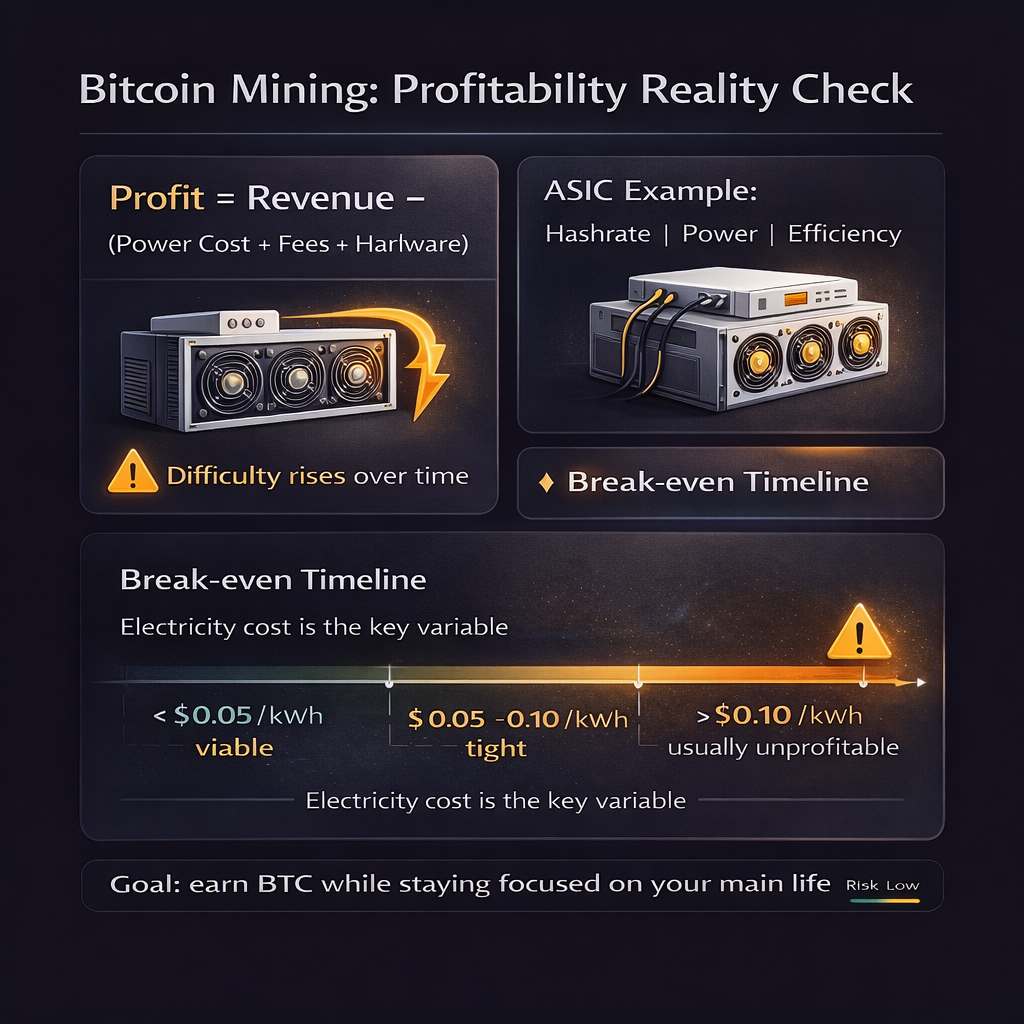
Bitcoin mining is a high-barrier earning model that converts specialized hardware, cheap energy, and capital scale into block rewards and transaction fees.
13: Bitcoin Mining (Solo or Pool)
Bitcoin mining uses specialized computer hardware called ASICs to solve complex mathematical puzzles, validating Bitcoin transactions and adding blocks to the blockchain. Successfully mining a block earns the miner the block reward, currently 3.125 BTC, plus transaction fees.
The 2025 mining reality check shows current network stats as of November 2025. Global hashrate runs 900 EH/s to 1.1 ZH/s (zettahash per second). Network difficulty reached 155.97-156T, an all-time high. Block reward sits at 3.125 BTC, roughly $337,500 at $108K per BTC.
Hashprice runs $43-$51 per PH/s per day, a multi-month low. Daily Bitcoin mined totals roughly 900 BTC worth $97M at current prices. Average block time stays around 10 minutes with 144 blocks daily.
The mining profitability equation is: Profit = (Hashrate × Hashprice × Days) – (Power Consumption kW × Electricity Rate × 24hrs × Days) – Hardware Cost Amortization.
A real example using the Antminer S21, the latest generation, shows the economics. Purchase price runs roughly $6,000-$7,000 for 2025 pricing. Hashrate delivers 200 TH/s or 0.2 PH/s. Power consumption uses 3,500W or 3.5 kW. Efficiency runs 17.5 J/TH.
Daily profitability calculation at average electricity rates: Daily revenue from 0.2 PH/s × $47/PH/s equals $9.40 per day. Daily electricity at $0.10/kWh means 3.5 kW × 24 hrs × $0.10 equals $8.40 per day.
Daily profit comes to $9.40 minus $8.40 equals $1.00 per day. Annual profit before equipment cost reaches $365. Break-even time stretches to roughly 19 years at current hashprice, not including difficulty increases.
At $0.05/kWh with cheap electricity, the numbers improve. Daily electricity costs $4.20. Daily profit reaches $5.20 per day. Annual profit hits $1,898. Break-even takes roughly 3-4 years.
Mining pool versus solo mining presents different tradeoffs. Mining pools, recommended for 99% of miners, combine hashrate with thousands of other miners and share rewards proportionally. Payout comes regularly through daily or weekly small BTC amounts based on your contribution.
The advantages are consistent income, lower variance, and easier to predict returns. The disadvantages include pool fees at 1-3% and requiring trust in the pool operator. Top pools in 2025 include Foundry USA, AntPool, F2Pool, and ViaBTC.
Solo mining works independently where you keep the entire block reward if you find a block. Reality check: With 200 TH/s versus 1.1 ZH/s network, you have a 0.000018% chance per block. Expected time to find a block runs roughly 7,600 years. Recommendation: Only viable with large operations having 100+ PH/s fleet.
Key profitability factors start with electricity cost as the most important variable. Profitable operations need electricity under $0.05/kWh. Marginal profitability runs $0.05-$0.10/kWh.
Unprofitable operations pay over $0.10/kWh at current hashprice. Industrial rates in Texas and Washington state run $0.03-$0.05/kWh. Residential average U.S. electricity at roughly $0.15/kWh is not profitable.
Hardware efficiency matters significantly. Latest generation from 2025 runs 16.5-17.5 J/TH and stays profitable. 2023-2024 models at 20-30 J/TH are marginal. Older miners over 30 J/TH shut down at current hashprice. Recommendation: Only buy latest generation ASICs.
Bitcoin price affects everything. At current $108K, profitability is difficult but possible. If BTC drops to $80K, most miners become unprofitable, though hashrate drops and difficulty adjusts down. If BTC rises to $150K, profitability improves 40%+. Some miners HODL mined BTC betting on future price appreciation.
Network difficulty trends consistently upward, making mining harder. November 2025 shows all-time high at 156T. Your hashrate earns less BTC over time as difficulty increases. Difficulty adjustment happens every 2,016 blocks, roughly 14 days, adjusting up or down based on network hashrate.
Alternatives to traditional mining include hosting or colocation where you host your miners at professional data centers with cheap electricity. Cost runs $0.06-$0.12/kWh all-in for electricity plus hosting.
The advantages are professional setup, cheap power, cooling, and maintenance. The disadvantages include less control, hosting fees, and minimum contracts of 1-3 years.
Mining stocks or funds let you invest in publicly traded mining companies like Marathon Digital, Riot Platforms, or CleanSpark.
The advantages are exposure to mining without operational headaches. The disadvantages are stock performance doesn’t always match BTC price and management risk exists.
Tax considerations show mining income taxed as ordinary income at 10-37% rates at fair market value when mined. Later sale creates additional capital gains tax on appreciation from mining date to sale date. Deductions include equipment depreciation, electricity costs, and hosting fees.
Capital requirements run $6,000-$10,000 per miner, with multiple needed for serious operations. Time investment needs 10-20 hours setup and 2-5 hours weekly for maintenance and monitoring.
Difficulty rates as advanced (8/10), requiring technical knowledge, electrical setup, and managing noise and cooling. Risk level is high due to hardware depreciation, electricity costs, difficulty increases, and price volatility.
Verdict for 2025: Bitcoin mining is barely profitable to unprofitable for small-scale home miners at current hashprice. Only viable for operations with access to electricity under $0.05/kWh, latest generation ASICs, scale of 50+ miners, and long-term HODL mentality. Many miners are pivoting to AI/HPC hosting for more stable revenue streams.
14: Cloud Mining
Cloud mining rents Bitcoin mining hashrate from companies that operate large-scale mining farms. You pay a subscription or contract fee and receive proportional mining rewards without owning or operating hardware.
Major cloud mining platforms in 2025 include Genesis Mining, established since 2013, though check current operational status. HashFlare offers contract-based mining but verify legitimacy. NiceHash runs a marketplace connecting hashrate buyers and sellers. Hashing24 partners with BitFury data centers.
Scam alert: Cloud mining has a massive scam history. Many fraudulent “companies” take your money and never deliver returns. Ponzi schemes are common. Do extensive research before investing.
How to identify legitimate operations: Look for transparency about mining locations and data centers. Check for realistic profitability calculators, not “guaranteed 300% returns.”
Verify they have physical operations you can confirm. Look for established reputation with 3+ years operating. Check for clear contract terms with fees disclosed upfront.
Real profitability shows most cloud mining contracts are unprofitable after fees. Companies need to profit, so they take a significant cut.
Example contract breakdown: 1 TH/s for $500 on a 2-year contract generates daily revenue of 1 TH/s × $0.047/TH/s equals $0.047 per day. Electricity and maintenance fee runs $0.02 per day. Net daily comes to $0.027 per day. 2-year total reaches $19.71, a 96% loss on $500 investment.
Capital requirements run $500-$5,000 for typical contracts. Time investment needs 30 minutes setup, then becomes passive afterward. Difficulty rates as beginner (2/10) if you find a legitimate platform. Risk level is very high due to scam risk and negative ROI being common.
Recommendation: Avoid cloud mining. Better to buy Bitcoin directly or invest in mining stocks if wanting mining exposure.
Advanced Strategies: DeFi, Yield Farming & Sophisticated Approaches
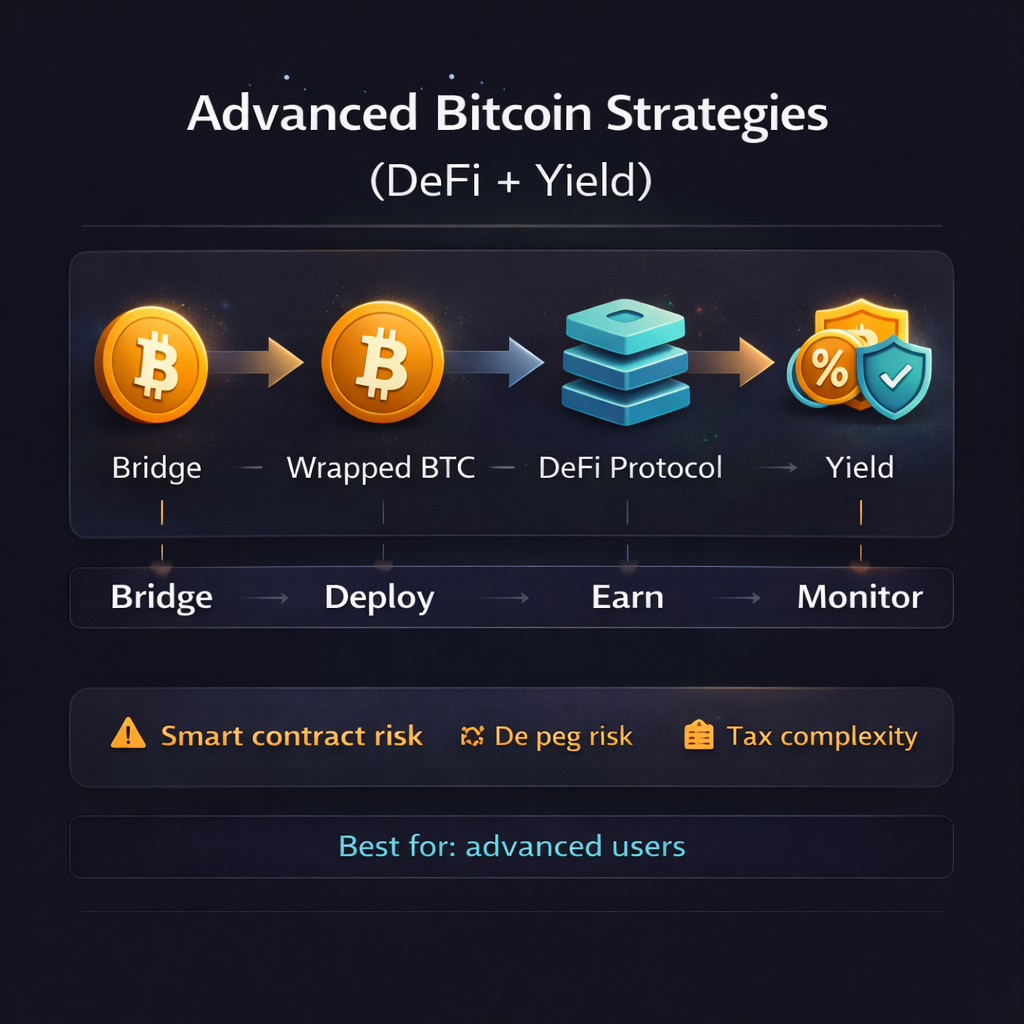
This section looks into advanced DeFi strategies, unpacking how yield farming, liquidity design, and smart risk management work together at a higher level.
15: Yield Farming with Wrapped Bitcoin
Yield farming converts Bitcoin to “wrapped” versions like WBTC, renBTC, or tBTC that operate on Ethereum or other smart contract platforms. You deposit wrapped Bitcoin into DeFi protocols to earn yield through lending, liquidity provision, or staking.
Understanding wrapped Bitcoin starts with WBTC (Wrapped Bitcoin), an ERC-20 token backed 1:1 by Bitcoin held by custodian BitGo. renBTC uses a decentralized bridge with trustless wrapping via RenVM protocol.
tBTC employs the Threshold network with decentralized custodianship model. The purpose allows Bitcoin to interact with Ethereum’s DeFi ecosystem.
Top DeFi yield strategies include lending protocols. Aave lets you deposit WBTC to earn variable APY, typically 0.5-3%, plus AAVE rewards. Compound allows supplying WBTC to earn interest plus COMP governance tokens.
Returns run 1-4% APY base rate, boosted with incentives. Risk includes smart contract risk and wrapped Bitcoin de-pegging risk.
Liquidity provision works through platforms like Curve Finance where you provide WBTC to stablecoin pools like WBTC-renBTC-sBTC for trading fees plus CRV rewards. Uniswap V3 lets you provide WBTC-ETH liquidity in concentrated ranges.
Returns run 5-15% APY from fees plus rewards but with impermanent loss risk. Risk includes impermanent loss if BTC/ETH prices diverge and smart contract risk.
Bitcoin-native DeFi through Layer 2s includes Stacks (STX) using Proof of Transfer allowing Bitcoin DeFi without wrapping. Rootstock (RSK) is a Bitcoin sidechain with DeFi capabilities. Lightning Network earns routing fees by providing liquidity channels. Returns vary widely in this still early ecosystem.
Step-by-step yield farming guide starts with converting BTC to wrapped version using Curve, Uniswap, or direct wrapping services. Choose protocol by starting with blue-chip protocols like Aave, Curve, or Uniswap.
Deposit assets by connecting wallet like MetaMask, approving transaction, and depositing. Monitor position by tracking APY changes and checking for protocol updates or audits.
Compound rewards by claiming and reinvesting rewards for compound growth. Exit strategy should plan when to exit based on opportunity cost versus risks.
Real example using Curve WBTC lending: Deposit 1 WBTC worth roughly $108,000. Base APY runs 1.5%. CRV rewards add roughly 2% but variable.
Annual return totals roughly $3,780 at 3.5% total APY. Gas fees run roughly $50-$200 total for wrapping, depositing, claiming, and unwrapping. Net return comes to roughly $3,580-$3,730.
Key risks include wrapped BTC de-peg where if WBTC loses parity with BTC, rare but possible, you lose value. Smart contract exploits mean DeFi protocols can have bugs, so only use audited, established protocols.
Impermanent loss when providing liquidity can lose value versus just holding BTC. Complexity involves multi-step process, Ethereum gas fees, and needing to understand DeFi mechanics.
Capital requirements start at $1,000 minimum since gas fees make smaller amounts uneconomical. Time investment needs 4-6 hours initial learning and 1-2 hours weekly monitoring.
Difficulty rates as advanced (8/10), requiring DeFi knowledge and risk awareness. Risk level is high due to smart contract risk, wrapped Bitcoin mechanics, and impermanent loss.
Tax nightmare: Converting BTC to WBTC creates a taxable event. Earning rewards creates taxable income. Converting back creates another taxable event. You must track every step for tax reporting.
16: Bitcoin Venture Investing
Venture investing puts capital into Bitcoin-related startups, mining companies, or infrastructure businesses, similar to traditional venture capital but focused on the Bitcoin ecosystem.
Investment vehicles include Bitcoin mining companies through public stocks. Marathon Digital (MARA) showed 23% hashrate increase in 2025. Riot Platforms (RIOT) is a major U.S. mining operator.
CleanSpark runs a growing mining operation. Returns show stocks can 2-5x with Bitcoin bull runs but are volatile.
Bitcoin ETFs and funds include spot ETFs like BlackRock IBIT and Fidelity FBTC for direct BTC exposure. Grayscale Bitcoin Trust (GBTC) converted to ETF with lower fees. Returns track Bitcoin price minus small management fee of 0.12-0.25%.
Private Bitcoin startups require accredited investor status with $1M+ net worth or $200K+ annual income under SEC rules. Platforms include Republic and StartEngine for retail crowdfunding, plus AngelList for accredited investors.
Examples include Lightning Network companies, Bitcoin payment processors, and mining tech. Returns offer high risk/high reward with 10x+ or total loss potential.
Bitcoin mining investment funds offer pooled exposure to mining operations. Returns share in mining profits minus management fees. Access often requires $25K-$100K minimum investment.
Capital requirements start at $1,000 for public stocks and ETFs, with $25K+ for private investments. Time investment needs 2-5 hours weekly for research and monitoring.
Difficulty rates as intermediate-advanced (6/10) for stocks and expert (9/10) for private deals. Risk level is very high since startups have a 90% failure rate.
Tax Strategies & Legal Considerations
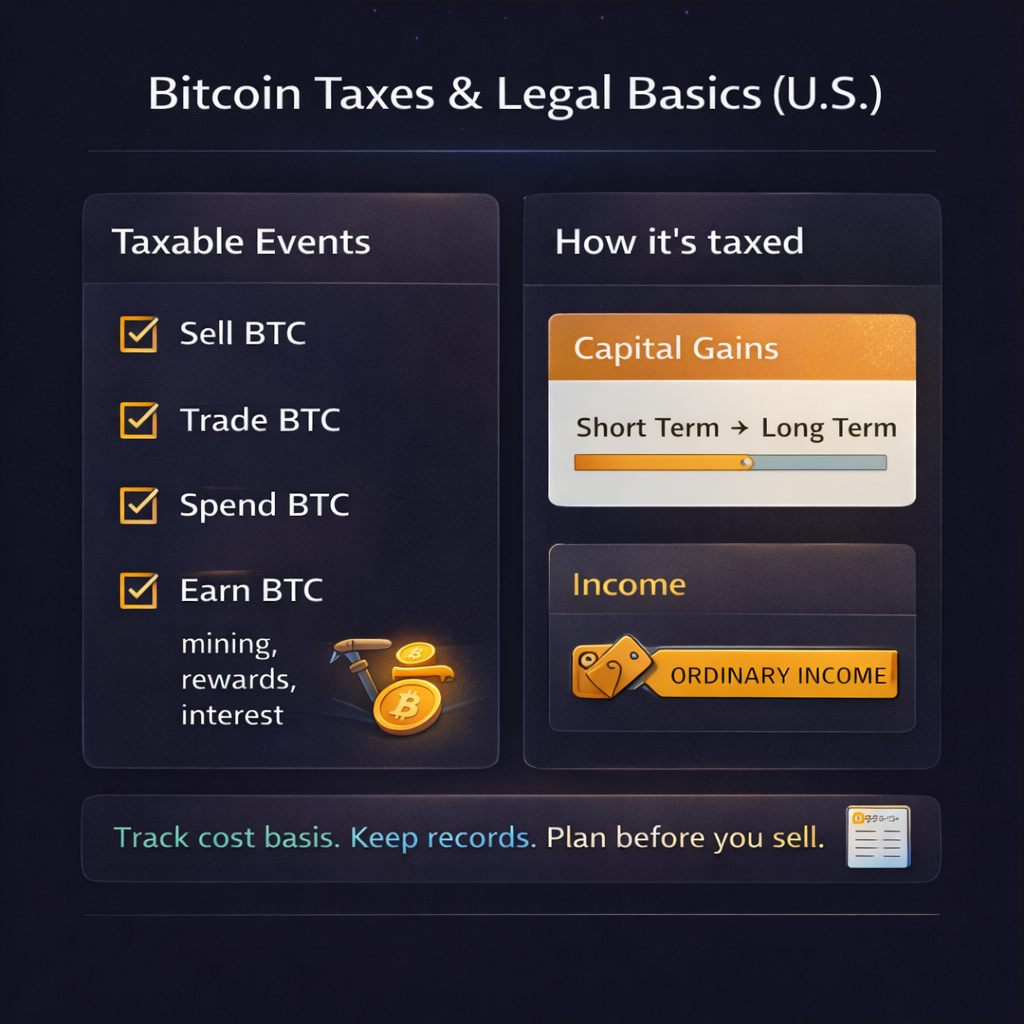
This part of the article focuses on smart tax planning strategies and the legal boundaries every U.S. Bitcoin holder should understand.
The Complete Guide to Bitcoin Taxes in the U.S.
The IRS treats Bitcoin as property, not currency, creating two tax categories. Capital gains tax applies when selling or trading. Short-term gains from holdings under 12 months get taxed at 10-37% as ordinary income.
Long-term gains from holdings 12+ months get taxed at 0%, 15%, or 20% based on income level. Calculation uses profit equals sale price minus purchase price for cost basis.
Income tax applies when earning Bitcoin. Mining, staking, airdrops, and interest get taxed as ordinary income at 10-37% rates. Value uses fair market value at time of receipt. Later sale creates additional capital gains tax from receipt value to sale value.
Major 2025 tax changes include Form 1099-DA, new for 2025. Crypto brokers and exchanges must report digital asset sales to IRS, similar to stock brokers’ Form 1099-B. Exchanges will send you and the IRS this form showing transactions. Impact means IRS can automatically match your tax return to exchange reports.
Wallet-specific tracking became a new 2025 requirement. You must track gains and losses separately for each wallet and exchange. Safe harbor rules allow transitioning existing holdings. Example: If you bought 1 BTC on Coinbase and 1 BTC on Kraken, you must track separately.
Taxable events include selling Bitcoin for USD or fiat, trading Bitcoin for another cryptocurrency, using Bitcoin to buy goods or services, and earning Bitcoin through mining, staking, interest, airdrops, or wages. Receiving Bitcoin as business payment also triggers taxes.
Non-taxable events include buying Bitcoin with USD, transferring Bitcoin between your own wallets, holding Bitcoin regardless of appreciation, and gifting Bitcoin under $18,000 in 2024 or $19,000 in 2025 annual exclusion.
Tax reporting forms include Form 1040 where you check “Yes” to the crypto question on the first page as mandatory disclosure.
Form 8949 reports all Bitcoin sales and trades with details including date acquired, date sold, proceeds, cost basis, and gain or loss. Schedule D summarizes capital gains and losses from Form 8949.
Schedule 1 reports Bitcoin mining and staking income as ordinary income. Form 1099-DA, new for 2025, comes from exchanges showing your transactions.
Legal tax reduction strategies include holding 12+ months since long-term capital gains save 17-22% versus short-term rates. Turn trading into investing. Tax-loss harvesting works because Bitcoin is not subject to wash-sale rule unlike stocks.
You can sell at loss, claim deduction, and immediately rebuy. Offset up to $3,000 ordinary income annually with excess losses carrying forward indefinitely.
Strategic income year timing means realizing gains in years with lower income for lower tax bracket. If taking a sabbatical year, sell Bitcoin then.
Charitable donations work by donating Bitcoin directly to qualified charities. Deduct full fair market value with no capital gains tax. Must hold 12+ months to deduct full value.
HODL strategy avoids triggering taxable events. Hold Bitcoin long-term and only sell when absolutely needed. Retirement accounts through platforms like iTrustCapital or BitcoinIRA allow Bitcoin in self-directed IRAs. Grows tax-deferred or tax-free in Roth accounts. Contribution limits apply.
Opportunity zones defer capital gains by reinvesting in Qualified Opportunity Zone funds within 180 days. Bitcoin gains are eligible.
Penalty for not reporting includes failure to file at 5% of tax owed per month up to 25%. Failure to pay runs 0.5% per month.
Accuracy penalty hits 20% of underpayment if substantial understatement. Fraud penalty reaches 75% of tax owed plus potential criminal charges. Interest compounds on unpaid taxes.
IRS enforcement reality shows they partnered with Chainalysis, a blockchain analysis firm, to track transactions. Exchanges report to IRS through Form 1099-DA starting 2025. “John Doe” summons allow IRS to get customer data from exchanges.
Tens of thousands of taxpayers received IRS warning letters. Recommendation: Report everything since the risk is not worth it.
International considerations vary since tax treatment differs by country. Some nations like Portugal and El Salvador have Bitcoin-friendly tax policies. Always consult local tax professional.
Legal Bitcoin Earning Structures
For serious Bitcoin earners, different structures offer advantages. Sole proprietorship is the default, simplest option. Report on Schedule C and pay self-employment tax at 15.3% on profits. No liability protection exists.
LLC provides single-member or multi-member structure with liability protection for business debts. Pass-through taxation means profits taxed on personal return. Can elect S-Corp treatment for payroll tax savings. Cost runs $500-$2,000 setup plus annual fees.
S-Corporation reduces self-employment tax by paying reasonable salary plus distributions. More complex bookkeeping and payroll requirements apply. Savings can reach 5-15% on taxes for high earners.
C-Corporation creates separate tax entity with 21% flat corporate rate. Double taxation applies on corporate profits and dividends. Only viable for very large operations.
When to form entity: Earning $50K+ yearly from Bitcoin activities, wanting liability protection for mining or lending, hiring employees, or seeking outside investment.
Regulatory compliance includes Money Services Business (MSB) registration if running Bitcoin ATM, exchange service, or high-volume P2P trading. May need MSB registration through FinCEN.
Securities laws usually don’t create issues when earning from Bitcoin itself. But promoting investment schemes or mining pools as “securities” can trigger SEC jurisdiction.
State licensing varies as some states require money transmitter licenses for Bitcoin businesses. Requirements vary by state and activity.
Risk Management & Common Mistakes
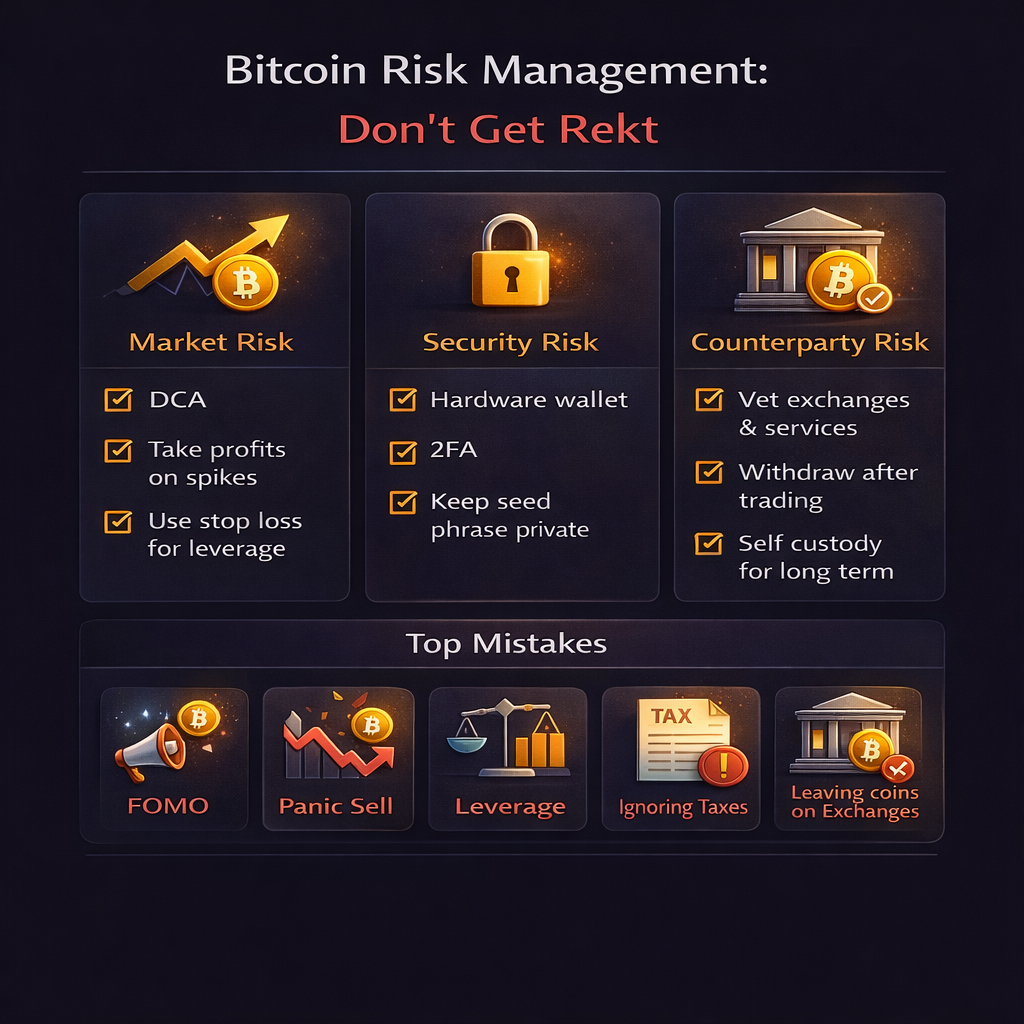
This section focuses on the practical risks people overlook and the common errors that turn good opportunities into unnecessary losses.
Risk Categories & Mitigation Strategies
Market risk from Bitcoin volatility means Bitcoin can drop 20-40% in weeks or 50-80% in bear markets. Mitigation includes never investing money you need within 4 years.
Dollar-cost average rather than lump sum investing. Hold through volatility if using long-term strategy. Use stop-losses only for trading positions, not HODL.
Security risk from hacks, scams, and loss creates multiple threats including exchange hacks, phishing, malware, and lost private keys. Mitigation uses hardware wallets like Ledger or Trezor for holdings over $10K. Always enable 2FA on all accounts using authenticator app, not SMS.
Keep majority of Bitcoin in cold storage offline. Backup seed phrases using metal backup like Cryptosteel in multiple secure locations.
Always verify addresses by double-checking wallet addresses before sending. Test small amounts first by sending test transaction before large transfers.
Counterparty risk from platform failures has history including Mt.Gox in 2014, Celsius in 2022, BlockFi in 2022, FTX in 2022, and Gemini Earn freeze. Mitigation follows “not your keys, not your coins” principle through self-custody for long-term holdings.
Diversify across platforms by never keeping all Bitcoin on one exchange. Research platform solvency through proof-of-reserves and audits. Limit exchange holdings to active trading amount only. Understand insurance coverage since FDIC does not cover crypto.
Regulatory risk from government actions could include bans, restrictions, unfavorable tax treatment, or exchange shutdowns. Mitigation means staying informed on regulatory developments.
Use compliant platforms that are registered and licensed. Keep detailed records for tax compliance. Diversify storage globally if holding significant amounts.
Tax risk creates unexpected liabilities from large gains creating surprise tax bills and complex tracking requirements. Mitigation sets aside 20-30% of profits for taxes, especially for day traders. Use crypto tax software like Koinly, CoinTracker, or TokenTax. Track every transaction contemporaneously. Consult crypto-specialized CPA for profits over $10K.
Technological risk from protocol changes and bugs includes hard forks, protocol upgrades, and software bugs. Mitigation uses established wallets and platforms with strong developer communities. Keep software updated. Understand implications of major protocol changes. Diversification across cryptocurrencies, not just Bitcoin.
10 Common Mistakes to Avoid
1. FOMO buying at peaks means don’t chase parabolic moves. Bitcoin at all-time highs often corrects 20-40%. Dollar-cost average instead.
2. Panic selling in crashes locks in losses. Bitcoin has survived five 80%+ bear markets and always recovered to new highs. Emotional selling is the enemy.
3. Overtrading creates problems since every trade equals fees plus taxes. 95% of day traders lose money. Reduce frequency, improve outcomes.
4. Ignoring security by saying “I’ll move to hardware wallet later” then getting hacked happens too often. Secure Bitcoin from day one.
5. Not taking profits is okay sometimes. It’s acceptable to sell some Bitcoin during bull runs. Consider 5-10% sells at 2x, 3x, 5x gains.
6. Believing scams happens when no legitimate service guarantees returns. “Send 1 BTC, get 2 BTC back” equals scam. Fake celebrity giveaways equal scam.
7. Using high leverage at 100x means 1% Bitcoin move liquidates you. Even experienced traders blow up with high leverage.
8. Forgetting taxes means every trade is taxable. Day traders can owe huge taxes even if year ends flat. Track everything.
9. Investing more than you can afford to lose treats Bitcoin as less speculative than it is. Never use emergency funds, rent money, or debt to buy Bitcoin.
10. Not having exit strategy means saying “I’ll sell when Bitcoin hits my dream price” but never doing it because you want more. Set partial profit-taking rules.
Position sizing framework suggests conservative portfolios use 2-5% Bitcoin allocation. Moderate portfolios use 5-10% Bitcoin allocation. Aggressive portfolios use 10-25% Bitcoin allocation. Speculative portfolios use 25%+ Bitcoin allocation with high risk.
Real Success Stories & Case Studies

Below are practical case studies that show how ideas perform when tested under real conditions.
Case Study 1: The Patient HODLer – David’s 10-Year Journey
David, a software engineer, first heard about Bitcoin in 2013 when it was roughly $100. Initially skeptical, he bought $1,000 worth as a “lottery ticket,” getting 10 BTC.
His strategy started with initial purchase in December 2013 at $1,000 for 10 BTC at $100 average. During the 2014-2015 bear market, he watched his investment drop to $200, an 80% loss, but didn’t sell.
The 2017 bull run saw Bitcoin hit $20K, making his portfolio worth $200K. He sold 2 BTC to pay student loans. The 2018-2019 bear market dropped his remaining 8 BTC to $24K value, but he held through.
The COVID crash in 2020 saw Bitcoin drop to $4K. David dollar-cost averaged $5,000 more, buying 1.25 BTC. The 2021 bull run reached $69K with peak portfolio around $640K, but he didn’t sell.
The 2022-2023 bear market dropped portfolio to $185K. He continued DCA with $200 monthly. The 2024-2025 recovery saw Bitcoin cross $100K.
Current status in November 2025 shows Bitcoin holdings of 10.5 BTC, calculated as original 10 minus 2 sold plus 2.5 DCA accumulated. Portfolio value reaches roughly $1,134,000 at $108K per BTC. Total invested was roughly $16,000 over 12 years. Return delivered 70x+ return.
Key lessons include surviving five 50%+ corrections by not panic selling. Taking profits strategically paid off debt while keeping majority.
Dollar-cost averaging during bear markets increased holdings. A 10+ year horizon allowed volatility to be ignored. Simple strategy of HODL plus DCA beat 99% of trading strategies.
Case Study 2: The Mining Operator – Carlos’s Industrial Operation
Carlos, an electrical engineer, researched Bitcoin mining in 2019. Instead of home mining, he planned an industrial-scale operation.
Phase 1 from 2020-2021 started with negotiating an electricity contract in upstate NY at $0.035/kWh using hydroelectric power. He raised $200K from partners plus $300K loan for warehouse and equipment.
He purchased 50 Antminer S19 Pro miners at roughly $6,500 each totaling $325K. Set up 1,000 kW facility with industrial cooling and joined F2Pool mining pool.
Initial operations showed monthly revenue of roughly 20 BTC during 2020-2021 with 6.25 BTC block rewards. Monthly costs ran roughly $25,000 electricity plus $8,000 operations totaling $33K.
Monthly profit calculated as 20 BTC × $30K average equals $600K revenue minus $33K costs equals $567K monthly. ROI paid off entire $500K investment in 10 months.
Phase 2 during 2022 bear market saw Bitcoin drop to $16K while many miners capitulated. Carlos’s operation remained profitable due to ultra-low electricity. He acquired 100 additional miners at distressed prices of $2,000 each. Expanded hashrate 3x while competitors shut down.
April 2024 halving impact cut block rewards to 3.125 BTC. Monthly Bitcoin mined dropped from roughly 60 BTC to roughly 30 BTC. Profitability squeezed but remained positive.
2025 diversification allocated 30% of facility to AI/HPC workloads using Nvidia H100 hosting. AI revenue generates $50K monthly stable versus Bitcoin mining volatility. Still mining with 70% capacity producing 21 BTC monthly at current difficulty.
Current status shows total Bitcoin held at 400+ BTC, a mixture of early mining plus held through bear markets. Bitcoin value reaches roughly $43M at $108K per BTC.
Annual profit runs roughly $2M after all costs, employees, and taxes. Challenges include difficulty keeps rising while exploring additional revenue streams.
Key lessons show industrial-scale only works with extremely cheap electricity. Bear markets create equipment buying opportunities. Diversification through AI hosting reduces Bitcoin price dependency.
Long-term HODL strategy multiplied returns beyond just mining income. Professional operation with LLC, insurance, and employees necessary at scale.
Case Study 3: The Failed Day Trader – Melissa’s $50K Lesson
Melissa, a marketing professional, heard about Bitcoin in 2024. She watched YouTube trading videos and believed she could “beat the market.”
Her strategy, which turned out to be mistakes, started in January 2024 with investing $50,000, a significant portion of savings. Her approach used day trading with 10x leverage on Binance Futures. First month made $8,000 profit, making her overconfident. She increased leverage to 20x thinking it was “easy money.”
The collapse came in February 2024 when Bitcoin dropped 15% over 3 days. Four separate positions got liquidated due to leverage. Total losses hit $35,000 in 2 weeks.
Emotional trading meant trying to “win it back” with even riskier trades. By March 2024, her account dropped to $8,000, an 84% total loss.
Recovery and lessons followed. She stopped trading completely and read books on investing psychology. She dollar-cost averaged remaining $8,000 plus $500 monthly into spot Bitcoin.
November 2025 status shows recovery to roughly $25,000 through patient HODLing. Still down overall but learned expensive lesson about leverage and overtrading.
Key lessons include leverage being a fast road to liquidation. Day trading is not investing. 95% of traders lose money, and Melissa was part of the majority. Emotional “revenge trading” compounds losses. Simple DCA plus HODL outperforms complex trading for most people.
Case Study 4: The Bitcoin Affiliate Marketer – James’s $10K/Month Income
James, a content creator, started a Bitcoin YouTube channel in 2022 with 5,000 subscribers.
His strategy created educational content, not financial advice, covering Bitcoin basics, wallet tutorials, and exchange reviews. He signed up for multiple affiliate programs including Coinbase, Binance, Ledger, and Swan Bitcoin. Honest reviews disclosed affiliate relationships. He focused on helping beginners, not promising riches.
Growth trajectory showed 2022 going from 5,000 to 25,000 subscribers, earning $500-$1,000 monthly affiliate income. 2023 grew from 25,000 to 80,000 subscribers, earning $2,000-$4,000 monthly. The 2024-2025 bull run expanded from 80,000 to 250,000 subscribers, earning $8,000-$12,000 monthly.
Current income breakdown shows Binance affiliates at $5,000 monthly from trading fees from referrals. Ledger hardware wallet brings $2,000 monthly at 15% commission. Coinbase contributes $1,500 monthly. Other platforms add $1,500 monthly. Total reaches roughly $10,000 monthly passive income.
Key success factors include genuine helpfulness, not clickbait. Consistent content at 3 videos weekly. Multiple affiliate streams, not reliant on one. Growing during bull market when more newcomers mean more referrals. Reinvesting 50% of affiliate income into Bitcoin, now holding 12 BTC.
How to Get Started: Step-by-Step Action Plan
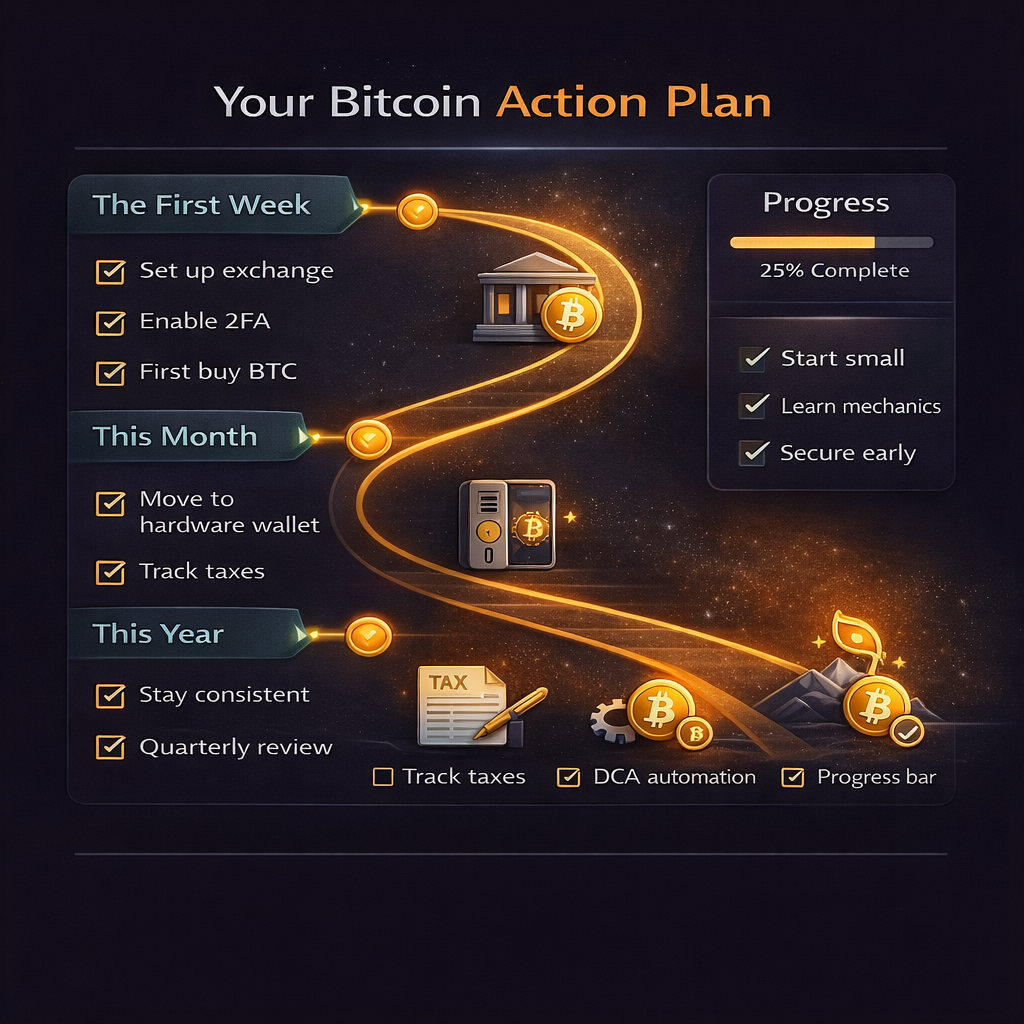
This action plan is designed to help you move forward deliberately, focusing on what matters at each stage.
For Complete Beginners: The First Week
Day 1 focuses on education. Read Bitcoin white paper, only 9 pages for foundational knowledge. Watch “Bitcoin Explained” video, recommend Coin Bureau or Andreas Antonopoulos. Understand key concepts including blockchain, mining, wallets, and private keys. Time investment runs 2-3 hours.
Day 2 chooses your strategy. Based on this guide, select one method to start. Passive and low-risk begins with HODLing plus DCA. Medium-risk considers lending or affiliate marketing. Active and high-risk starts learning trading but practice first. Capital-intensive researches mining if you have cheap electricity.
Day 3-4 handles platform setup. For buying, choose exchange like Coinbase for beginners, Kraken for lower fees, or Binance for features. Complete KYC verification by uploading ID and proof of address. Enable 2FA using Google Authenticator or Authy, not SMS. Link bank account or payment method. Time investment runs 1-2 hours.
Day 5 makes first purchase. Start small with $50-$200 test purchase. Execute market buy order. Confirm Bitcoin appears in exchange wallet. Important reminder: Don’t invest money you can’t afford to lose.
Day 6 sets up security. If holding under $1,000, keep on reputable exchange like Coinbase or Kraken. If holding $1,000-$10,000, consider mobile wallet like BlueWallet or Exodus. If holding over $10,000, purchase hardware wallet like Ledger Nano X or Trezor Model T. Practice small transfer to wallet and verify receipt.
Day 7 creates plan and tracks progress. Set DCA schedule for weekly or monthly automatic purchases. Determine target allocation of 2-10% of portfolio. Set up crypto tax software like Koinly or CoinTracker, free tier to start. Journal your investment thesis and goals. Schedule quarterly reviews to assess strategy.
Beginner-to-Advanced Progression Path
Stage 1 foundation covers months 1-3. Focus on HODLing plus dollar-cost averaging. Goal targets accumulating 0.01-0.1 BTC depending on budget. Learn market cycles, Bitcoin fundamentals, and security best practices. Allocate 2-5% of portfolio.
Stage 2 passive income covers months 4-9. Add Bitcoin rewards credit card and affiliate marketing if content creator. Consider Bitcoin lending, starting with 10% of holdings on established platform. Learn DeFi basics, yield opportunities, and risk assessment. Increase to 5-10% portfolio allocation if comfortable.
Stage 3 active strategies covers months 10-18. Explore paper trading futures and options with no real money yet. Try swing trading with 5% of Bitcoin holdings. Research mining profitability based on local electricity costs. Learn technical analysis, chart patterns, and risk management. Maintain core HODL position separate from trading capital.
Stage 4 advanced sophistication takes 18+ months. Master one active strategy, either trading, mining, or yield farming. Diversify across multiple earning methods like HODLing plus trading plus passive. Consider tax-optimized structures like LLC or retirement accounts. Optimize portfolio for risk-adjusted returns. Goal becomes self-sufficient Bitcoin income stream.
Critical principle throughout: Never advance to next stage until comfortable and profitable at current level. Most people should remain at Stage 1-2, HODLing plus passive income. Advanced strategies have high failure rates.
Interactive Tools & Calculators
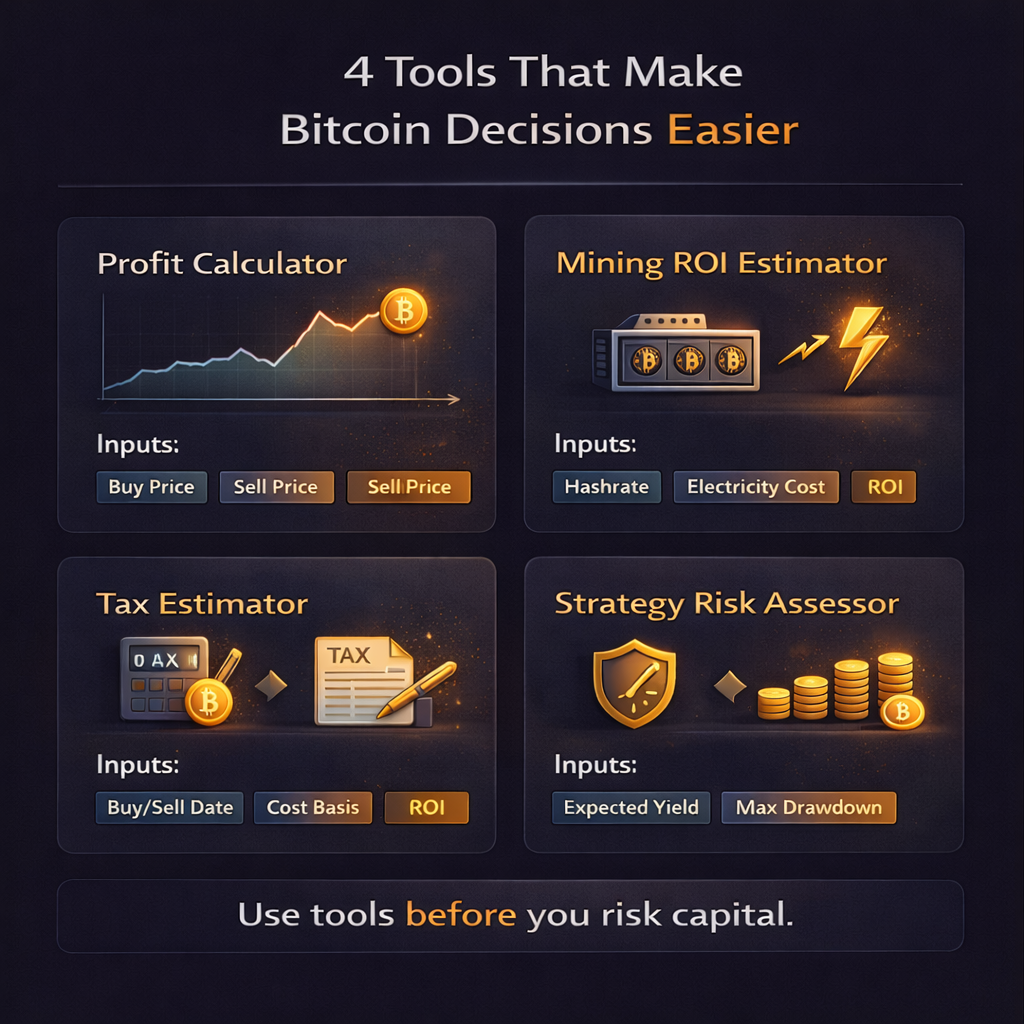
To help you make informed decisions about Bitcoin earning strategies, we’ve developed four essential calculators. These tools provide personalized analysis based on your specific situation, capital, and goals.
Tool 1: Bitcoin Profit Calculator
This calculator shows how your Bitcoin investment would have performed historically and projects future growth based on your investment strategy.
Required Inputs:
- Initial investment amount in dollars
- Purchase date using date picker to calculate from any historical point
- Additional monthly investment amount for dollar-cost averaging strategy
- Holding period in months to see growth over time
- Expected annual return percentage, defaulting to conservative 15%
Calculator Outputs:
- Current Bitcoin value based on historical price data
- Total return in dollars showing absolute gains
- Return on investment as percentage for easy comparison
- Comparison versus S&P 500 and Gold to benchmark performance
- Interactive graph showing portfolio growth over time with visual timeline
Data Source: The calculator pulls real-time and historical Bitcoin prices from CoinGecko or CoinMarketCap API, ensuring accuracy and up-to-date valuations.
How to Use: Enter your actual or planned investment amounts and dates. The calculator shows exactly what your returns would have been with historical data or projects future returns using your expected growth rate.
This helps visualize the power of dollar-cost averaging versus lump sum investing and shows how holding period dramatically affects returns.
Tool 2: Bitcoin Mining Profitability Calculator
This calculator determines whether Bitcoin mining makes financial sense for your specific situation, factoring in all costs and revenue streams.
Required Inputs:
- Miner model from dropdown menu including Antminer S21, S19 XP, WhatsMiner M50S, and other current models
- Quantity of miners you plan to operate
- Electricity cost in dollars per kilowatt-hour, your most critical variable
- Pool fees as percentage, typically 1-3%
- Bitcoin price in dollars, auto-populated from live API but adjustable for scenarios
- Network difficulty, auto-populated with current data but adjustable for future projections
Calculator Outputs:
- Daily, monthly, and annual profit projections accounting for all costs
- Break-even timeline showing when you recover initial hardware investment
- ROI percentage to compare against other investment opportunities
- Sensitivity analysis showing what happens if Bitcoin price changes plus or minus 20%
- Your hashrate contribution to total network for perspective
Special Features:
- Compare multiple miner models side-by-side to find best option
- Adjust difficulty projection using slider for plus or minus 20% change
- Historical profitability chart showing how mining economics have changed
How to Use: Input your local electricity rate and select mining hardware you’re considering. The calculator immediately shows whether mining would be profitable in your situation.
The sensitivity analysis helps you understand how price changes affect profitability, critical for long-term planning. Most users discover home mining is unprofitable with residential electricity rates above $0.10 per kWh.
Tool 3: Bitcoin Tax Estimator
This calculator helps you understand tax obligations from Bitcoin activities and identifies opportunities to reduce tax burden legally.
Required Inputs:
- Annual income in dollars to determine your tax bracket
- Filing status as single, married filing jointly, married filing separately, or head of household
- State from dropdown for state-specific tax calculation
- Bitcoin sold amount in dollars during tax year
- Holding period as either under 12 months or 12+ months
- Cost basis in dollars, what you originally paid
- Mining or staking income in dollars if applicable
Calculator Outputs:
- Capital gains tax owed based on holding period and bracket
- Income tax on mining or staking as ordinary income
- Total tax liability combining all Bitcoin-related taxes
- Effective tax rate as percentage of total Bitcoin income
- Comparison showing short-term versus long-term holding savings
- Suggested tax-loss harvesting opportunities to offset gains
How to Use: Enter your actual Bitcoin transactions and income information. The calculator shows exact tax obligations under current law. The comparison feature demonstrates how holding Bitcoin for 12+ months can save 17-22% in taxes versus selling earlier.
This tool helps you plan strategic selling to minimize tax burden, such as spreading sales across multiple years or selling during lower-income years.
Tool 4: Bitcoin Strategy Risk Assessor
This personalized assessment tool recommends which Bitcoin earning methods best match your situation, skills, and risk tolerance.
Required Inputs:
- Selected earning method from dropdown of all 16 methods covered in this guide
- Risk tolerance level as low, medium, or high
- Available capital in dollars you can allocate
- Time commitment in hours per week you can dedicate
- Technical skill level as beginner, intermediate, or advanced
Calculator Outputs:
- Compatibility score from 0-100% showing method fit
- Risk rating visualization with clear graphics
- Expected returns range based on historical data
- Capital requirements showing minimum and recommended amounts
- Recommended alternatives if compatibility score is low
- Step-by-step getting started guide for your selected method
How to Use: Answer the five input questions honestly about your situation. The tool analyzes whether your chosen method realistically fits your profile. For example, if you select day trading but indicate beginner skill level and low risk tolerance, the compatibility score will be very low, and the tool will recommend HODLing or other passive methods instead. This prevents beginners from attempting advanced strategies likely to result in losses.
Personalized Recommendations: Based on your inputs, the tool might recommend: “Your profile shows 85% compatibility with HODLing plus DCA strategy. With $5,000 capital, low risk tolerance, and 2 hours weekly availability, this method maximizes returns while matching your constraints. Alternative: Consider Bitcoin rewards credit cards requiring zero time investment.”
These interactive tools transform the information in this guide into actionable insights specific to your situation. Use them before committing capital to any Bitcoin earning strategy. The calculators help you avoid common mistakes like underestimating costs, overestimating returns, or choosing strategies mismatched to your skills and risk tolerance.
Conclusion
Bitcoin has evolved from a niche digital experiment into a $2.1+ trillion asset class validated by major institutions, Fortune 500 companies, and 560 million global holders.
The 2025 landscape offers unprecedented opportunities. $138 billion in Bitcoin ETFs provide accessible investment vehicles. 335 institutional entities demonstrate legitimacy. Regulatory clarity through Strategic Bitcoin Reserve, GENIUS Act, and CLARITY Act establishes legal frameworks.
This guide covered 16 distinct methods to earn Bitcoin, from ultra-safe HODLing historically delivering 100-200% per 4-year cycle to high-risk day trading where 95% fail. The reality is simple: Bitcoin isn’t a get-rich-quick scheme, but a legitimate long-term wealth-building asset for those willing to be patient and manage risk properly.
The three-tier strategy for most people includes foundation at 80% of Bitcoin activities through buying and holding Bitcoin long-term, dollar-cost averaging through volatility, and securing with hardware wallet.
Passive income at 15% of efforts includes Bitcoin rewards credit cards, affiliate marketing if applicable, and potentially conservative lending with small allocation. Active strategies at 5%, optional, means if you must trade, do so with under 10% of capital, extensive education, and accepting high failure rate.
Key success factors across all methods include security consciousness using hardware wallets, enabling 2FA, and verifying addresses. Tax compliance tracks every transaction, uses crypto tax software, and plans for liabilities.
Risk management never invests emergency funds, diversifies platforms, and understands limitations. Patience rewards long-term holders while short-term traders usually lose. Continuous learning adapts to rapidly evolving technology, regulation, and strategies.
The 5 Absolute Essentials
- Start with HODLing by buying Bitcoin, holding 4+ years, and riding through volatility. This strategy beats 99% of trading strategies.
- Security first means hardware wallet for holdings over $10K. Enable 2FA on everything. Never share seed phrases. Verify addresses twice.
- Tax awareness requires knowing every trade is taxable. Use crypto tax software from day one. Set aside 20-30% of profits for taxes.
- Avoid leverage by not using borrowed money or margin trading until you’ve proven 2+ years of consistent profitability without leverage.
- Keep learning since Bitcoin ecosystem evolves rapidly. Follow reputable sources like CoinDesk, The Block, and Unchained Podcast. Avoid get-rich-quick influencers.
Most importantly: Only invest what you can afford to lose. Bitcoin is still speculative. Treat it as venture allocation in your portfolio, not core retirement savings. Position size determines both opportunity and risk.
Your Next Steps – Take Action Today
This week, choose your primary strategy, recommend HODLing plus DCA for beginners. Open account on reputable exchange like Coinbase, Kraken, or Binance.
Make first small purchase of $50-$200 to learn mechanics. Set up automatic recurring purchases for DCA schedule. Enable all security features including 2FA and withdrawal whitelist.
This month, purchase hardware wallet if holding will exceed $10K. Sign up for crypto tax software like Koinly or TokenTax free tier. Create Bitcoin education plan with 1 hour weekly reading and learning. Set quarterly review schedule to assess strategy and rebalance if needed. Join Bitcoin community on Twitter or Reddit r/Bitcoin for learning, not trading signals.
This year, maintain consistent DCA regardless of price volatility. Track all transactions for tax purposes. Increase allocation gradually as comfort grows. Consider supplementary methods like rewards card or affiliate marketing. Resist urge to trade or overtrade since discipline equals success.
Long-term over 4+ years, continue accumulating through full market cycle. Bitcoin has never had a negative 4-year period. Your 2025-2029 accumulation will likely generate significant returns by 2030+, assuming continued institutional adoption and fixed supply dynamics.
Making money with Bitcoin isn’t about finding a secret strategy or perfect trade. It’s about understanding that Bitcoin represents a fundamental shift in monetary technology. Those who combine patience, security consciousness, and disciplined accumulation over 4-8 year horizons will likely build meaningful wealth. Start small, start today, stay consistent.
Disclaimer & Risk Warnings
This article is for educational and informational purposes only and should not be considered financial advice, investment advice, trading advice, or any other type of advice. You should consult with a financial advisor before making any investment decisions.
Bitcoin and cryptocurrency investments carry substantial risk of loss. You could lose all money invested. Key risks include extreme volatility where Bitcoin can lose 20-80% of value in short periods. Regulatory risk means governments may implement restrictions or bans.
Security risk includes hacks, scams, and permanent loss of funds being common. No insurance means cryptocurrency holdings are not FDIC insured or protected by SIPC.
Tax complexity creates tax obligations that can exceed profits if not properly managed. Platform risk means exchanges and platforms can fail, freeze withdrawals, or become insolvent.
No guarantees exist since past performance does not indicate future results. Market manipulation happens as cryptocurrency markets can be manipulated by large holders.
Do not invest money you need for living expenses, emergency funds, borrowed money or credit card debt, retirement savings unless via specialized retirement accounts, or more than you can afford to lose completely.
Tax and legal considerations vary. Cryptocurrency tax laws vary by jurisdiction. This article reflects U.S. tax treatment. International readers must research local regulations. Consult qualified tax professionals and legal advisors for personalized guidance.
Platform reliability note: This guide does not endorse any specific investment platform, exchange, or service mentioned in this article. Always conduct your own due diligence before using any platform.
No guarantees: Author and publisher make no guarantees about Bitcoin profitability and are not liable for any losses incurred based on information in this guide.
Essential Questions Answered
Can you really make money with Bitcoin, or is it too late?
Yes, you can still make money with Bitcoin in 2025, and it’s not too late. While early adopters from 2009-2014 saw 100,000x+ returns, Bitcoin still offers significant opportunity.
Only 560 million people, roughly 7% of world population, own cryptocurrency. Institutional adoption is just beginning with $138B in ETFs and 335 major entities holding BTC. Conservative analyst projections range from $150K-$200K by end of 2025, representing 40-85% upside from current roughly $108K.
Long-term projections for 2030 reach $380K-$900K. However, expectations should be realistic. Bitcoin won’t deliver 1,000x returns from here, but 2-5x over 3-5 years is reasonable based on adoption trajectory and supply dynamics.
What’s the safest way to make money with Bitcoin?
Buy and hold, called HODLing, combined with dollar-cost averaging is the safest strategy with proven track record. Purchase Bitcoin regularly, such as $100-$500 monthly, regardless of price. Hold for 4+ years to ride through volatility and store in secure hardware wallet.
This strategy requires no trading skills, minimal time investment, and has historically delivered positive returns across all 4-year periods since Bitcoin’s creation.
Avoid leverage, day trading, and yield farming as beginner. Only allocate 2-5% of portfolio if conservative, 10%+ if aggressive.
How much money do I need to start making money with Bitcoin?
You can start with as little as $10 on most exchanges like Coinbase, Kraken, or Binance. However, optimal starting amounts vary by method. HODLing and DCA works with $50-$500 monthly recommended for meaningful accumulation.
Trading needs $1,000-$5,000 minimum to manage risk properly, never risking more than 2% per trade. Mining requires $6,000-$10,000 per ASIC miner, needing multiple for profitability.
Lending starts at $1,000+ since gas fees make smaller amounts uneconomical.
Affiliate marketing needs $0, just an audience or platform. For beginners, start with $100-$1,000 in HODLing strategy, learn fundamentals, then expand allocation as confidence grows.
Is Bitcoin mining still profitable in 2025?
Bitcoin mining is barely profitable for most individuals in November 2025. Network difficulty reached all-time high at 156T, and hashprice dropped to $43-$51 per PH/s, a multi-month low.
Break-even electricity costs are approximately $0.05-$0.07/kWh with latest-generation ASIC miners. Average U.S. residential electricity at $0.15/kWh makes home mining unprofitable.
Profitability factors include electricity cost as most important, must be under $0.05/kWh. Hardware efficiency needs latest 16.5-17 J/TH miners. Scale matters as small operations with 1-5 miners struggle with overhead. Bitcoin price affects everything, as if BTC rises to $150K+, profitability improves significantly.
Many miners are diversifying into AI/HPC hosting for stable revenue. Home miners should generally avoid mining in 2025 and instead buy Bitcoin directly unless they have access to very cheap electricity.
What are the tax implications of making money with Bitcoin?
Bitcoin is taxed as property in the U.S., creating complex obligations. Capital gains from selling or trading get taxed as short-term under 12 months at 10-37% ordinary income rates, or long-term at 12+ months at 0%, 15%, or 20% preferential rates.
Income tax applies to earning Bitcoin through mining, staking, or interest at ordinary income rates of 10-37% at fair market value when received. Later selling earned Bitcoin creates additional capital gains tax.
Every taxable event must be reported, including selling, trading, using Bitcoin to buy goods, and earning Bitcoin. Penalties for non-compliance range from 20% accuracy penalty to 75% fraud penalty plus potential criminal charges. Use crypto tax software like Koinly or TokenTax to track everything.
How long does it take to make money with Bitcoin?
Timeline varies dramatically by method. Immediate results come from day trading profits or losses, affiliate commissions when referrals trade, and accepting Bitcoin payments.
Short-term within weeks to months includes Bitcoin rewards credit cards with monthly cashback, mining payouts daily or weekly from pools, and lending interest weekly or monthly.
Long-term over years applies to HODLing capital appreciation with best returns over 4+ year cycles. Historical data shows Bitcoin has never been negative across any 4-year period.
Should I quit my job to make money with Bitcoin full-time?
No, almost certainly not, unless you meet all required criteria. You need 12+ months of living expenses saved in fiat, not crypto. Consistent profitability for 18+ consecutive months from Bitcoin activities.
Keep your job, build Bitcoin income streams on the side, then reassess after 2+ years of consistent profitability. Bitcoin should enhance financial independence, not create precarious income dependence.