Since 2020, NFTs have evolved from simple digital collectibles into valuable assets with real utility across gaming, art, and virtual experiences. As blockchain networks multiplied, creators and traders needed better ways to exchange or move these assets without losing ownership or authenticity—leading to the rise of NFT swapping and NFT bridging.
Both methods solve different challenges. NFT swapping focuses on trading assets efficiently, while NFT bridging enables movement across blockchains for greater interoperability.
Understanding how each works and when to use them can help maximize value, reduce costs, and unlock more opportunities in the expanding NFT economy. This guide explores both in detail.
Key Takeaways
- NFT swapping enables quick, peer-to-peer trades that increase liquidity and activity in secondary markets.
- NFT bridging allows assets to move securely across different blockchains, unlocking new use cases in gaming and the metaverse.
- Security risks differ between swapping and bridging, with bridges requiring stronger safeguards due to multi-chain complexity.
- Transaction speeds and costs vary, with swapping generally being faster and cheaper than bridging processes.
- Bridging expands NFT accessibility by supporting cross-chain compatibility, while swapping focuses on efficient asset exchanges within a single network.
What is NFT Swapping?
NFT swapping is the process of exchanging one non-fungible token for another, or for a combination of NFTs and cryptocurrencies, without the need to sell and repurchase through traditional marketplaces.
Unlike a standard buy-sell transaction, swapping allows two or more parties to directly trade their digital assets in a single, streamlined agreement—often using smart contracts for automation and security.
This method is popular among collectors, gamers, and digital artists who want to diversify or upgrade their portfolios quickly. NFT swapping can also involve advanced formats such as multi-asset trades, wrapped NFTs, or fractional ownership exchanges, enabling greater flexibility and liquidity.
How NFT Swapping Works
NFT swapping simplifies the exchange of digital assets by allowing owners to trade directly without going through the traditional “sell-and-buy” process on marketplaces. The process typically relies on blockchain-based smart contracts, which ensure the trade is executed only when both parties meet the agreed terms.
Here’s how it works in detail:
Step-by-Step Process of Swapping NFTs
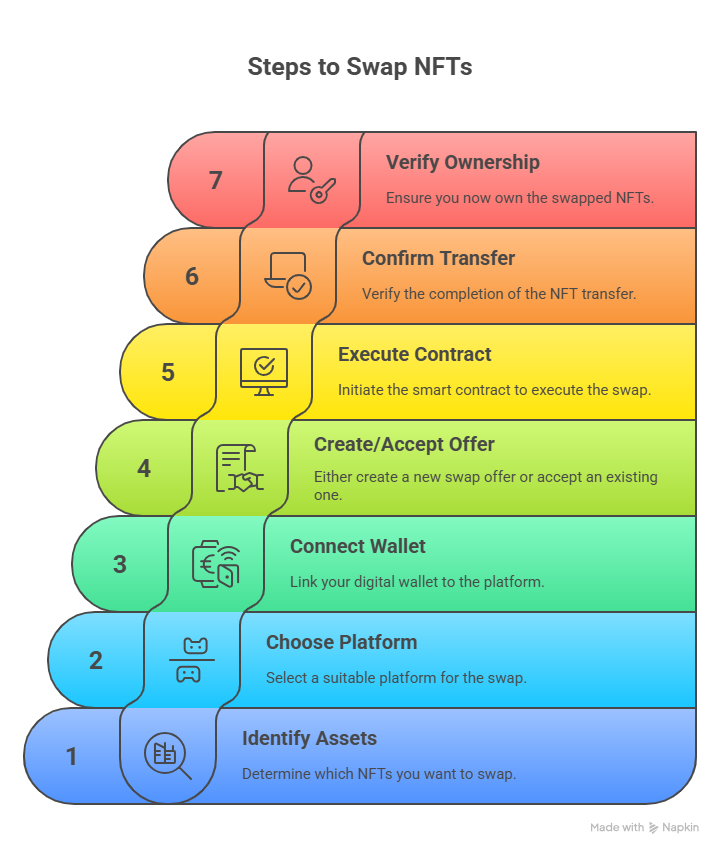
Identify the Assets to Be Swapped
Both parties decide which NFTs (or NFTs plus cryptocurrency) will be exchanged. This could be a simple one-to-one trade or a multi-asset swap.
Choose a Swapping Platform
Select a trusted NFT swapping platform that supports the relevant blockchain (e.g., Ethereum, Polygon, or Binance Smart Chain).
Connect Your Wallet
Link your crypto wallet, such as MetaMask, Trust Wallet, or WalletConnect, to the platform. This wallet stores your NFTs and enables smart contract interaction.
Create or Accept a Swap Offer
- Initiator: Creates a swap offer by selecting the NFTs they want to give and the ones they want in return.
- Recipient: Reviews the offer to ensure the assets and conditions match their expectations.
Smart Contract Execution
The swap is governed by a smart contract that holds both parties’ assets in escrow until the trade is completed. If either side fails to meet the agreed terms, the assets are returned.
Confirmation and Transfer
Once both parties approve, the smart contract executes the swap instantly, transferring ownership of the NFTs on-chain.
Verify Ownership
Each party checks their wallet to confirm receipt of the new NFT(s) and the corresponding transaction record on the blockchain.
Platforms and Tools That Enable NFT Swaps
- NFT Trader: A peer-to-peer swapping platform supporting ERC-721 and ERC-1155 tokens.
- Sudoswap: Enables decentralized NFT swaps with automated liquidity pools.
- Swap.Kiwi: Focused on direct swaps without service fees, mainly for Ethereum-based NFTs.
- Tokenlon / OpenSea Bundles: While primarily marketplaces, they allow multi-item trade offers between users.
- Custom Smart Contracts: For projects or communities that want in-house swapping without relying on external platforms.
In essence, NFT swapping works because blockchain technology ensures security, transparency, and trustless transactions, eliminating the need for intermediaries while giving traders more control over their exchanges.
Main Types of NFT Swaps
NFT swapping is not limited to simple one-to-one trades. As the NFT market grows, swapping methods have evolved to offer more flexibility, better liquidity, and broader participation.
Below are the main types of NFT swaps and how they work:
Auction-Based Swaps
In auction-based swaps, the NFT owner lists their asset for trade in a competitive bidding format. Instead of only bidding with cryptocurrency, participants can offer other NFTs or a mix of NFTs and tokens as part of their bid.
This method encourages competitive offers and allows sellers to choose the trade that provides the best overall value. Auction-based swaps are popular in art and collectibles markets, where rarity and desirability drive bidding activity.
For example, an artist lists a rare NFT for swap, receiving offers that include a mix of high-value NFTs and cryptocurrency from multiple bidders before choosing the best deal.
Multi-Asset Swaps
Multi-asset swaps involve trading multiple NFTs—or NFTs plus cryptocurrencies—in a single transaction.
This method is ideal for portfolio adjustments, allowing both parties to balance value without breaking the deal into multiple trades. Smart contracts handle the complexity by ensuring all assets are transferred simultaneously, reducing risk and saving on transaction costs.
A gamer, for instance, trades three in-game NFT weapons and some ETH for another player’s rare in-game skin and armor set in one unified swap.
Fractional Swaps
Fractional swaps deal with NFTs that have been “fractionalized” into smaller ownership units, usually represented as fungible ERC-20 tokens. This allows users to swap portions of high-value NFTs without having to trade or own the entire asset.
Fractional swaps make expensive NFTs more accessible and increase liquidity by allowing more participants to get involved.
For example, instead of swapping an entire NFT worth $50,000, a collector trades 20% of its fractionalized shares for another partial share of a different NFT.
Wrapped NFT Swaps
Wrapped NFT swaps involve converting an NFT into a “wrapped” version compatible with a different blockchain or marketplace. This enables swaps that wouldn’t otherwise be possible due to blockchain incompatibility.
Wrapped NFTs act as tokenized representations of the original asset and can be traded or swapped like native NFTs on the target network.
Example: An Ethereum-based NFT is wrapped into a Binance Smart Chain-compatible version so it can be swapped with a BSC NFT in a decentralized platform.
Direct Swaps
Direct swaps are the simplest form of NFT swapping—two parties agree to exchange NFTs directly without involving other assets or complex terms. The trade is executed peer-to-peer, often using escrow-based smart contracts to ensure fairness.
Direct swaps work best when both NFTs are perceived as having comparable value, or when both traders value the asset beyond its market price.
For example, two collectors trade a rare NFT art piece for an exclusive music NFT directly through a secure swap platform.
Benefits of NFT Swapping
NFT swapping offers several advantages that empower users and expand the digital asset ecosystem beyond simple buying and selling.
Here are some key benefits:
Access to Cross-Chain Markets
Swapping NFTs, especially through wrapped NFTs or multi-chain platforms, allows users to tap into markets on different blockchains.
This cross-chain access breaks down silos, enabling collectors and traders to explore a wider variety of assets without being limited to a single blockchain ecosystem. It opens opportunities to find rare NFTs, participate in emerging projects, and diversify portfolios efficiently.
Enhanced Asset Utility
NFT swapping increases the functional value of digital assets. Instead of holding NFTs passively, users can actively trade to acquire assets that better fit their needs—whether it’s for gaming, art, or virtual land. This dynamic exchange ability encourages more creative use cases and promotes NFT circulation within communities.
Expanding NFT Ecosystem Reach
By facilitating direct, multi-asset, and fractional trades, NFT swapping drives more participation from various types of users—collectors, gamers, investors, and creators alike. This expansion of active users broadens the ecosystem’s reach, fostering innovation and greater market liquidity.
Reduced Transaction Costs
Swapping NFTs directly through smart contracts can be more cost-effective than selling and repurchasing on marketplaces, which often charge listing fees, commissions, and multiple transaction fees. By bundling trades into a single swap transaction, users save on gas fees and marketplace costs.
Faster and More Flexible Trading
NFT swapping enables quicker transactions compared to traditional listings and sales, which can take days or weeks to complete. The ability to negotiate swaps directly with other users or through automated platforms allows for near-instant exchanges, providing flexibility in managing NFT portfolios or gaming assets.
What is NFT Bridging?
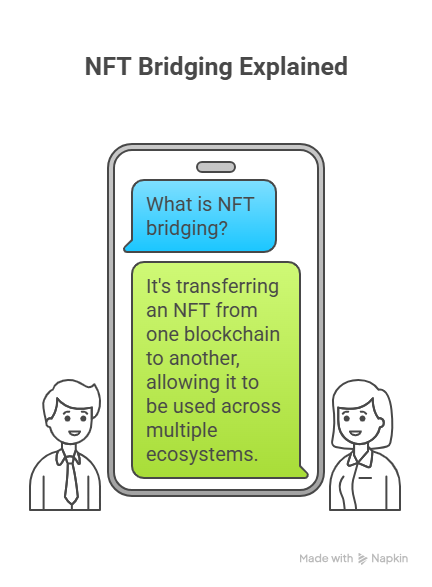
NFT bridging is the process of transferring a non-fungible token from one blockchain network to another, enabling the NFT to exist and be used across multiple ecosystems. Unlike swapping, which exchanges NFTs between users, bridging focuses on moving the same NFT across different blockchains to increase accessibility and interoperability.
Since most NFTs are built on specific blockchains like Ethereum, Binance Smart Chain, or Solana, bridging addresses the issue of fragmentation—enabling owners to access new marketplaces, applications, and gaming platforms on other chains without losing ownership or the unique metadata associated with the NFT.
Technically, bridging often involves locking the original NFT in a smart contract on the source chain and minting a wrapped or representative version on the destination chain, ensuring seamless cross-chain asset movement.
NFT bridging expands the possibilities for creators and collectors by breaking blockchain boundaries and enhancing NFT utility in the growing multi-chain ecosystem.
How NFT Bridging Works
NFT bridging enables the movement of a non-fungible token from one blockchain to another, allowing it to operate seamlessly across different networks. This process relies heavily on smart contracts and wrapped assets to maintain the NFT’s uniqueness and ownership integrity throughout the transfer.
Here’s an in-depth explanation of the technical process and key components involved:
Technical Process and Steps Involved in Bridging
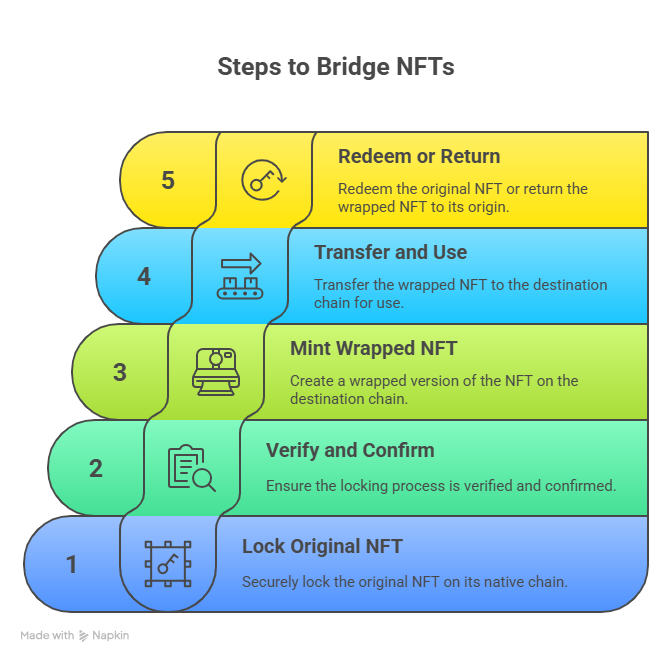
Locking the Original NFT
The first step in bridging an NFT involves locking the original token on its native blockchain. This is done through a smart contract that securely holds (or “escrows”) the NFT, preventing it from being transferred or sold while the bridging process is underway.
Locking the asset guarantees that the NFT cannot exist simultaneously on two blockchains, avoiding duplication or fraud.
Verification and Confirmation
Once locked, the bridging protocol verifies the transaction and confirms the NFT’s status on the source chain. This step ensures the NFT is authentic and securely stored, preparing it for representation on the destination blockchain.
Minting a Wrapped NFT
After confirmation, the bridging platform mints a wrapped version of the NFT on the target blockchain. This wrapped NFT serves as a one-to-one representation of the original token, holding metadata that links back to the source asset.
Wrapped NFTs maintain the same uniqueness and properties but exist on the new blockchain, making them compatible with that network’s marketplaces and applications.
Transfer and Use on Destination Chain
The wrapped NFT is then transferred to the user’s wallet on the destination blockchain. At this point, the NFT can be bought, sold, or used within apps native to that chain—such as games, virtual worlds, or DeFi platforms—effectively extending its utility.
Redeeming or Returning the NFT
When the owner wants to move the NFT back to the original blockchain, the wrapped NFT is burned (destroyed) on the destination chain. Simultaneously, the original NFT is unlocked and returned to the owner’s wallet on the source blockchain, completing the cycle and ensuring only one active version exists at a time.
Role of Smart Contracts and Wrapped Assets
Smart contracts automate and secure every step of the bridging process. They handle locking the original NFT, minting wrapped tokens, verifying transactions, and executing transfers without the need for centralized intermediaries.
This trustless automation reduces risks like fraud and ensures transparency since all actions are recorded immutably on the blockchain.
Wrapped NFTs serve as the bridge’s backbone, providing a blockchain-compatible representation of the original asset on the new network.
They contain all relevant metadata, provenance, and ownership details, effectively mirroring the original NFT’s value and uniqueness. Wrapped NFTs allow users to interact with their assets in new environments while maintaining the connection to the original token.
Main Types of NFT Bridges
NFT bridging comes in several forms, each designed to facilitate the transfer and interoperability of NFTs across different blockchain environments.
Here are the primary types of NFT bridges:
Token Wrapping
Token wrapping is the most common method for bridging NFTs across incompatible blockchains. In this process, the original NFT is locked on its native chain, and a wrapped version—essentially a tokenized representation—is minted on the destination chain.
Wrapped NFTs carry metadata linking back to the original asset, ensuring provenance and authenticity remain intact. This approach allows NFTs to be used on blockchains where the original token standards aren’t supported, vastly increasing interoperability and user access.
Sidechain Bridging
Sidechain bridging involves moving NFTs between a primary blockchain (mainnet) and a secondary chain (sidechain) that operates parallel to it. Sidechains are designed to reduce congestion and fees on the mainnet while offering faster transaction speeds.
NFT owners can bridge their tokens to sidechains to benefit from lower costs and quicker interactions, then move them back to the mainnet as needed. Sidechain bridges often use smart contracts and custodial mechanisms to lock and release NFTs securely.
Cross-Chain Bridging
Cross-chain bridging connects completely different blockchain networks, such as Ethereum and Solana or Binance Smart Chain. These bridges enable NFTs to move seamlessly across ecosystems with distinct protocols and standards.
Cross-chain bridges often combine token wrapping, relayers, and smart contract orchestration to maintain asset integrity during transfers. This type of bridging significantly expands NFT accessibility, allowing users to participate in multiple ecosystems without creating duplicate assets.
Benefits of NFT Bridging
NFT bridging unlocks significant advantages by enabling seamless interaction between different blockchain networks. These benefits extend beyond simple asset transfer, enhancing how NFTs are used and expanding opportunities for creators and collectors alike.
Access to Cross-Chain Markets
One of the biggest benefits of NFT bridging is opening access to multiple blockchain marketplaces. Instead of being confined to a single network, bridging lets users buy, sell, and showcase their NFTs across various ecosystems.
This wider reach increases visibility, liquidity, and the chance to connect with different communities and platforms. Bridging effectively removes barriers caused by blockchain silos, making NFTs more versatile and widely tradable.
Enhanced Asset Utility
Bridging expands how NFTs can be used by making them compatible with diverse blockchain applications. For example, an NFT minted on Ethereum can be bridged to a gaming-focused blockchain, where it serves as an in-game asset or collectible.
This cross-network flexibility allows owners to maximize the functional value of their NFTs, integrating them into new virtual environments, marketplaces, or decentralized finance (DeFi) platforms.
Expanding NFT Ecosystem Reach
By enabling NFTs to move across different chains, bridging fosters a more interconnected ecosystem where assets, users, and developers benefit from shared innovation.
This cross-pollination encourages broader adoption of NFTs, helps projects gain traction in multiple communities, and drives collaborative growth. As more blockchains become interoperable, the NFT landscape becomes richer and more dynamic, welcoming a greater variety of participants and use cases.
Cost and Speed Efficiency
Bridging NFTs to networks with lower gas fees and faster transaction times can make NFT trading and usage more economical and accessible. Users can avoid congested and expensive mainnets by moving assets temporarily to sidechains or layer-2 solutions, thus reducing costs while maintaining control and ownership.
Preservation of Provenance and Security
NFT bridging protocols are designed to ensure the authenticity and provenance of assets remain intact during transfers. Smart contracts and wrapped tokens maintain a verifiable link to the original NFT, preserving trust and security even as the asset moves between chains.
Key Differences Between NFT Swapping and NFT Bridging
Alt text: NFT swapping vs NFT bridging
Understanding how NFT swapping and NFT bridging differ is crucial for users looking to maximize asset utility while managing risks and costs.
Here’s a detailed comparison covering essential aspects:
Security Considerations
Security risks vary significantly between NFT swapping and bridging. Swapping typically occurs through decentralized platforms or smart contracts designed to execute trades atomically, reducing counterparty risk. However, swaps can still be vulnerable to fraudulent offers or smart contract bugs.
Bridging, on the other hand, involves locking assets and minting wrapped versions across blockchains, which introduces additional points of vulnerability, especially in the bridge’s smart contracts or relayer mechanisms. Bridges have historically been targeted by hackers, making rigorous audits and decentralized designs critical for security.
Speed of Transfer
NFT swapping generally involves a single blockchain transaction or atomic exchange, resulting in faster completion times. Depending on network congestion, swaps can finalize within minutes.
NFT bridging tends to be slower because it requires multiple steps—locking, confirmation, minting wrapped NFTs, and sometimes waiting for cross-chain finality. These layers add latency, meaning bridging can take longer, especially on slower or congested networks.
Transaction Costs
Swapping NFTs often incurs lower fees, as it usually involves just one blockchain transaction or a single smart contract call. Fees depend largely on the blockchain used and the complexity of the swap (e.g., multi-asset swaps may cost more).
Bridging involves multiple transactions across different blockchains: locking the original NFT, minting the wrapped NFT, and sometimes additional cross-chain messaging fees. Consequently, bridging tends to be more expensive, particularly on high-fee networks like Ethereum mainnet.
Interoperability
Bridging is explicitly designed to enhance multi-chain compatibility by allowing NFTs to move and function across different blockchains. It supports broader ecosystem integration and cross-chain applications, which swapping alone cannot achieve.
Swapping primarily occurs within a single blockchain or between NFTs on compatible chains but does not inherently enable cross-chain NFT mobility.
User Experience and Complexity
Swapping NFTs tends to be more straightforward for users: select NFTs to trade, confirm the swap, and finalize the transaction. It requires less technical knowledge and fewer steps.
Bridging NFTs involves more complex processes, including interacting with multiple smart contracts and possibly managing wrapped tokens, which can be daunting for less experienced users.
Use Case Focus
NFT swapping is ideal for direct trades, portfolio rebalancing, or acquiring desired NFTs quickly within the same blockchain. It emphasizes peer-to-peer exchange and immediate value transfer.
NFT bridging serves use cases centered around cross-chain utility, enabling NFTs to be used in new environments, marketplaces, or applications not accessible on their native chains. It’s more about expanding functional reach than just trading.
Practical Applications and Industry Impact
NFT swapping and bridging are transforming how digital assets are traded, used, and integrated across various industries. Their practical applications extend well beyond simple asset exchange, fueling innovation in secondary markets, gaming, metaverse experiences, and multi-chain ecosystems.
How NFT Swapping Fuels Secondary Markets and Trading
NFT swapping plays a critical role in energizing secondary markets—the platforms where NFTs are bought, sold, and traded after initial minting. By enabling direct, peer-to-peer exchanges, swapping provides liquidity to what would otherwise be a relatively illiquid market.
This liquidity encourages more users to participate, as they can trade NFTs without needing a centralized intermediary or lengthy listing processes.
For example, platforms like Rarible and OpenSea have incorporated swapping features that allow users to quickly exchange NFTs, significantly reducing friction and improving user experience. In 2024, OpenSea reported over $14.86 billion in monthly trading volume, a substantial portion of which was facilitated by efficient NFT swaps.
Swapping also supports fractional ownership models, where users trade fractions of high-value NFTs, broadening access to expensive digital assets. This democratization increases trading activity and market depth, allowing more diverse participation and speculative opportunities.
Moreover, auction-based swaps and direct swaps empower collectors to negotiate deals flexibly, making secondary markets more dynamic and responsive to demand fluctuations. These mechanisms contribute to vibrant ecosystems where NFTs continuously change hands, helping projects sustain long-term value and community engagement.
How NFT Bridging Supports Gaming, Metaverse, and Multi-Chain Platforms
NFT bridging is a game-changer for industries that rely on cross-platform interoperability, such as gaming and the metaverse. By allowing NFTs to move seamlessly between blockchains, bridging opens up vast possibilities for asset reuse, cross-platform interaction, and enhanced user experiences.
In gaming, NFTs represent in-game assets—characters, skins, weapons, or land—that players want to use across multiple games or platforms. For instance, Axie Infinity, one of the largest NFT-based games, uses bridging to allow assets minted on Ethereum to be used on sidechains like Ronin, reducing transaction fees and increasing speed.
This bridging has helped Axie Infinity reach over 2 million daily active users at its peak, highlighting how cross-chain asset mobility fuels player engagement and retention.
Similarly, metaverse projects like Decentraland and The Sandbox rely on NFT bridging to let users bring assets from different chains into their virtual worlds.
This cross-chain compatibility encourages collaboration between projects and expands the creative possibilities for users, who can own virtual real estate, collectibles, and avatars that work across multiple ecosystems.
Multi-chain platforms such as Polygon and Binance Smart Chain benefit from bridging solutions by attracting NFT projects from Ethereum and other networks, thereby increasing their market share and ecosystem activity. Bridging enables developers to target diverse user bases without fragmenting assets, driving innovation and scaling adoption.
Final Thoughts
NFT swapping and bridging each offer unique ways to unlock the true potential of digital assets. Swapping provides quick, secure trades within marketplaces, boosting liquidity and user engagement.
Bridging, on the other hand, enables NFTs to move across multiple blockchains, expanding usability in gaming, metaverse, and multi-chain platforms. Together, these processes enhance NFT accessibility, functionality, and market reach.
Understanding their differences and benefits helps collectors and creators make informed decisions, allowing them to maximize value and participate fully in the growing multi-chain NFT ecosystem.
Frequently Asked Questions
What Is the Difference Between Swapping and Bridging?
Swapping is the direct exchange of NFTs, usually within the same blockchain, while bridging moves NFTs across different blockchains by locking the original asset and creating a wrapped version on another chain.
Can NFT Be Swapped?
Yes, NFTs can be swapped through platforms and smart contracts that enable direct, secure exchanges between users.
Can You Bridge NFTs?
Yes, you can bridge NFTs by using specialized NFT bridges that lock your original asset on one blockchain and mint a wrapped version on another, enabling cross-chain transfers.
What Is the Difference Between NFT and SBT?
NFTs (Non-Fungible Tokens) represent unique digital assets that can be freely bought, sold, or transferred, while SBTs (Soulbound Tokens) are non-transferable tokens tied to a specific identity, used to prove credentials or reputation on the blockchain.
How to Bridge NFT From Base to Ethereum?
To bridge an NFT from Base to Ethereum, connect your wallet to a trusted NFT bridge platform that supports both networks, then follow the steps to lock your NFT on Base and mint its wrapped version on Ethereum—confirming all transactions and paying any required fees.